
By Richard Winters
My Rating: 1 out of 10
4-Word Review: A night at discotheque.
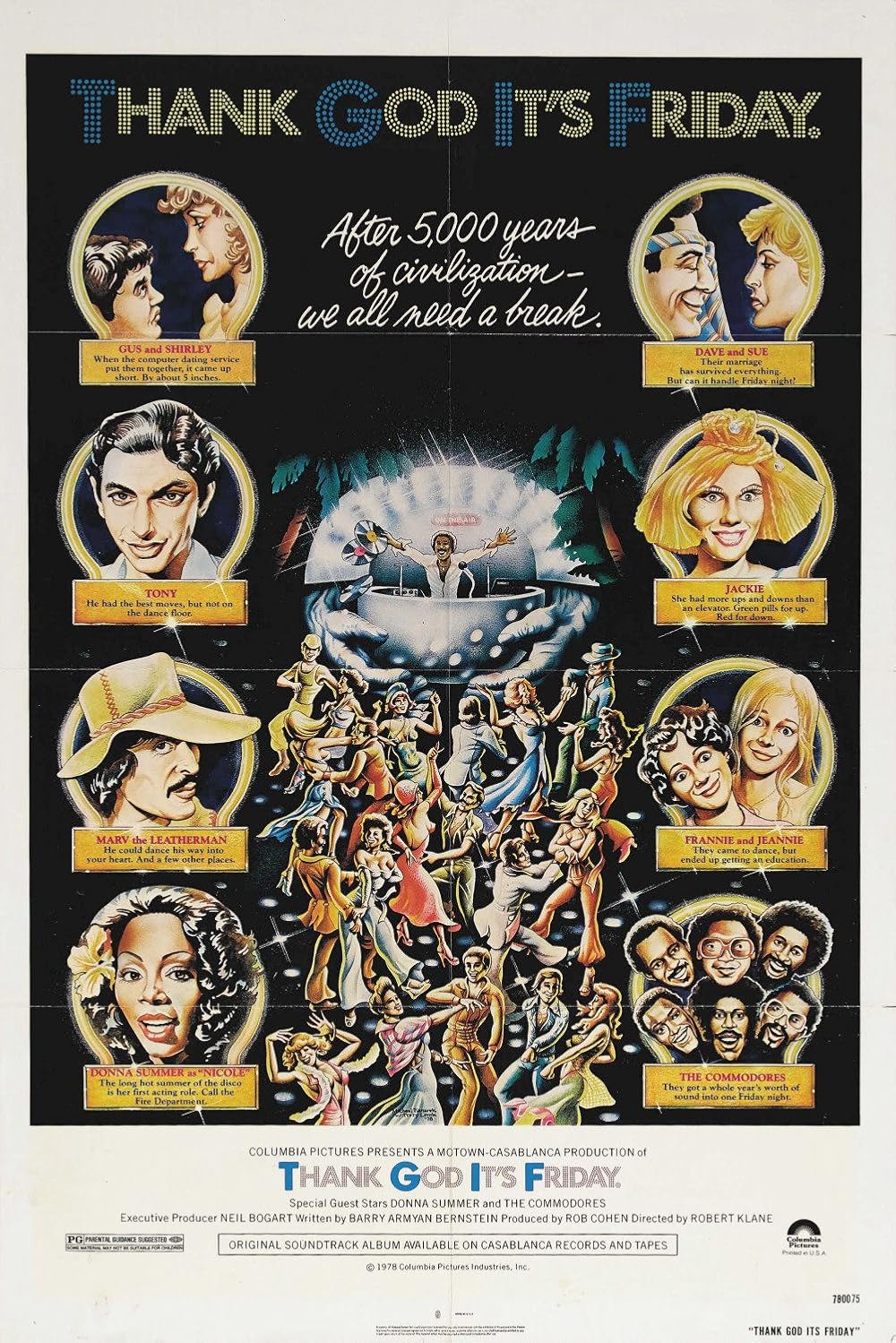
This film was requested for review and was a part of the disco craze that permeated pop culture during the mid to late 70’s. It was released just 6 months after Saturday Night Fever but was nowhere as good and didn’t have the same staying power. The plot revolves around several people who decide to spend their Friday evening at a local L.A. discotheque and the various conversations and ‘adventures’ that they have while inside the place. The main cast is Donna Summer who plays a character named Nicole who tries to ger her ‘big break’ by singing one of her songs while everyone is on the dance floor, but the club DJ (Ray Vitte) goes to great lengths to prevent that. There’s also two underage friends (Valerie Landsburg, Terri Nunn) who sneak into the club in order to win a dance contest, and a married couple (Mark Lonow, Andrea Howard) who go to the club on a lark, but then have their marriage challenged when club owner Tony (Jeff Goldblum) begins aggressively hitting-on the wife while the husband gets side-tracked by a ditzy patron named Jackie (Mayra Small) who gives him drugs that makes him behave erratically.
The biggest shock was that this lame thing was directed by Robert Klane, who burst onto the scene in the early 70’s with the dark comedy classic Where’s Poppa? that was both edgy and inventive and based on his book of the same name, but this has none of that. The dialogue and situations are quite stale, and it was like he was just selling out his career, which did eventually recover when he wrote the script for Weekend at Bernie’s, but this is definitely a black mark. What’s even more perplexing is that the screenwriter for this, Armyan Bernstein, was able to sell six more screenplays after this one, even though this one displays no writing talent at all and his subsequent scripts that were made in the 80’s all bombed at the box office, but I guess this kind of shows how it’s more who you know in Hollywood that proves who gets the breaks and who doesn’t.
The concept of having an entire movie take place inside one location has a certain appeal, but Klane captures the proceedings in a flat sort of way. It was shot inside an actual club, that has since been torn down and was described by those who went there as a ‘labyrinth’, but I didn’t get that feeling while watching it. Most of it is shot in and around the dance floor, which quickly becomes boring visually. The various ‘dramedies’ of the characters fail to elicit any interest. To some degree you could say this was a realistic look at the club scene as I remember going out to dance clubs in the 90’s in Chicago hoping to pick-up some action, or meet ‘cool new friends’ but coming away disappointed and feeling like it was all overrated and on that level that’s exactly what you get here. The characters come in anticipating way more excitement than they actually receive, but the film still needs to convey this in some sort of compelling way, and it doesn’t.
A good example of this is the married couple, which has some potential, but the characters don’t learn anything, or change. In a good movie/script the main people are supposed to go through a character arch and end up in a different spot, either in an emotional, or intellectual way, or in their situation in life, then they were at the beginning, but the couple leaves the place returning to their ‘happy married’ mindset. However, since the wife was so quick to consider the advances from the club owner and the husband with the young punk girl, that it should’ve rattled them and they should’ve left seriously contemplating whether their marriage was really all that strong.
The same goes for Donna Summer’s character. She spends the entire evening trying to aggressively get her chance to sing. It might’ve worked better had the movie had a parent, or friend being the one that was pushy while Summer stood shyly back and thus made her seem a little less narcissistic. Either way when she finally sing and the crowd loves it, it doesn’t mean much because it wasn’t in front of a record producer, so therefore there was no contract and thus just a fleeting moment in time.
I did like Goldblum and it’s easy to see why out of the entire cast he was the one that had a long a distinguished career though it’s a little confusing why he hits so hard on another man’s wife when he has a plethora of hot women that he has slept with, or willing to sleep with him, so why get so fixated on the one? Debra Winger is an absolute delight too mainly because of her exquisite beauty, which is at the absolute peak here and makes watching the movie more than worth it just for that. In fact, that’s the only reason why I decided to give this one point.
Out of the entire runtime there’s only four mildly diverting moments that stands out. The first is when the lady holding the torch in the Columbia Pictures symbol breaks out into a disco dance. The second, in a scene that the producers strongly considered cutting, is when a guy asks if he can but into a dance that Debra Winger is having with another guy, but instead of continuing the dance with her he goes on with the other guy. The third is a nice dance routine that Marv Gomez has on the rooftops of some parked cars while the fourth consists of Goldblum’s car, a prized possession of his, that falls completely apart.
My Rating: 1 out of 10
Released: May 19, 1978
Runtime: 1 Hour 29 Minutes
Rated PG
Director: Robert Klane
Studio: Columbia Pictures
Available: DVD, Blu-ray, Amazon Video, Tubi, YouTube
 Scopophilia