Monthly Archives: December 2025

S*P*Y*S (1974)

By Richard Winters

My Rating: 4 out of 10

4-Word Review: Targeted to be killed.

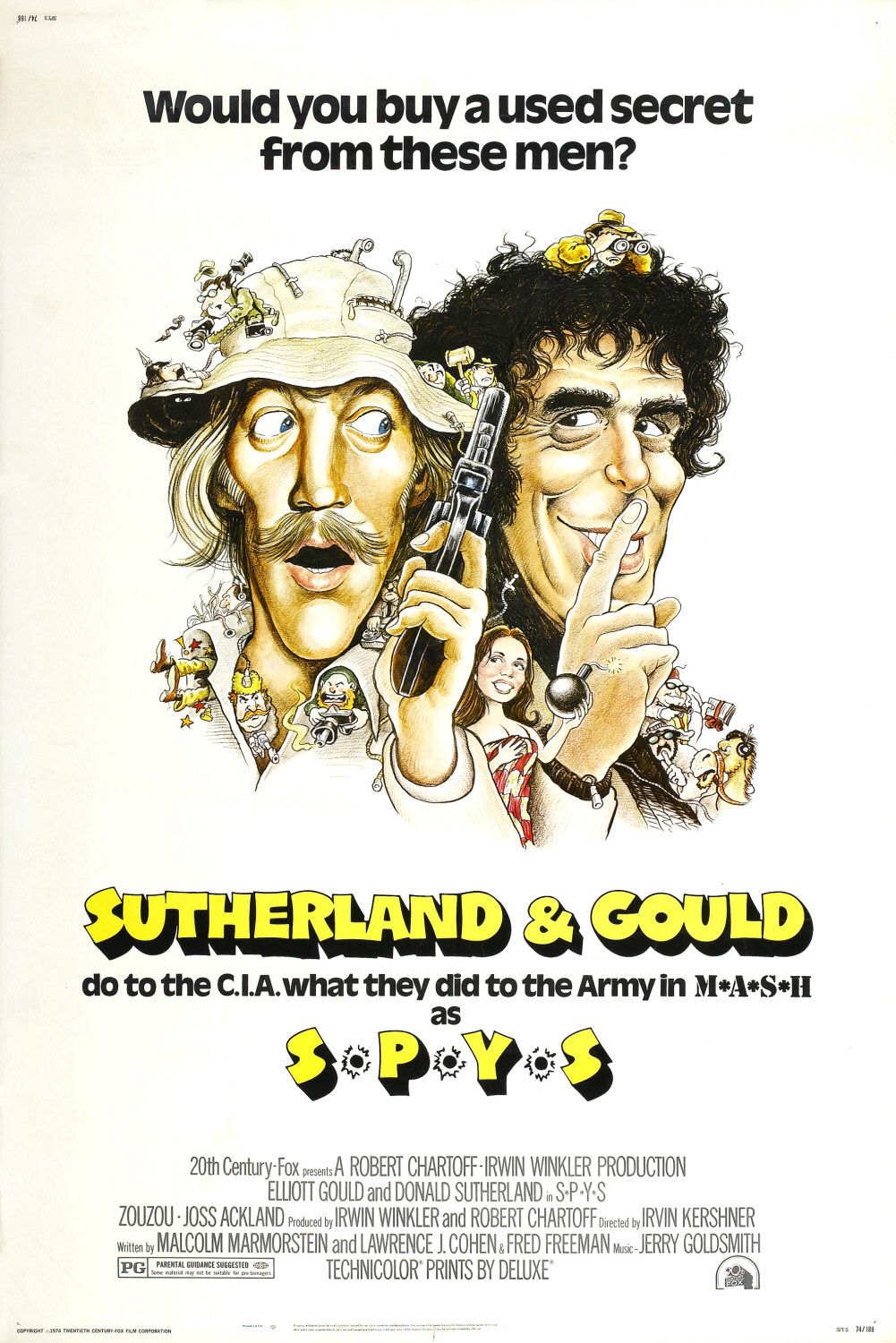
Bruland (Donald Sutherland) and Griff (Elliot Gould) are two CIA agents stationed in France who prove to be inept at every turn. When they accidentally kill a Russian gymnast defector (Michael Petrovitch) the head of the CIA Paris unit, Martinson (Joss Ackland), makes a deal with the soviets to have the two killed. This would then avoid a dangerous retaliation that could lead to a nuclear war. However, neither Bruland or Griff are made aware of this until they start getting attacked by people from all ends including the KGB, the CIA, the Chinese communists, and even a French terrorist group. In their pursuit to survive the two, who initially disliked the other, form an uneasy alliance.

The film’s original title was ‘Wet Stuff’, but the producers wanted a tie-in with M*A*S*H that had been hugely successful and also starred Gould and Sutherland, so they changed it to make it seem similar to that one, but the attempt failed and the movie became a huge bomb with the both audiences and critics alike. Viewers came in expecting the same irreverent humor, which this doesn’t have, so audiences left disappointed and the word of mouth quickly spread causing it to play in the theaters for only a short while. The irony though is that in countries that hadn’t seen M*A*S*H, like the Netherlands and Germany, it fared better because the expectations going in weren’t as high.

On a comic level it’s not bad and even has its share of amusing bits. The way the defector gets killed, shot by a gun disguised as a camera, was clever and there’s also a unique car chase in which Gould takes over the steering wheel from the backseat while someone else puts their foot to the pedal. The initial rendezvous between Sutherland and his on-and-off girlfriend (Zouzou) has its moments too as he finds her in bed with another guy while a second one is in the bathroom forcing him to have to pee in the kitchen sink. Gould then, who thought she was ‘raping him with her eyes’ when they first met, takes over and gets into a threesome while the dejected Sutherland has to sleep on the couch.

On the negative end the characterizations are poor to the point of being nonexistent. Initially it comes-off like Gould and Sutherland are rivals, which could’ve been an interesting dynamic, but this gets smoothed over too quickly. Having the two bicker and compete would’ve been far more fun. There’s also no sense of urgency. While Sutherland does lose his spy job and forced to pretend to feign illness to get out of paying a restaurant bill it’s then later revealed that he did have the money, but this then ruins any possible tension. Had they been in a true desperate situation the viewer might’ve gotten more caught up in their dilemma, but as it is it’s just too playful. The villains are equally clownish and in fact become the center of the comedy by the final act, which takes place at a wedding, while the two leads sit back and watch making them benign observers in their own vehicle.

The film needed somebody that was normal and the viewer could identify with. Buffoons can be entertaining, but ultimately someone needs to anchor it and this movie has no one. I thought for a while that Zouzou would be that person, and she could’ve been good, but she and her terrorist pals end up trying to assassinate the two like everybody else, which adds too much to the already cluttered chaos. The satire also needed to be centered on something. For instance, with Airplane the humor was structured around famous disaster flicks from the 70’s and all the jokes had a knowing tie-in. Here though it’s all over the place. Yes, it pokes fun of spies, but that’s too easy, and having it connected to let’s say James Bond movies would’ve given it a clearer angle and slicker storyline.

Since it did have a modicum of success in certain countries it convinced screenwriter Malcolm Marmorstein to continue to pursue the formula as he was sure it was simply the botched marketing that had ruined this one, so he wrote another parody script, this time poking fun at the army, just a year later, which also starred Gould, and was called Whiffs, which will be reviewed next.

My Rating: 4 out of 10

Released: June 28, 1974

Runtime: 1 Hour 40 Minutes

Rated PG

Director: Irvin Kershner

Studio: 20th Century Fox

Available: DVD-R

The Kentucky Fried Movie (1977)

By Richard Winters

My Rating: 6 out of 10

4-Word Review: Zucker brother’s first movie.

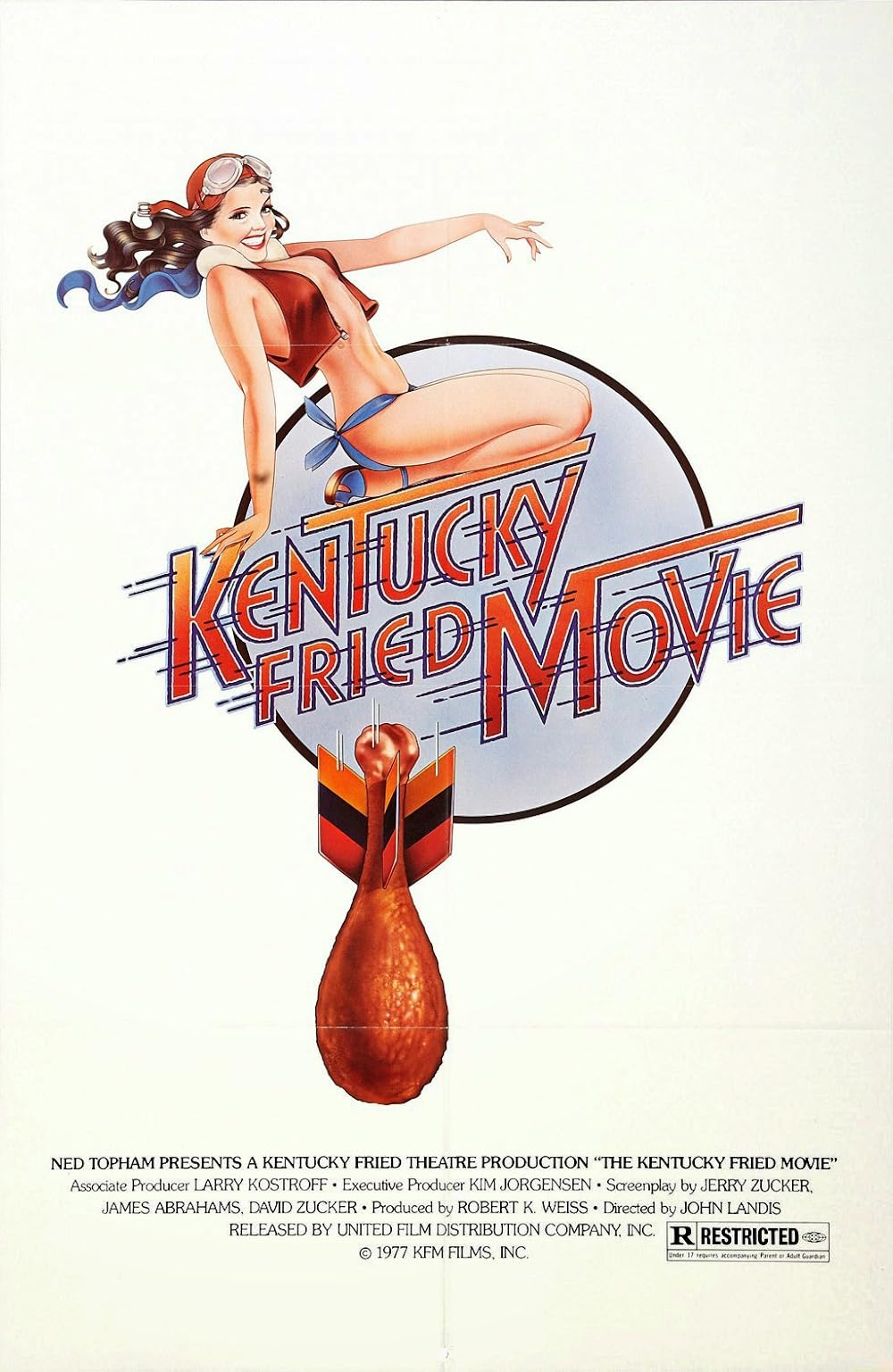
In 1974 there was the release of The Groove Tube which had a format of comical skits, much like a variety show, that managed to be a big hit and thus ushered in several imitators causing a whole new genre to surface. Unfortunately, those copycats didn’t fare as well and many of them were downright lame. By 1977 the trend had died off and yet brothers David and Jerry Zucker along with their friend Jim Abrahams were motivated to make another one revolving around funny sketches that had gotten a good response from audiences during their improvisational shows done on stage. The studios though weren’t impressed citing the decline in box office receipts towards sketch movies and thus refused their request for financing. They were then able to get a verbal deal from a wealthy real estate developer who agreed to fund the project as long as they made a 10-minute short that he could use to shop around to attract other investors, but when he found out how much it would cost just to produce the short he pulled out forcing the Zuckers to put up their own money, which amounted to $35,000, to get the short made.

This though proved to be beneficial as it attracted the attention of a young up-and-coming filmmaker John Landis, who had just gotten done directing Schlock on a minuscule budget and felt he could do the same here. It also got shown to Kim Jorgenson a theater owner who found it so funny he got other owners to play it before the main feature, and this was enough to get them to pool their money into a $650,000 budget that when completed made a whopping $7.1 million at the box office. This then directly lead to them getting studio backing for their most well-known hit Airplane which was a script that they had written before doing this one but had been previously unable to get any backing for.

Like with most films made during the brief period when this genre was ‘hot’ the jokes and skits are hit-or-miss. The opening sequences dealing with a TV news show are the weakest. Watching a reporter pick his nose because he doesn’t realize that he’s on the air isn’t really all that outrageous when today YouTube has actual news bloopers showing essentially the same thing. Having an ape go berserk in the studio during a live broadcast was too obvious and telegraphs the punchline to the viewer right from the beginning and thus making the outcome quite predictable.

The parody of Bruce Lee movies entitled ‘A Fistful of Yen’ definitely has its share of amusing moments though it goes on a bit too long and the special effects look cheap. My favorite segments came after this one and take up most of the final 20-minutes. These include Hare Krishna monks going to the bar after a ‘hard day of work’ harassing people on the street. There’s also ‘The Courtroom’ skit that’s a parody of Perry Mason-style TV-shows from the 50’s. The Zinc Oxide bit involving a housewife, played by Nancy Steen, who’s forced to face the reality of what life would be like if all the items in her house that was made from Zinc Oxide suddenly disappeared.

The film also features well-known actors who volunteered their time with little pay and appear in brief cameos. These include Bill Bixby as a spokesperson for a send-up of aspirin commercials. There’s also Donald Sutherland who plays a klutzy waiter during a parody of disaster flicks, Tony Dow playing his most famous role of Wally from ‘Leave it to Beaver’ as a jury in the Courtroom and Henry Gibson, in what I found to be both the funniest and darkest skit, where he essentially plays himself in a mock add showing how parents (Reberta Kent, Christopher Hanks) can still keep their deceased son as a ‘a part of their family’ by bringing along his increasingly decomposed corpse with them wherever they go.

My Rating: 6 out of 10

Released: August 10, 1977

Runtime: 1 Hour 23 Minutes

Rated R

Director: John Landis

Studio: United Film Distribution Company

Available: DVD, Blu-ray, Amazon Video, Plex, Pluto TV, Roku, Tubi, YouTube

Porky’s Revenge (1985)

By Richard Winters

My Rating: 4 out of 10

4-Word Review: Rescue from shotgun wedding.

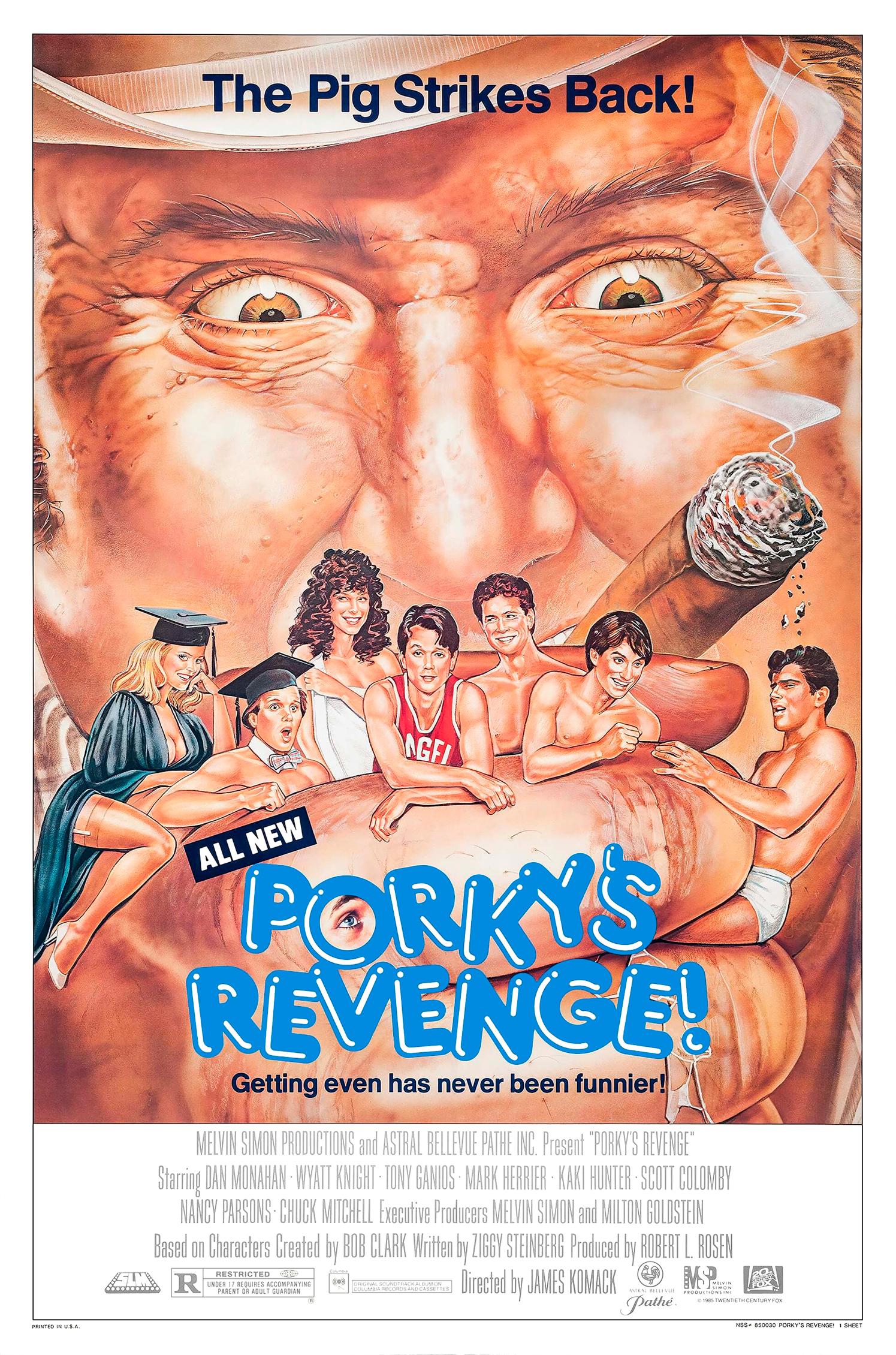
Porky (Chuck Mitchell) has rebuilt his casino that was destroyed by the teens in the first film by turning it into a riverboat. To help pay for this he extorts Coach Goodenough (Bill Hindman) for money and other such favors since he owes him on a gambling debt. Pee Wee (Dan Monahan) and his friends try to come to their coach’s rescue by sneaking onto the boat and taking pictures of the illegal gambling activity, which they hope to show to the district attorney. Porky though catches them in the act and threatens revenge, so to get out of their jam they agree to throw their next basketball game, so that Porky can bet against them and win a lot of money. Meanwhile Meat (Tony Ganios) is having problems of his own when he gets ‘forced’ into having sex with Porky’s daughter Blossom (Wendy Feign) causing Porky to insist that the two now must get married.

While fans of the franchise traditionally rate this at the weakest of the three films I found it to be a step up and even, at least at the beginning, to be moderately amusing particularly the pool scene where the cheerleaders concoct a scheme to get the boys to take off their bathing suits and prance around in front of the parents naked. The script was written by Ziggy Steinberg, whose career is the perfect encapsulation of Hollywood, where if you’re considered ‘up and coming’ you can find plenty of work, but the second your material is perceived as getting stale you can quickly become a leper and no offers to be found. This though came at a point where he was still a sought-after commodity, and I felt the script was better structured and seemed much more like a sequel continuing the elements from the first one versus going off on wild tangents like the second one did.

It helps having Chuck Mitchell back as the title character. It’s not like his acting is all that great, but his big presence and gruff, unfiltered delivery keep it fun and he offers a bona fide nemesis for the kids to go after. The casino boat is impressive, and the majority of the film’s $8 million budget was used just to build it. Seeing it get destroyed, which comes near the end, is exciting too and probably more memorable than the destruction of Porky’s original backwoods casino.

The characters though lack growth. Pee Wee for example is still obsessed about getting laid even though he had already lost his virginity in the first film, so his personality needed to evolve into something else. He should, especially being a senior, be the confident one who now takes some insecure freshman under his guidance to show him how it’s done instead of acting as a perpetually immature junior high kid, which by this point is no longer even remotely interesting.

The pranks continue to go overboard and boarder on cruelty. The one that gets played on Beulah Balbricker (Nancy Parsons) is especially stupid. She is set up to believe that she’s going to have a rendezvous with her long-lost boyfriend Snooky (Sandy Meilke), so she goes to a hotel room lying in bed in her nightie waiting for him to enter, so that they can return to their ‘passionate ways’ of the past. In reality though it would never work that way. These two had not seen, or corresponded with each other in many years, so there was no guarantee that both would still have the same feelings for the other. Since so much time had passed they were by this point theoretically strangers, so to avoid embarrassment and possible rejection they would instead get together at a restaurant, or over drinks in order to ‘catch up’ with things and then if they still both felt the same spark they might check into a hotel room, but nobody would just do that right off the bat.

I did though like the way her character changes, she’s the only one that does, by having her behaving like a completely different person once she’s finally able to get together with the real Snooky. However, I feel it would’ve made more sense had she been portrayed as someone who had never had sex versus one that just hadn’t had it in a while. Having her being lifelong frigid would’ve explained better why she was so hyper obsessed with suppressing everyone else’s sexuality. A better payoff would’ve had her really have sex with Tommy (Wyatt Knight) and found much to her surprise to liking it and this would then inspire her evolution.

Spoiler Alert!

The prank involving the bridge operator (Mal Jones) gets botched as well. It hinges on him believing that Wendy (Kaki Hunter) and Tommy are jumping off it to commit suicide, which distracts him enough so that he leaves to bridge operator room and allows Pee Wee to go in and close the bridge and thus destroy Porky’s boat that is trying to go underneath it. However, the bridge isn’t high enough from the water to be that dangerous. In fact, if it was truly that dangerous then both Tommy and Wendy would’ve died when they jumped off of it, but they don’t so the operator would never have been fooled. If anything, he would’ve thought they were just a couple of teens going out for a late-night skinny dip and wouldn’t have panicked at all.

My Rating: 4 out of 10

Released: March 22, 1985

Runtime: 1 Hour 32 Minutes

Rated R

Director: James Komack

Studio: 20th Century Fox

Available: DVD, Blu-ray

Porky’s II: The Next Day (1983)

By Richard Winters

My Rating: 0 out of 10

4-Word Review: Banning a Shakespeare play.

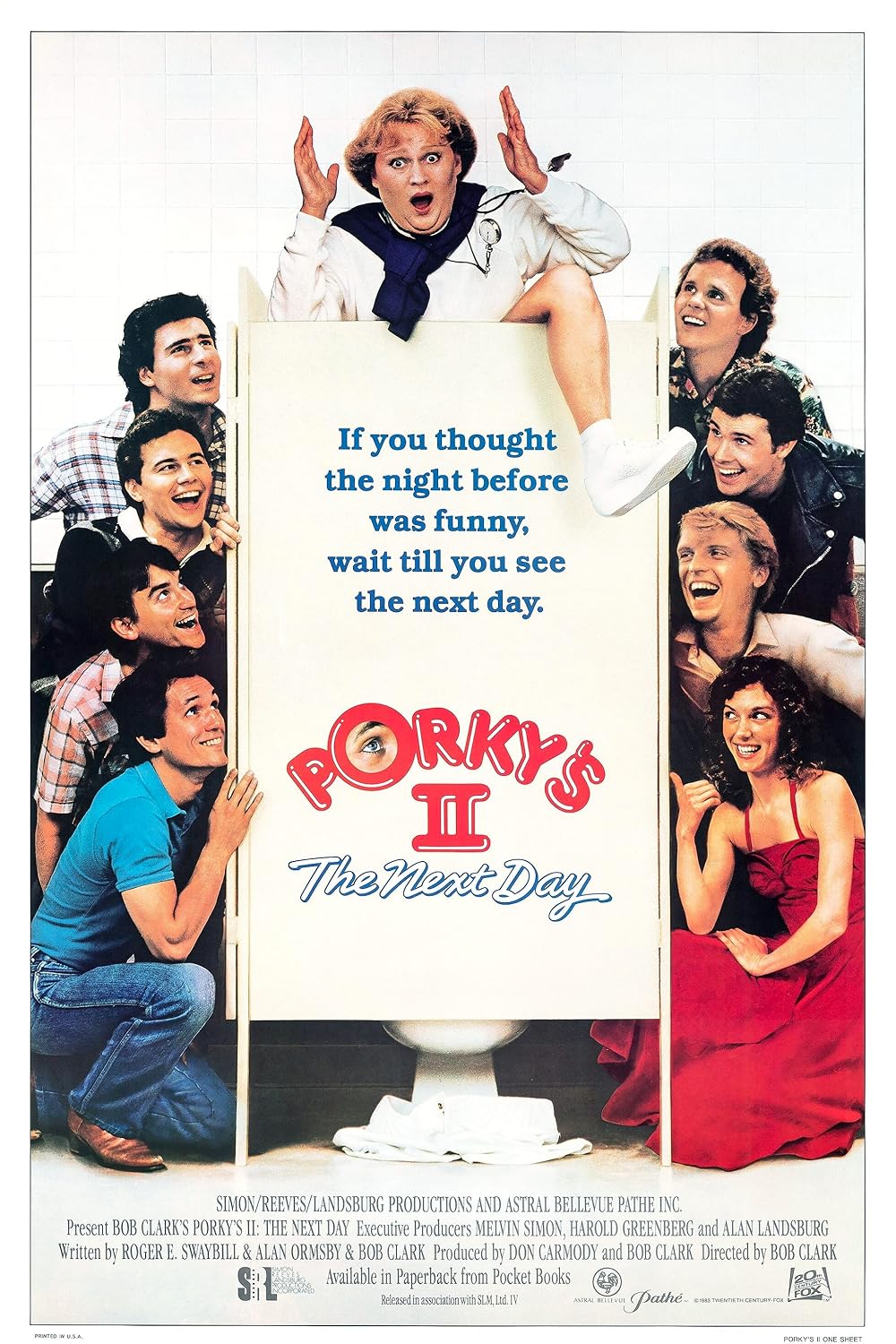
Now that Pee Wee (Dan Monahan) has lost his virginity to Wendy (Kaki Hunter) they decide that their next project will be putting on a production of ‘Romeo & Juliet’ at their high school, which will be directed by Mrs. Morris (Ilse Earl) Pee Wee’s mother. Problems though ensue when John Henry (Joseph Runningfox), a Seminole Indian, gets cast in the lead where he will then kiss Wendy, a white woman, on stage, which gets the local Klux Klan upset and they proceed to ambush things, so it won’t be able to proceed. There’s also outcry from a local Reverend named Bubba Flavel (Bill Wiley) as he and his religious constituents feel that the play is ‘obscene’ and therefore must be shut down in the name of ‘decency’. The teen cast then visits the office of County Commissioner Bob Gebhardt (Edward Winter) hoping he can use his influence to help keep the play going and while he initially promises them that he will, he eventually renegades. This angers the kids, and they devise an elaborate revenge on not only him, but the Klan and Reverend Flavel.

It’s quite clear that writer/director Bob Clark, who was working on Christmas Story while helming this one, had no idea that the first installment was going to be as big of a success as it was and there had clearly been no plans for a sequel. When the studio came begging for one, he felt obliged and spent 6 months, with the help of two other screenwriters, to come up with something. The result though is a movie in desperate search for a story with a script that’s a mishmash of over-the-top nonsense. What made the first one so good was that as crude as it was it still showed teens as they were with dialogue and situations that rang true, but here all of that gets thrown out with everything played up in an extreme way simply for the sake of a cheap laugh.

The most annoying aspect are the one-dimensional characters particularly the Reverend who is a cartoonish caricature in a silly send-up of a southern preacher. The same goes with the City Commissioner that is well played by Winter, which helps keep it remotely entertaining, but portraying a politician as being sleazy and two-timing is quite cliched and redundant. The return of Beulah Ballbricker, played by Nancy Parsons, is problematic as well. In the first film she was very strict with the rules, but here she’s turned into a religious fanatic, which seems like two different people. The scene where she sits on a toilet and begins singing loudly is dumb. Sure, people may talk on the phone while taking a dump, or read a magazine, or even browse the internet, but bellowing out a loud rendition of ‘That Old Black Magic’ while in a public stall is not one of them making her beyond ‘goofy’ and more into someone who should be institutionalized.

The pranks come off as unnecessarily cruel especially the scene in a graveyard where Pee Wee is made to believe that he accidentally killed a prostitute while having sex with her, which could be quite traumatic for someone and yet his ‘friends’ act like it’s ‘all in fun’. What’s worse is that Pee Wee never brings it up afterwards apparently having no qualms whether a sex worker dies at his hands or not just as long as he’s not blamed, which unintentionally makes him cold and uncaring.

The climactic bit where Wendy dresses up as a big bosomed 17-year-old prostitute who makes a major scene at a posh restaurant in an effort to embarrass the commissioner gets overdone too. For one thing it’s seems awfully extreme to put so much effort to get revenge on what’s nothing more than a tacky high school play with cheap props that isn’t going to make any money and cast members who weren’t all that excited about being in it, so why get so upset if it gets canceled? It also begs the question why these kids are so sure they can get away with their hijinks and not suffer any consequences. The ‘prank’ that gets done inside the restaurant causes a lot of damage and since these teens live in the same community as the adults they would most assuredly get recognized by someone and be either arrested for causing a disturbance and handed a very hefty bill for the repairs, or their parents would, which for them would be just a bad.

The only small funny bit, and I kid you not, comes at the very end during the closing credits, when the head waiter at the now ravaged restaurant tries to save face by convincing the patrons that it had all been an ‘April Fool’s joke’, which got me to chuckle. It’s also kind of amusing how Pee Wee gets so aroused by pics in National Geographic, or sexually stimulated by strippers who aren’t even naked, but just scantily clad enough to excite him anyways, which in this porn saturated era probably wouldn’t be deemed all that titillating, so in that aspect it’s interesting, but everything else is a disaster. It doesn’t even have Porky. How can you have a film titled ‘Porky’s’ if that character never actually shows up though he does reappear in the third installment, which will be reviewed next.

My Rating: 0 out of 10

Released: June 24, 1983

Runtime: 1 Hour 38 Minutes

Rated R

Director: Bob Clark

Studio: 20th Century Fox

Available: DVD, Blu-ray

The Sailor Who Fell from Grace with the Sea (1976)

By Richard Winters

My Rating: 4 out of 10

4-Word Review: They dissect a cat.

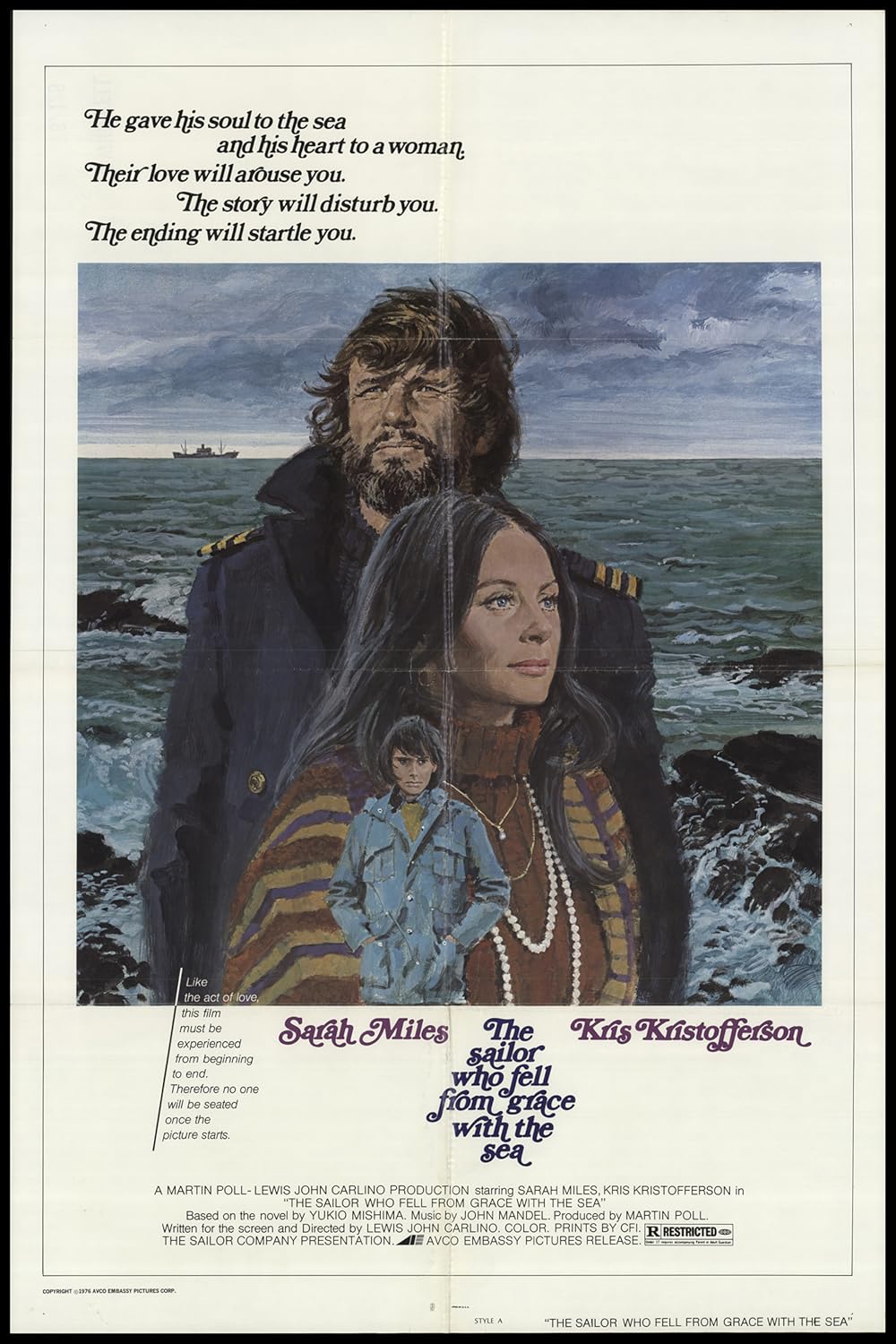
Jonathan (Jonathan Kahn) is a 14-year-old who lives with his mother (Sarah Miles) and nanny Mrs. Palmer (Margo Cunningham) in a beachfront house along the sea after the death of his father three years earlier. Jonathan enjoys his friendship with a group of boys lead by Chief (Earl Rhodes), but his mother does not approve due to Chief’s anti-social sentiment forcing Jonathan to have to sneak out on the sly to see them. One day Jonathan finds a peep hole in his bedroom wall that allows him to see inside his mother’s bedroom, and he begins to peer in on her when she’s undressed, and this creates an unhealthy arousal. When his mother begins a relationship with a sailor named Jim (Kris Kristofferson) he becomes jealous and conveys as much to Chief who devises a sinister plan to ‘solve the problem’.

Lewis John Carlino had a highly respected career as a screenwriter garnering 4 Academy Award nominations for best screenplay, but his three forays as director weren’t as successful and all started out well but ended up just missing the mark. This one was no exception as many critics at the time felt the problem lay in adapting a novel, that was written by Yukio Mishima, which was set in Japan, and trying to convert it to English society. The cultures differences that make up the complex Japanese society that were so integral to the characters in the book gets completely lost in the translation leaving the viewer feeling cold, detached, and genuinely confused when it’s over.

The on-location shooting filmed in Dartmouth, Devon, England, is excellent and the one thing that helps the movie stand-out particularly the isolated hillside house that gives the atmosphere an almost surreal-like feel. There’s also a really creepy performance by Rhodes who nails it as a highly intellectualized kid who displays no moral compass and effectively comes-off as a very believable young sociopath. However, these moments gets coupled with some very disturbing ones dealing with animal cruelty which includes a very drawn-out scene involving the killing and dissecting of a cat as well as putting a firecracker in a seagull’s mouth and while no animal was actually harmed during the production it still left many audiences at the time upset and will very likely do the same with viewers today.

The film’s biggest flaw though is that it doesn’t interpret the character’s actions in any way that helps makes sense of their motivations and for the most part they’re all quite two-dimensional. Jonathan’s arousal at seeing his naked mother needs much better explaining. Most kids aren’t this way, so what is it about his psyche that causes him to enjoy it without any guilt or shame? The movie gives us no clue, nor does it explain how his father died and when you add in the boy’s weird behavior and you start to wonder if the Jonathan maybe had something to do with it, which would’ve opened an interesting subtext if even brought up subtlety, but the script fails to touch on it.

The book makes the reasons for the son’s actions clearer. For instance in the novel the boy losses respect for the sailor when he sees him jump into a water fountain, which he considers to be undignified and the movie really needed to have some similar moment as the kid, like in the book, is initially in awe of the man, but it’s never totally clear what creates the deadly shift. Also, when the son is caught peeping in at his mom the response by his mother in the book is different as she feels the boy should receive a severe punishment, but the sailor, in hopes of becoming ‘friends’ with the kid whom he’s now helping to raise, resists, but the film flubs this scene too by treating it almost like a forgettable throwaway moment that has no impact versus one that would’ve helped reveal the sailor in a more in depth way.

Spoiler Alert!

The ending, which should’ve been a shocker, falls flat as well. In the novel it’s made clear that the boys plan to drug and dissect the sailor just like they did with the cat and they even bring along the tools to do it, in the movie we only witness him drinking the spiked tea. The camera then zooms way out showing the boys at an extreme distance where it’s not obvious what they’re doing. To really make a memorable impression we should’ve seen the boys stab the sailor several times with their knives, which would’ve been far more startling. I felt too there needed to be a reaction from the mother. Does she find out what they did, or does his violent demise remain a mystery? How does her relationship with her son evolve, or devolve afterwards? These questions remain unanswered making the movie seem less like a story and more as a concept that’s never adequately fleshed out.

My Rating: 4 out of 10

Released: April 5, 1976

Runtime: 1 Hour 45 Minutes

Rated R

Director: Lewis John Carlino

Studio: AVCO Embassy Pictures

Available: DVD, Blu-ray, Amazon Video, Plex, Roku Channel, Tubi, YouTube