Monthly Archives: November 2024

The Warriors (1979)

Version 1.0.0

Version 1.0.0

By Richard Winters

My Rating: 7 out of 10

4-Word Review: Back to Coney Island.

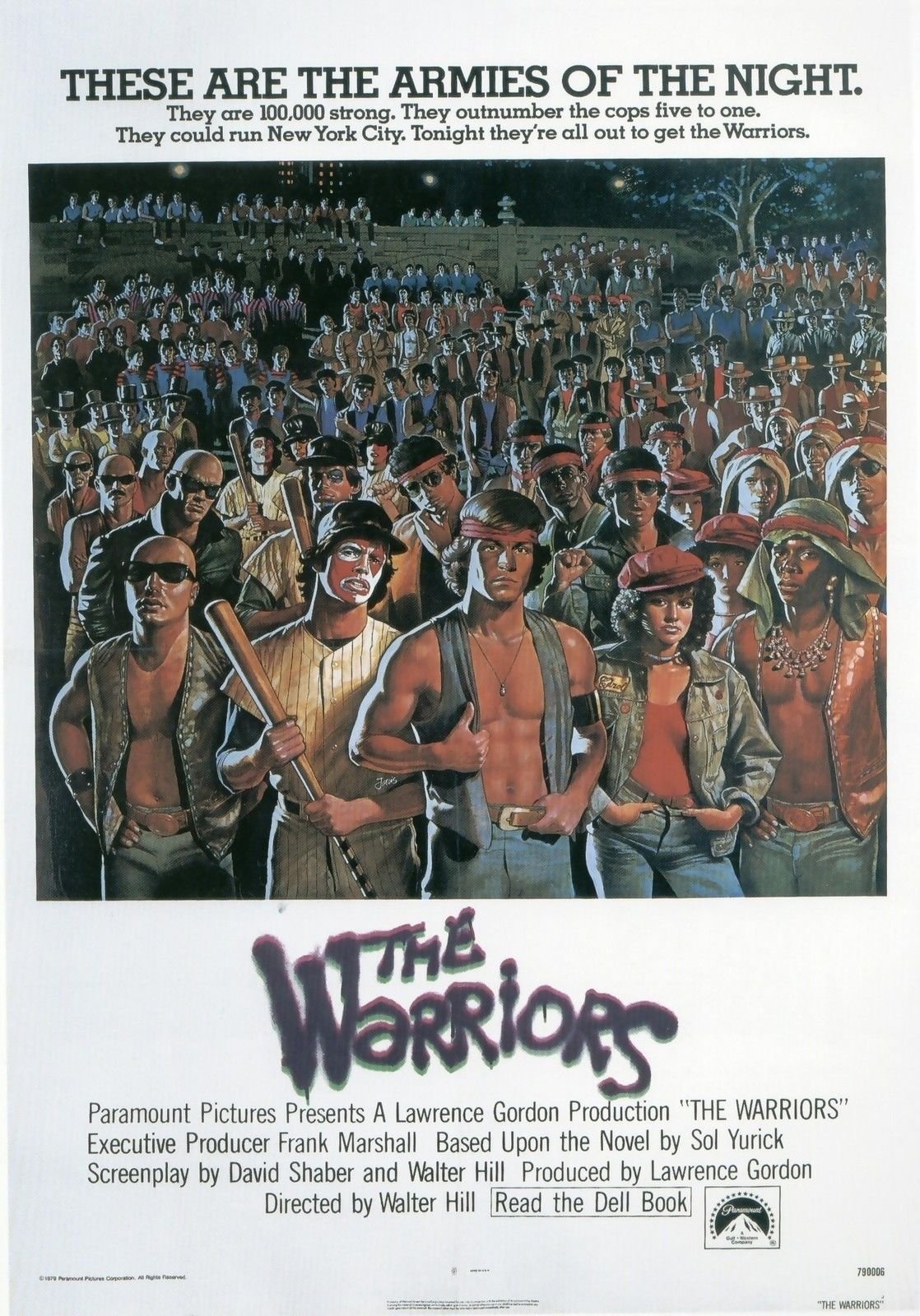
The Warriors lead by Cleon (Dorsey Wright) make their way to from Coney Island to Van Cortland Park in order to attend an outdoor rally lead by Cyrus (Roger Hill) who heads the gang called The Riffs. It’s Cyrus’ idea to bring all the gangs in New York City together as one because if they do so they’ll be able to outnumber the police. However, Luther (David Patrick Kelly), who’s a member of the Rogues gang is not privy to this idea and thus shoots and kills Cyrus, which gets witnessed by Fox (Thomas G. Waites) a member of the Warriors. Once Luther realizes he’s been spotted he quickly accuses the entire Warriors gang of carrying-out the murder, which sends the mob into violent chaos and in-turn causing the death of Cleon. Swan (Michael Beck) becomes the group’s new de-facto leader though it receives a frosty reception from Ajax (James Remar), but since they’re in such an urgent situation he has no time to fight him for it as the gang now must make their way back to the safety of their territory while having to trek through the turfs of other gangs who are all out to kill them.

For a film about gang life this one is quite different. Most of the movies before then that dealt with this topic would typically place the protagonist as being someone outside of the gang culture, but here that outside world doesn’t even exist. Everything is fully from inside the gang world, which is what makes it so fascinating as the viewer gets immersed into a universe that most likely they really wouldn’t experience or understand otherwise. However, as big as their turfs wars are one of the most memorable moments in the film doesn’t deal with the action at all, but instead it’s the scene inside the subway car where some suburbanites come-on after a night at the club and sit across from The Warriors, who are quietly judged, through their glances, at the disheveled nature of the gang members, which they’re distinctly aware of, revealing how even though in the gang’s mind their the ‘top dog’ of their universe, they’re still perceived from the mainstream world as being people to look down upon.

I also really dug the gang attire. Some may argue this gets ‘campy’ and hurts the realism with proposed remakes offering to play down some of it, but for me it’s what makes it more fun. Personally, I found the Baseball Furies and roller-skating gang known as The Punks to be generally frightening. Even if the gang carrying baseball bats wears facial make-up resembling the rock band KISS I still in no way would want to meet them in a dark alley and in a lot of ways The Warriors constantly coming into these weird gang types as they cross through their territories creates a surreal nightmare atmosphere.

I did though find some of the action to be problematic. It starts with The Warriors trying to outrun another car driven by a rival gang, which I found unrealistic. Possibly if it was a short distance then maybe, but to go several blocks wouldn’t be fathomable. I would think at least a couple of the gang members would tire-out and slow down and ultimately be hit by the vehicle. Having The Warriors totally annihilate the Baseball Furies even though it was the Furies with the baseball bats while the Warriors had only their fists didn’t make sense either. Maybe you could argue that The Warriors had such good fighting skills they were able to use that to overpower the other side, but logically I think one or two of them should’ve at least gotten hit by a bat, which the Furies were swinging wildly, and the fact that they’re all able to get out of the fight unscathed is a bit of an eye roll. Having a few of them later trapped in a room with a female gang that shoots directly at them with a gun and none of them get hit by even a stray bullet is equally unrealistic. Also, since they all get involved in punching their opponents, you’d think there would be numerous scratches, abrasions, and dried blood on the broken skin of their knuckles, at the very least, but on the subway ride after the fights there’s a quick close-up of Micheal Beck’s hands, who was involved in the majority of battles, and they’re completely unblemished.

The 1965 novel version, the author, Sol Yurick, was not happy with the film, has many differences including the gang rape of the female, played in the movie by Deborah Van Valkenburg, by the protagonist gang members, that doesn’t occur here. The book also delves more deeply into the gang leaders sad home life, which the movie doesn’t tackle at all, but it would’ve helped create a better understanding of the main character’s motivations. If a remake does get made, and it’s been talked about, I think it would be more interesting if it followed the book’s plotline, which ultimately is grittier.

My Rating: 7 out of 10

Released: February 9, 1979

Runtime: 1 Hour 33 Minutes

Rated R

Director: Walter Hill

Studio: Paramount

Available: DVD, Blu-ray, Amazon Video, YouTube
Outland (1981)

outland

By Richard Winters

My Rating: 6 out of 10

4-Word Review: Deaths at mining outpost.

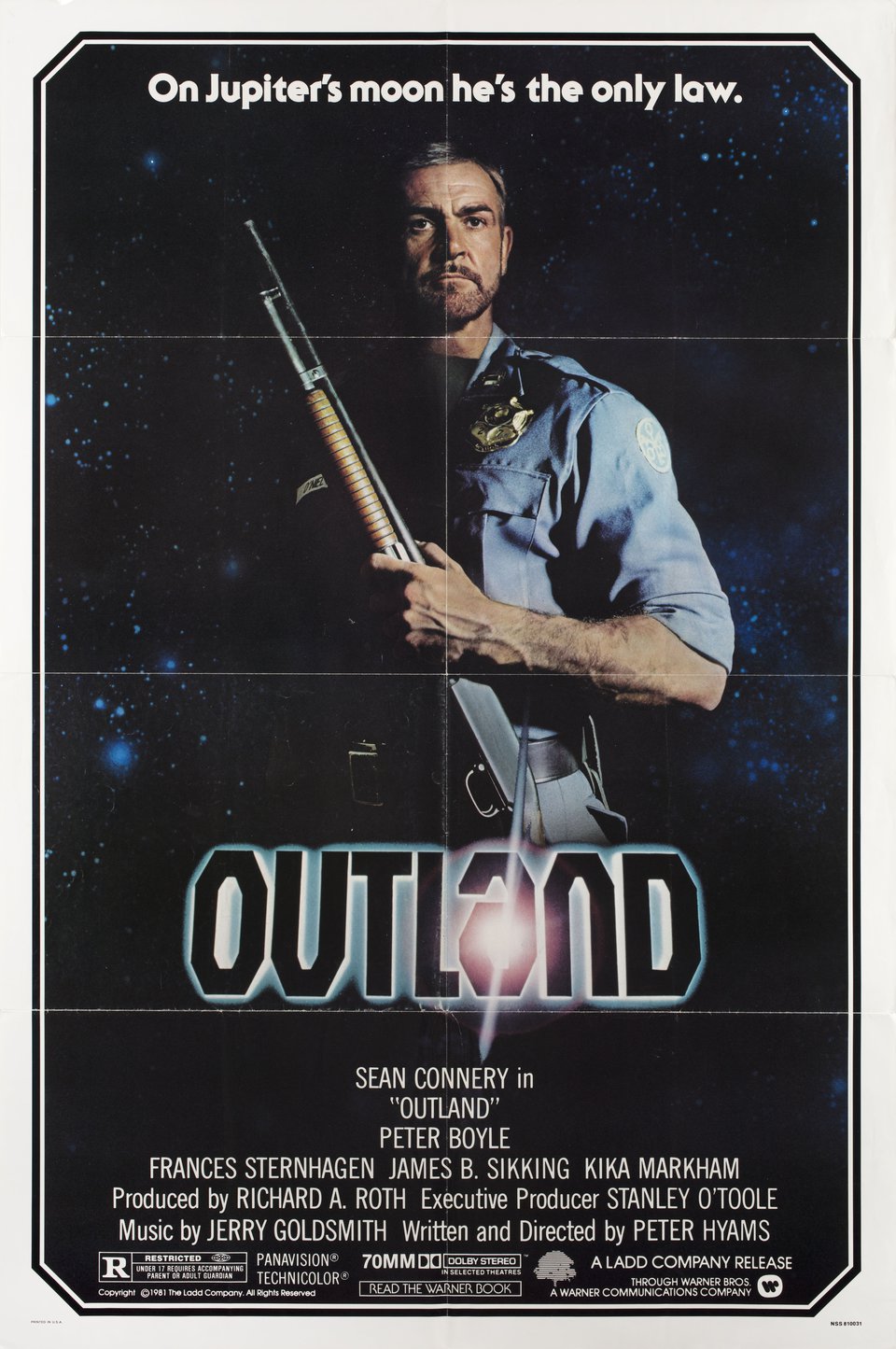
William (Sean Connery) is a federal marshal assigned to an isolated mining outpost on one of Jupiter’s moons. The outpost, known as Con-Am 27, is supervised by Mark Sheppard (Peter Boyle), who boasts a high productivity from his miners, but this comes at a cost as they seem to be steadily dying-off after suffering from bizarre psychotic episodes. William brings a blood sample of one of the latest victims to Lazarus (Frances Sternhagen), a nurse stationed at the outpost, who runs it through some tests and learns that he had been taking a powerful drug that can allow the men to work long hours at a high rate, but they will eventually burn-out and be driven crazy after about 10-months of use. William learns that Sheppard is fully aware of the drug use and allows it since it helps his workers achieve high results while also paying-off the police authorities to keep quiet. William refuses to go along with this and openly challenges the status quo of the space station causing Sheppard to call-in two assassins who’ll arrive on the latest shuttle and dispose of William unless he’s able to kill them first.

The film was inspired by writer/director Peter Hyams’ desire to make a western, but was advised by studio execs that westerns were no longer profitable, but sci-fi movies dealing with outer space were, so he decided to switch the setting of High Noon, a famous western starring Gary Cooper, to that of a space station, but otherwise kept many of the story elements from that one intact. The response by critics at the time was mixed with some labeling the effort as ‘trite’ while others, like critic Desmond Ryan of the Philadelphia Inquirer calling it ‘scarier than Alien, which I found funny since that one has gone on to be a timeless classic while this is largely forgotten.

The film does score when it approaches the human factor like greed and the way management can and will exploit the workforce if it’s able and the resentment and apathy workers can have towards their jobs, which even if it’s in some distant future could still most likely be reoccurring elements that will go on no matter what the time period. The look of the space station, particularly from the outside, is cool and I enjoyed the way the film replicates the ominous silence of space especially at the beginning.

Some other futuristic effects don’t work as well like the way the computers feel the need to make little beepy noises every time it prints out a word, or message, which may have seemed high tech at the time, but is now antiquated. The television screens display the old tube models while today we have the flat HD variety making this ‘future’ seen here seem more like the past. There’s also plentiful shots of people openly smoking in meeting rooms, but since second-hand smoke was proven to cause lung cancer and outlawed now, more people vape anyways, then why would it have been brought back in the future?

Connery shouldn’t have to explain why he’s going up against this evil conglomerate when no one else will help him, as the viewer should be able to surmise this on their own, which shows how poorly fleshed-out his character is. Having him rebuff his son’s and wife’s request to come back to earth with them because he has something to ‘prove’ unintentionally works against his likability as it makes him seem selfish versus noble. Would’ve been better had his wife left him on bad terms, maybe because for example he was an alcoholic, or too focused on his job, and thus with nothing else to lose he decides to prove to himself he can do at least something right by taking down the bad guys since he’s essentially failed at everything else. The audience would’ve been more emotionally invested in his quandary if he had nowhere else to turn, instead of here where he technically does have an option.

Sternhagen is an interesting choice for the female lead in that she’s not the proverbial young and attractive heroine like viewers have come to expect in Hollywood action flicks. Had she been more romantically enticing that might’ve made the viewer dislike William, particularly if he acted upon his emotions, since he was already married, so to avoid any possible conflict they made the lady character older and sarcastic and thus not somebody to typically fall in love with. While I appreciated the concept of having two people work together without it leading into a sexual escapade, which becomes a cliche in itself, I still felt it was hard to fathom that she’d be the only one at this outpost that would offer him assistance. The work crew wasn’t real happy with management especially finding out that they were fed a drug meant to ultimately kill them, so I’d think there would be some of them who would want to help William take down their oppressive employer, which would’ve also helped it add a wrinkle to the High Noon formula, which it otherwise follows too closely to the point that it becomes predictable and redundant.

While I did like the shoot-out that happens in the giant greenhouse, which visually is impressive due to its vast largeness, I did feel overall the assassins weren’t interesting. We barely see their faces and they come-off as being no different than the other workers already at the station and this lack of distinction makes them forgettable. Initially I thought William wouldn’t be able to know which ones coming off the shuttle, as there are quite a few people who disembark it, were the killers, so there would be added suspense of him being unclear of who exactly was after him, but this quickly gets answered when William can see via circuit cameras the two men taking out their weapons, which ruins what could’ve been an added mystery. Ultimately, I felt the assassins shouldn’t have been human, but instead an indestructible killer robot, which would’ve kept it more in the space age realm and given it added excitement and special effects.

My Rating: 6 out of 10

Released: May 22, 1981

Runtime: 1 Hour 49 Minutes

Rated R

Director: Peter Hyams

Studio: Warner Brothers

Available: DVD, Blu-ray, Amazon Video, YouTube
Steel (1979)

steel

By Richard Winters

My Rating: 4 out of 10

4-Word Review: They build a skyscraper.

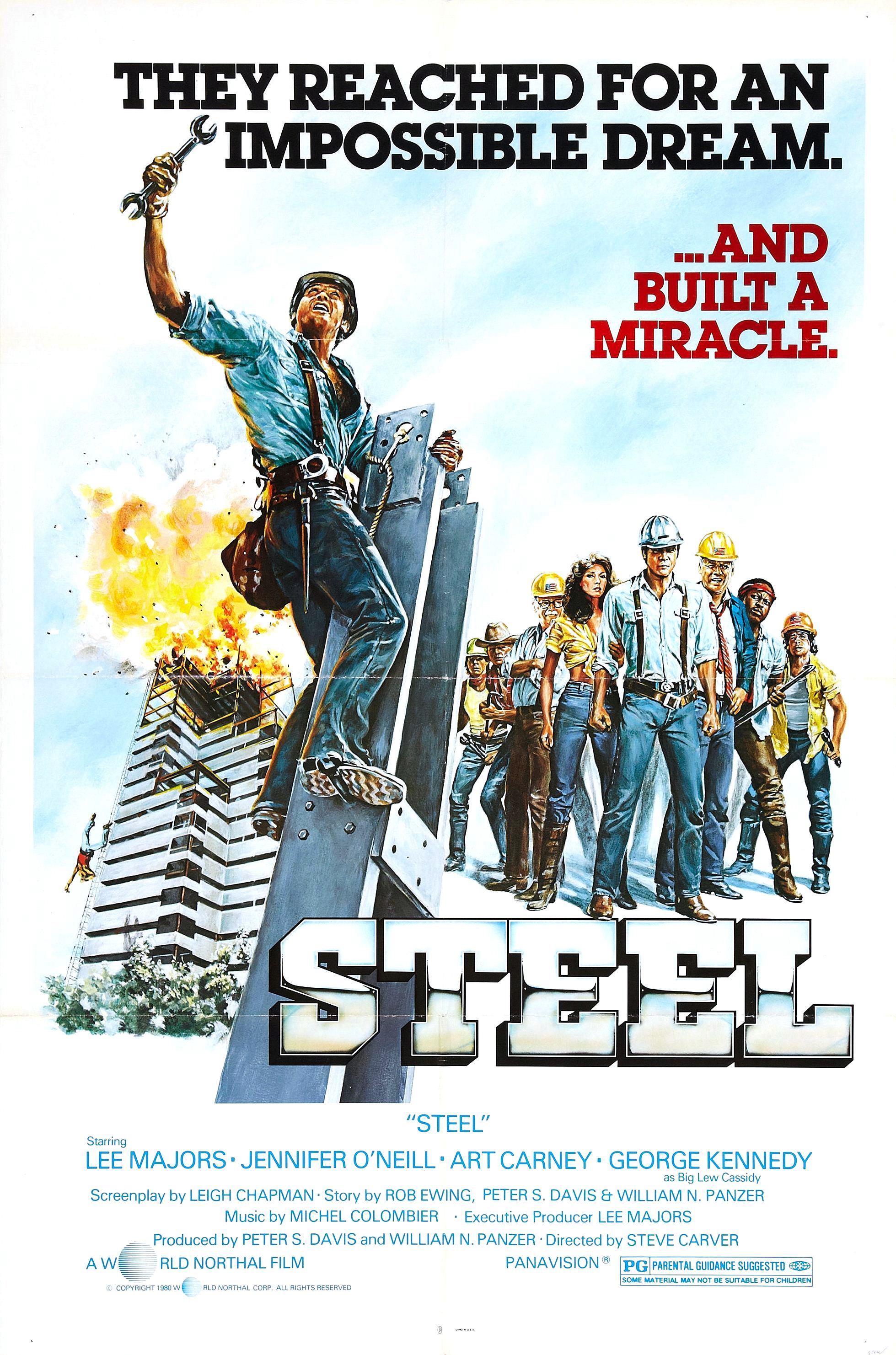
Big Lew (George Kennedy) runs a construction company that builds skyscrapers and is under pressure to get his most recent project, which will be one of the tallest he’s ever been put in charge of making, completed under budget. While climbing onto a metal high beam, one of the other workers with him freezes and refuses to come down. Lew attempts to relax him, but in the process, he loses his balance and falls to his death. Cass (Jennifer O’Neill) is put in temporary charge, but she’s overwhelmed with the demands and thus goes to Mike (Lee Majors) to help take over the project and make sure it gets done in time. Mike used to be a part of the hard-hat team, but an accident caused him to become afraid of heights and forced him to take a job as a truck driver, but when the daughter of an old friend comes calling, he can’t refuse. He assembles a motley crew of misfits who all have eccentric personalities but also know how to build tall buildings and do it right even when put under grueling circumstances. Not all of them know about Mike’s fear and he tries to hide it from them due his concern that they might not respect him anymore if they found it, but while he struggles to keep everyone working at a near impossible pace he must also fight-off the likes of Eddie (Harris Yulin) who’s been tapped by a criminal conglomerate to do whatever he can to hijack the efforts of Mike’s crew and make sure the building is never finished.

The film is for the most part just a TV-movie if not for one brief moment when a prostitute gets into the truck that Lee Majors is driving and takes-off her shirt. It would’ve been best had it been made for that medium because as a theatrical release it didn’t do well and has been largely forgotten without any DVD, Blu-ray, or even a steaming venue to its name. Infact the only thing that stands it out is what occurred behind-the-scenes as stuntman A.J. Bakunas died when attempting the world record by diving off a construction site at 315 feet from the 22nd story where he reached speeds of 115 mph. The jumped looked perfect, but upon landing the air bag split and he died from the injuries the next day.

While his death was certainly regrettable, his father was a part of the 1.000 onlookers who witnessed it, it was not shot in a way that makes it work in the film. While the footage was kept and edited into the movie you only end up seeing a few seconds of it making it seem like it wasn’t even worth attempting if that’s all that was going to be seen. It was also used to kill-off George Kennedy, it was his character’s fall that the jump was created for, but Kennedy’s hard-ass persona is the one thing that gives the story any color and it’s a shame that he hadn’t stayed in all the way through.

The supporting cast if full of familiar B-movie faces and some of them are quite good, but they’re not in it enough. The movie might’ve been more entertaining had the workers themselves carried it, but instead we get introduced to their quirky temperaments, while Majors busily makes the rounds to beg them to come aboard as his crew, but then after that they’re largely forgotten and instead the focus gets put on Majors who is by far the dullest of the bunch and it would’ve worked better had he not been in it at all. O’Neil had great potential, seeing a woman trying her best to head an all-male crew, most of whom weren’t exactly gentile, could’ve made for some high drama and been considered even groundbreaking and the film clearly misses-the-mark by not having taken that avenue.

The building that was used for the film was the Kinkaid Towers in Lexington, Kentucky, which when compared to major skyscrapers in large cities is quite puny and unimpressive. The opening shot capturing it from the ground-up as its half-built doesn’t help to dispel this feeling and if anything seems rather laughable especially when there’s no other tall building around it, so there’s no cosmopolitan vibe at all to it.  However, the shots showing the men walking on the high beams several stories up with seemingly nothing holding them down is nerve-wracking to watch especially for those who fear heights, so in that vein it succeeds, but with everything else it’s rather flat.

My Rating: 4 out of 10

Released: July 25, 1979

Runtime: 1 Hour 42 Minutes

Rated PG

Director: Steve Carver

Studio: Fawcett-Majors Productions

Available: DVD-R

Going Ape! (1981)

goingape

By Richard Winters

My Rating: 0 out of 10

4-Word Review: He inherits three orangutans.

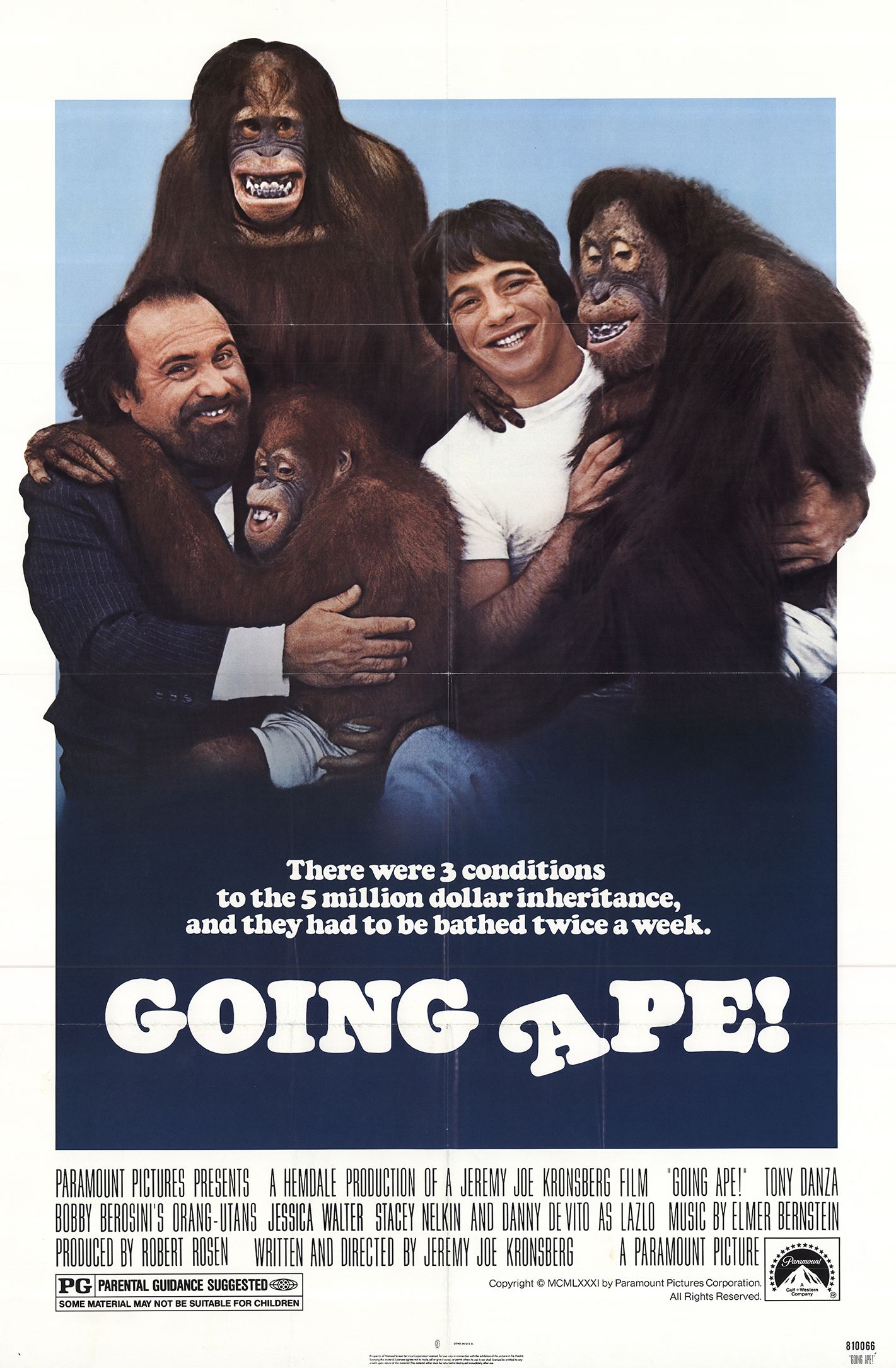
Foster (Tony Danza) is an outcast in his family because when he grew up, he did not get involved in the family’s circus business. Now that his father has died, he’s set to inherit nothing and everything left to his greedy sisters, at least that’s what he presumes. Instead, he’s given custody of three orangutans that were part of his father’s circus business. If he can care for them for 5-years and none of them dies he’s set to inherit the $5 million estate. Foster takes on the challenge, but his live-in girlfriend Cynthia (Stacey Nelkin) doesn’t care for it and moves-out while Foster spends the rest of the time trying to win her back. He also becomes menaced by a couple of mafia-styled hitmen (Art Metrano, Frank Sivero) who want to kidnap the apes and do harm to them because if just one of them dies then the entire fortune would go to the zoo.

In 1977 Jeremy Joe Kronsberg was a struggling writer who had only one writing credit to his name, penning an episode to the short-lived series ‘Code R’. He sent out a script called Every Which Way But Loose, that all the studios rejected it as they considered the storyline and comedy be inane and silly. However, by chance Clint Eastwood came upon it and to the surprise of many decided to take it on as his next vehicle. He had been looking to do a comedy in order to broaden his appeal and thought this script would achieve that despite the advice from his agent and production staff who all insisted it would be a bad idea. The movie managed to make a ton at the box office, which convinced Hollywood studio heads and producers alike that maybe this Kronsberg guy, which they had all considered to be a hack writer, ‘had something’ that they just didn’t see and therefore his next script, no matter how bad it may seem, was going to be automatically green-lit and what’s more he’d even be given the offer to direct it.

It was like the Hollywood dream. The little guy that everybody thought had no talent was suddenly the overnight success story, but like with a lot of Hollywood dreams, it didn’t end so well. This movie became both a critical and box office bomb and lead any potential future offers that Kronsberg may have had thrown off the table. Though he’s still alive today, at the ripe old age of 87, he never got another script or teleplay sold and his entire Hollywood ‘career’ ended up being nothing more than a 3-year flash.

The film starts out alright. I actually chuckled at the Danza character cutting-off splinters from his wood desk and trying to sell it as pieces of Babe Ruth’s bat, but the quirkiness of the beginning gets overtaken by the orangutans, which I found ugly and obnoxious. Their rotted teeth alone are disgusting to look at and every time they open their mouths it’s more unsettling than peering into a hillbilly’s. They were trained  by then world famous Bobby Berosini, a Czech born immigrant who became a famous orangutan trainer that began to do stage shows with them in Las Vega during the 70’s, but then in 1988 a Vegas dancer secretly recorded him abusing the apes, including slapping and punching them, before going onstage and when it was sent to PETA it became available to the public and his career and image took a massive downfall.

The stupid villains, which are nothing more than a hammy, cliched send-up from the Godfather movies, are pathetic and the point where the movie really goes downhill. Their pratfalls are dumber than something you’d see in a kiddie flick and devolve the film into the inanest level possible. It’s also chillingly prophetic as Metrano, who plays the head-honcho, is seen twice falling from a lofty height including once out of high-rise window, which had a creepy similarity to his real-life accident in 1989 when he fell from a ladder and became paralyzed.

Danza is likable enough, but I found his character to be ridiculous with the way he put up with the apes even as they tore-up his apartment and kind of felt he should’ve given-up on them just like his girlfriend did and came to the conclusion the money wasn’t worth the hassle and just pawned them off on somebody else, or even given them away to the zoo who seemed so desperate for the fortune. Despite winning the Razzie award for his performance I really felt it was DeVito, who speaks in an accent, that was the scene-stealer and had he been made the star it might’ve worked better.

Nelkin is cute, so she gets a few points there, and Walter has great potential as her snobby mother, but unfortunately her services here get greatly misused as she soon sides with Danza and his cause instead of working against him and becoming the chief villainess of which she would’ve been great.

There are some reviewers on IMDb who proudly insist that this is ‘the greatest movie ever made’, but I feel they are either desperate for attention and will say any outrageous thing to get it, or haven’t seen any of the timeless classics, so that they really don’t know what they’re talking about. In either case this is a bad movie that will harbor very little enjoyment to anyone who sees it whether they’re young or old. Yes, there’s a big smash-up car chase at the end, but this is just thrown-in to camouflage the lack of originality in the story.

My Rating: 0 out of 10

Released: April 10, 1981

Runtime: 1 Hour 27 Minutes

Rated PG

Director: Jeremy Joe Kronsberg

Studio: Paramount

Available: Blu-ray, Amazon Video, YouTube

One From the Heart (1982)

oneheart

By Richard Winters

My Rating: 2 out of 10

4-Word Review: Break-up/make-up

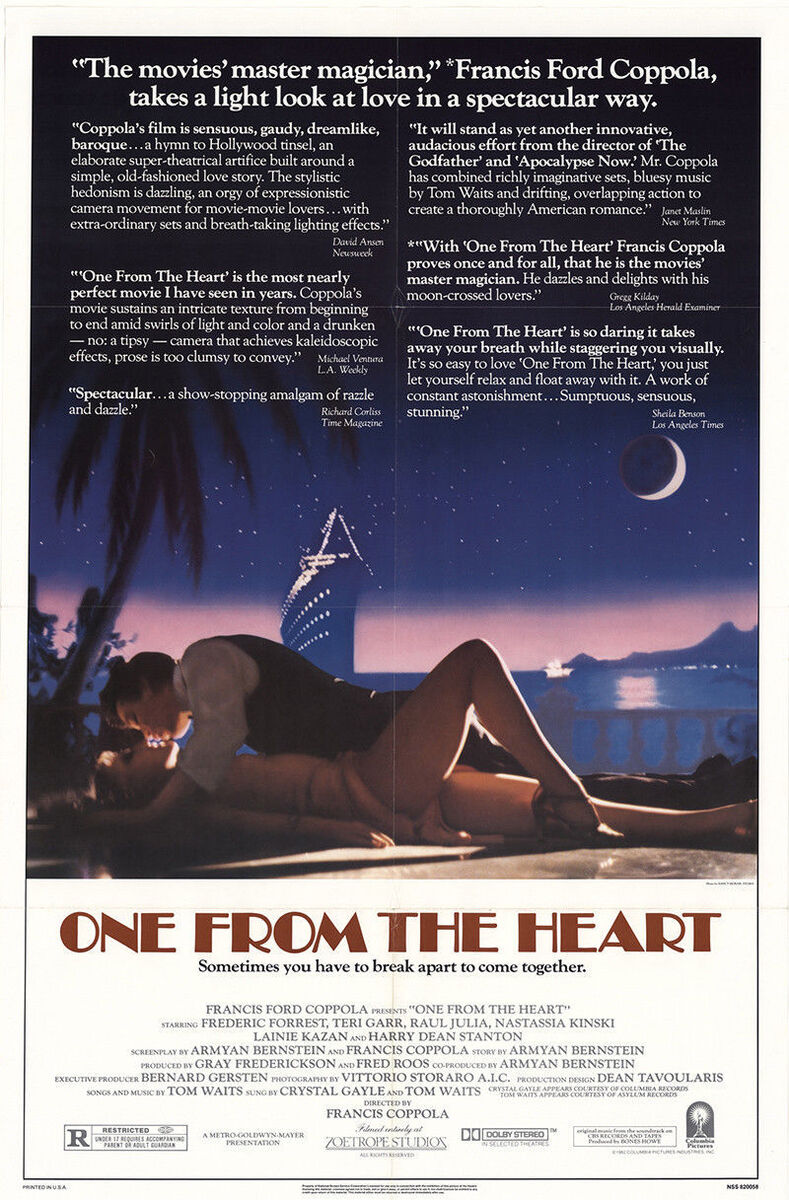
Hank (Frederic Forrest) and Frannie (Teri Garr) have been together for 5-years but while celebrating their anniversary at home the cracks in their relationship begin to show. Frannie is upset that they can never go out and wants more adventure. Hank doesn’t see this as a problem, so the two break up. Frannie meets Ray (Raul Julia) a waiter who has ambitions to become a singer. Hank gets together with Leila (Nastassja Kinski) who is much younger than him and lives the fast lifestyle. Each spends a night with their new partner, but end-up longing for their former mates when it’s over. Ray offers to take Frannie to Bora Bora, but will she really board the plane, or will Hank catch-up with her in time and convince her to move back with him?

The movie has a weird look about it and this is mainly because director Francis Ford Coppola decided he wanted to film the entire thing on the soundstage of his Zoetrope studios. This in retrospect seemed absurd as the setting was Las Vegas with one of the most flamboyant downtowns of any city, so if the real thing is already visually arresting why trump it with a fake one that isn’t half as exciting? The artificial presence kills the movie from the very start and what’s worse is that it was so painstakingly expensive to create the set design, which is massive, that it sent Coppola and his studio into bankruptcy of which it took many years to recover and all of it wouldn’t have been necessary if they had just shot it on-location, which would’ve been a thousand times better.

The lighting is one of the more annoying aspects particularly the red light that shines through the couple’s home window making it look like they live in the red-light district of Denmark, or near a police station. The outdoor scenes look as phony as you’d expect including having the night sky shown to have a ‘ceiling’ and the distant mountain vistas appearing as nothing more than a cheap matted on paintings. Everything comes-off as loopy like a great director whose ego got the best of him, and he made a massive artistic overreach for no other purpose then just to see if he could. The music interludes by Crystal Gayle and Tom Waits don’t work either. If a movie is intended to be a musical, as this one kind of is, then each song needs to sound distinct and at least moderately peppy, but here it comes-off like the same droning song that just never ends and adds little to the already goofy set-up.

The characters are poorly fleshed-out and, with the modest exception of Harry Dean Stanton and Elia Kazan, wholly uninteresting. The break-up is the biggest problem as the ‘squabble’ appears to be over nothing more than the fact that Hank didn’t take Frannie out on their anniversary, but to move-out because of something like that seems awfully trite. Normally for relationships/marriages to go really bad there needs to be a lot of anger simmering underneath the surface and this thing at best is just a tiff especially when at the beginning they seemed content with other. To make it realistic there should’ve been clear underlining animosity right away and not go from ‘happy couple’ to break-up with a snap-of-the-finger.

Not sure either if it’s exactly possible to get back together after the other partner has slept with someone else. Granted there could be some exceptions, but most people would consider it an extreme betrayal and unforgivable and certainly not something that they could just conveniently forget about and return back to the ‘happy couple’ that they were. Yes, in this instance they both cheated, but that makes things even worse. Who’s to say you can ever trust the other again? If one tiny disagreement can get each one to suddenly jump in the arms of a perfect stranger what’s to say that won’t get repeated in the future?

Garr, who appears topless in several scenes and even fully naked from the back in one moment, is okay. The supporting cast is also good especially Allen Garfield as Julia’s perturbed boss. I even found Kinski a bit mesmerizing with her singing and the way she was able to balance herself on a big orange ball that used to be the sign for the Spirit of 76 gas stations, but overall the thing is so thinly plotted, with too much emphasis being put on the garish set design, that it can all be summed up as a hopeless experiment gone wrong. Even Coppola has admitted in subsequent interviews that it’s a ‘total mess’, so if the director is warning you that his own movie doesn’t have much going for it, you’d better listen.

My Rating: 2 out of 10

Released: February 11, 1982

Runtime: 1 Hour 39 Minutes

Rated R

Director: Francis Ford Coppola

Studio: Columbia Pictures

Available: DVD, Blu-ray, Amazon Video, YouTube
Animal Behavior (1989)

animal

By Richard Winters

My Rating: 4 out of 10

4-Word Review: Cellist falls for biologist.

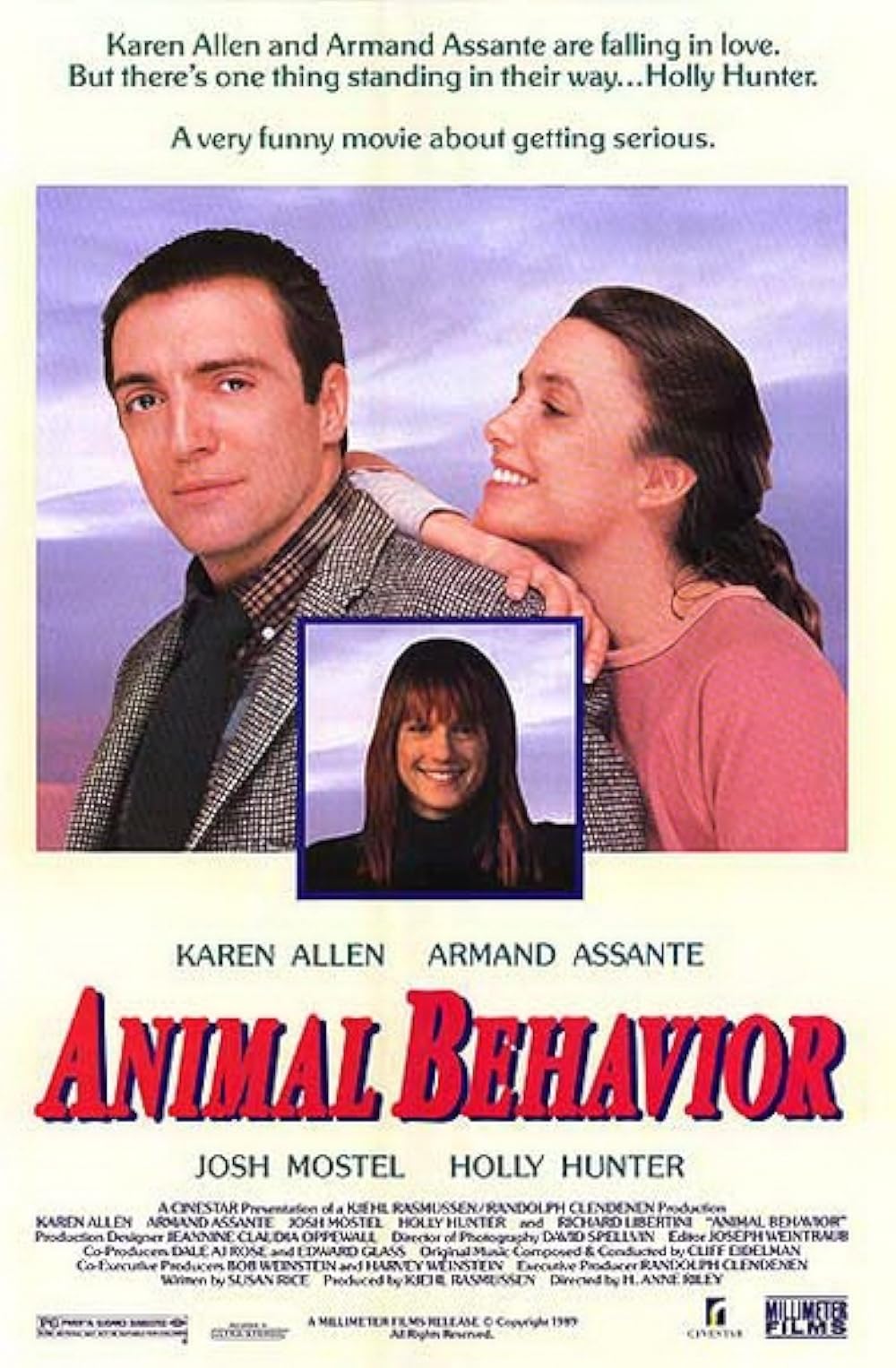
Alex (Karen Allen) is a biologist employed at a university where she is researching on finding new ways to communicate with chimpanzees including the use of sign language but finding it challenging in getting any funding. Mark (Armand Assante) works at the same school as an orchestra instructor. He meets Alex by chance and while their first encounter is awkward, he immediately takes an interest in her and tries to pursue a relationship. Alex is so involved in her work that she doesn’t pick-up on Mark’s advances initially and then when she does, she comes under the mistaken impression that he’s married which causes her to avoid him and making Mark believe that she doesn’t like him when deep down she really does.

The film, which has never been released on either DVD or streaming and can only be obtained from a very rare VHS print, is more known for its behind-the-scenes troubles than anything that goes on in front of the camera. The main issue was the squabbling, or ‘creative differences’ between director Jenny Brown and the producer Kjehl Rasmussen causing her to leave the project, which began filming in 1984. The production then ran out of money forcing it to be shelved for many years in an unfinished state before Rasmussen was able to receive enough funding to complete it with him as the director. However, out of its initial $3.5 million budget it was only able, after its limited release, to recoup a paltry $41, 526 at the box office making it a huge financial loss. It also came-out 4 years after one of its stars, Alexa Kenin who plays a not very talented cello student, died mysteriously at the young age of 23 for causes that are still unknown to this day.

Despite all of its production problems I came away finding it not too bad and enjoyed the orchestral score and the giant animated musical notes that appear during the opening credits as well as the vast New Mexico landscape. Assante is an interesting casting choice as he plays the romantic lead not in a lovesick way but approaches it instead in more as a matter-of-fact type, which you’d expect a person working in Academia might do. I did though find his ability to handle chimps as relaxed and comfortable was a bit of a missed opportunity as having him afraid of them, which is what I think most people would be like, would’ve given their young relationship more of a challenge to work through and thus more intrigue to the story.

His inability to every criticize Sheila, played by Kenin, who is a very poor cello player, made him in-turn come-off as a failure of a teacher. Granted the film wanted the viewer to like the Assante character and if his criticism of her playing was too harsh it might make them turn-on him, but the guy is her teacher and not her friend. A friend is someone that doesn’t want to hurt the other person’s feelings, but a teacher is paid to get to the source of the problem. If he is just going to allow this student to leave in a delusion that she’s a competent then when is she ever going to get better, or be motivated to improve? A good teacher is obligated to call a student’s attention to their shortcomings and by avoiding doing this he comes-off as weak and ineffective.

While Allen’s performance is also good, I had some problems with why Assante would want to get into a relationship with her. It’s clear from the get-go that she’s so into her chimps that she’s out of touch with everything else around her. Why pursue someone romantically who’s always going to put her monkeys first and make him have to constantly compete with them for her attention?

A far better love interest would’ve been Coral that gets played by Holly Hunter who is an absolute scene-stealer and gives the movie some much needed spunk. This was before she won the Academy Award, so her role is limited, but she still makes the most of it playing a single mother with an autistic child, played by Crystal Buda. She is a neighbor to Assante and the two get into a quasi-style relationship though they don’t have any sex, but I didn’t know why she didn’t want to pursue further past the friendship level as they seemed quite compatible and it would’ve allowed in more drama forcing both her and Allen to compete for the same man, which could’ve lead to some juicy confrontations.

Josh Mostel, as Assante’s friend, is fun, not so much for anything he says, but more for his big white-guy afro. The climactic sequence, which takes place in a large scale maze made out of hay bails is diverting simply because it’s never been used before, or since. However, the characterizations of the University faculty, who are portrayed as being stiff, uptight, while also a bit ‘wacky’ is too broad to be either amusing or insightful.

My Rating: 4 out of 10

Released: October 27, 1989

Runtime: 1 Hour 28 Minutes

Rated PG

Director: Jenny Brown

Studio: CineStar Productions

Available: VHS, DVD-R (dvdlady.com)

Interiors (1978)

interiors

By Richard Winters

My Rating: 8 out of 10

4-Word Review: Artistic family harbors turmoil.

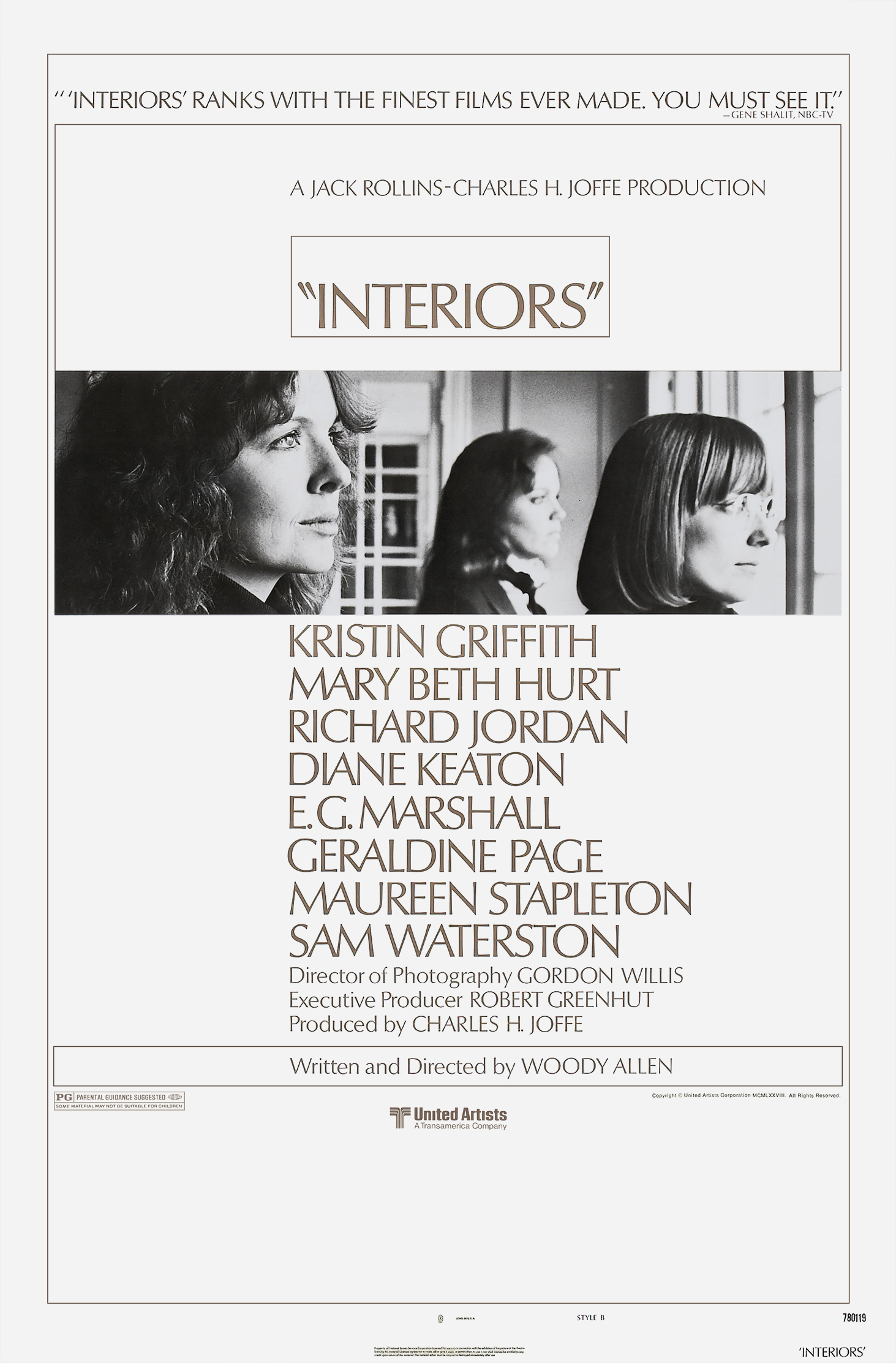
Eve (Geraldine Page) is an interior decorator whose emotions she keeps bottled-up and who also has a controlling and temperamental nature to not only her husband Arthur (E.G. Marshall), but also her three grown daughters: Renata (Diana Keaton), Flyn (Kristin Griffin), and Joey (Mary Beth Hurt). One morning, while at the breakfast table, Arthur announces to not only Eve, but also the two other daughters present, that he wants a separation though he insists it’s not ‘irrevocable’. Eve becomes upset and refuses to face it. While the two do separate she continues to cling to the delusion that they’ll ultimately reunite. When it finally becomes painfully clear that is not going to happen she then attempts suicide. While she’s in the hospital recovering Arthur goes out and meets Pearl (Maureen Stapleton) whom he quickly falls in love with. When he brings her home to meet the family they’re shocked at how he intends to marry her while his former wife is still in the hospital. This then brings out the hidden hostilities that the daughter’s feel towards their parents as well as each other and in Renata’s case the repressed envy that her own husband Frederick (Richard Jordan) feels for her.

This was Woody Allen’s first dramatic film, which was a big deal when it was first released as he’d only done wacky comedies before this and many were curious and apprehensive about him trying something so completely different from his past work. While he’d been trying to get a drama produced for years his investors constantly nixed the idea fearing that because he attracted audiences through his funny stuff that anything with a serious nature would turn-off would-be theatergoers and be a financial flop, but after the monumental success of Annie Hall they finally decidedly to relent and gave Woody the chance to spread his artistic wings.

The result overall is downright impressive. It’s clearly inspired by the films of Ingmar Bergman, his cinematic idol, but in some ways this is even moodier and more poignant than some of his stuff. While his later dramas fell into becoming a cliche of themselves using many of the same elements taken from this one, namely pretentious artistic characters living in New York who suffer from pretentious problems and relationships, here it’s fresh making the issues that they go through seem illuminating versus rehearsed and contrived like in some of his later works.

That’s not to say I didn’t find some problems here. The fact that we have characters, in this case Keaton, talking directly to the screen, apparently in an attempt to show that she’s speaking with a therapist, is a bit of a cop-put as she’s able to convey her deep seated thoughts and feelings verbally without forcing the director to have to show it through her actions and conversations, which may be more difficult to do, but also more rewarding for the viewer. Arthur’s decision to tell Eve that he wanted to leave while sitting a the meal table with the two daughters present seemed rehearsed. Normally when a couple decides to split they do it privately and have it out through a discussion or argument versus a canned speech that Arthur does, which comes-off like he’s orating in front of a group of people.

Woody’s attempts though to show the struggles and challenges people have who pursue creative endeavors I felt were quite well done. In his later dramas I found it annoying how many characters worked as artists because it reality only a very small portion of the populace can make a living that way, but here I was able to forgive it. I liked how we see close-up the challenges of this by the way Renata writes a poem on paper but is constantly scratching out words that she puts down showing the many drafts an author must go through before it eventually might come-out perfectly. The fact that it’s later revealed that her father helps fund her poetic passions made sense too as a poet able to live-off of their writings is about as rare as it gets.

Richard Jordan’s character is the one I found the most fascinating and I was genuinely surprised that while other cast members were nominated for the Oscar he wasn’t even though to me he’s superb.  The way his character broods incessantly about not getting the critical accolades that he expects and how it turns him into a mopping, alcohol drinking mess who snips at his wife’s perceived shortcomings in an immaturely emotional attempt to bring her down to his level was completely on-target composite of the insecure artist. The scene where he tries to rape Flyn, so he can have the pleasure to ‘fuck someone who’s inferior to me’ fit the personality of someone who harbors frustration that they’re able to mask with a veil of civility most of the time but will allow it to come-out when alone in the presence of someone more vulnerable.

The real star though is the cinematography by Gordon Wills, who ironically went on to make his directorial debut in a movie called Windowswhich was the original title for this one. The gray, cold color schemes and shots showing an ice-covered tree branch effectively reflects the icy emotions of the family and the lack of music with long pauses of silence and empty rooms help symbolize how alienated each member is from the other. The most pronounced moment involving the crashing waves of the ocean and the almost dream-like ‘conversation’ that Joey has with her mother is by far the film’s most memorable element and something that will stay with you long after it’s over.

My Rating: 8 out of 10

Released: August 2, 1978

Runtime: 1 Hour 32 Minutes

Rated R

Director: Woody Allen

Studio: United Artists

Available: DVD, Blu-ray, Freevee, Pluto, Amazon Video, YouTube

Uphill All the Way (1986)

uphill

By Richard Winters

My Rating: 2 out of 10

4-Word Review: Bumbling cowboy con-men.

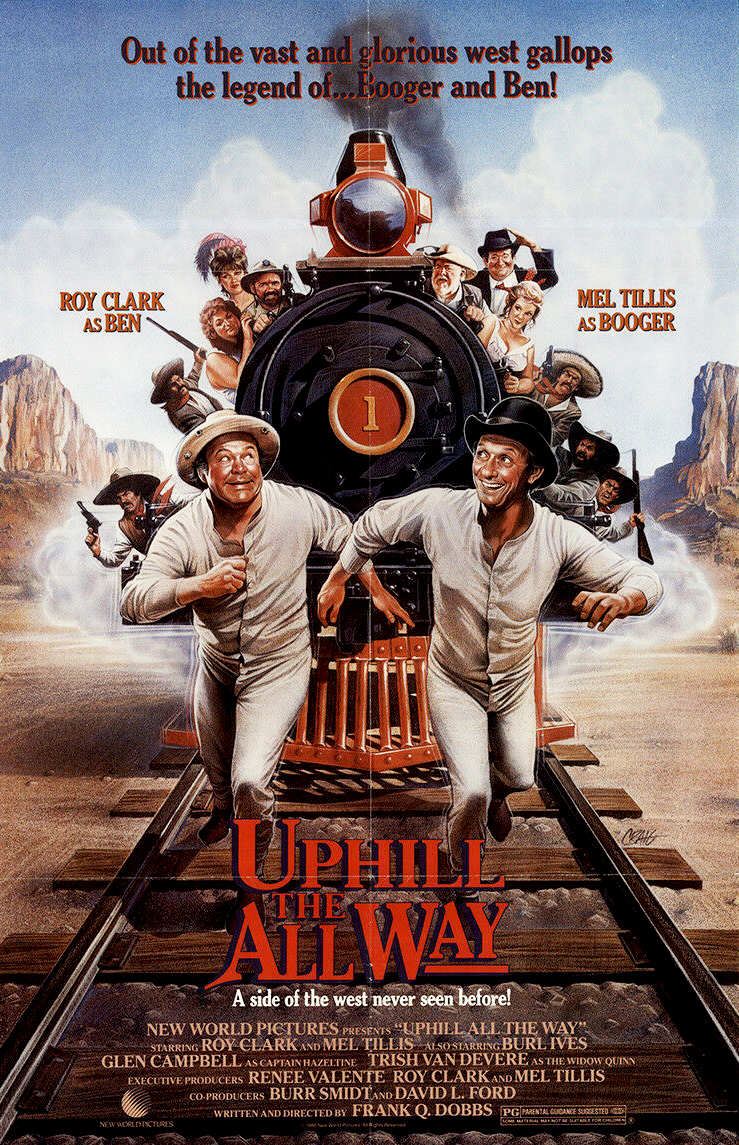
Ben (Roy Clark) and Booger (Mel Tillis) are two con-men living in the old west, who don’t have a dime between them. After getting kicked-off a train for not having tickets they then venture to a saloon in order to win some money at poker, but even though they attempt to cheat, they still end up losing. In desperation they try to trade in their rifle for a loan, but the bank teller (Richard Paul) mistakenly thinks they’re trying to hold him up and sounds the alarm. The two then go on the run while being chased by a posse of sorts that includes the sheriff (Burl Ives) two prostitutes (Elaine Joyce, Jacque Lynn Colton) and the town drunk (Frank Gorshin).

The film is a misguided effort to replicate the campy, rural humor of the TV-show ‘Hee-Haw’, which Roy Clark hosted for almost 17years and which Mel Tillis made several guest appearances, and try to turn it into something resembling a movie. While the show never met any critical acclaim it still managed to succeed because all the humor, much of it being ribald and corny, was set-up into brief segments that only lasted for a few minutes if even that long and relied almost exclusively on one-liners. As soon as the punchline was uttered it would quickly move to another segment much like the variety show ‘Laugh-In’ was styled. However, trying to expand that format and silly comedy into a feature length film is virtually unworkable. Instead of a plot we get a collection of goofy situations coupled with goofy characters saying and doing cartoonish things that gets strung along with a mind numbing 90-minutes before it finally, mercifully manages to end much like putting a sick horse out of its misery.

Had the chemistry between the two stars been better it might’ve had some chance, but Tilis and Clark, both better known as country singers of which they’re very good at, don’t have what it takes to carry a movie. I was thankful at least that Tillis didn’t rely on his old stuttering routine for cheap laughs and here for the most part he articulates quite well, but he fails to have much to say that is amusing. Clark with his tubby physique coupled with his high-pitched voice seems all wrong for different reasons and his attempts at being exacerbated comes-off as affected. The banter between the two is stale and with both being in their 50’s they lack the fresh boyish charm that they might’ve otherwise been able to exude had they done this when they were in their 20’s.

The supporting cast falls equally flat. Burl Ives looks old and tired here and like he’s just phoning-it-in. Gorshin, a great and versatile talent if given the right material, is completely wasted as a drunk who does and says very little. Trish Van Devere, who during the early 70’s was considered a leading lady, reveals how sadly her career had fallen, she officially retired after doing just one more movie after this one and I think it was because she was no longer getting any quality offers, doesn’t appear until 55-minutes in and almost becomes like a background character with not much to do. Burt Reynolds does appear briefly near the beginning, he apparently accepted no fee for his work here, but is quite amusing and had he been in more scenes might’ve saved it. Elaine Joyce stands-out too as she usually played bubble-headed blondes, but here is a bitchy, angry type and does surprisingly well with it though if she’s going to be the best thing about a movie then you know it must be in real trouble.

The story is disjointed too as it starts out as a playful chase comedy then strangely diverts into an extended shoot-out where the two become hold-up in a home with another family trying to fend-off a group of bad guys that are separate from the ones chasing after them making it seem like two different, poorly realized plots meshed into one. I will give it some credit for being a movie with a Texas setting that was actually filmed in Texas unlike some other movies that say the setting is Texas when it really isn’t. You can tell that it is the Lone Star state because of the prickly pear cactus that is seen all about, which is different from the upright variety that’s seen in the deserts of Arizona and California. Though on the negative end it was shot in the month of October when the searing heat of the region was over and any good Texas movie should have the heat play a factor since that’s very much a strong characteristic of the state.

My Rating: 2 out of 10

Released: January 21, 1986

Runtime: 1 Hour 26 Minutes

Rated PG

Director: Frank Q. Dobbs

Studio: New World Pictures

Available: DVD, Blu-ray, Amazon Video, YouTube