
By Richard Winters
My Rating: 7 out of 10
4-Word Review: School teacher sleeps around.
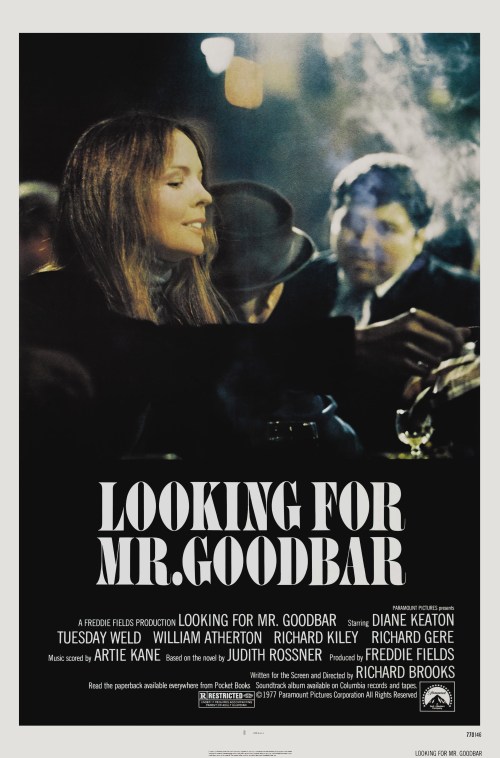
Theresa (Diane Keaton) is a young school teacher trying to get over the break-up with Martin (Alan Feinstein) a married college professor of whom she’d been in a relationship with for several years. Tired of living with her parents (Priscilla Pointer, Richard Kiley) and her domineering father she decides to get a studio apartment near the club scene. She picks-up Tony (Richard Gere) at a bar one night and takes him home. His volatile, drug induced behavior scares her at first, but eventually she enjoys his unpredictable ways. When he disappears for long periods she begins bringing more strangers home finding the one-night-stands to be a liberating change from her repressive catholic upbringing, but the more she partakes in this edgy lifestyle the more danger she puts herself in.
The film is based on the Judith Rossner novel of the same name, which itself is based on the true story of Roseann Quinn. Quinn was a school teacher living in New York City who had a propensity of bringing home men she’d meet from a bar that was across the street from her studio apartment. On the evening of January 1st, 1973 she invited John Wayne Wilson, a man she met at the bar, back to her place for intended sex, but instead it resulted in murder when he was unable to achieve an erection and he felt she was making fun of him.
Rossner read about the incident in a newspaper and became intrigued with the case and intended to write about it for an upcoming article in Esquire magazine, but the editor feared legal action since it was based on an actual case and reneged on the assignment, so Rossner turned it into a novel using fictional names for the real-life people. It got published in 1975 to rave reviews and instantly became a best seller, which caught the attention of writer/director Richard Brooks who had turned other true crime stories into hits such as In Cold Blood and felt he could do the same with this. In fact the film did quite well as it raked in $22.5 million and was the top movie in the country on its opening weekend.
While Rossner openly detested the film version I felt it does a great job of exposing the bleak, lonely existence of the 70’s single’s scene and how sexual liberation can end up being just as much of a trap, if not more, as monogamy. The dim, dark lighting, particularly inside Theresa’s apartment brings out the grim existence, and twisted personalities, of its characters nicely. The viewer feels as caught up in the depressing, aimless world as the protagonist and its the vividness of the 70’s young adult, city culture that makes this an excellent film to see simply to understand the motivations of the people who lived it. While on paper reading about someone that was a school teacher for deaf students during the day turning into a reckless, sexually promiscuous lady by night may seem shocking and hard to fathom, the film seamlessly fills-in-the-blanks to the extent that you fully grasp, from her stifling family and religious upbringing as well as her painful break-up and insecure body image, to what drove her to it and thus cultivates a very revealing character study.
Keaton, Kiley and Tuesday Weld, who plays Theresa’s older sister who experiments with the wild lifestyle herself, are all stand-outs, but the film also has some great performances from actors who at the time were unknowns. Gere is especially good, quite possibly one of the best acting jobs of his career, as the creepy, but still strangely endearing Tony. LeVar Burton has very few lines, but still makes an impression with his pouty facial expressions as the older brother to one of Theresa’s deaf students. Tom Berenger though turns out to being the ultimate scene stealer as the psychotic who’s so on edge with his personal demons that he lashes violently out over the smallest of provocations.
Spoiler Alert!
While the film is known mainly for its notorious ending, which still packs a bit of a punch, its effect is muted by director Brooks unwisely telegraphing it ahead of time. Virtually the whole movie is done from Theresa’s point-of-view and yet at the very end it cheats it by having a scene between Gary and his gay lover giving the viewer an unnecessary warning about his mental state, which wasn’t needed. For one thing in the real-life incident the assailant was a married man and not gay, so adding in the gay subtext and using it to explain his psychosis could be considered homophobic and armchair psychology. It also hurts the shock value as the audience knows what’s coming versus having them as surprised as Theresa when he suddenly lashes out unexpectedly, which would’ve made for a more emotionally impactful, gripping finish.
My Rating: 7 out of 10
Released: October 19, 1977
Runtime: 2 Hours 16 Minutes
Rated R
Director: Richard Brooks
Studio: Paramount
Available: DVD
 Scopophilia