Monthly Archives: June 2023

Surrender (1987)

surrender

By Richard Winters

My Rating: 1 out of 10

4-Word Review: Pretending to be poor.

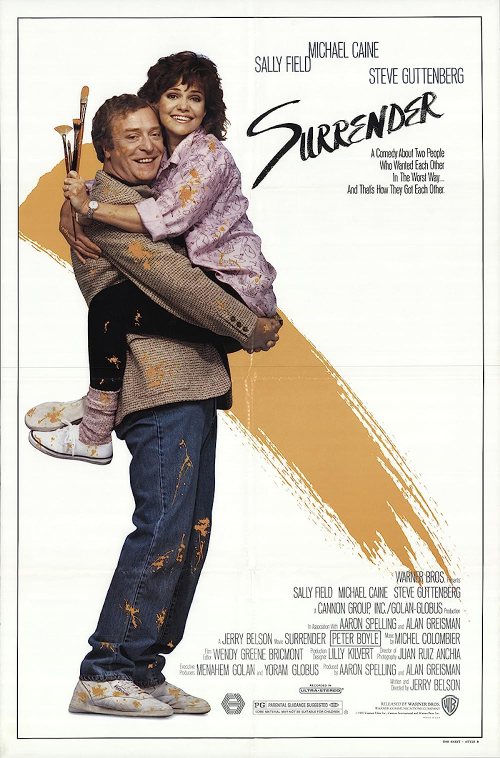
Sean Stein (Michael Caine) is a successful novelist, who after suffering through two contentious divorces, has decided that women are only after him for his money and considers them off-limits. Daisy (Sally Field) is a struggling artist, who is in a relationship with Marty (Steve Guttenberg), a successful attorney with no interest in making a long term commitment. While attending a charity ball that gets overrun by gunmen who rob the place, Sean and Daisy, find themselves tied-up together and despite the stressfulness of the situation slowly get to know each other. The next day, after they ultimately get freed, Sean asks Daisy for a date, but decides to pretend that he’s poor to make sure she loves him for who he is rather than because of his money.

While Jerry Belson wrote several successful comedies during the 70’s and based this story loosely on his own life experiences where he proudly stated that everything that happened to Sean in this movie happened to him in real-life, the pacing and basic comedy scenarios really don’t work. It starts out alright  as they’re several flashbacks showing Sean with his attorney, played by Peter Boyle, battling his ex-wives in court. The different hairstyles that they have as they go through the years is funny and the most creative thing in the movie. I was though disappointed that the two women who play the ex-wives, Louise Lasser and Iman, are never give a single word of dialogue, which wastes the talents of these well-known actresses.

After the first ten minutes though things quickly fall apart. Having armed thieves crash the party that the two are at is particularly troubling as there is no forewarning for why this is happening. People who attending posh parties usually don’t find themselves at gunpoint, so why are they here? Had there been even a fleeting mention of a group of criminals crashing area get togethers then maybe, but here we get no explanation either before, or after giving the plot a haphazard quality like the filmmakers are happy to throw in any crap they want whether it makes sense, or not. The characters respond to what most would consider to be a traumatic experience like it’s just a ‘run-of-the-mill thing’ and by the next day barely remember it, even though many people would have genuine PTSD after it was over.

Caine’s attempts to woo Sally would in most cases have the woman thinking he was a potential stalker. First he comes to her house six hours before their date saying that he couldn’t wait that long to see her and wanted to spend every waking minute with her that he could, which for any sane woman would be a serious red flag. He then kisses her without her consent and begs for immediate sex, or he might not be able to control himself and instead of calling 9-1-1 she gives him a pity fuck. Not only is this unfunny and stupid, but an insult to the viewer’s intelligence that they would find any of this to be a normal, well-adjusted way to start a healthy relationship.

I also thought Caine, who was a raving misogynist who even had signs on the front gate of his home banning women from entering, came around to liking Sally too quickly. Sure she was kind to him when they were tied-up, but an avowed women-hater doesn’t just change his ways overnight, but in this movie that’s exactly what happens, which isn’t realistic. If anything it should’ve been Sally chasing after Caine, who might’ve liked her a little at first, but so set in his ways would still decide to avoid her and only after an extended period of time, and continual prodding by Sally, would he eventually relent.

The pretending to be poor thing isn’t handled well either. I was expecting there to be a lot of comic moments dealing with Caine trying to desperately hide his wealth and background, but that never gets played out. He isn’t even forced to rent himself a seedy, little apartment in order to hide the fact that he lives in a mansion as Sally was apparently never curious about seeing his place, but how many serious relationships are there where they always go to one partner’s home and never the other?

The third act gets even more ridiculous as it has Caine insisting that Field needs to sign a prenup agreement. She’s resistant at first, and even insulted, but then eventually signs it without ever bothering to read it, which is idiotic. She also goes to Vegas and wins 2 million dollars at the slot machine her very first time playing it, which is beating insurmountable odds.

I did like the scene where Caine hands Sally a manuscript he has written, which was published into a book though he doesn’t tell her this and then becomes insecure when she doesn’t immediately like it, which being a budding screenwriter myself, I found funny and despite all the other absurdity in the film, a bit true to life. I was hoping the movie would explore this situation more, but it doesn’t making the rest of it a sore disappointment.

I was surprised why either of these big name stars agreed to do it. I know Caine was willing to be in almost anything for the money, but I’m not sure what Sally’s excuse was and if you ask me I’d find the old reruns of her TV-show ‘The Flying Nun’ to be more entertaining. It’s easy to see why this dumb thing, despite the star quality, has never gotten a DVD or Blu-ray release and nobody’s been clamoring for it either. It bombed badly at the box office too managing to recoup only $5 million of it’s $15 million budget.

My Rating: 1 out of 10

Released: October 9, 1987

Runtime: 1 Hour 34 Minutes

Rated PG

Director: Jerry Belson

Studio: Warner Brothers

Available: VHS, Tubi
Think Big (1989)

thinkbig1

By Richard Winters

My Rating: 1 out of 10

4-Word Review: Truckers with big muscles.

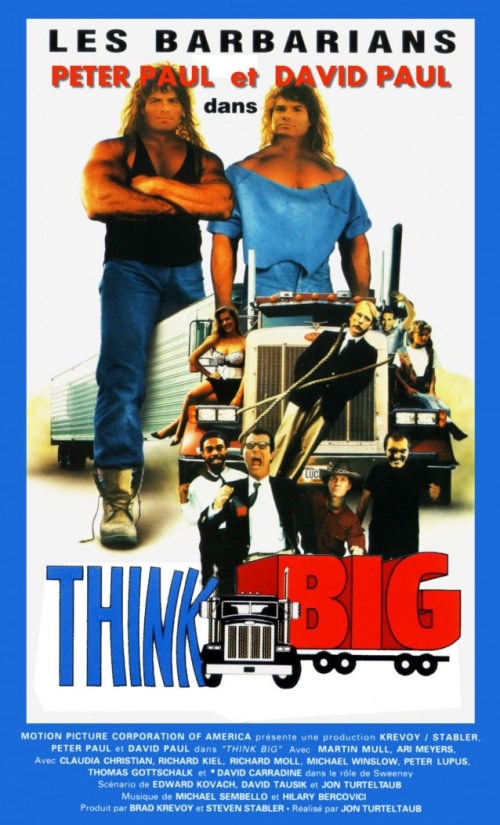
Rafe and Victor (Peter Paul, David Paul) are brothers who make a living driving a truck though they’re always missing the freight deadline to the constant consternation of their boss (Richard Moll). He gives them the ultimatum: either get this new delivery to its intended destination within 30 hours, or find a new job. Holly (Ari Meyers) is a teen genius who has invented a mechanism that can electronically deactivate any code allowing one to start, or stop any other device without having a key, or password to do it. When she finds out that the company she’s been working at, or more honestly enslaved at, wants to use her invention for unscrupulous means she escapes with her device in hand and then hides inside the brothers’ truck. Initially the brothers want to throw her out as they consider her presence a sign of bad luck, but eventually they help her out in her quest to avoid the bad guys.

The Pauls, who were bodybuilders before they got into acting, made their film debut in D.C. Cab, as The Barbarian Brothers, which lead to guest starring roles in TV-Shows like ‘Knight Rider’ that eventually got them starring in their own movie The Barbarians, that did well enough at the box office that producers gave them this comedic vehicle though it proved to be a disaster. Most of the problems lie with the silly script that’s filled with pseudo science, dated technology, and campy humor, which will amount to one long, continuous eye roll from the viewer.

The brothers are poor actors with their scenes in Natural Born Killers getting deleted because of what director Oliver Stone felt was shameless overacting, and their dialogue here doesn’t help. It’s one thing to be bit dimwitted, but these guys are infantile and their chicken bone chant that they do is highly redundant and annoying. For big guys they’re quite wimpy as they allow their boss to grab them by the neck and during fights they get punched by men who are far smaller and immediately fall down backwards by the power of the blow though you’d think in reality the person doing the punching would get their hand injured and they’d run-off hollering while these two big buys would remain standing. Their profession isn’t interesting either and puts to waste their big muscles. Instead of driving a big rig they should be working as club bouncers, or security for celebrities, or even just owning a workout gym.

The plot is also cluttered with villains. Martin Mull plays the head of the evil agency and while he does get a few funny ad-libs I didn’t feel his part was necessary. David Carradine, who plays this cantankerous repo man that tries to take back the brothers’ truck, gets wasted too. Initially I was surprised why a star with his stature would even appear in this though I did find him amusing and the caricature he creates to be colorful, but the stupidity of the script overshadows him and since he’s only seen sporadically his acting efforts get lost.

Richard Kiel was the one bad guy that I did like.  In his past roles he’s played the one who’s strong, but not bright, but in this film he’s the exasperated leader that gets irritated by the dummies around him. For this reason I thought he should’ve been the main heavy and Mull’s presence cut out completely. It’s also interesting seeing him take-on the Paul brothers as usually his physical presence dominates everyone else, but here it’s a much more of an even fight. I did though find it frustrating that we see him struggling to get out from underneath a car and the film then cuts away, only to see his character appear later, uninjured, with no explanation for how he got out of his predicament.

While Ari Meyers’, who’s best known for her work on the ‘Kate & Allie’ TV-show, acting isn’t the best she’s still easy-on-the-eyes and therefore should’ve been made the lead while the brothers could’ve been cast in support as these bumbling truckers she’d meet along the way, where their presence could be used as comic relief, but having the whole thing centered around them kills the movie right from the start. Throwing-in a sappy ‘life lesson’ speech at the end just makes it even worse and a genuine insult to the intelligence of anyone who sits through it.

My Rating: 1 out of 10

Released: October 23, 1989

Runtime: 1 Hour 26 Minutes

Rated PG-13

Director: Jon Turteltaub

Studio: Motion Picture Corporation of America

Available: VHS, DVD-R (dvdlady.com)

Hot Resort (1985)

hot

By Richard Winters

My Rating: 2 out of 10

4-Word Review: Looking for some action.

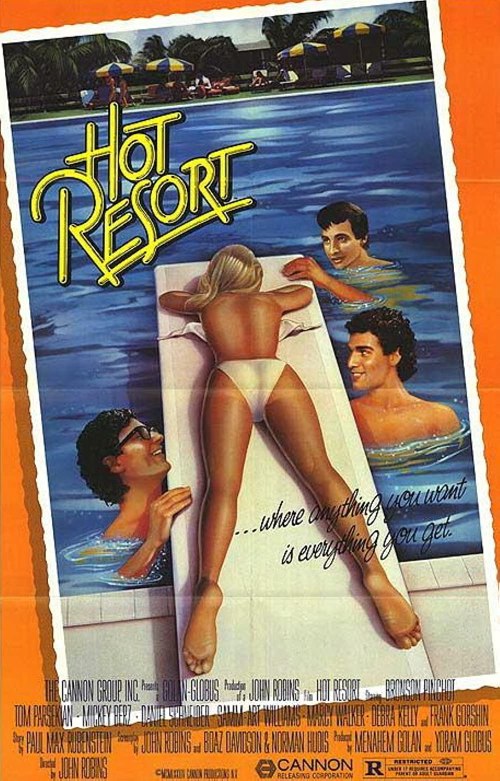
Filmed on the island of St. Kitts in the West Indies the story, or what little there is of it, follows around a group o college men lead by Brad (Bronson Pinchot) and Chuck (Dan Schneider) who travel there in order to work at the resort and earn some money over the summer. They hope also to hit-on the bikini-clad babes in-between shifts and seem to have sex much more on their minds than work. The resort manager (David Lipman) hires disciplinarian Bill Martin (Samm-Art Williams) to get them under control, but even he has a hard time keeping them in-line. The boys also clash with a group of snotty ivy leaguers, who are on the island to film a soup commercial. After having several run-ins with them the boys challenge the Ivy guys to a rowboat race and become determined to beat them even if it means cheating.

This yet another low budget production produced by The Cannon Group, which was run by Yoram Globus and his cousin Menaham Golan. They made a business of buying bottom barrel scripts and turning them into low budget productions and while some of them where a delightful surprise and even rivaled a standard Hollywood production this was certainly not one of them. The script was co-written by Boaz Davidson, who had earlier success with the Israeli teen comedy Lemon Popsicle, which was later Americanized into The Last American Virgin that was also written and directed by him, but this one has none of the comic spark of those and seems compelled to reach to the lowest common denominator possible almost challenging the viewer to see how much inane, low brow humor they’re willing to sit through before turning it off.

Granted 80’s teen sex comedies where never meant to be masterpieces, but this thing, even when compared to those others, is incredibly uninspired and adds nothing new to the otherwise tired mix. The only two things that are a bit different from the norms of that genre is that the fat guy, played by Schneider, who later went on to star in the TV-show ‘Head of the Class’, isn’t shown constantly stuffing his face with food, or the butt of all the jokes. In fact he’s portrayed as being just as hip as the others and getting more action than the rest of them.

The film also switches things around in that it isn’t the men that are on the aggressive make, but instead the women, who literally grab the guys as they’re walking and minding their own business and then bring them into a room for hot action. At one point they even swipe an elderly man off the sidewalk though it’s hard to believe that any woman could be that oversexed. It might’ve made the story more funny and at least given it a certain logic by having the females take some sort of drug that causes them to become sexual animals, but that’s not the explanation here, which just makes the shenanigans all the more insane.

I started to wonder too if these gals were on the pill because if not they risked getting pregnant, which would force them to either get a lot of abortions, or raising kids they really didn’t want all by themselves since they didn’t even bother to get the names of the guys they had fucked, and seemed to choose them at random. Also, if you really think about it, it comes-off like rape as the men constantly say no and resist making it more like we’re witnessing a crime than just a carefree sex.

The guys who play Ivy Leaguers speak in such an overblown accent that it’s not even mildly amusing, but genuinely irritating and there’s simply no way that anyone who talked like that, no matter how deluded they were, would think they were cool and not worried that people would be making fun of them behind their backs. I will give some props though to the scene where the emergency medical personal must come to the aid of a couple who get stuck inside a car that they were making love in forcing the fire department to saw off the roof of the vehicle to get them out though anyone who would even think of trying to have sex in the back seat of a tiny VW bug should have their heads examined.

Some of the supporting players are amusing particularly Stephen Stucker, who plays the same type of character that he did in Airplane! where he’d jump into a scene say something quirky and then quickly jump back out. I also enjoyed Frank Gorshin (billed as Mr. Frank Gorshin) a talented impressionist who rose to fame playing the Riddler on the ‘Batman’ TV-show. Here he plays a dirty minded middle-aged man who tries to teach the youngsters the finer points of hitting-on chicks much to the consternation of his wife (Zora Rasmussen) who sits next to him and listens in as he talks about it. Mae Questal though, who’s best known for being the voice of Betty Boop and Olive Oyl gets sorely wasted particularly in the scene where she gets ‘tricked’ into putting on a dress with a giant bullseye on the back, which her husband plans to use as a target to aim his gun at, though it’s hard to imagine any woman wouldn’t have seen this before she put it on, which just shows how stupid and poorly thought out the gags are.

Even on the level of cheap, soft core porn it’s no good. The nudity is infrequent and fleeting and the women aren’t exactly cover girls looking more like they’re around 30 and a bit ‘rough-around-the-edges’, so if you’re looking to grab this thing simply for some healthy voyeurism you’ll still end up sorely disappointed anyways.

My Rating: 2 out of 10

Released: January 14, 1985

Runtime: 1 Hour 33 Minutes

Rated R

Director: John Robins

Studio: The Cannon Group

Available: VHS, DVD-R (dvdlady.com)

Phobia (1980)

phobia1

By Richard Winters

My Rating: 3 out of 10

4-Word Review: His patients are dying.

Dr. Peter Ross (Paul Michael Glaser) is a Canadian psychiatrist who has come up with a radical new therapy to help cure those who suffer from phobias. The program includes having them watch their fears played out visually on the big screen and thus forcing them to conquer those irrational thoughts and be able to go on living normal lives. Peter feels he’s making great progress with his patients only to suddenly have them start to die-off one-by-one with each perishing in ways that reflects their private phobia that they had hoped to overcome.

This is definitely one of those movies where what happened behind-the-scenes had to be far more interesting than anything that occurred in front of the camera. Having John Huston, the legendary director who helmed such classics as The Maltese Falcon and Key Largo doing this one, which is nothing more than a cheap thriller with 80’s slasher instincts, has to be the most baffling thing about it. It wasn’t like his career was on the outs either as he went on to direct several more critically acclaimed flicks in the 80’s that were well financed with big name stars and he had just 5 years earlier did the well received The Man Who Would Be King, so why he decided to take a weird foray into doing this inept thing, which just by reading the script you could tell was a mess upfront, I don’t know.

It starts out with some visual panache, but otherwise could’ve easily been directed by a no-name, two-bit director and no one would’ve known the difference. The one segment dealing with a car chase down the city streets that culminates with a man falling from a tall building had some potential though I would’ve framed the shot differently showing it from a bird’s-eye view where the viewer could see how far off the ground the victim really was versus having the camera on the ground looking up, which is less dramatic. I suppose it might’ve given away the safety net that’s clearly present as you never see him hit the ground, it cuts away while he’s still in mid-air, but in either case it’s the only mildly diverting moment of the whole film.

Everything else is run-of-the-mill including the numerous deaths, which despite the tagline don’t all have to do with their phobias either. For instance one woman fears being in big crowds, so in order to ‘cure’ her, the doctor has her go onto a crowded subway, but she panics and runs back to his place where she ultimately dies when a bomb explodes. The segment dealing with a woman who fears men gets pretty ridiculous as he has her watch a movie of a woman getting gang raped, which would appall anyone and yet when she runs out of the room in disgust and shock he’s confused. The very fact that he talks about ‘curing’ his patients is a major red flag altogether as in psychiatry you never really ‘cure’ anybody, which just shows how poorly researched and shallow the script really is.

Paul Michael Glaser, better known for his work in the TV-show ‘Starsky and Hutch’, makes for a wretched leading man and it’s no surprise that he decided to get into directing after this one and has never starred in a theatrical film since. It’s not completely his fault as his character exudes a cold demeanor, so you never really care about him, or his quandary. John Colicos, as the police detective, is far superior and helps enliven the film with the few scenes that he is in though his interrogation techniques are highly unethical and the fact that he only focuses on one angle as to who the culprit is makes his character come-off as unintentionally inept.

The film does feature a twist at the end as to who the killer really is, but it’s dumb and not worth sitting through. In fact the ultimate reveal is so bad that it ruins everything else that came before it, as it had been watchable up until that point, but the climax solidifies it as a bomb.

My Rating: 3 out of 10

Released: September 26, 1980

Runtime: 1 Hour 30 Minutes

Rated R

Director: John Huston

Studio: Paramount Pictures

Available: Blu-ray

Buster and Billie (1974)

buster2

By Richard Winters

My Rating: 5 out of 10

4-Word Review: Dating a loose woman.

Buster (Jan-Michael Vincent) is a high school senior living in rural Georgia during the late 1940’s. He’s been dating Margie (Pamela Sue Martin), but finds her to be stuck-up and her unwillingness to have sex makes him frustrated. He begins seeing Billie Jo (Joan Goodfellow), who has moved into town and due to having limited social skills puts-out for the other boys by allowing them to have sex with her, one after the other, in the woods late at night. Buster at first dates her simply for the action, but eventually the two get into a serious relationship and he breaks-up with Margie. They begin going out publicly letting the whole town know that they’re a couple, but the other boys become jealous as they can no longer have easy sex like they use to and thus plot a dark revenge.

The story is based loosely on an actual event that occurred in Florence, South Carolina in 1948 that the film’s screenwriter Ron Turbeville remembered hearing about growing up. The recreation of the era though lacks style and this may be in large part due the film’s limited budget. While it gets a zero in  atmosphere I did at least like the way it doesn’t sugar coat things for nostalgic purposes. The teens behave in the same ways they do now and thus it’s gritty on that level.

The acting is good surprisingly even from Jan-Michael who in his other films tended to have a cardboard presence, but here he gives the thing most of its energy. He even appears, shockingly, fully nude and in fact this was the first mainstream American movie to show a male naked from the front, of which Jan stated in later interviews he was quite proud to expose of his well-endowed ‘equipment’. Goodfellow is also seen nude and is quite attractive though I wish she had more to say. Robert Englund, in his film debut, is the most memorable playing an albino with brown hair and his pale complexion makes him look creepier, at least I felt, than he did as Freddy Kruegar.

I didn’t understand though why Buster would risk his social standing for this ostracized girl. I got that Margie was annoying, so breaking-up with her wasn’t a stretch, and Billie was essentially ‘easy-pickings’, but why go public with it? It made more sense that they would’ve seen each other on the sly, but not wanting to risk the social scrutiny of letting everyone know about it. This would’ve clearly lost Buster’s social status not only amongst his friends, but the town as a whole including his own parents, so why add on all that needless stress? Billie too was very shy, so becoming center stage and having all eyes on her would be something she most likely would’ve wanted to avoid, which makes the second act overly idealistic.

It’s also frustrating that Billie doesn’t say much. You want to get to know this person, but never really do. The only time she’s ever given any insight is when Buster explains to his parents why she had sex with all the other guys (in order to be liked), but this is something we should’ve heard coming-out of her lips instead of his. By having Buster do almost all the talking, even when they’re alone together, makes it seem like she’s mentally handicapped, which I don’t believe was the intent and yet ultimately that’s how it comes-off and thus making their romantic moments sterile and uninteresting.

Spoiler Alert!

The final sequence though is where it really falls apart as the boys inadvertently kill Billie when they gang rape her (during a rainstorm even though the sky is still clear and sunny). Buster then tracks them down at a pool hall where he single-handily beats them up and ultimately kills two of them, but the guys just allow themselves to be beaten without attempting to throw a punch, which is not only unrealistic, but boring. Having a big brawl, where each side fights equally would’ve been far more exciting. The twist in which Buster somehow gets released from jail the day after her funeral, so that he can decorate her gravesite with all the flowers that he’s stolen from everyone else in town is far-fetched and overly forces the sentiment.

My Rating: 5 out of 10

Released: August 21, 1974

Runtime: 1 Hour 40 Minutes

Rated R

Director: Daniel Petrie

Studio: Columbia Pictures

Available: Amazon Video

The End (1978)

end2

By Richard Winters

My Rating: 7 out of 10

4-Word Review: His days are numbered.

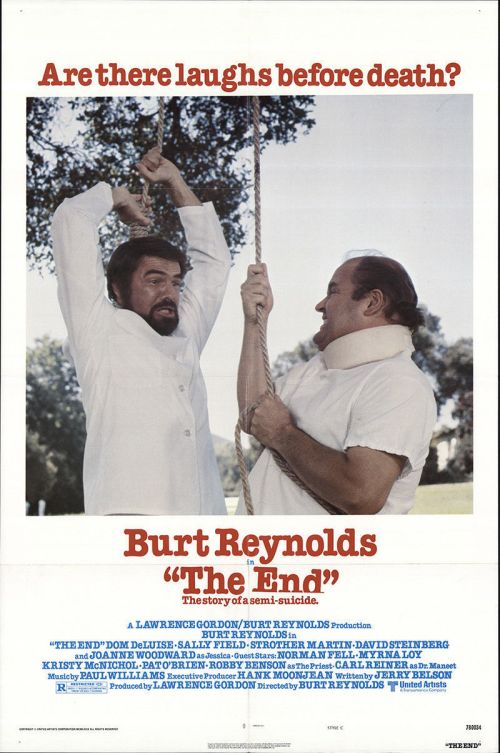
Sonny (Burt Reynolds) is a real estate broker known to make crooked deals. He gets diagnosed with an incurable disease and told he has only a limited time left. He says goodbye to his ex-wife (Joanne Woodward) who seems more interested in her new boyfriend, his daughter (Kristy McNichol) and his folks (Pat O’Brien, Myrna Loy) and even his live-in girlfriend (Sally Field) without actually telling them his condition. He then attempts suicide, but this gets him stuck in a mental hospital where he comes into contact with Marlon (Dom DeLuise) who agrees to help kill him, so Sonny can avoid going through the agony of the disease, but then after several aborted attempts Sonny decides he wants to live, or at least as long as he can, while Marlon continues to try and kill him and can’t seemingly be stopped.

The script was written by Jerry Belson, who also did the brilliant satire Smile and the original Fun With Dick and Jane, two of the funniest films to come out during the 70’s. This one is no exception, yet despite be written in 1971 and purchased by a studio, no one seemed to want to touch it. Many stars and producers felt the theme was too maudlin and wouldn’t be able to sell as a comedy. Reynolds though felt it was one of the funniest scripts he had read, and the character most closely identified to who he really was, and therefore jumped at the chance to direct and star in it though the studio was still reluctant and only agreed to finance it once he accepted starring in Hooper, which they felt was the sure money-maker though this one ended up doing quite well, surprising many, at the box office too.

Much of the credit goes to Reynolds who plays the part perfectly. Somehow he can create the slimiest of characters, and this one is a bit scummy with his admittedly shady real estate deals, and yet with his comic talent are still able to make him seem endearing. The studio had wanted the character’s profession to be a stock car racer, but this seemed too stereotypical, so I was happy that he kept it in the white collar realm and openly able to expose all of his personal flaws, which made him quite relatable. It’s also one of the rare times you get to see him with both a mustache and beard, or at least through the whole movie. The studio wanted to nix this too, but it helps give him a distinctive look.

Like with most actors turned director Burt allows for long takes, particularly during the first act, where the supporting cast is given ample time to play out their scenes without any interruption, which leads to many funny moments. I enjoyed Norman Fell as the doctor, and Robby Benson’s as a young priest who listens to Burt’s confession while he takes off his collar and puts it into his mouth, which creates a weird popping noise. These segments have an entertaining quality, but come-off more as vignettes and don’t help to propel the story along.

The second act, in which Burt ends up in the mental ward, are the best and his teaming with DeLuise is hilarious. I realize not all the critics enjoyed Dom’s take on a crazy man, Variety Magazine, labeled his performance as being ‘absolutely dreadful’, but there’s no denying the infectious chemistry he and Burt have, making the scene where he tries to drop Burt from a bell tower, or the segment where he tries to hang him up by a noose, quite memorable. The segment though where Burt goes swimming out into the ocean in an attempt to drown and then has a change of heart and tries getting back to shore and the voice-over prayer that he gives to the Almighty he order to help him back is laugh-out-loud and not only the top comedy moment in this movie, but quite possibly any movie ever.

Spoiler Alert!

The only problem I had was with the ending. In the original script the DeLuise character was supposed to kill Burt after he got out of the ocean, but Burt felt the movie needed some ‘hope’, so instead he has DeLuise attempting to chase Burt along the shoreline, in a sort of stop-action way that looks cartoonish. I felt there needed to be more of a resolution. If Reynolds does decide to live out the rest of his days what does he do with it? Does he try to mend his ways by paying back all those he had swindled? Or does he make amends with the people in his life including his ex and daughter? None of this gets answered, which is disappointing. A good movie needs a healthy character arch and this one doesn’t really have any. A better third act would’ve shown how the diagnosis had changed him and had the film not labored so much with the comical vignettes of the first half we might’ve gotten there and it’s just a shame that we never do.

My Rating: 7 out of 10

Released: May 10, 1978

Runtime: 1 Hour 41 Minutes

Rated R

Director: Burt Reynolds

Studio: United Artists

Available: DVD, Blu-ray, Amazon Video, YouTube

The Purple Rose of Cairo (1985)

purple1

By Richard Winters

My Rating: 7 out of 10

4-Word Review: Breaking the fourth wall.

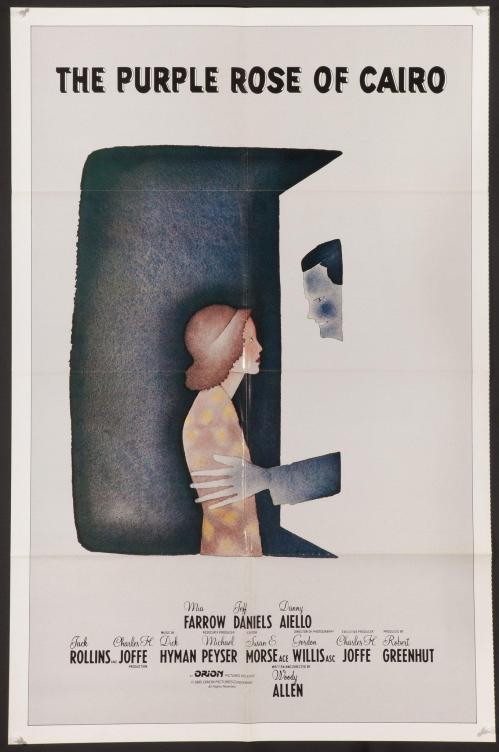
Cecilia (Mia Farrow) is a lonely woman living in 1935 who’s stuck in a dead-end job and an abusive marriage. As an escape she regularly goes to the movies and becomes especially entranced with one called ‘The Purple Rose of Cairo’ particularly the dashing young man character named Tom (Jeff Daniels). Tom notices Cecilia continuing to attend each showing and thus breaks out of the black-and-white movie he is in and into the real world just so he can speak with her as he feels he’s falling in love. Cecilia tours him around the small New Jersey town where she lives while the rest of the cast in the movie he’s left sit around and hope he’ll come back, so they can continue on with the story. The actor, Gil Shepherd (also played by Daniels), who played Tom in the movie hears about Tom jumping out of the screen and heads to New Jersey in order to coax him back, but Tom is having too much fun getting to know Cecilia and has no intention of returning to the phony life of the movie world. In the meantime Gil also meets up with Cecilia and the two begin to hit-it-off. Will Cecilia choose Gil over Tom and if so will this get Tom to go back into the movie once and for all?

This was the first of Woody Allen’s nostalgic picture that would replicate the time and place of when he grew up and in fact the theater where Cecilia watches her movies was the Kent Playhouse, which Allen had gone to when he was 12 and which he describes ‘one of the great, meaningful places of my boyhood’. His ability to capture working class life and Cecilia’s bleak existence is completely on-target making the opening 20-minutes one of the most impactful of the whole film. Farrow is nothing short of excellent and Danny Aiello, who got this part to make-up for getting passed over in Broadway Danny Rose, is quite good too particularly with the way he’s able to show the human side of his character despite him being quite abusive and domineering to his wife otherwise.

The comedy takes off when Tom literally jumps out of the screen and Allen is very creative at thinking out every conceivable angle at not only how the other patrons in theater respond, which is some of the funnier bits in the film, to the characters onscreen, who are also quite amusing most notably Zoe Caldwell who plays the Countess and has some great zingers, but also the film’s producer (Alexander Cohen) and how he responds to the ‘calamity’. Some may argue that it’s missing a cause, since film characters don’t jump out of the screen everyday what allowed it to happen in this case, which the movie never answers, but for me that’s what made it even more amusing as everyone reacts in wildly different ways to the unexplainable and if anything Allen at least doesn’t cop-out by turning it into some sort of dream that Cecilia had, which would’ve been disappointing. I’d rather have as some odd fluke in the universe than reverting to an overused dream gimmick.

My one complaint was Daniels who’s deadly dull. He has a few amusing responses to things, but he’s bland most of the way. Michael Keaton was cast in the part initially, but after 10-days of filming Allen decided he seemed ‘too contemporary’ and thus had him replaced, which is a shame as Keaton has a more dynamic onscreen presence while Daniels seems too transparent. I didn’t like the entering in of the actor character either as that just started to make it too confusing. The actor should’ve been wildly different than the character he played, extreme narcissistic ego, which would’ve been hilarious. While he does show some of these traits it’s not enough and it gets hard telling the difference between the two. Having a rich Hollywood actor, who would most likely already be in a relationship anyways, falling in love with a nondescript housewife didn’t make a lot of sense. While the scenes between Cecilia and Tom are quite endearing, the moments between her and Gil are boring and start bogging the whole thing down.

Spoiler Alert!

Some have complained about the so-called ‘unhappy ending’, which Leonard Maltin in his review described as ‘a heartbreaker’, but I found it to be a perfect. The odds that a relationship between a up-and-coming Hollywood star and a New Jersey housewife would actually work are pretty slim. Besides Cecilia’s love affair wasn’t with people anyways, but with movies and their ability to sweep her away from her sad existence and into a fantasy world and on that level it’s a happy one as Cecilia returns to the theater all broken-hearted only to again forget her troubles when she gets wrapped-up in a Fred Astaire and Ginger Rogers flick proving that movies would always be there for her even when people won’t.

My Rating: 7 out of 10

Released: January 26, 1985

Runtime: 1 Hour 22 Minutes

Rated PG

Director: Woody Allen

Studio: Orion Pictures

Available: DVD, Blu-ray, Amazon Video, Tubi, YouTube

Summertree (1971)

summertree

By Richard Winters

My Rating: 6 out of 10

4-Word Review: Dropping out of college.

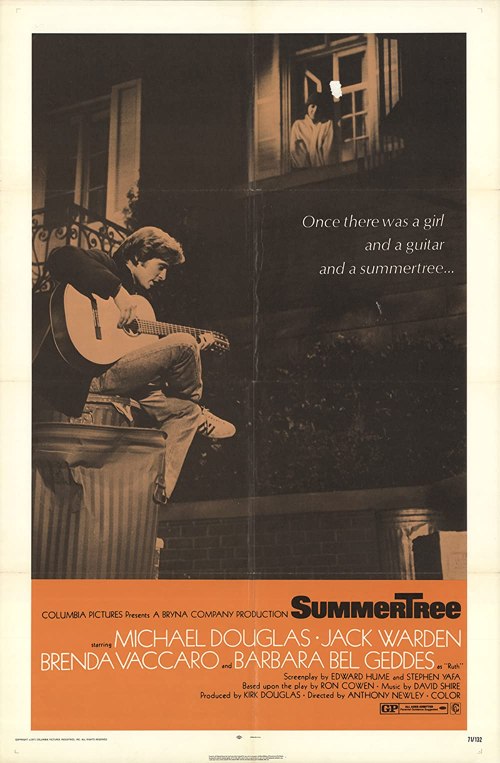
Jerry (Michael Douglas) is a 20-year-old university student who finds going to college to be drag as he’s disinterested in the subjects being taught and would rather play his guitar for a living. Since the year is 1970 his parents (Jack Warden, Barbra Bel Geddes) fear that this could get him drafted and advise against it, but Jerry refuses to listen convinced that he’ll get accepted into the conservatorium, which will restore his student draft deferral. In the meantime he also starts up a relationship with Vanetta (Brenda Vaccaro), a local nurse he meets when he brings in Marvis (Kirk Calloway), a black youth he’s spending time with through the big brother program, into the hospital after he skins his knee. Everything seems to be going Jerry’s way, he even gets a job playing his guitar at a local coffeehouse, but then the draft notice comes in the mail and the  music school decides, to his shock, not to accept him. He feels he has no other choice but to escape to Canada, but Vanetta does not want to go with him and his parents don’t think this is a good idea and secretly plot to prevent it.

The film is based on the stageplay of the same name by Ron Cowen that was produced in 1967 and originally had Douglas cast in the lead only for him to get fired during the rehearsal phase and replaced by David Birney, which so incensed his father Kirk, that he bought the rights to the play in order for it to be made into a film that his son could star in. It’s directed by Anthony Newley, which is an unusual choice since Newley was from Britain and not as affected by the Vietnam war and also for the fact that he was mainly known as an actor, writer, and singer with very little hand in directing. Overall he does okay, but the song done over the opening credits, which is sung by actor Hamilton Camp, is atrocious and makes you want to turn it off before it’s even begun. The stop-action ‘comedy’ done through a home movie type look, that gets shown while the horrible song is played, is bad too making this thing really stumble out of the gate though it manages to recover.

The plot works like three stories compressed into one. The segments dealing with Jerry’s relationship with the child, who is very streetwise and foul mouthed, but still quite engaging, are the best. His attempts to form a relationship with Vanetta though prove awkward as he follows her down a lonely dark alley late at night, which would make him seem by today’s standards like a stalker, and then taking her out to a cemetery on their ‘first date’ when it’s pitch black out would not be something most people would find romantic and instead quite creepy. Vaccaro is a great actress though more in roles featuring strong women and not necessarily as a love interest. This did precipitate a long on-going relationship between the two in real-life that lasted 6 years and for voyeurs you also get to see her topless as she rarely ever did nude scenes, but for whatever reason decided to do it here.

Spoiler Alert!

His relationship and conversations with his parents I initially found interesting. Coming into the movie I thought this would be a long, drawn-out arguments of conservative old-school parents and the liberal kid, but that’s not really the way it works. The parents are against him going to war as much as he is and it’s only the staying in school part that they find disagreement, but then when he decides to go to Canada in a last ditch effort to avoid the draft suddenly they’re against that too even to extent of trying to bribe a mechanic to fiddle with Jerry’s car, so he can’t drive it, but why? The shift in their perspectives seemed too quick. If they’re concerned they might not be able to see him much if he’s stuck in another country it would still be better than him coming home in a body bag and even if he does come out of it alive he’d be emotionally scared, or physically disabled for life, which wouldn’t occur if he was in Canada, so from my perspective the parents should’ve supported his ‘escape plan’ and the fact that they don’t needed more explaining.

The ending in which the parents are in their bedroom, with Jerry now off to war, and them acting like ‘everything will work out’, which is a far cry from what they thought before, gets botched. For one thing there’s an issue of Life magazine sitting on top of the TV talking about the weekly body count from the war on it’s cover, but I would think the parents would’ve thrown that out as they wouldn’t want to be reminded that their son may soon become one of those statistics and just leaving it in a place where they’d constantly be reminded of it didn’t seem realistic. They also both roll over and go to sleep while leaving the TV on, but who does that? Seeing an image of Jerry’s dead body being carried away on the TV isn’t the shocking surprise that the filmmakers though it would be as as the film spends a lot of time priming the viewer that is what it’s leading up to making the final image corny and even tacky instead of riveting.

My Rating: 6 out of 10

Released: June 9, 1971

Runtime: 1 Hour 29 Minutes

Rated R

Director: Anthony Newley

Studio: Columbia Pictures

Available: DVD, Amazon Video, YouTube

Zelig (1983)

zelig1

By Richard Winters

My Rating: 4 out of 10

4-Word Review: Wanting to fit in.

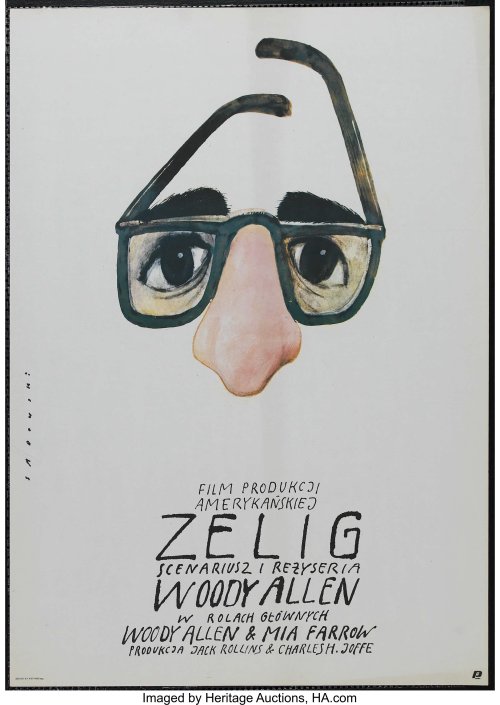
Leonard Zelig (Woody Allen) is a man living in the 1920’s and 30’s who has an uncanny ability to reflect the personalities and features of those he’s surrounded with. Even if he’s in the company of someone of a different race, or ethnicity, he can still acquire their traits, including their skin color, until he looks exactly like them. He becomes known as a the human chameleon and Dr. Eudora Fletcher (Mia Farrow) , a psychiatrist, becomes determined to find the root cause. She takes him on as a patient and under intense hypnosis comes to the realization that his deep need to be liked by others causes him to conform to the most extreme ways imaginable. Through her therapy she gets him to become more confident in expressing his own opinions, but this leads to him arguing with others over the most mundane reasons, which leads to several fights. She again puts him under hypnosis, so that he’ll become more of centrist, but this then leads to even further complications.

Allen was inspired to do this movie when his friend Dick Cavett was hosting a history series on HBO and a segment was done where Cavett’s likeness got spliced into an historical image. While the effects of using old newsreel footage and photos from long ago and inserting in cast members to make it seem like they were there when the picture was taken may not seem like that big of a deal today, but back in the 80’s it was very much talked about. I remember an entire segment of CBS Morning News hosted by Diane Sawyer going in depth about the ‘incredible’ special effects and ‘how did they do it?’ With digital filmmaking and movies like Forrest Gump we’re used to it, but back then it was state-of-the-art and got nominated for several awards. To help make it look as authentic as possible cinematographer Gordon Willis used vintage cameras and lenses from the 20’s and then stomped on the negatives of the film in his shower to help create the crinkles and scratches.

While telling the story through newsreel footage is certainly diverting and many times amusing I was fully expecting after about 20 minutes or so that it would eventually become more like a normal movie with the plot being propelled by actual characters, dialogue, and conventional scene structure, but instead it sticks with the novelty until the bitter end, which for me was a mistake as it makes the viewer too detached from the people in the movie to the point that they become distant caricatures that we really care nothing about. Much comedy is also lost as everything hinges on the voice-over narration of Patrick Horgan and how he describes what’s going on versus having it played out. A great example of this is when Allen gets into an argument with someone over whether ‘it’s a nice day, or not’, but all we see of it is some grainy, black-and-white figures in a distance that appear to be squabbling when witnessing the actual argument in real-time would’ve been so much funnier.

My favorite moment had nothing do with the special effects, but instead was the scene with Farrow and Allen where she tricks him, using reverse psychology, into admitting he really wasn’t a psychiatrist like her, and the movie needed more segments like this one. The vintage footage is nice for awhile and highly creative, but ultimately makes it come-off like a one-note joke, or an experimental film that’s misses the most basic elements of a good story, which is character development. It’s a shame too as Farrow gives a strong performance, which gets overshadowed. Usually she’s best at playing emotionally fragile types, but here is a strong woman and does quite well though I thought it was ridiculous that in color segments where here character is speaking in the modern day as an old woman another actress, Ellen Garrison, plays the part when they could’ve easily had Farrow doing it by dying her hair gray and putting on a few wrinkles. So much effort was put into the black-and-white vintage stuff that they forgot about the simplest of all special effects: stage make-up.

There’s also a host of other famous faces that have cameo bits as they talk about the fictional Zelig in the modern-day like historians discussing a past event, or famous person. Of these includes Susan Sontag, Saul Bellow, Irving Howe, and John Morton Blum, but like with the newsreel element it gets overplayed and derivative. It also brings to question what exactly was the movies’ point. Was it a satire on conformity and if so it could’ve gone much deeper, or poking fun at documentaries, which could’ve been played-up much more too. In either case it’s a misfire that’s engaging for awhile, but eventually, even with its short runtime, wears itself out.

zelig2

My Rating: 4 out of 10

Released: July 15, 1983

Runtime: 1 Hour 19 Minutes

Rated PG

Director: Woody Allen

Studio: Orion Pictures

Available: DVD, Blu-ray