Monthly Archives: January 2021

Bread and Chocolate (1974)

By Richard Winters

My Rating: 9 out of 10

4-Word Review: He has no home.

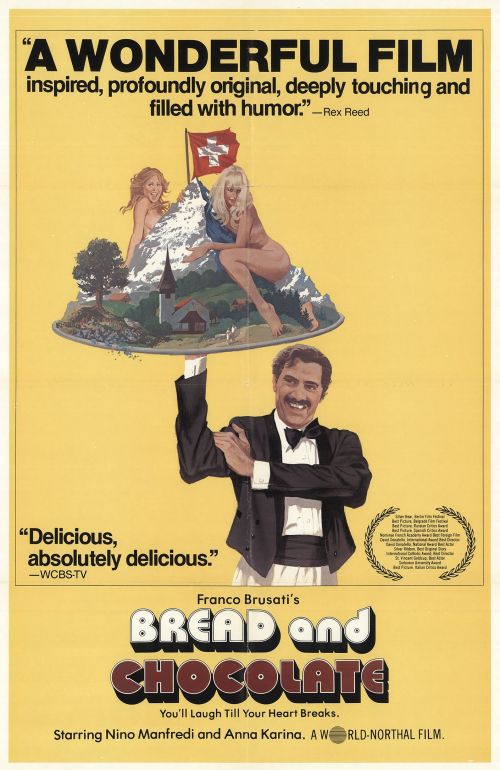
Nino (Nino Manfredi) has moved to Switzerland to work as a guest worker in that country since he’s unable to find employment that pays a living wage in his homeland of Italy. In order to provide for his family he works various odd jobs and then sends the money back home to his wife and kids who he has not seen in years. There are many other foreigners from other countries competing for the same jobs as Nino including a Turkish worker (Gianfranco Barra) who vies for the head waiter position at a fancy restaurant that Nino also wants, but even though the two don’t get along they’re still forced to room together in a cramped attic apartment. Nino’s only source of companionship comes in the form of a friendship that he has with Elena (Anna Karina) a Greek who lives across the street from him in an equally small loft. He moves in with her and her son when he gets kicked out of his other place, but because she’s also a guest worker striving to make ends meet she has no time for a relationship making Nino feel like an unwanted outsider no matter where he goes.

This critically acclaimed film really allows the viewer to get to know their characters and the desperation that they feel. Many viewers today may be unaware of the guest worker program that many European countries took part in during the 60’s and 70’s, so watching this will be an educational experience as well as a good character study. What I found most fascinating though was the issue of racism. Most people wouldn’t consider Switzerland to be a ‘racist’ country, so it’s interesting to see how this element can creep in anywhere and it doesn’t have to hinge on one’s skin color either as the Swiss end up picking on the Italians simply because they aren’t from there, poor and ‘stealing their jobs’, so are therefore in their minds deserving of being looked down upon, much like foreign workers in this country can sometimes feel.

The film also makes keen observations in regards to the rich versus poor and how having a lot of money can sometimes make one a weaker person less able to handle challenges. This comes to a head with Nino’s friendship with an Italian Industrialist (Johnny Dorelli) who despite living a lavish lifestyle commits suicide after losing a custody battle with his ex-wife even though Nino hasn’t seen his family for years and lives in near squalor, but because he’s toughened to the hard times he’s able to preserve and remain upbeat where the rich man couldn’t.

There’s many memorable moments, so many that it would be hard to list as the story and characters are so multi-layered the laughs and insights come in literally just about every frame. Many will consider Nino’s visit with some farm workers who out of desperation have moved into a chicken coop and start behaving like the chickens they tend, which is funny and unique, as the film’s highlight. However, my favorite part came when Nino decides, in an effort to move up in society, to pretend that he’s Swiss and even dyes his hair blond and begins speaking in a Swiss accent. Then while at a bar he watches a soccer match between Switzerland and Italy on the TV and even though he initially cheers for the Swiss team he can’t help but eventually shout out in excitement when Italy scores a goal, which just proves the old saying: You can take a person out of their homeland, but you can never take the homeland out of the person.

The film’s most redeeming quality though is showing the strong bond that forms between the guest workers. Even if they’re at first strangers and from different countries they immediately offer support and friendship to Nino no matter where he goes simply because they are going through the same hardships as he, which becomes a wonderful testament to the hearty human spirit.

My Rating: 9 out of 10

Released: January 18, 1974

Runtime: 1 Hour 40 Minutes

Director: Franco Brusati

Studio: Cinema International Corporation

Available: DVD, Blu-ray (Region B/2)
High Rolling in a Hot Corvette (1977)

By Richard Winters

My Rating: 6 out of 10

4-Word Review: Two guys drop out.

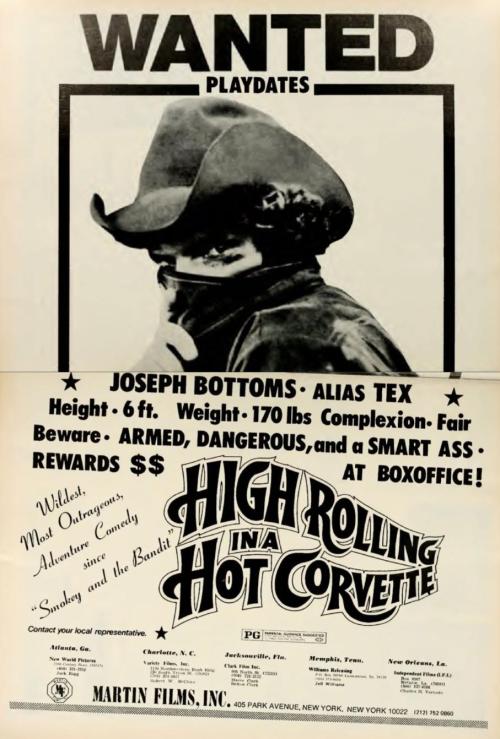
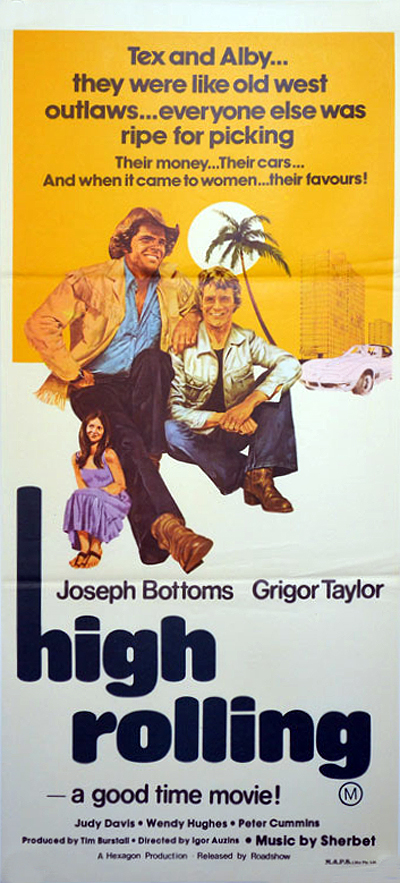
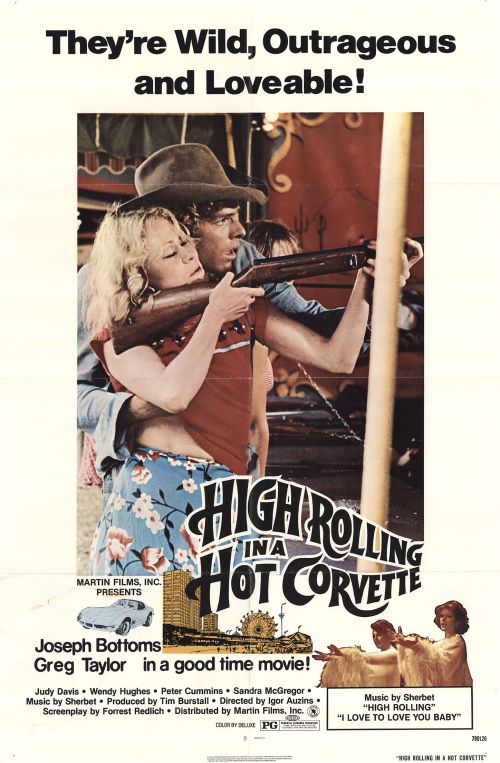
Tex (Joseph Bottoms) and Alby (Grigor Taylor) are two friends working at a carnival who decide, after Tex gets fired when he’s caught having sex with a female customer, to breakaway from the grind by heading out to the Gold Coast and Surfer’s Paradise. They hitch a ride with Arnold (John Clayton) who drives a snazzy green Corvette. After he takes the two to a hotel for the night he comes-on to Alby, who beats Arnold up that puts him into an unconscious state. When Tex finds out what happened they decide to make a run for it by driving away in Arnold’s green corvette, which to their shock is loaded with bags of marijuana. They use Arnold’s money from his wallet to help them get into ritzy nightclubs where they meet up with attractive singers Susie and Barbie (Sandra McGregor, Wendy Hughes), but once the money is spent they’re forced to rob a tour bus full of passengers, but just as they’re ready to escape with the loot Arnold returns with his muscular friends and an ugly confrontation ensues.

This is another Australian flick where it could’ve easily been filmed here and you’d never know the difference. Whether it’s intentional or not the American influence is quite strong including having them eat at such restaurants as Kentucky Friend Chicken and McDonald’s. The Outback is the one area that can help Australia stand out, but the two never go there and stick to the lushly green coastal region, which again looks no different than many of the landscapes in the U.S.

They even hire an American actor for the lead, which I felt was a mistake. Apparently they thought it would be easier to sell to distributors abroad if not all the actors spoke with an Aussie accent, but Bottoms, who is the younger brother of the more famous Timothy Bottoms, isn’t a good enough actor to make anything that he does onscreen either interesting or memorable. His reckless wild boy behavior comes-off as affected and forced and the way he aggressively comes-on to women would be considered misogynist and sexual harassment by today’s standards. Plus, there’s never any explanation for why this Texan would be working the carnival scene in Australia to begin with.

The tone of the film when compared to its trailer, which can be seen on YouTube, is far more grim and dramatic. The trailer gives you the impression it’s a comical, freewheeling adventure that will bring you back to your youthful days of rebellion, when really it’s more about them desperately living on the edge, getting beat-up and seeking shelter in an abandoned church when it rains. If anything it makes the creature comforts of suburbia, even with some of the compromises that come with it, seem not so bad by comparison.

These guys aren’t too smart either and it becomes harder and harder to keep siding with them with each jam they stupidly get themselves into. Driving off with the Corvette was just asking for trouble since they didn’t bother to change the license plate, so any cop could scan the number and realize that the vehicle was stolen. When they rob the bus, which is the best moment in the movie, they don’t wear any masks, so they’ll be easily identifiable. It also makes you wonder why if these bums needed money so bad they couldn’t just find a job like the rest of us instead of robbing innocent people, which is not a nice thing to do and makes the viewer not want to like these guys who are, at least in theory, supposed to be the protagonists.

The filmed is helped by the appearances of two young Australian actresses at the start of their careers. Hughes is beautiful as the showgirl that they meet but her part is ultimately too small. I was afraid Judy Davis, who plays a hitchhiker that they pick-up, would have the same fate, but she returns later on to give the cops a wild car chase driving the Corvette that makes it worth it.

The film though lacks any discernable point or message. The characters show no  arc and behave the same way at the end that they did at the beginning. Nothing conclusive is giving to their ultimate fate. Will they be able to live on the road and on-the-edge all of their lives? This hardly seems possible, but the movie makes no effort to answer this question causing it to be vapid and undistinguished from the plethora of other road movies out there.

My Rating: 6 out of 10

Released: August 4, 1977

Runtime: 1 Hour 21 Minutes

Rated PG

Director: Igor Auzins

Studio: Hexagon Productions

Available: DVD-R