Monthly Archives: September 2015

Kes (1969)

kes 1

By Richard Winters

My Rating: 6 out of 10

4-Word Review: Boy trains a kestrel.

Billy (David Bradly) is a poor working class youth living in Yorkshire who finds his existence to be bleak and pointless. He is bullied constantly by his older brother Jeb (Freddie Fletcher) and ignored by his burdened mother (Lynne Perrie) while also being picked on at school. As means of some solace he finds a nest of baby kestrels inside an abandoned building. He takes one of them and keeps it in his backyard shed where he trains it, which in return gives him a sense of purpose.

The film is based on the novel by Barry Hines who also wrote the screenplay and although the plot is basically the same it does vary in two major ways. The first one being that in the book everything takes place in one day and with a lot of use of flashbacks to explain the backstory, which I liked better, but here it’s given a linear narrative. The book also explains a bit more about the otherwise absentee father and even has one scene involving him while here the character is non-existent and never even mentioned.

On a purely cinematic level it is well made and nicely exposes Billy’s hopeless working class world without ever being heavy-handed. The drama is fresh and natural with each scene and character ringing true. The segments involving the training of the bird is the most engaging and I wished had been extended.

The children are fantastic without being too cute or precocious and respond to things in ways that are honest to their nature. The adult cast is good as well although not as likable. The teachers and school administrators, with their very old fashioned approach to discipline, come off as genuine jerks. At one point one of them even raps the open palms of the children’s hands with a cane, which makes their eyes well up with tears and is unpleasant to watch.

The worst is the segment involves Billy’s physical ed. teacher Mr. Sugden, which is played by Brian Glover who was an actual high school instructor at the time as well as a former wrestling. Here he plays a coach who brutally bullies his students in a scene that makes its point and then goes on too long with it. I also didn’t like that director Kenneth Loach superimposes the score of the soccer (football) game that the students are playing onto the screen, which wasn’t necessary as who wins the game was not important at all and hurt the film’s realism by distracting the viewer and taking them out of the story.

Some have complained about the thick dialect of the characters, which makes it hard at times to understand what they are saying. Certain American versions have been dubbed to make the lines uttered clearer although the version I watched, which was from the Criterion Collection, seemed to have the original accents intact, which I preferred as it kept it more authentic and for the most part I didn’t have any problem with it.

Spoiler Alert!

The only real issue that I had with the film is its downbeat ending. I realize that it is the same as the one in the book, but felt a bit frustrated that every time there is a movie dealing with a child taking care of an animal it always for some reason has to end in tragedy, which made it a bit formulaic. The kid never gets a break and having the falcon get killed at the end was like rubbing salt into the wound. The bird that actor Bradly buries apparently died of ‘natural causes’ but at the time he was under the belief that it had been killed simply to suit the purposes of the film and the angry reaction that you see on his face was very real.

End of Spoiler Alert!

kes 2

My Rating: 6 out of 10

Released: November 16, 1969

Runtime: 1Hour 50Minutes

Rated GP

Director: Kenneth Loach

Available: DVD, Blu-ray, Amazon Instant Video
Disco Godfather (1979)

disco godfather

By Richard Winters

My Rating: 2 out of 10

4-Word Review: Don’t try angel dust.

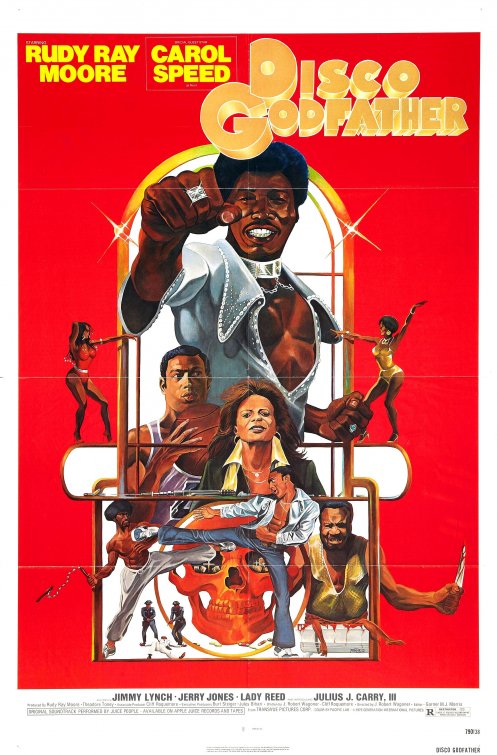
Tucker (Rudy Ray Moore) is the DJ at a local discotic known as Blueberry Hill who becomes concerned when his nephew takes a new drug called angel dust that causes him to have weird hallucinations and forces him into the hospital. Since Tucker is also a former cop he decides to use his connections with the police force to take down the drug dealers and clean up the streets before they can corrupt any more of the youth, but the dealers have other ideas including kidnapping Tucker and forcing him to ingest the drug via a gas mask.

This was the fifth feature for Moore and the last one where he was credited as the star. The former comedian created a character for his stage act called Dolemite that proved so popular that in 1975 it was turned into a movie and Moore became a star at the age of 48. Yet by this time the act was starting to get old. He still had the energy, but seeing a man who was clearly in his 50’s somehow able to beat up guys who were much younger and bigger than him didn’t make a lot of sense.

The story itself is run-of-the-mill and splicing in disco dance numbers where the camera conspicuously focuses in on the scantily-clad gyrating bodies of the females doesn’t help and if anything makes it even more boring. The fight sequences looked quite staged and it’s obvious that the actors are pulling their punches and kicks.

The only thing that makes this otherwise uninspired low budget mess slightly diverting are the drug sequences in which the characters start tripping out on all sorts of weird hallucinations as well as a segment dealing with a religious group trying to ‘cure’ one of the victims through an exorcism. The final segment in which Moore sees his mother turning into a devil is goofy enough to give this thing 2 points and had this movie cut out the derivative drama and emphasized more of a surreal quality it would’ve done better.

My Rating: 2 out of 10

Released: September 3, 1979

Runtime: 1Hour 33Minutes

Rated R

Director: J. Robert Wagoner

Studio: Transvue Pictures Corporation

Available: DVD

Creator (1985)

creator

By Richard Winters

My Rating: 2 out of 10

4-Word Review: Cloning his dead wife.

Harry Wolper (Peter O’Toole) is an eccentric college professor obsessed with the idea of cloning his dead wife. With the help of an undergraduate assistant named Boris (Vincent Spano) he sets up a makeshift shed in his backyard and uses the university equipment for his experiments. He employs the services of Meli (Mariel Hemingway) a 19-year-old in desperate need of funds whose egg he uses as part of the cloning process. After a while she starts to fall in love with him and as the fetus of his dead wife takes shape she becomes jealous and feeling that he should be more concerned with the living than the dead.

O’Toole is engaging as ever in the type of role that most suits his talents. Had the film stayed centered on him it would have been a joy to watch, but unfortunately it enters in the generic Spano who looks like he was pulled straight off of the cover of a men’s modeling magazine. I presume this was because the studio felt a movie centered on a man over 50 wouldn’t attract the all-important 16-30 year-old demographic, but despite being an obvious chick-magnet he adds little and there was period in the middle where he isn’t seen for a long time to the point where I forgot about him and didn’t miss him at all.

Hemingway adds quirky energy as the free-spirit and her kooky romance with O’Toole adds genuine spark, but the film regresses by spending too more time focusing on Spano’s relationship with fellow coed Barbara (Virginia Madsen). This romance is very formulaic and makes the film seem like two movies in one while sucking all of its offbeat potential right out. If anything Spano should’ve fallen for his robot that is by far funniest thing in the movie.

Spoiler Alert!

David Ogden Stiers makes for a good antagonist and John Dehner, in his last theatrical film appearance, is solid as O’Toole’s loyal colleague, but the film’s biggest problem is when it shift gears and destroys the whole cloning angle completely. It then centers on a mysterious illness that befalls the Barbara character that like in Love Story never gets explained and comes out of nowhere. She goes into an immediate coma and is put on life support where her parents (Rance Howard, Ellen Geer) agrees much too quickly and without bothering to even get a second opinion to take her off of it and allow her to die. This then forces Spano to talk to her endlessly until just as the she is about to be disconnected she ‘miraculously’ comes back to life, which is too implausible, too contrived and too cute for even the most hopeless of romantics and helps ruin the engaging performances of its two lead stars, which is the only good thing about it.

End of Spoiler Alert!

My Rating: 2 out of 10

Released: September 20, 1985

Runtime: 1Hour 47Minutes

Rated R

Director: Ivan Passer

Studio: Universal

Available: VHS, DVD, Amazon Instant Video

The Strawberry Statement (1970)

strawberry statement 4

By Richard Winters

My Rating: 5 out of 10

4-Word Review: Students go on strike.

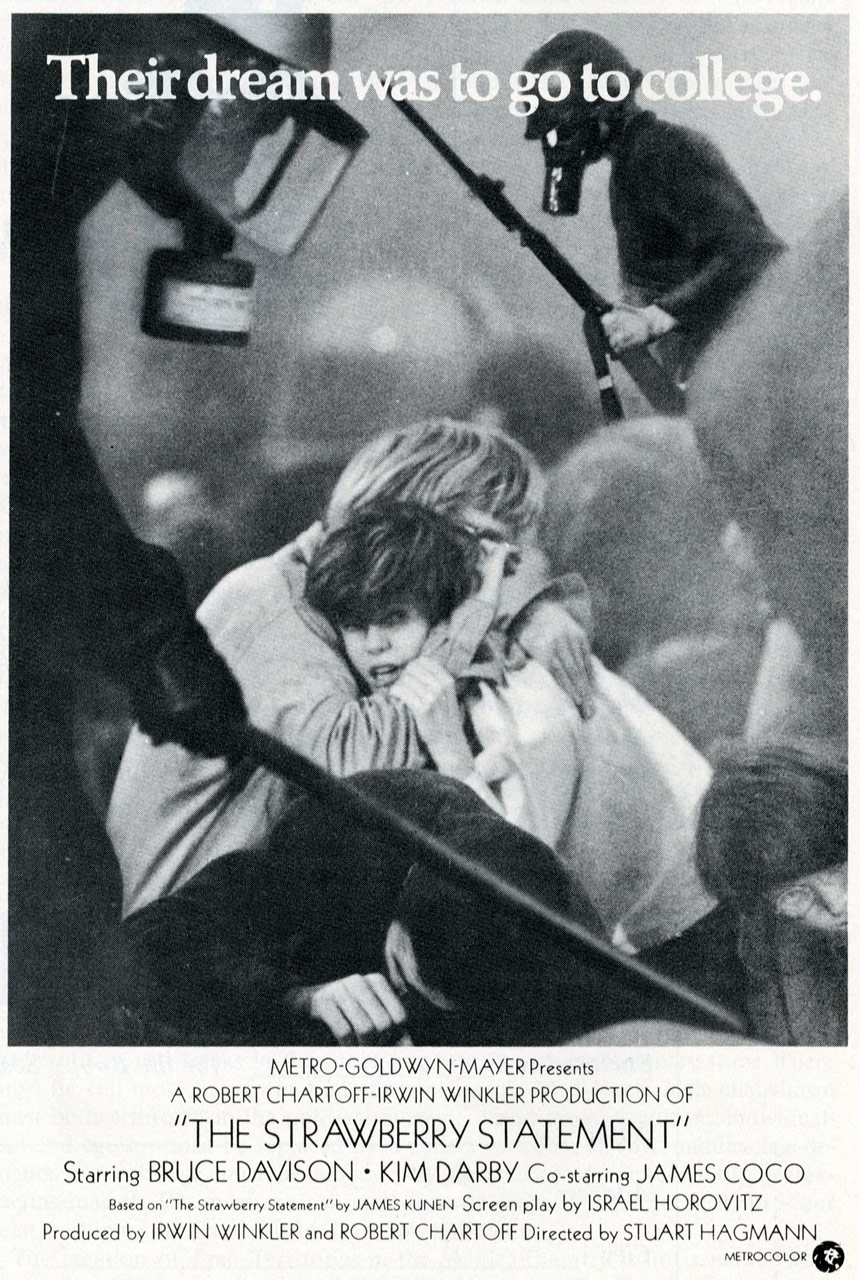
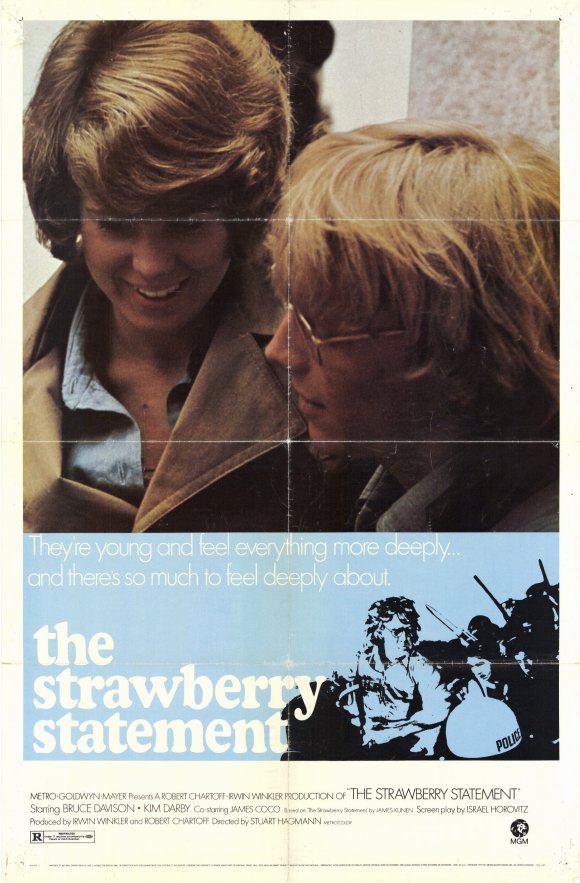
Simon (Bruce Davison) is a young college student attending a university simply as a means to get an education and find himself a good job. He has no real interest in the student revolt going on, but as a lark and a way to meet girls, he decides to passively get involved with students who have taken over the administrator’s building in protest of the school’s plan of building a gymnasium in an African American neighborhood. Slowly Simon finds himself taking up more of their cause and embracing their stance especially after meeting Linda (Kim Darby) who is much more of a student radical, but the two are ill-prepared for the brutal outcome when exasperated school officials have the police violently storm the building and haul the students out.

The film is based on the book ‘The Strawberry Statement: Notes of a College Revolutionary’ by James Kunen, which in turn is based on his experiences of being involved in a student sit-in that took place at Columbia University in April of 1968. The book’s narrative had more of an engagingly detached manner as it looked at the contradictions and hypocrisies of both sides while the screenplay by Israel Horovitz is nothing more than a commercialized effort to cash in on the counter-culture emotions of the time while glossing over or ignoring some of the book’s more perceptive points. The plot is too loosely structured and relies heavily on artsy camerawork and moody music to propel it until you get an hour into it and realize that nothing much has really happened. The whole thing would’ve been better focused had it been done with a voice-over narration by the main character.

strawberry statement 3

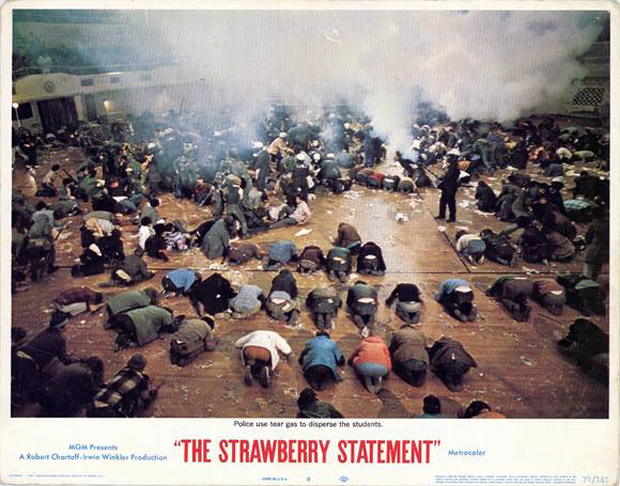
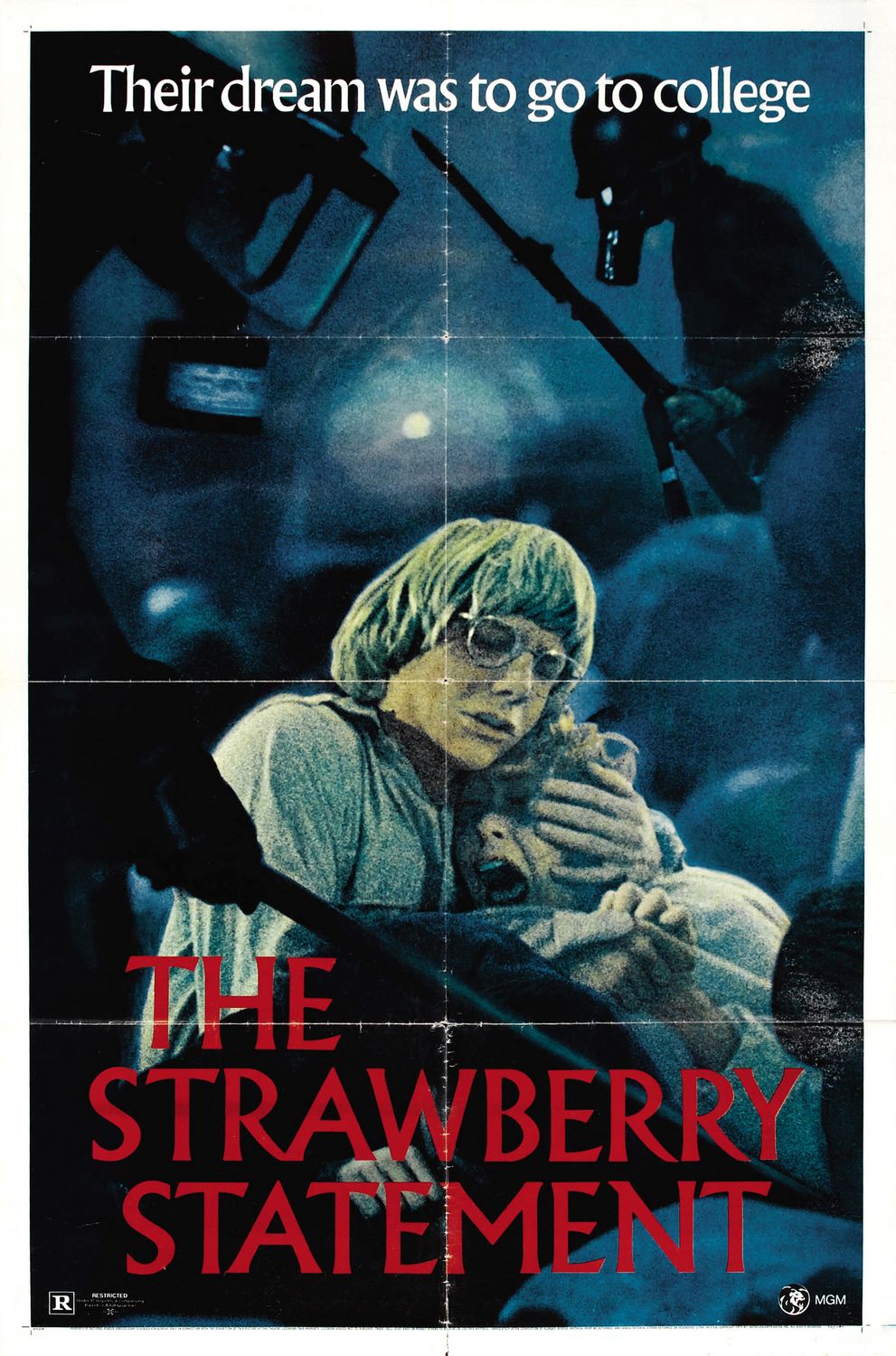
Although at times it borders on being pretentious I still found director Stuart Hagmann’s camerawork to be intoxicating especially the bird’s eye view of the students forming into several large circles as a way to block the police from entering and taking them out. Some of the scenes involving the demonstrations look staged and phony especially when compared to similar scenes of actual protests that were captured in Medium Cool that came out around the same time. However, the scene where the students grab a police officer, strip off his pants and force him down the slide and onto the swings at a children’s playground is downright amusing. The climatic sequence where the students are violently herded out of the building while sprayed with tear gas is well captured and by far the most startling and memorable thing about the movie.

Davison gives a solid performance and creates a middle-of-the-road character that is engaging enough to hold the thing together. It’s also great seeing Bud Cort playing an atypical role of an amorous girl-crazy coed who’s constantly looking to get laid. This film also marks the film debuts of David Dukes, Jeannie Berlin, Paul Willson, Andrew Parks, Kristina Holland and soap actress Jess Walton. You can also spot Horovitz and Kunen in brief cameo parts as well as character actor James Coco as a deli owner who’s all too willing to have his placed robbed simply so he can collect the insurance money.

Although they wanted to shoot the movie at Columbia where the incident actually occurred they were unable to get permission and were forced instead to do it at Berkeley, which in some ways helped it as the liberal, free-spirited look and mood of the region helped match the tone of the story. Ultimately though the film fails to ever really gel and comes off as being too placid and generic while failing to distinguish itself from the myriad of other student protest movies from that era.

strawberry statement 2

strawberry statement 1

My Rating: 5 out of 10

Released: June 15, 1970

Runtime: 1Hour 49Minutes

Rated R

Director: Stuart Hagmann

Studio: MGM

Available: DVD (Warner Archive), Amazon Instant Video

One Wild Moment (1977)

one wild moment 1

By Richard Winters

My Rating: 5 out of 10

4-Word Review: Fling with friend’s daughter.

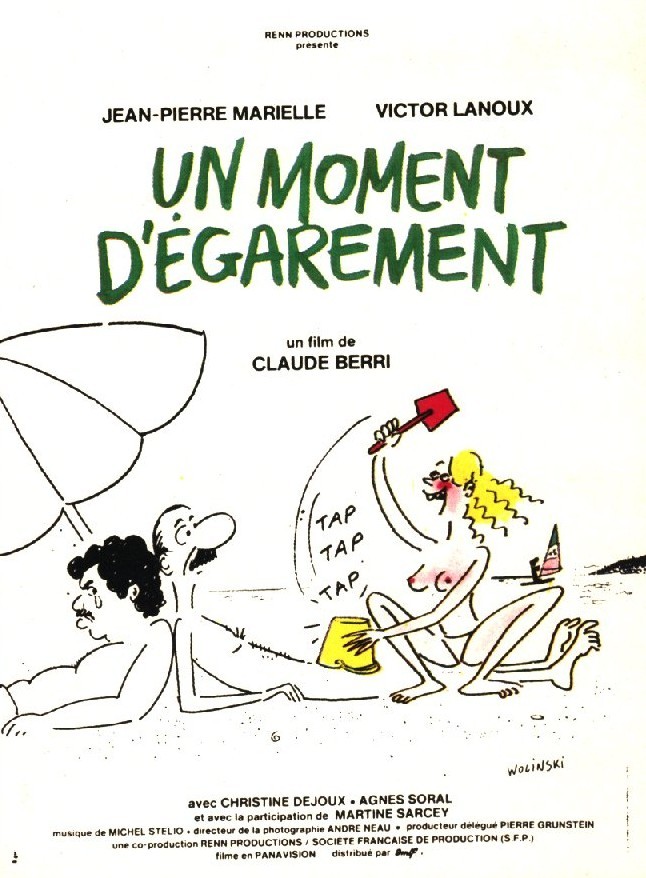
Pierre and Jacques (Jean-Pierre Marielle, Victor Lanoux) are longtime friends who decide to take a vacation together along the French Riviera and both bring along their 17-year-old daughters. One night Pierre and Victor’s daughter Francoise (Agnes Soral) attend a late night wedding party and the revelry and energy of the moment culminates with them having a tryst along the beach. Although Pierre has feelings for Francoise and vice-versa he wants to keep it from going any further for fear that it will jeopardize his friendship with Victor. Francoise though wants it to continue and the two quarrel with their mixed feelings as they ponder telling Victor about it.

Although this is not a great film it is still far superior to its American remake Blame it on Rio. For one thing it works more as a drama while the remake was played strictly for laughs. The dialogue has more of a realistic conversational quality and the characters are better rounded and more dimensional. The structure is  leisurely paced given it a day-in-the-life feel without having every scene forced to conform to contrived comedy like in the other one. The scene where the two make love has much more of a natural quality to it and less stagey. I also enjoyed more of an emphasis on subtly where the characters are not compelled to verbally describe their feelings, but instead it relies on their facial expressions, which is much more powerful.

Marielle gives a far better performance than Michael Caine did in the equivalent role who seemed awkward, stiff and uncomfortable throughout. The rift that the character has with his daughter Martine (Christine Dejoux) gets better fleshed out here while in the remake it is only briefly touched on. I also thought it was interesting that at one point Marielle’s character slaps his daughter during an argument when she comes back well after her curfew, which doesn’t get shown in the American film and I presume this is because of Hollywood’s concern that it might make the character less appealing as they always want to make their protagonists are wholly likable and politically correct, but in the process it also makes them less real.

The two daughters are much more believable and like young women ready to enter adulthood instead of a middle-aged man’s sexual fantasy like in the other one. I also found it amusing how when Francoise tells her father about her tryst he doesn’t immediately become upset about it like in the American film where sexual mores are more stringent, but only after she tells him it was with a man over 40.

Thankfully there is also no silly side-story involving one of the men’s wives having an affair with the other, which was the dumbest part about the remake and in fact there is no wife character here at all. The only real problem with this version is its abrupt ending that leaves open all sorts of loose endings and is quite unsatisfying and becomes unfortunately a major mark against it.

My Rating: 5 out of 10

Released: December 21, 1977

Runtime: 1Hour 28Minutes

Rated R

Director: Claude Berri

Studio: Quartet Films

Available: VHS