Monthly Archives: July 2014

Did You Hear the One About the Traveling Saleslady? (1968)

did you hear the traveling saleslady

By Richard Winters

My Rating: 3 out of 10

4-Word Review: Saleslady saves family farm.

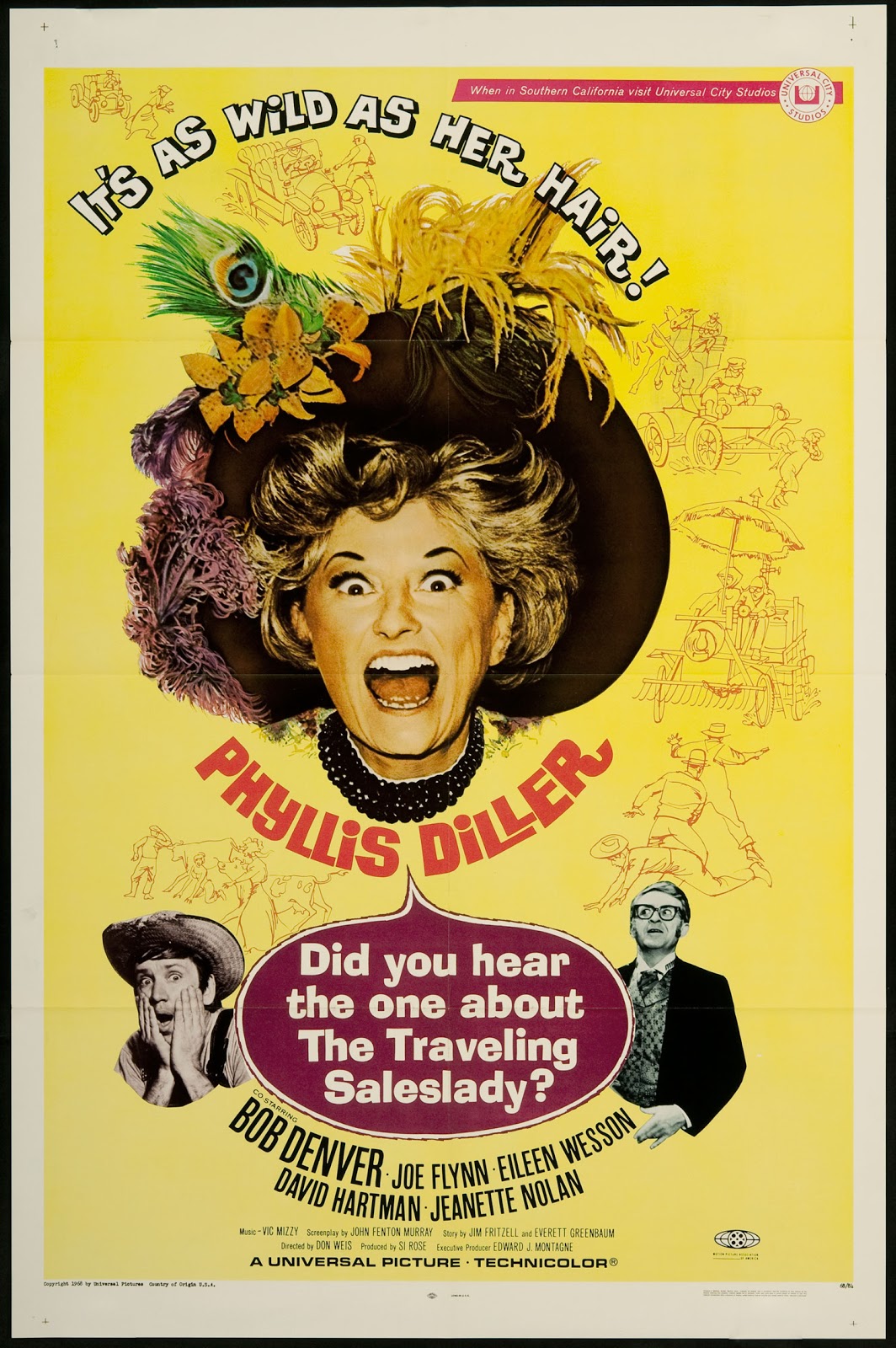
Agatha (Phyllis Diller) is a traveling saleswoman who arrives in a small Missouri town in the summer of 1910 trying to sell a piano that can play by itself. During a demonstration of it one of the townspeople, the kindly, but inept Bertram (Bob Denver) accidently destroys it. Agatha now finds herself stuck with a piano she can’t sell and nowhere to go. Bertram allows her to stay at his family farm, which is at risk of being foreclosed by the town’s greedy banker Hubert Shelton (Joe Flynn). Bertram and Agatha come up with a way to save the farm by winning an automobile race in a wild vehicle created by Bertram using parts from the destroyed piano.

It seems hard to believe in retrospect that eccentric comedian Diller was ever considered star making material, but she did 8 films during the 60’s with 4 of them centered on her flamboyant persona. All of them tanked both critically and at the box office with this one being the last of them. I imagine trying to come up with a scenario using Diller as the centerpiece would be no easy task, but this screenplay penned by John Fenton Murray is too broadly written to be even remotely interesting and seemed already badly dated even for its era. The humor is locked in a kiddie level with a plot that is excessively simplistic and won’t intrigue anyone over the age of 6.

Diller pretty much just plays herself, which would be alright if some her jokes and lines were actually funny, but none of them are. The reoccurring gags centered on her whacky outfits, ugly appearance and horses that go crazy the second she reveals any part of her legs gets old fast. Denver’s character is nothing more than an extension of Gilligan and Flynn is pretty much being the same character he was in ‘McHale’s Navy’.

The film is watchable if you come into it with extremely low expectations, but that is not saying much. None of the gags work and the town’s set was clearly filmed inside Universal’s studio lot, which looks phony and annoying. Denver’s milking machine invention, which can milk 6 cows at once, has potential, but when the cows escape and rampage the entire town it becomes forced humor at its worst, which goes likewise for the climatic and silly car race.

My Rating: 3 out of 10

Released: July 14, 1968

Runtime: 1Hour 34Minutes

Not Rated

Director: Don Weis

Studio: Universal

Available: None at this time.
Runaway, Runaway (1971)

runaway runaway 1

By Richard Winters

My Rating: 4 out of 10

4-Word Review: Teen girl runs away.

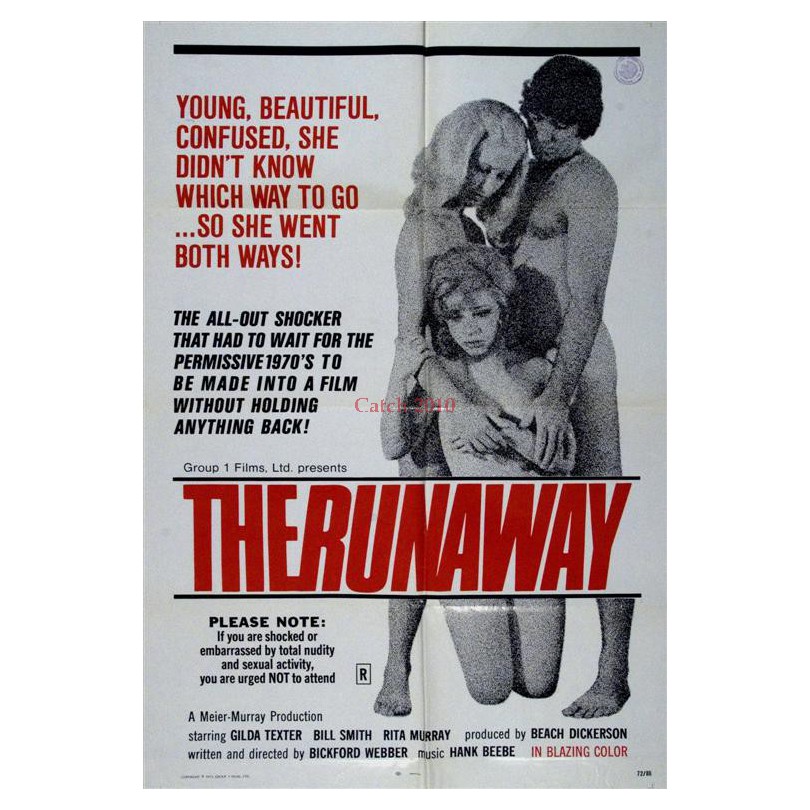
Ricki (Gilda Texter) is a teen girl who has had enough of her unhappy home life and decides to run away and meet up with a guy in California who she has strong feelings for but knows little about. Along the way she takes a ride from Frank (William Smith) whose job is finding young runaways and returning them to their parents. He tries to help Ricki, but she rejects it even though they remain on friendly terms. She then meets up with Lorri (Rita Murray) who works as a prostitute, but is also a closet lesbian. She gives Ricki a place to stay and then makes sexual advances towards her. Although Ricki at first resists she eventually gives in, but remains conflicted about her feelings towards Lorri and unhappy with her situation that seems no better for her than the one she ran away from.

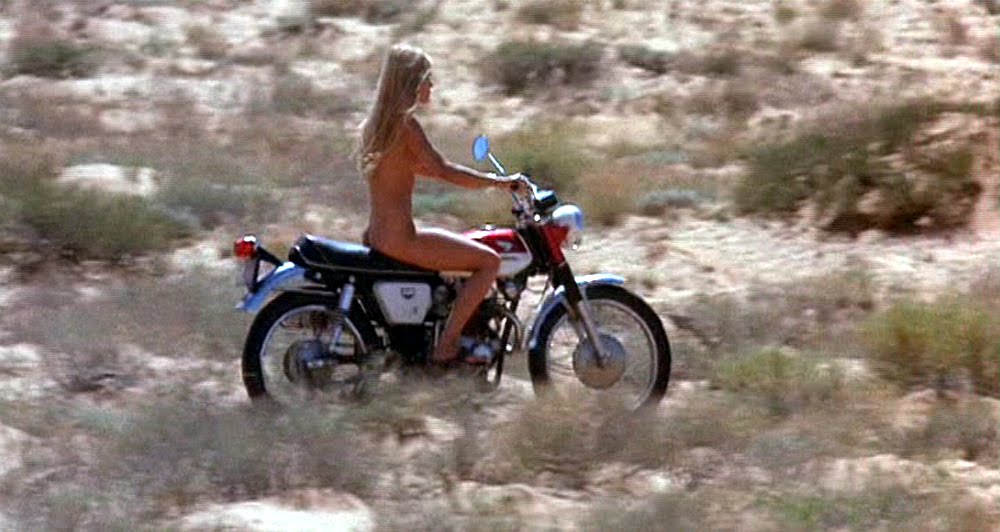
Texter rose to fame after playing the nude blonde riding on a motorcycle in the film Vanishing Point. Her scene lasted for only a couple of minutes, but most male viewers came away remembering her part more than anything else and producers were quick to pick up on it. She was soon given a starring role here, which was hoped to jettison her into a full-time acting career, which never happened and eventually she settled down into the role of costume designer for films, which she did through 2006.

gilda texter 2

Either way she does quite well and shows more flair and ability than most young beauties that get acting jobs with only limited experience or training. She speaks her lines with a nice inflection and has some good facial expressions especially during the scene where she is attacked.

Smith who has made a career playing bulky tough guys is quite good in the sympathetic role as an older father figure. However, in these more cynical times his over concern for her welfare could seem more like a dirty old man with deep seated sexual desires. The fact that they do end up going to bed together seemed quite creepy and unnatural and I didn’t care for it and felt she would have been better off had she stayed with Lorri and formed a more lasting relationship with her.

Hank Beebe’s music score is distinctive and bucked the trend of the time by not having a psychedelic or rock sound, but instead it’s more on the jazz side. The bouncing vibrant song done over the opening credits is especially good and I would love to credit the lady who sings it, but none is given.

The opening sequence features a scene where Ricki gets attacked by a man at an isolated location of an abandoned dessert building that is played by Ron Gans, who later went on to be a famous voice-over narrator for movie trailers, and it is exciting. Another part that I found interesting is when Ricki goes to a party and gets drugged, which makes good use of the fish-eye camera lens, but overall this thing gets too talky and eventually becomes quite boring.

The Ricki character seems a bit too naïve as well. Most runaways I would presume would be practical enough to have some money in their pocket, but she has absolutely none. She barely knows this guy that she has ‘fallen in-love’ with and has no idea where he lives or even his phone number, but somehow expects to magically meet up with him anyways. She also makes no attempt to find a job once she gets to her new location even though that is the first thing most people, even movie characters will do in order to help them get back on their feet and give them some independence.

The story is derivative and predictable and gives us no new insight or slant into the runaway issue. The ending offers no real conclusion and despite some good attempts at realism and well-written dialogue the film is overall sterile and forgettable.

My Rating: 4 out of 10

Released: June 13, 1971

Runtime: 1Hour 30Minutes

Rated R

Director: Bickford Otis Webber

Studio: Meier-Mayer Productions

Available: None at this time

WUSA (1970)

wusa

By Richard Winters

My Rating: 1 out of 10

4-Word Review:  Liberal working for conservatives.

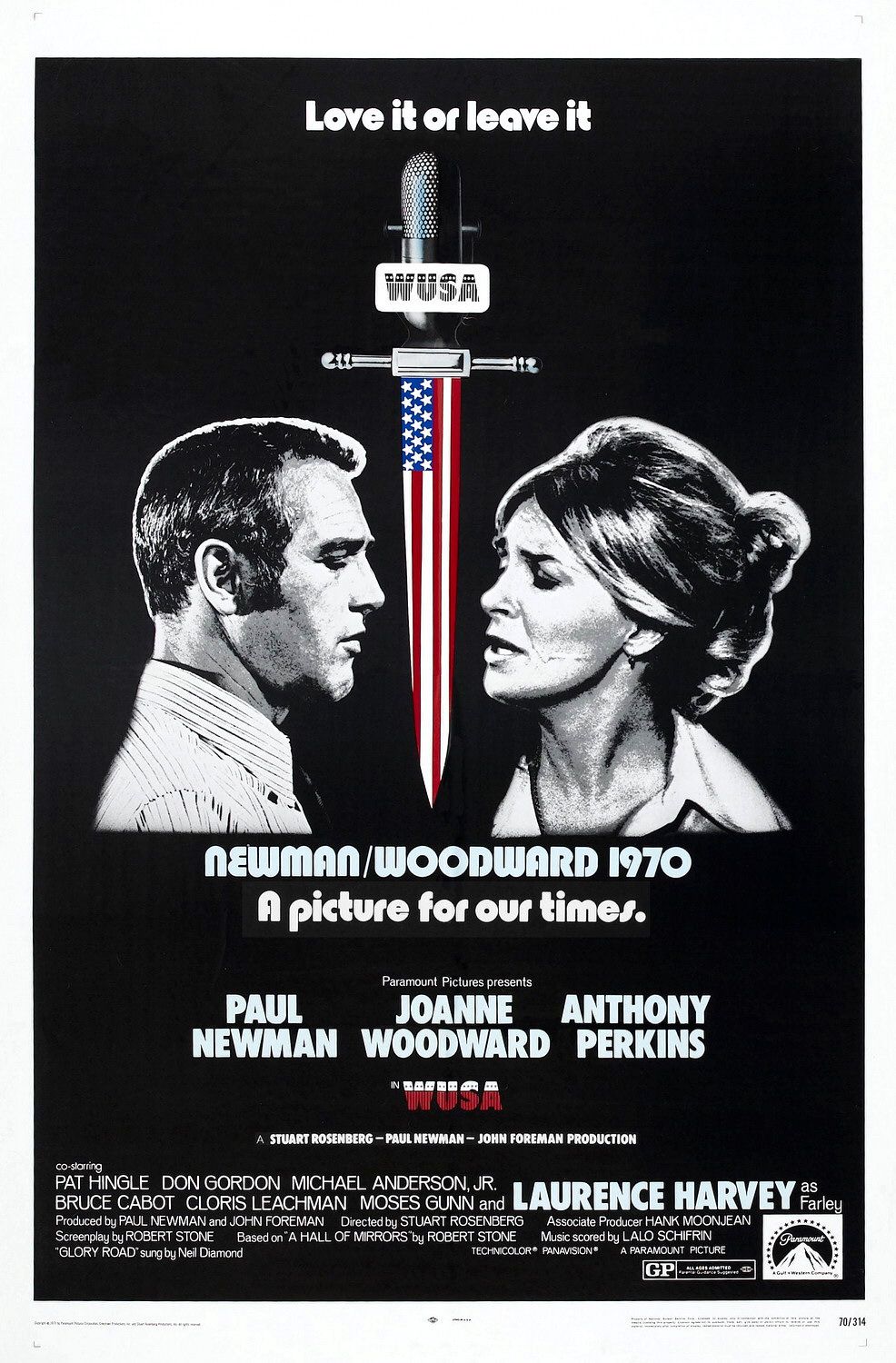
A drifter (Paul Newman) travels to Louisiana and gets a job as a DJ at an ultra-conservative radio station. Despite being a professed liberal he decides to go along with the right-wing rhetoric because he has grown apathetic with things and now just wants to ‘blend-in’.

The idea has a lot of potential, but it is never able to take off. Part of the problem is that instead of trying to play it like satire in the Network vein it instead approaches it with pinpoint seriousness and saturates the viewer with a gloom and doom message. The long and winding stream of social complexities makes the viewer, as with the main character, grow apathetic. The ‘powerful’ statements are redundant and too engulfed with the politics of its day to give anything that is broadly insightful.

It is easy to see why this is probably Newman’s most forgettable film. There is nothing unique or even slightly diverting about it and it meanders badly with no action whatsoever. The ‘exciting’ mob scene at the end looks staged and unconvincing.

The film has leanings as a character study, but even they are weak. Newman’s angry loner role is simply a less intense version of his Hud character. Joanne Woodward as the prostitute with a ‘heart of gold’ is clichéd and dull. Anthony Perkins is the only one that comes off as interesting, but it’s not enough to save it.

This is a truly limp and lifeless picture and I would be amazed if there was anyone out there who would like it.

My Rating: 1 out of 10

Released: August 19, 1970

Runtime: 1Hour 55Minutes

Rated PG

Director: Stuart Rosenberg

Studio: Paramount

Available: DVD, Blu-ray