Monthly Archives: January 2012

Dirty Mary Crazy Larry (1974)

dirty1

By Richard Winters

My Rating: 5 out of 10

4-Word Review: Fast cars fast women.

During the 70’s car chase movies were all the rage.  Smoky and the Bandit, Convoy, Vanishing Point, and Two-Lane Blacktop were just a few.  Most of these films followed the comedy adventure blueprint closely resembling the politics of the time where the police were the befuddled authority figures and those being chased symbolized the downtrodden masses looking to break free from the values and customs of yesteryear and find their own identities. Dirty Mary Crazy Larry is pretty much the same as the rest with a few notable exceptions the biggest being its very downbeat ending, which was quite talked about at the time of its release and one of the main reasons this film continues to have a strong cult following today.

The story is based on the novel by Richard Unekis called The Chase. It involves an out of work race car driver named Larry and his mechanic (Peter Fonda, Adam Roarke) who decide to rob a grocery store to make ends meet. Much to their dismay they are accompanied by a hooker named Mary (Susan George) and the three spend the rest of the film riding in Larry’s Dodge Charger with a powerful V-8 engine and avoiding the relentless pursuit of the police.

The screenplay follows the book pretty closely, but does make a few ill-advised changes. One is that in the book the two leads characters were career criminals who robbed for a living. I thought this made more sense and gave the characters a little more grounding.  I didn’t understand why a race car driver and his mechanic would suddenly be pushed to robbery, or what lead them into their fix. The robbery is executed in much too sophisticated a way for a pair of novices as they kidnap the store manager’s wife and daughter and then threaten to harm them unless the manager opens up the store’s safe. They also rig his home phone up to a tape recorder device so every time he calls home he hears the voice of the two and thinks they are still there even though they had already hit the road.  Criminals who had done this all their lives would be brazen enough not only to come up with this idea, but to also pull it off.  People with no background in robbery most likely would not.  There is also no explanation as to why they chose this store and how they planned the whole thing out, which would have helped.

Another change that was made was the addition of the Mary character.  In the book it was just the two men, which made it more gritty.  Although easy on the eyes the character serves no fundamental purpose to the story line.  All she does is have very redundant arguments with Larry that quickly become tiring.  I began to realize that these shouting matches were put in solely as filler material and it ends up getting inane.

Although I have like Peter Fonda in other films, most notably Easy Rider, I did not feel his laid back persona fit this part.  Larry is indeed a potentially interesting character as it is a person who can only find solace when he is taking extreme risks and driving real fast, but Fonda seemed unable to bring out this edginess effectively and his incessant gum chewing ends up becoming real annoying.

Vic Morrow probably gives the film’s best performance as the sheriff.  Normally the police are portrayed as bumbling idiots in this type of genre, but here they were a little more human and I liked the way that he was a bit of a non-conformist himself in the relentless way  he pursued the trio.

I also liked the attempt by the film makers to put in more realistic elements to a car chase that is never shown in most movies. One particular scene involves a pick-up truck that has nothing to do with the chase pulling out and getting side-swiped by Larry’s car.  For a minute the film becomes somber as they think they may have killed the other driver, which is good. Too many chase films always show other drivers and pedestrians miraculously getting out of the way and never being hit or injured even though in reality a lot of them probably would. The subject of seat belts also comes up, which is another pet peeve that I have with these films.  The occupants of these cars are never shown wearing them and with the stunts that they do they would all end up injured and killed without them.  They don’t wear them here either, but at least Larry does mention to Mary that she should put one on and there is also an amusing scene where a big yellow billboard stating ‘There is only one word for people that don’t wear seatbelts…STUPID’ which is shown briefly just before one of the out-of-control police cars goes careening through it.

Of course the best thing about the film and the one thing that has made this film so famous is the notorious ending, which is a downer for sure. If you consider this a spoiler then please don’t read any further, but the truth is when I first saw this film many years ago I already knew it was going to have a downbeat ending, but it kept me more intrigued because I didn’t know how it would happen.  Unless you count the film’s opening shot there is no foreshadowing of it and it happens very suddenly where the victims end up not knowing what hit them, which is also realistic.  Personally I loved it and most other viewers seem to also.  Too many chase movies have the good guys being able to escape one close call after another when in reality the odds will catch up with you sooner or later and with this film that is what happens, which in some ways can be considered ‘refreshing’. The scene is captured well and features one of the best explosions I have seen and without any of that tacky computerized special effects. I also liked the way the film ends very abruptly after it happens without any denouncement.

Normally I argue against Hollywood remakes, but this is one instance where it would be a good thing.  One of the main problems here is the film’s low-budget.  Although I felt they captured the central California countryside nicely (it was filmed in and around Stockton) the indoor sets are quite bland and dull. A bigger budget, tighter script, and some flashy camera work could work wonders here.  Too many times Hollywood seems driven to remake films that were already good the first time and only ends up tarnishing the original instead of remaking films that didn’t quite work on the first run and trying to make them better.

My Rating: 5 out of 10

Released: May 17, 1974

Runtime: 1Hour 33Minutes

Rated PG

Director: John Hough

Studio: 20th Century Fox

Available: VHS, DVD, Amazon Instant Video
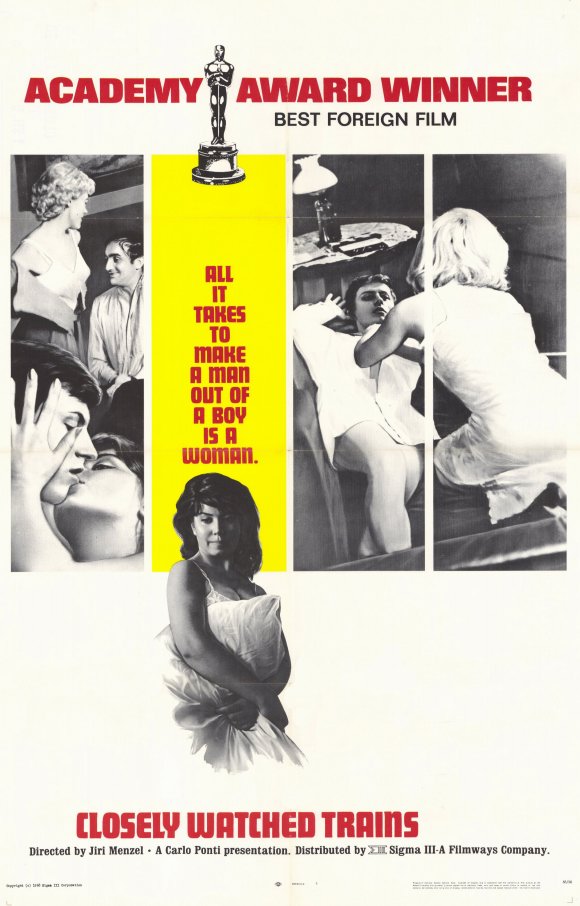
Closely Watched Trains (1966)

closely watched trains

By Richard Winters

My Rating: 7 out of 10

4-Word Review: Boy loses his virginity.

This is an engaging, amiable Czechoslovakian import that won the Academy Award for best foreign film of 1966. The story pertains to a young man named Milos (Vaclav Neckar) who follows in his father’s footsteps and gets a job at the local railway company during World War II. He almost immediately becomes bored with it and gets preoccupied with a beautiful young train conductor named Messa (Jitka Scoffin). The two have a sexual tryst, but Milos is unable to ‘rise to the occasion’.  He becomes despondent and even tries to commit suicide, but is saved at the last minute. While he is recuperating in the hospital the Dr. informs him that he suffers from premature ejaculation.  Milos then spends the rest of the time scouring the village for some prostitutes that he can ‘practice on’ so that he can learn to control his condition and become a ‘real man’.  A subplot involves plans to blow-up a German train carrying some high level ammunition.

Despite the fact that it is very leisurely paced and everything happens at one not very exciting location I still found the film to be immensely enjoyable. I had the feeling that director Jiri Menzel spoke straight from the heart with this one. The bleakness of the characters situation and the poor, hopeless conditions of their country is vivid and yet the ingenuity and perseverance of the human spirit never fades. Anyone who has dealt with an oppressive situation will most assuredly relate. The fact that this film stays so highly amusing and touching despite the depressing elements is what makes this a winner.

In a lot of ways this was years ahead of its time. The very liberal sexual attitudes and provocative scenes were stuff not yet seen in most movies and didn’t really become the norm, even for European films, until the 70’s and 80’s. Although not extreme there is indeed some lingering eroticism and even nudity. One segment involves Milos’s very amorous co-worker Hubicka (Josef Somr) rubber stamping the naked rear of Zdenka (Jitka Zelenohorska) who works as the station’s secretary. When her shocked mother finds out about this she parades her daughter all around town, exposing her rear to everyone, so that they can witness the ‘outrageous crime’ while the amused Zdenka finds it a turn-on.  There is also another scene, which another reviewer considered to be the most unique scene ever put on film that involves an old woman and a goose. I’ll agree it is very different, but I am not exactly sure what she was doing with it, or if I want to know, or if it is even legal, but it does indeed catch your attention.

Of course the drawback to this is the fact that the character’s attitudes seem far too modernistic for the era. At no time did I feel like I was really being transported back into the 1940’s.  There was also a little too much preoccupation with the sex angle and I felt there needed to be a little more balance with the actual war.

The Milos character is a bit too wide-eyed. He looks literally like a ‘deer-in-headlights’ through the entire progression of the movie. He seems overtly naïve for someone of 18. I know it was done for comical purposes, but having his mother dress him for his first day of work was going over the top. For the first half of the film he has hardly any dialogue and it is difficult for the viewer to relate to him, or get inside his head. Things do even out at the end when he ‘transforms into a man’, which I liked, but the opening half paints him too much as a caricature.

If there was one thing that really rubbed me the wrong way it would be the downbeat ending. I didn’t think it was necessary and tended to go against the film’s theme, which was human survival and coping. Still, it’s a good film with a great message. The budget was clearly very low, but it’s entertainment value high.

My Rating: 7 out of 10

Released: November 18, 1966

Runtime: 1Hour 33Minutes

Rated NR (Not Rated)

Director: Jiri Menzel

Studio: Filmove

Available: VHS, DVD (The Criterion Collection)

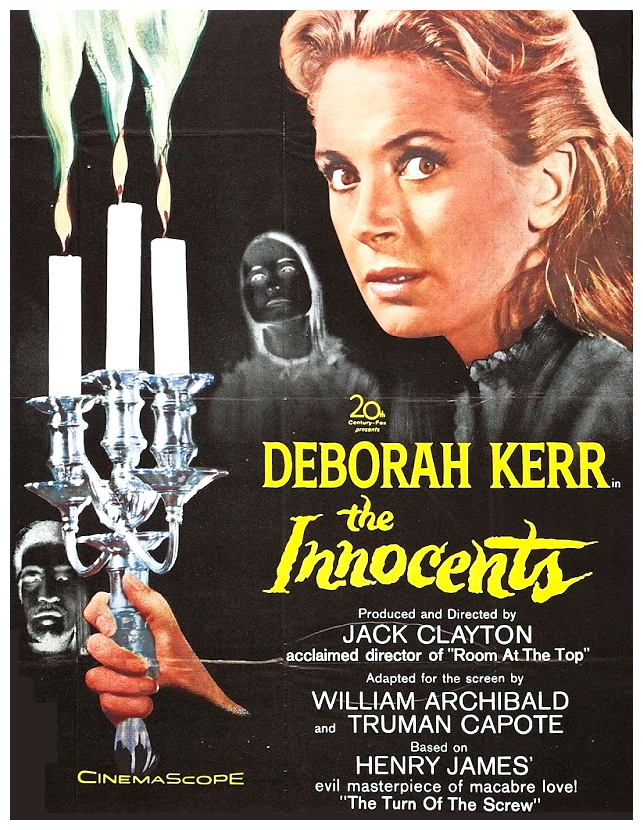
The Innocents (1961)

innocents 1

By Richard Winters

My Rating: 6 out of 10

4-Word Review: Children frighten their governess.

Legendary British actress Deborah Kerr plays Miss Giddens, the governess hired to care for two children at a sprawling English estate. However, the children are not exactly as they seem. Strange occurrences and behaviors begin to manifest as well as several ghostly sightings, which leads Miss Giddens into believing that the children may actually be possessed.

The film is based on the Henry James novel The Turn of the Screw. I have not read the book, but those that have feel this is a pretty satisfying adaptation. I did like the slow, methodical pacing. It helps to build the tension as well as enhance the mystery. Things are revealed in deliberate layers, which kept me intrigued throughout.

Director Jack Clayton shows a marvelous handle on the material.  The estate that they chose for the setting is perfect and captured well in glorious black and white by famed cinematographer Freddie Francis.  There is a lot of spooky imagery throughout including a creepy nightmare sequence in the middle.  The garden with its hulking, strange statues is used quite effectively especially in the haunting finale.  The music also grabs your attention right from the start with a very eerie song that is played before you see a single image on the screen. The song is similar to the one used in Rosemary’s Baby.  In fact there are several things here that reminded me of that film as well as The Shining.

Kerr was a good choice for the increasingly frightened governess.  I loved that scared expression on her face, which becomes progressively more frequent. Yet she is also effective when the character decides to become proactive by taking matters into her own hands and singlehandedly trying to ‘cure’ the children herself.  This also helps make both the character and the story a more multifaceted because you are never sure if this stuff is really happening or all just inside her head.

What really impressed me the most though was the performances of the two children especially Martin Stephens who plays Miles the young boy. His character shifts through many different moods, playing an innocuous child one minute and then a menacing, volatile one the next. He does each one flawlessly and becomes practically mesmerizing in the process.  Pamela Franklin is also fine in the role of Flora. This was her film debut. Eight years later her career would peak playing her signature role as Maggie Smith’s nemesis in The Prime of Miss Jean Brodie.

Another thing that I liked about the children is that they are initially portrayed as being normal and even engaging.  This is unlike other films with a similar theme like Children of the Damned or Children of the Corn where the kids are given creepy features right from the start. Here it works better and is more chilling to the viewer because the children’s dark side is unsuspected.

Unfortunately, despite the film’s impeccable technical quality, I still went away feeling unsatisfied. Part of the problem is that nothing really happens.  The ghosts appear but then do nothing but just stand there, which quickly becomes tiresome. One scene in particular has the camera constantly cutting back to the lady ghost standing across the lake until she starts to look like a mannequin, which I suspect she was.  The buildup is good, but I would have liked more of a payoff.  The ending is much too vague and gives no explanation as to why this was happening, if it was happening, or whatever became of the main character.

I couldn’t help but feel that this story would have worked better as an episode from one of the old horror anthology series like The Alfred Hitchcock Hour or even The Twilight Zone where it could have all been compacted into an hour. A hundred minutes seems like much too long for such little to happen. It is also interesting to note that in 1972 a film came out entitled The Nightcomers starring Marlon Brando that attempts to speculate what happened to the children before the main character of the governess arrives and before James’s original story begins.

My Rating: 6 out of 10

Released: December 25, 1961

Runtime: 1Hour 40Minutes

Rated NR (Not Rated)

Director: Jack Clayton

Studio: 20th Century Fox

Available: VHS, DVD