
By Richard Winters
My Rating: 10 out of 10
4-Word Review: Possessed by the devil.
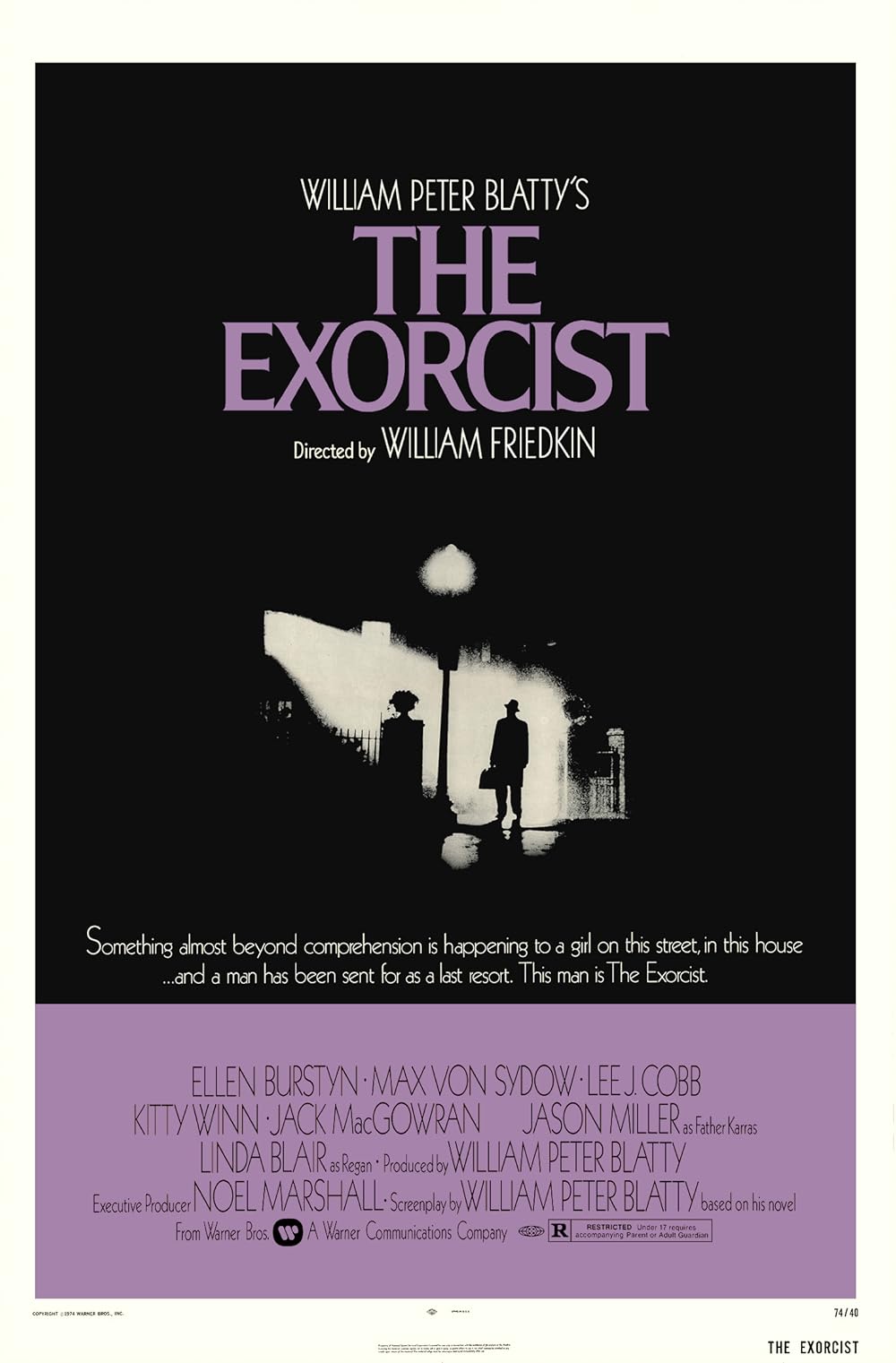
Chris McNeil (Ellen Burstyn) is a famous Hollywood actress living on location in a neighborhood of Washington D.C. known as Georgetown where the latest movie she’s working on is being shot. She’s renting a posh home along with her two servants (Rudolf Schundler, Willi Engstrom), her secretary Sharon (Kitty Winn) and her 12-year-old daughter Regan (Linda Blair). Things start out fine, but then Regan begins exhibiting odd behaviors. Chris takes her to several doctors as Regan’s anti-social traits continue. The doctors prescribe various drugs, but nothing works. At her wits end Chris, a non-believer, finally resorts to asking a local priest, Father Karras (Jason Miller) if he’ll perform an exorcism on her daughter. Karras though is going through a crisis of faith and doesn’t believe the archaic ritual will help her but becomes more convinced after he visits the girl who displays knowledge of his personal life that she would not have known about otherwise. Eventually he asks the church for permission to conduct one, but under the condition that he do it alongside Father Merrin (Max Von Sydow) an elderly man with a heart condition who had done an exorcism many years earlier in Africa.
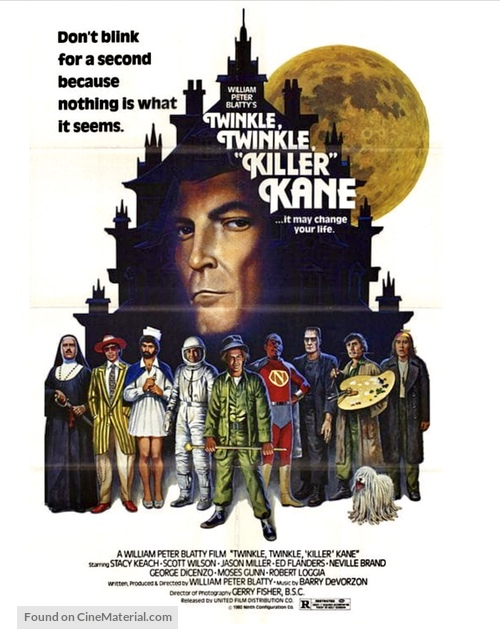
The film was based on the bestselling novel of the same name that in-turn was inspired by the true-life event that occurred in 1949 where priests performed an exorcism on a troubled 14-year-old boy named Ronald Edwin Hunkeler. Author William Peter Blatty, read about the incident while a student attending Georgetown University. After having become a successful screenwriter during the 60’s where he wrote mainly comedies for director Blake Edwards, he approached his agent about writing a horror novel about a child possessed but was initially talked out of it. Then in 1968 he watched Rosemary’s Baby, which he felt had a weak ending that he could’ve done better, so he brought up the exorcism concept to a book publisher while attending a cocktail party and he agreed pay him a $25,000 advance to write the book in 10-months. Upon publication the sales were at first sluggish, but then after an appearance on the ‘Dick Cavett Show’ they skyrocketed, which soon lead to a movie rights deal with Blatty commissioned to write the script.
The movie follows the book closely though in a more condense form with scenes that were groundbreaking in its level of explicitness and perversity including an infamous crucifix masturbation moment. However, it’s the angiography that many viewers found the most disturbing. While it’s shockingly explicit it’s also lauded by medical professionals as being highly accurate and for many years afterwards was used in radiological training films. Many critics at the time condemned the scene labeling it ‘irresponsible’ and ‘needless’, but I liked it. A good horror movie should put the viewer in an uneasy state right from the start and then continue to turn the screws tighter as it goes on. This moment clearly telegraphs to the audience that the filmmakers will not shy away from showing something graphic even if it’s outside of good taste and if they’re going to be this brazen with this scene then it makes it all the more unsettling about what’s to come next.
In many ways, and I don’t believe it was intentional, but the film does become an inadvertent satire on the medical, psychiatric community as their ‘diagnosis’ on Regan are really just guesses and the extreme reliance on prescribing medications, which they feel will somehow ‘resolve everything’. I didn’t really have a problem with this as I think many doctors at the time, and maybe even now, would respond the same way if given such a bizarre case. My one issue though is that eventually one of them, played by Peter Masterson, gets up in front of a roundtable of other doctors and suggests that Chris take Regan to an exorcist. I don’t believe any real medical doctor would ever suggest it or certainly be met with pushback by the other medical professionals in the room. I realize the movie had to find a way to progress to the third act, so the idea of an exorcist needed to be brought up at some point, but it would’ve made more sense had it come from Chris’s servants, who were deeply spiritual already. Chris could’ve scoffed at it at first, but then after thinking and even reading up on it, would eventually relent.
The performances are uniformly excellent. Burstyn was not the first choice as there were other actresses more famous than her at the time, but her ability to display distraught emotion and continue to do so as it progresses and still keep it fresh and genuine makes her the best person for the role bar none. Blair is quite good too though Mercedes McCambridge does voice the demon during the exorcism moments, which kind of affects things. Don’t get me wrong McCambridge’s deep vocals makes it scarier, but had the lines, which are quite obscene, been recited by Blair herself it would’ve made it more shocking. Plus, it would still allow credence for the doctors to say it was a mental illness and not a possession since whatever was being said was coming from her natural voice.
The real star though is Father Karras as he’s the one that goes through an actual internal change during the course of the story, from a person who’s had a crisis of faith to ultimately regaining it. Miller, who’s perfect, was not the original choice as Stacey Keach had already been offered the role and signed on, but then director William Friedkin went to watch the play That Championship Season, which Miller had written and afterwards the two met backstage and Friedkin talked about his new project that got Miller to describe his own Catholic upbringing and his quarrels with it, which convinced Friedkin that he’d be the better actor and thus the studio bought Keach out of his contract. As much as I like Keach this was still a good move as Miller’s guilt-ridden face, which gets on full display every time he’s in front of the camera, leaves a lasting visual impression. I also liked the way the character remains skeptical until the very end versus other horror films that would have the people believing in the supernatural right away, or pretty quickly. However, in real-life there’s always going to be cynical people, so allowing in their apprehension through Karras makes the story stronger and more three-dimensional.
Spoiler Alert!
I felt the ending, in which Chris pronounces Regan to be ‘cured’ and not remembering a thing and then driving away, to be a bit lacking. Chris was portrayed as being secular, but you’d think after what she saw her daughter going through would’ve changed that. This could’ve been done subtly by having her holding a crucifix, something she had despised her staff putting underneath her Regan’s pillow earlier or just shown wearing a small one around her neck.
I also didn’t like the side-story dealing with the Burke Dennings character, played by Jack MacGowran, being apparently pushed out the window by the demon and falling to his death down a flight of cement stairs as this takes away the impact of when it happens to Father Karras at the end. Instead of Karras’ death being the shocking, unexpected twist that it should’ve it comes off more like a ‘here-we-go-again’ thing. If I had been the director I would’ve removed both Dennings death and Lee J. Cobb character completely as I really didn’t think he added much or helped progress the story forward. I would’ve still had the steps being shown in the early part of the film as a forewarning by having Karras runup them during his early morning workouts and this could’ve been when he first met Chris as they’d bump into each other one day while she was leaving to go somewhere. The head being twisted all the way around, which is described as happening to Dennings, but never shown, could’ve been revealed as occurring with Karras, possibly with his eyes glowing when the pedestrians come running to his aid, which would’ve been a good creepy final horror visual.
My Rating: 10 out of 10
Released: December 26, 1973
Runtime: 2 Hours 15 Minutes
Rated R
Director: William Friedkin
Studio: Warner Brothers
Available: DVD, Blu-ray, Amazon Video, YouTube
 Scopophilia