
By Richard Winters
My Rating: 9 out of 10
4-Word Review: Falling for older woman.
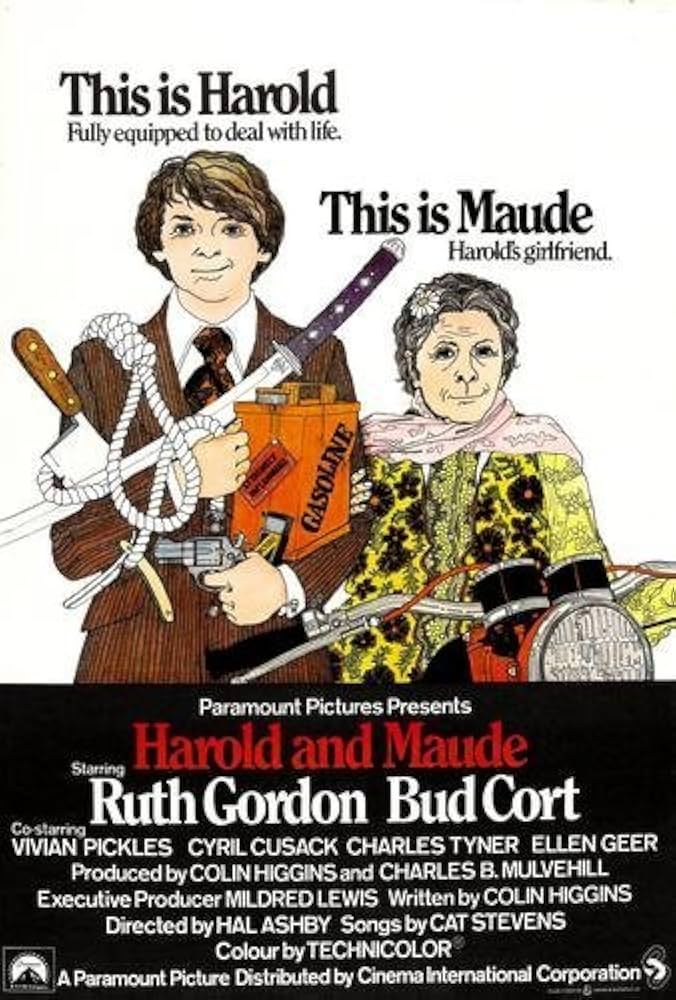
Harold (Bud Cort) is a young man still living at home with his mother (Vivian Pickles) who is an upper-class socialite that dominates Harold at every turn. Harold resents his mother’s control and thus stages fake suicides as a way to rebel. She in turn devises ways to ‘cure’ him of his death obsession by buying him a new car, which he turns into a mini hearse, setting him up on blind dates and even trying to get him recruited into the army. All of these ploys fail, and the real turnaround doesn’t occur until he meets Maude (Ruth Gordon) a kooky old lady with a carefree spirit. The two nonconformists form a strong bond and eventually a romance. When Harold announces that he plans to marry her it causes shock and disgust with all those who know him.
While this film has become a huge cult hit, there’s even a theater in Essen, Germany where it’s been shown, outside of a 10-week period during COVID, continuously since June 6, 1975, it was a box office flop when first released. Many prominent critics at the time panned it including Roger Ebert who gave it only 1 star out of 4. The two main reasons for this were the ultra-dark humor and offbeat storyline, which might’ve been a bit ahead of its time, but also some of it I suspect had to do with the editing. Director Hal Ashby, who was an editor before he ventured into directing, does a lot of long takes here, which is unusual for a comedy. Usually, humorous films consist of quick takes and a fast pace, but here the jokes particularly Harold’s suicide pranks are very drawn out to the point you don’t really see the joke happening until the payoff. While I loved this approach and consider to be the genius of both the movie and Ashby others especially in that time period could consider it off-putting and confusing as audiences are used to having their comedy spelled out for them and not to have to search for it.
The acting is splendid with the two leads nailing their characters perfectly. Cort was warned that if he took this role, he’d be type casted for ever after and it’s true his career flatlined, but with his slim physical build and unique face his choice of leading parts would’ve been limited anyways. Gordon on the other hand was in the midst of a career resurgence and her appearance here helped cement her for old lady roles for the next decade and a half.
While overshadowed it’s important not to forget the supporting cast, who are all fantastic as well. Vivian Pickles is great as Harold’s domineering mother. The argument could be made that she’s too much of a caricature and they would be right, but the scene where she answers Harold’s dating profile for him really had me laughing. Charles Tyner as the one-armed army recruiter who becomes shocked when Harold gets too enthusiastic about killing is good as is Eric Christmas who becomes physically repulsed when describing how sex might go between a young man and an old lady. Tom Skerrit billed as ‘M. Boorman’ in refence to Nazi war criminal Martin Boorman whom he once joked was probably ‘hiding out as a motorcycle cop’ is highly engaging as an exasperated policeman futility trying to write Maude a traffic ticket.
Spoiler Alert!
On the negative end, while minor, I did feel that Harold’s suicide pranks would be very hard if not impossible to pull off. The opening one which has him dangling from the ceiling with his feet clearly off the floor should’ve logically killed him. The scene where we see him through a window presumably setting himself on fire only to then immediately have him appear in the room is something he would not have been able to pull off alone and would’ve at the very least needed the help of someone else, but the film acts like he did it all on his own.
Maude’s car stealing doesn’t make sense either. She seemingly is able to simply hop into someone’s car and drive off with it like everyone just leaves their car doors unlocked and the keys in the ignition, which isn’t likely. If the explanation was that she was hotwiring them then this should’ve been shown, if even just briefly.
Maude’s suicide at the end was a mistake and I agree with critic Vincent Camby who complained that this made the movie seem ‘hypocritical’. She was a character that was so excited about life that it made no sense why she’d suddenly decide to end it. Some may say that she was haunted by memories of when she was in a concentration camp, but if that were the case then why didn’t she do it already at ag 50, 60, or 70? It also makes her seem selfish as she knew how Harold felt about her and killing herself was going to make him extremely upset and yet her response when he becomes horrified at the news that she’s taken some pills is quite detached like she never bothered to take his feelings into account. She was at the age where she could’ve fallen over dead at any moment from natural causes and the film should’ve ended with her dying that way instead.
My Rating: 9 out of 10
Released: December 20, 1971
Runtime: 1 Hour 31 Minutes
Rated PG
Director: Hal Ashby
Studio: Paramount
Available: DVD, Blu-ray, Amazon Video, Pluto TV, YouTube
 Scopophilia