Tag Archives: Susan George

Straw Dogs (1971)

By Richard Winters

My Rating: 8 out of 10

4-Word Review: Man defends his home.

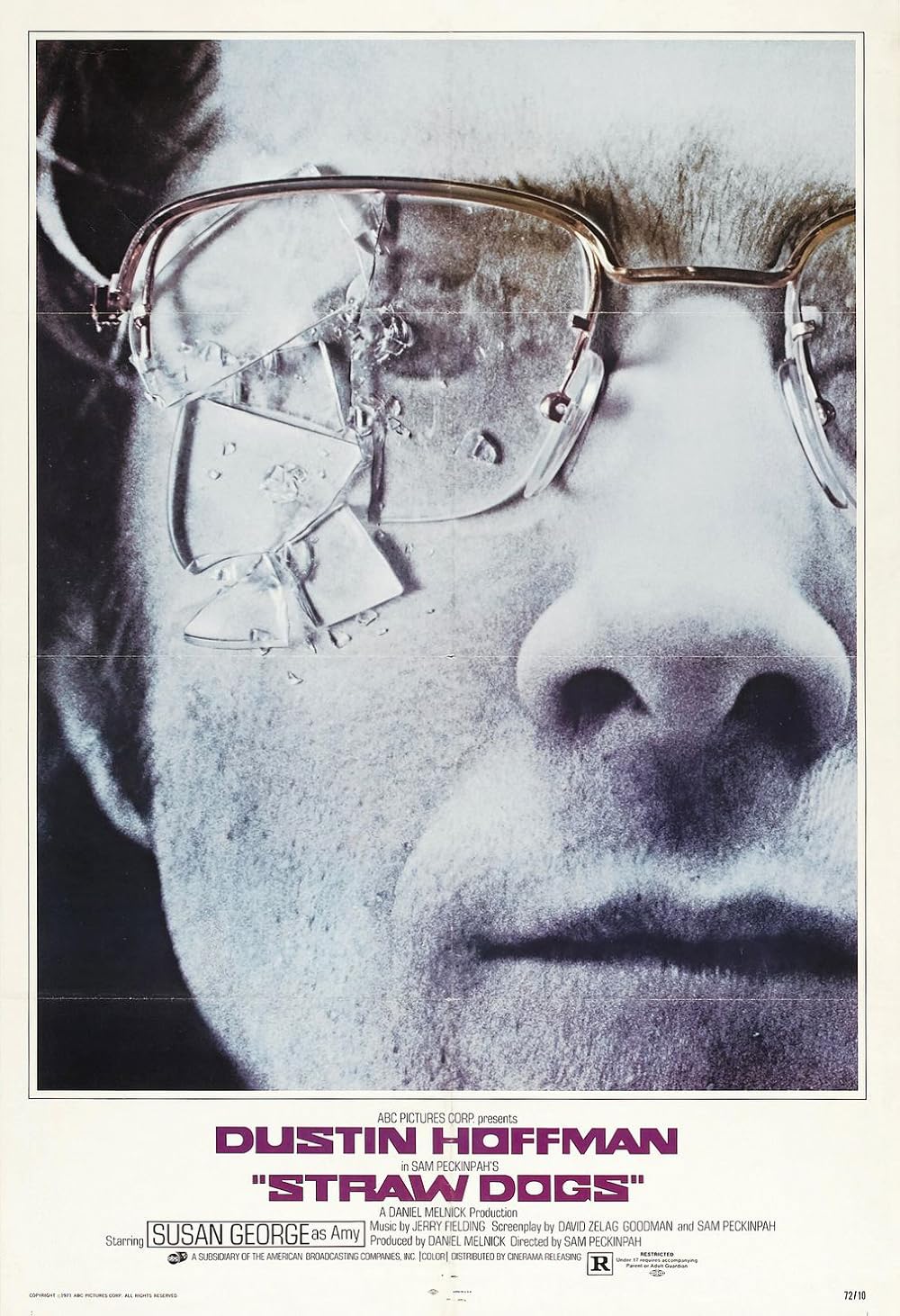
David (Dustin Hoffman), a nerdy mathematician, has been given a research grant and uses it to relocate to the rural countryside of England with his wife Amy (Susan George). They move into a farmhouse that was once owned by Amy’s father and they hire four men (Del Henney, Ken Hutchinson, Jim Norton, Donald Webster) to fix up the roof. The men though don’t work much and spend most of the time making fun of David and ogling Amy. After several bad encounters, including the grizzly death of their pet cat, David fires them and hopes that’ll be the last it, but things only get worse. When a teen girl named Janice (Sally Thomsett) disappears her violently drunken father Tom (Peter Vaughan) thinks it was caused by Henry (David Warner) a mentally handicapped man that Janice had shown an affinity for. Tom, along with the four other men, become a lynch mob determined to find Henry and bring him some ‘street justice’. David and Amy, while returning from a church service, hit Henry with their car as he’s running from the other men. David agrees to take the injured Henry into his home until a doctor can arrive, but the five men insist on getting inside to beat and kill Henry for his perceived crime. Since David had avoided having any confrontation with the men previously even when they had openly mocked him, they presume he’ll be a pushover this time as well, but David has finally decided to take a stand and will defend his home from the intruders in any way he can. 

While it was controversial at the time many now consider this the pinnacle of director Sam Peckinpah’s career and his directorial touches are supreme. The capturing of the brown empty vast landscape of nothingness, shot during the winter of 1971, brings out a surreal sense making it seem like the characters are living in a purgatory outer world where everything is dead and helps explain the deadness of the men’s souls that have been forced to endure their entire lives there. The climactic sequence where David’s home comes under siege is deftly handled. Normally in thrillers pounding music gets played during these segments to ramp up the tension, but here there’s only the sound of a distance foghorn, which makes it much more creepy, distinct, and helps accentuate the isolation. 

Some have been critical of the film’s violence especially at the time when there was activism going on that tried to stymie violent material on both TV and movies with the idea that violence was a ‘learned’ behavior and if people didn’t see it so much in entertainment, then they wouldn’t do it in real life. Peckinpah though saw it differently as he felt violence was an instinctual reaction that couldn’t just be ‘unlearned’ and that in certain situations it was necessary and not every conflict could be resolved peacefully, a message the film brings out quite well. 

While Susan George gives an excellent performance, as do the four villainous men, particularly Vaughan as their ringleader making them some of the creepiest bad guys in film history, I did find her character confusing. I didn’t understand why she’d marry a guy that she found by her own admission cowardly even bringing up that he was ‘running away’ from problems he was having at his university and his ‘hiding behind his studies’ in order to avoid it. She also shows no respect for his work and several times even vandalizes his chalk board that has his mathematical equations, so what attracted her to him in the first place? Would’ve made more sense had she initially idolized him for his academic status and then became painfully aware of his meekness as the film progressed, which would’ve made for a more interesting arch.

Spoiler Alert!

The film is based on the 1969 novel The Siege of Trencher’s Farm by Gordon Williams, but with many changes some of which worked while others didn’t. In the novel the couple had an 8-year-old girl, but in the film there is no child. To a degree it doesn’t make that much of a difference though when the bad guys attack the house it might’ve heightened the urgency more knowing that David was not only defending his ‘home’, but also the safety of his terrified daughter. The biggest change that the film does is that it creates a connection between Henry and Janice where Janice sneaks away with him during a church party where she invites him to be intimate with her, but in the process, he accidentally kills her, which seemed too similar to Of Mice and Men. It’s confusing too why this teen girl, who outside of her buck teeth seems reasonably attractive, would feel the need to throw herself at a mentally handicapped man, or get flirty with David, who is married. Why can’t she find guys her own age to fool around with? Knowing the hormones of most teen boys that shouldn’t be too hard, so without further explanation to her psyche, which doesn’t happen, her ‘inviting’ of Henry is quite unnatural and forced. 

In the book Henry is instead a child killer who’s being transported back to prison when the vehicle he’s in gets stuck in the snow, which allows him to escape. At the same time Janice, who’s mentally disabled, which isn’t made clear in the movie, runs away from a Christmas party where she ends up dying from the exposure to the cold, but otherwise it has nothing to do with the escape of Henry and is only presumed to have a connection by the five men, which makes more sense and the screenplay should’ve have kept it this way.

On the other hand, in the book none of the attacking men die and are only badly injured, but I think death gives it a more final resolution, so the movie scores there. I also liked how David is forced to resort to items he can find around the house, much like in the film Last House on the Left, which came out a year later, to fight off the bad guys versus the cliched machoism of having a big gun to blow them away and it also helps to show how intellectual wits can ultimately be used to overpower the otherwise physically stronger attackers. 

The rape scene in which the wife gets assaulted by not only one, but two men was another problematic moment as the book had no such segment. For one thing it makes it seem like she’s actually enjoying the attack, at least with the first one, and she recovers from it much too quickly and doesn’t even bother to tell David about it and able to go on relatively normally afterwards, which didn’t seem realistic and thus I think it should’ve been excised since it comes off as exploitive and doesn’t have that much to do with the main plot. 

My Rating: 8 out of 10

Released: December 22, 1971

Runtime: 1 Hour 57 Minutes

Rated R

Director: Sam Peckinpah

Studio: 20th Century Fox

Available: DVD, Blu-ray (Criterion Collection)
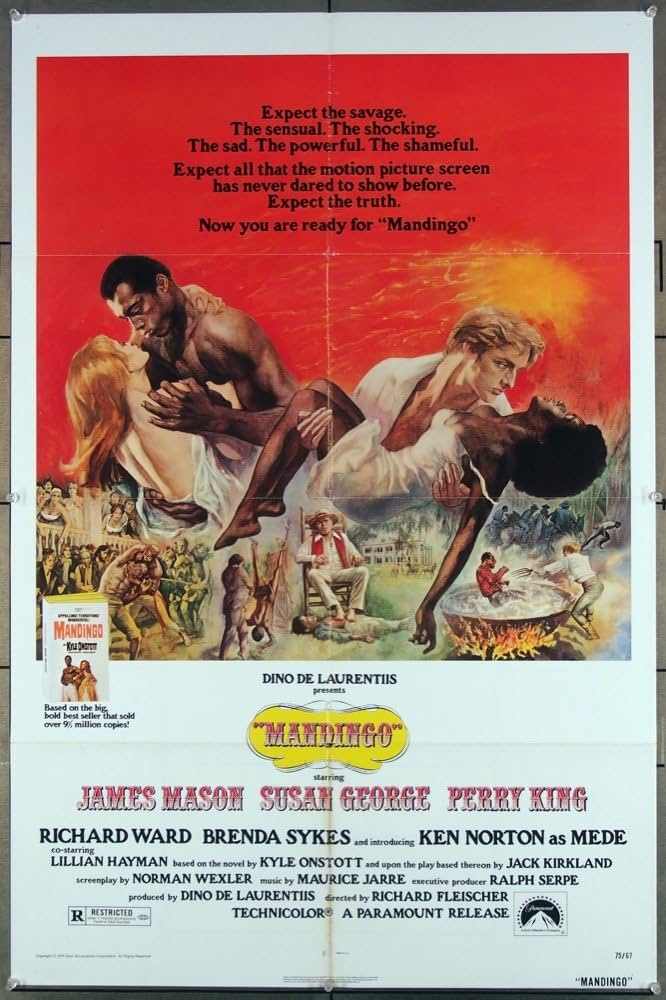
Mandingo (1975)

mandingo1

By Richard Winters

My Rating: 7 out of 10

4-Word Review: Slave turned into fighter.

Hammond (Perry King) is the son of aging plantation owner Warren (James Mason) who purchases a Mandingo slave named Mede (Ken Norton). Mede proves himself as having superior fighting skills, so Hammond turns him into a prize fighter and makes money off of him. Meanwhile Hammond is also having an ongoing sexual affair with a slave named Ellen (Brenda Sykes), but his father orders him to find a white woman in order to supply him with an offspring, so Hammond marries his cousin Blanche (Susan George), but on their wedding night he rejects her when he realizes she is not a virgin. Blanche becomes jealous of Ellen, whom is secretly carrying Hammond’s child, and causes her to miscarry. She then forces Mede to have sex with her, so she’ll become impregnated with a black baby and bring humiliation to Hammond. After the birth, when Hammond realizes what has happened, he then goes on a violent revenge not only against Blanche, but also Mede whom he once considered his prize possession, but will Mede just accept his punishment, or use his strength to finally turn on his master?

The story is based on the 1957 novel of the same name written by Kyle Onstott. Onstott had written a book about dog breeding with his adopted son, but that didn’t do too well, so at the age of 65 he became motivated to write a book that he hoped would be a bestseller and make him a lot of money. He decided a sensationalistic material was the way to get attention and thus choose to write a story based on many ‘bizarre legends’ he had heard growing up. It was printed by a small publisher and it soon got him the national attention that he craved and sold 5 million copies that not only lead to a series of books on the same theme, but also a 1961 stage play that starred Dennis Hopper. The film rights was purchased by noted producer Dino De Laurentiis and became a very rare exploitation film that was given a big budget and a major studio release.

Critics at the time gave it almost unanimously negative reviews including both Roger Ebert and Leonard Maltin, but today it’s seen in a slightly more favorable light. Personally, if you’re going to do a movie on slavery, a notoriously dark moment in human history, and you’re want to do it honestly, then a graphic portrayal of it such as this should be in store. It may make the viewers cringe throughout, but that’s kind of the purpose. On a purely shock value scale this thing delivers in an almost mechanical sense. It’s just one scene after another that should leave even the most seasoned audiences with their mouths agape. While it’s hard to pick just one moment that’s the most shocking as there are an incredible amount of them I felt the fight sequence where both men literally bite the flesh off the other until blood spurts out of the one’s neck is for the me the infamously top moment though having Mason using a black child as his own personal foot stool, or hanging a 60-year-old black man, played by Richard Ward, naked and upside down to be paddled not only by Hammond, but also by Charles (Ben Masters) who stops by to visit and immediately takes part while another black child looks on amused by it, comes in as a close second.

On the technical end I liked the way it was shot by cinematographer Richard H. Kline. Initially I found the decrepit look of the mansion, which was filmed at the Ashland-Belle Helene Plantation in Geismer, Louisiana, to be problematic as everything looked old and rundown, but you’d think if it had really been done in the time period it was lived-in then it should look new and just built. The overgrown lawn was an added issue as it made it seem like it was an abandoned place, but back then maybe they didn’t all use manually powered lawn cutters, or care to, so I was willing to overlook that portion. I did though love the use of natural lighting, electricity wasn’t a thing, so sunlight coming in from the windows was about it and the use of shadows nicely illustrated the dark personalities of the characters.

The acting is excellent and I was especially impressed with Mason who can seem to go from playing nice guys to villain with an amazing ease as most actors are usually just good at doing one or the other. Some complained about his attempt at a southern accent, but for a guy born and raised in Britain I thought he disguised it pretty well. Susan George, most noted for playing frightened damsel-in-distress types, does a terrific turn as an evil bitch who’ll stop at nothing to get her revenge. King is also impressive as he shows at times to have a certain conscious and appalled at what he sees, but ultimately is unable to get over the hump and becomes just as evil as the rest despite convincing himself and his slave girlfriend that he’s somehow ‘more reformed’.

My Rating: 7 out of 10

Released: July 25, 1975

Runtime: 2 Hours 7 Minutes

Rated R

Director: Richard Fleischer

Studio: Paramount

Available: DVD, Blu-ray, Amazon Video, YouTube

Sonny and Jed (1972)

sonny1

By Richard Winters

My Rating: 5 out of 10

4-Word Review: Couple steal from rich.

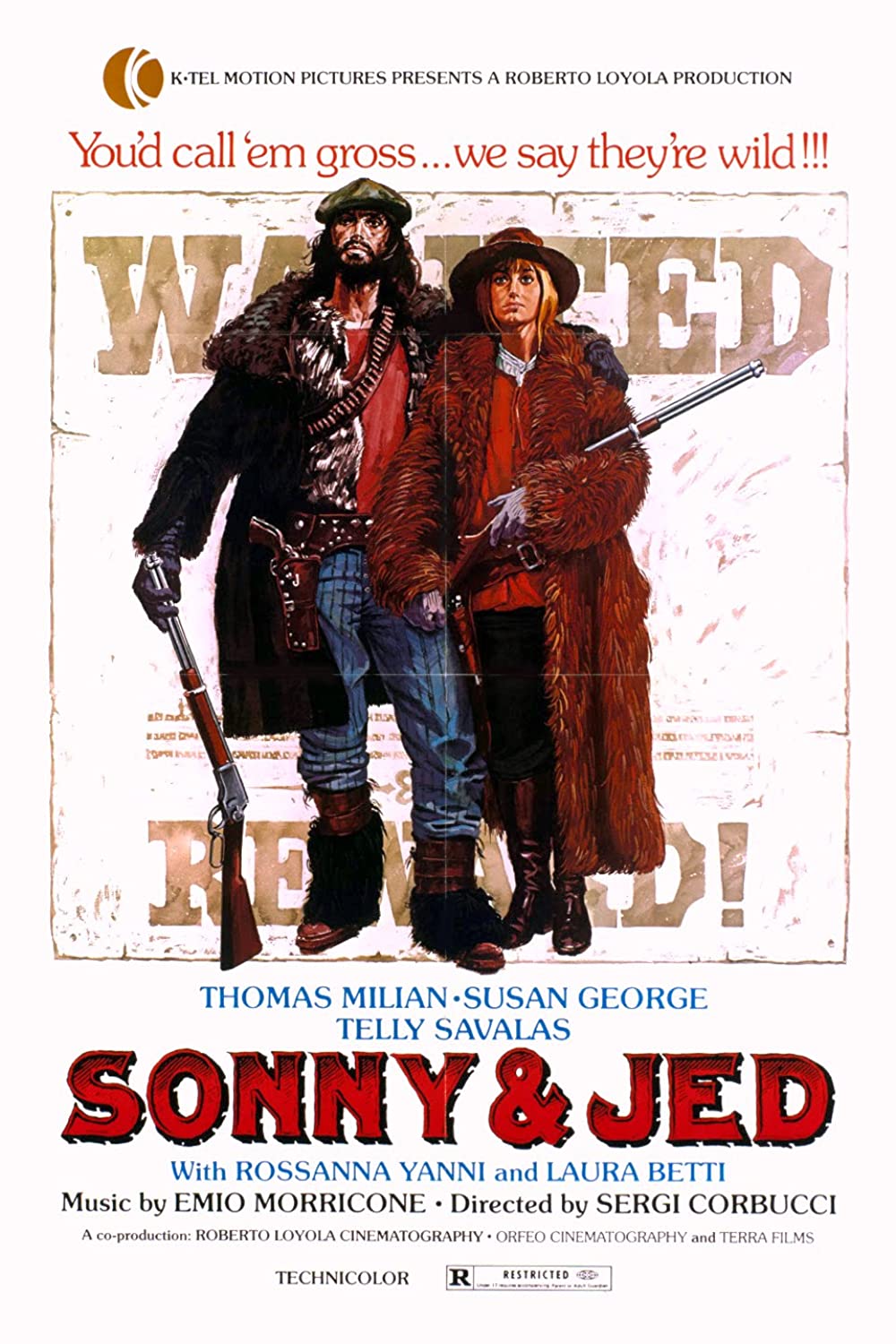
Jed (Thomas Milian) is an outlaw bank robber who sees himself as a modern day Robin Hood. Franciscus (Telly Savalas) is the sheriff determined to bring him in. When Francisus gets hot on Jed’s trail Jed uses the aid of beautiful young Sonny (Susan George) to evade capture. Sonny immediately becomes smitten with Jed despite the fact that he’s a very vocal misogynist. Sonny though ignores this as she’s so deeply wants to be in a loving relationship that she puts up with the abuse and even asks him to marry her, which he does, but his abuse continues. Jed then sets his sights on Linda (Rosanna Yanni) the wife of rich land baron Don Garcia (Eduardo Fajardo). Jed likes the fact that she has big breasts, which Sonny doesn’t, but when he puts the moves on her Sonny fights back by turning the tables on him and treating him in the same way that he did her.

After watching only a few minutes it’s easy to see why the spaghetti westerns went out of style as this lacks the lyrical quality of a Sergio Leone film, which put this unique genre on the map. Leone had that special knack that could mesh violence with subtle humor and make every scene, even one as insignificant as seeing flies fly around a person’t face, interesting. Sergio Corbucci, who directed this one, lacks that same ability and while he helmed some westerns in the 60’s this one doesn’t have a good balance. The action is bereft of any excitement while the humor is heavy-handed. The musical score by the always reliable Ennio Morricone is excellent, but everything else falls flat.

The storyline is the most annoying as Jed is too unlikable for anyone to want to fall in love with. His caustic comments on women are quite outlandish by today’s standards, which may offend some though others may get a kick out of it simply for the outrageousness. I have no doubt men back then may have been very much like his character, so on that end you could say it’s realistic, but having Sonny grow attached to him was off-putting. If he had reformed and then gotten married it might’ve made more sense, but to have the marriage occur in the middle when he’s still treating her like crap including one scene where he rapes her, just doesn’t work. His character does change a little at the very end, but it’s not enough to justify all she goes through and there’s no resolution as it shows them continuing to bicker without answering whether they were ever able to work things out, or ultimately broke-up.

Having Sonny so desperate to be loved, even at one point spying on another couple who are kissing and feeling envious, isn’t a sufficient enough reason for her to put up with the awful way he treats her. If she had been homely then maybe, but she’s actually quite attractive and could easily hold-out for something better making the way she throws herself at him too precipitous. Her character also needed more of an arc. The film teases this concept, but ultimately pulls-back when it should’ve pushed forward.

Milian’s performance is an acquired taste. Besides being vulgar and crude he also at one point scarfs up his spaghetti in such a slobbering manner that it’s genuinely disgusting and in another scene he gets under a cow and puts his lips directly over its teat and sucks the milk right out. Savalas, who is usually quite good in villainous roles, is only okay here. He’s supposed to be a relentless pursuer, but then allows Jed to escape while on a water raft instead of shooting him making him seem less threatening than he should.

Overall, this was George’s vehicle as she’s thoroughly engaging even able to mask her accent, which not all British performers can do, and at her most beautiful. I can only presume it was because of Milian’s star power that his character wasn’t downplayed because the movie would’ve worked better had it been solely centered around her and it’s just a shame she wasn’t given the keys.

My Rating: 5 out of 10

Released: August 11, 1972

Runtime: 1 Hour 32 Minutes

Rated R

Director: Sergio Corbucci

Studio: Titanus

Available: DVD-R

A Small Town in Texas (1976)

small1

By Richard Winters

My Rating: 4 out of 10

4-Word Review: Chased by crooked sheriff.

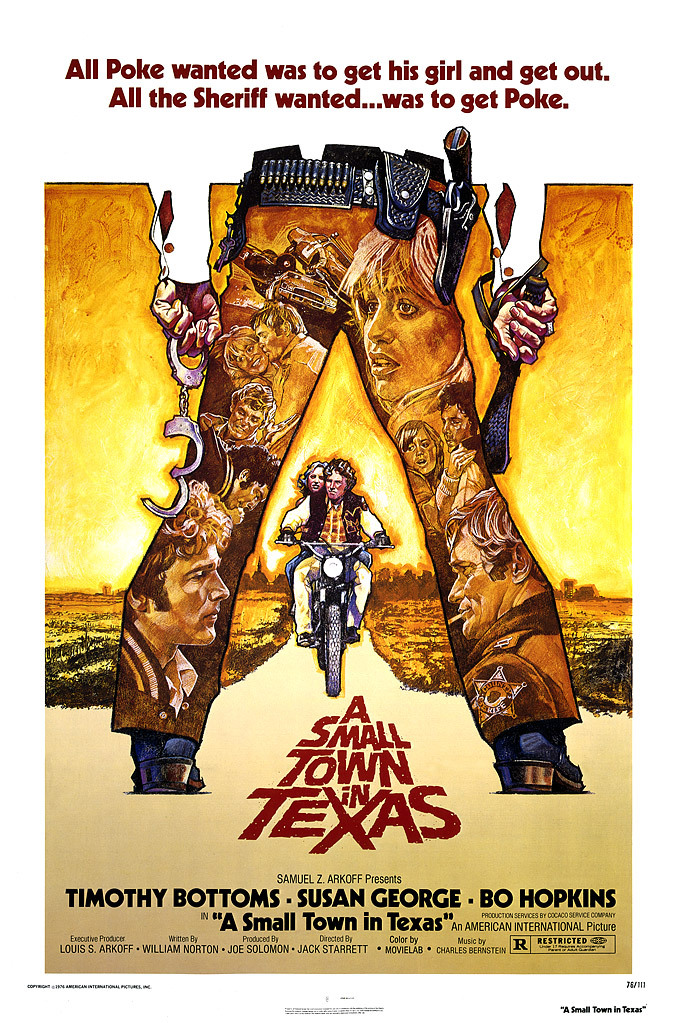
Poke (Timothy Bottoms) returns to his hometown in Texas after serving a 5-year sentence for marijuana procession. He finds that his girlfriend Mary Lee (Susan George), during the time he was away, has gotten into a relationship with the sheriff Duke (Bo Hopkins) who was also the man who convicted Poke that got him sent away. Poke begins harassing Duke for messing around with Mary Lee and follows him to a political event where Duke is in charge of guarding Jesus Mendez (Santos Reyes) who’s running for congress. It is here that he witnesses an assassin shooting Mendez and then watches Duke kill the shooter and take an envelope out of the killer’s pocket and put it in the trash. Poke retrieves the envelope and finds $25,000 inside. When Duke comes back to get the envelope and sees it’s gone he puts out an APB to have Poke arrested, which leads to an all-out car chase.

I couldn’t help but wonder if this was one of the career outputs that screenwriter William Norton considered ‘stupid’ as he was noted to having told his nurse on his deathbed that she ‘wasn’t dumb enough’ to have known any of the movies he had written. It’s not like it’s bad, but it isn’t particularly exciting either and takes 50-minutes before the first car chase gets going. Laying the ground work for the story is too leisurely. Instead of having Poke and Duke discuss how he had convicted him years earlier the drug bust should’ve been played-out right at the start to at least have given it a little more action.

The chases are impressive once they get going and at one point I literally winced as a car crashed into another and made me feel like I was actually in the vehicle and feeling the impact. Another has a police vehicle bursting into flames and a cop getting out screaming while flames shoot out his back, which was surprising since they must’ve blocked off the entire town center (filmed in Lockhart, Texas) to do it and most likely took an entire day to do, so there clearly was no compromising on the quality of the stunt work just because it was shot on-location versus in a closed studio lot. You also get to see a car crash through a giant block of ice, which marked a cinema first.

Bottoms though is weak creating a transparent character with no interesting arch, or personality and doesn’t even seem to be from Texas as unlike the others he has no Texan accent. Susan George at least conveyed an authentic sounding accent while masking her British one, so her presence gets strong points. Hopkins lends some interesting nuance as the bad guy and the sheriff wasn’t played-up as being an aging authoritarian, small-minded hick like in other films from this genre. Sure he was later found to be corrupt, but more like a cog in a bigger game instead of the center of it.

Spoiler Alert!

Story-wise there’s a lot of unanswered questions like why was Mendoza shot, which is later revealed to have been orchestrated by C.J. Barry (Morgan Woodward) a rich rancher who initially seemed very much behind Mendoza’s campaign, so why the double-cross? Why also would they think it would be a good idea to openly kill one of the men working for them? Who’s going to want to do a hit for them in the future if word gets out that the organization will use you as cover? Since this was a candidate for a major political party it was hard to believe that the investigation would be left solely to the small town sheriff to pursue as I’d be pretty sure federal agents would get called in.

My Rating: 4 out of 10

Released: June 2, 1976

Runtime: 1 Hour 36 Minutes

Rated R

Director: Jack Starrett

Studio: American International Pictures

Available: DVD-R (MGM Limited Edition Collection)

Fright (1971)

By Richard Winters

My Rating: 4 out of 10

4-Word Review: Psycho torments a babysitter.

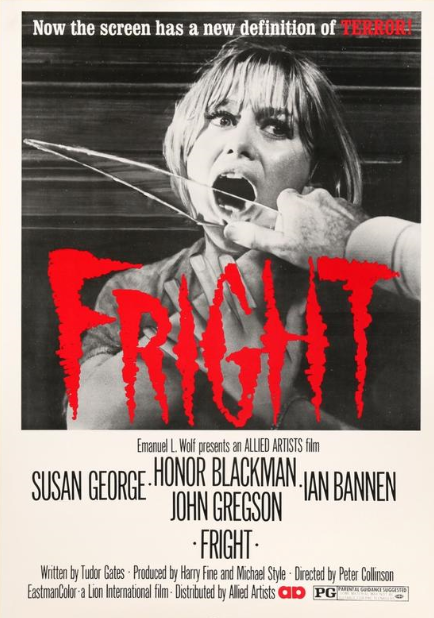
Amanda (Susan George) is a college student who earns money part-time by working as a babysitter. One night she takes a job with the Lloyds (Honor Blackman, George Cole) who assign her to watch after their sleeping toddler (Tara Collinson) at their isolated wooded estate while they go off to a dinner party. Once the couple leaves Amanda begins hearing strange noises and becomes convinced that someone outside is watching her unaware that Mrs. Lloyd’s ex-husband (Ian Bannen) has escaped from the nearby insane asylum and now looking to attack anyone inside.

While the babysitter-terrorized-by-a-psycho theme may now be considered a cliché with such popular films as Halloween and When a Stranger Calls having successfully done it it’s important to realize that this film did it first and to some extent does pretty well although it does veer off from the formula. I did like the creepy set-up where an extended amount of time is given to building up the atmosphere. Some of the best moments are seeing the shadowy images on the other side of the window and not knowing who it is. The film is most effective when it’s seen from Amanda’s point-of-view making the viewer feel trapped inside the home alongside her, but weakens when it cuts away to the outside, which lessens the tension.

Having Amanda’s boyfriend Chris (Dennis Waterman) arrive doesn’t help. The fear hinges on Amanda feeling that she is all alone in this big strange house in the middle-of-nowhere and entering more people into the mix takes that element away.

The film is unusual in that unlike the other thrillers with a similar plotline the parents here figure heavily into the story. Instead of just focusing exclusively on the babysitter the films consistently cuts between her scenes and the scenes of the couple at the party. In many ways its the mother that becomes the real star, which is fine to an extent, but the part is played by Honor Blackman, a very gifted actress, but at age 46 was looking way too old to be the mother of such a young child.

The film is also unusual in that when the police arrive it doesn’t just end in fact that’s when it starts to get going with the entire third act filled with this long protracted stand-off. To some degree I felt this made it more realistic as real-life hostage situations can happen with long ‘negotiating’ session between the police and the person inside. Police aren’t always able to immediately take control of a situation either and can sometimes be just as helpless as the victim, but in the process this approach takes away the confrontational element between Amanda and the psycho, which would’ve been more interesting at seeing how she could use her wits to outsmart the bad guy that never really gels.

Susan George really doesn’t figuring in as much of the action as you’d initially expect spends most of the time just crying and looking scared. The 3-year-old child, which was played by the daughter of the film’s director Peter Collinson, doesn’t help matters either. I found it very hard to believe that any child could remain asleep such as this one when Amanda and the psycho stood over her crib talking and at certain points even shouting. The child never screams or cries either even when a sharp piece of a broken-off mirror is put to her throat.

Bannen can be amazingly creepy, I enjoyed his work in The Offence where he played a suspected child killer being interrogated by Sean Connery, but here he’s given a bit too much latitude and becomes a caricature. Having him seesaw between being child-like to behaving aggressively comes off as manufactured and more strained than frightening.

Spoiler Alert!

The ending, in which Amanda shoots and kills the psycho, does not work. For one thing Bannen had already handed over the child to the mother and at that point was completed surrounded by the police with nowhere to run, so killing him wasn’t needed. It’s questionable how and where Amanda got the gun, supposedly it was the one that an officer had put down earlier, but how she was able to sneak up and get it from him is never explained. Also, she had most likely never shot a gun before, in Great Britain most people don’t own guns, so she’d probably not have been able to hit him, especially in her shaky emotional state, at a long distance, which makes this scene dumb and unnecessary.

My Rating: 4 out of 10

Released: September 18, 1971

Runtime: 1 Hour 27 Minutes

Rated PG

Director: Peter Collinson

Studio: British Lion Film Corporation

Available: DVD, Blu-ray, Amazon Video