Tag Archives: Review

Antonia and Jane (1991)

antonia and jane 1

By Richard Winters

My Rating: 7 out of 10

4-Word Review: Friends aren’t always friends.

Jane (Imelda Staunton) is a depressed single woman slipping into middle-age and jealous of her lifelong friend Antonia (Saskia Reeves) who she feels is prettier and gets all the breaks. Jane pours her thoughts out to her therapist (Brenda Bruce), but the twist is that Antonia sees the same therapist and is having the same problems only in reverse as she is jealous of Jane. The first half-hour looks at things from Jane’s point-of-view while the second half shows it from Antonia’s.

The element that really makes this movie so enjoyable is the cutaways. Everything talked about during their sessions is recreated visually. These recreations are all quite funny. Some of my favorites are when Jane talks about a trip to Canada and we see her pushing over a tall pine tree with one hand. There is also the segment where Antonia’s 10-year-old son gives a raunchy stand-up comedy routine to his friends during his birthday party. The part where the two find themselves trapped in an old French war movie complete with them speaking fluid French and subtitles is quite creative as is the many different and colorful outfits that the two wear each year when they get together for their annual visit with the other.

Somehow friendships between females are quite different than the ones of their male counterparts. Harbored jealousies and insecurities seem to always lurk beneath the surface no matter how ‘happy’ their facades and this film explores them with biting and accurate detail as well as showing how skewed people’s perspectives can sometimes be. I also found myself digging the name Antonia and wondered why we don’t hear more women named that so…

Memo to all young couples and parents to be: Let’s get a few more  Antonias out there and a few less Ashleys. Thank You.

The Howard character played by Bill Nighy is also quite amusing. Jane meets him at an art exhibit where he displays big blown-up black and white photographs of twenty-four different naked rear-ends. The two go down the line and analyze each and every one, which in a strange way I thought was kind of interesting. I also got a kick out of the way he asks Jane out on a date.

Howard: Are you involved in a long-term monogamous mutually self-absorbed sexual relationship?

Jane: No.

Howard: Me neither.

In an effort to keep the quirkiness going the two women characters sometime do strange things that at times makes them hard to relate to and is the film’s only real weakness. For instance Antonia tells Jane that she is having an affair with Jane’s husband and Jane becomes very supportive of it and attends their wedding even though most people would probably want to kill their friend if they told them that and the unfaithful husband to boot. There is another scene where Antonia meets a stranger at a theater and goes back to his place for sex and even allows herself to get tied up during some kinky bondage games, which most viewers will consider being too reckless and putting oneself into too vulnerable a position with someone they don’t even know.

Usually films that seemed obsessed with tying everything together get overdone and annoying, but here the ironies are hilarious and become funnier as it goes along. Strangely it is the very end where the film loses it flamboyance and instead gives us a nice, simple scene of genuine human affection that leaves the strongest impact in this very offbeat and entertaining gem.

My Rating: 7 out of 10

Released: November 2, 1991

Runtime: 1Hour 15Minutes

Rated R

Director: Beeban Kidron

Studio: Miramax

Available: VHS
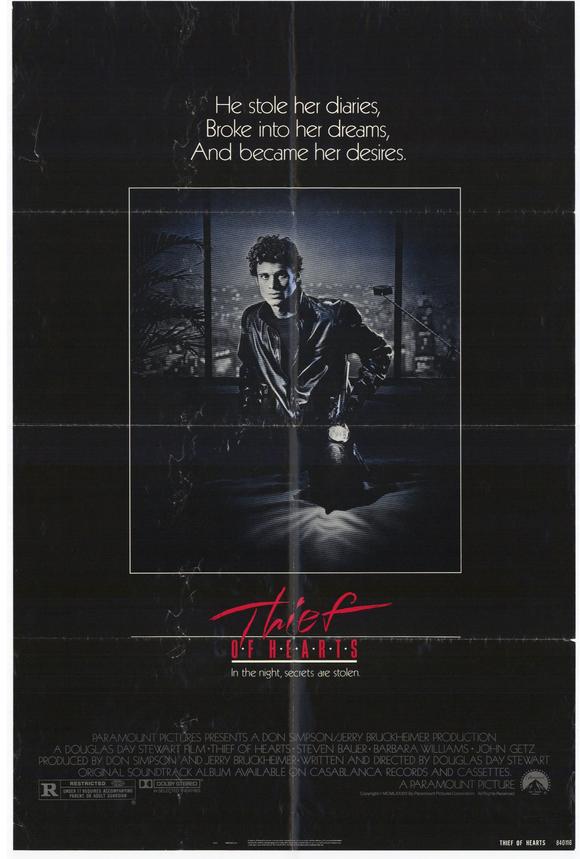
Thief of Hearts (1984)

thief of hearts

By Richard Winters

My Rating: 3 out of 10

4-Word Review: He knows her secrets.

Scott, who is played by actor Steven Bauer looking more like a heartthrob than a common criminal, robs the house of an affluent couple. He takes the diaries of the wife Mickey (Barbara Williams) and begins to read them. He starts to obsess over her and decides to try to woo her by using the knowledge of her ‘secret fantasies’ that he has learned.

Overall this is a draggy, one-dimensional film that is too programmed to the female viewer and eventually becomes like a soap opera. Exploring one’s fantasy world could have been interesting, but this thing barely touches the surface especially since her ‘fantasies’ are so ordinary and predictable that they hardly seem like a secret at all.

The characters are standard and unappealing. There is Janie (Christine Ebersole) the nosy co-worker who always seems ‘horny’. There is also the self- absorbed husband Ray (John Getz) who is such a doofus you wonder how they ever got married in the first place. Mickey our heroine is supposed to be the sensitive and conscientious one. Her perpetually worried and uncomfortable expression is intended to signify this. Yet she surrenders to Scott and his very obvious courting with little or no resistance. She makes her marriage look like it was meaningless and her morals quite dubious. Most viewers probably won’t sympathize with her especially since her marriage really wasn’t that bad and was simply suffering from the typical growing pains.

The sex scenes are a bore and not even worth five cents at a peep show. The music is bland and the songs (by Melissa Manchester) forgettable. The resolution- like ending is too protracted. The film is also humorless, but does have one unintentionally funny scene involving Mickey’s very hooky redecorating of Scott’s otherwise cool looking pad that supposedly makes it look better, but really doesn’t.

The only good thing about this film is David Caruso. He looks different and much younger here. He plays his sleazy rat-like character to the hilt and gives this dud a real boost of energy and should be mandatory viewing for any Caruso fan.

My Rating: 3 out of 10

Released: October 19, 1984

Runtime: 1Hour 40Minutes

Rated R

Director: Douglas Day Stewart

Studio: Paramount

Available: VHS, DVD, Amazon Instant Video

All Fall Down (1962)

all fall down

By Richard Winters

My Rating: 7 out of 10

4-Word Review: Don’t idolize older brother.

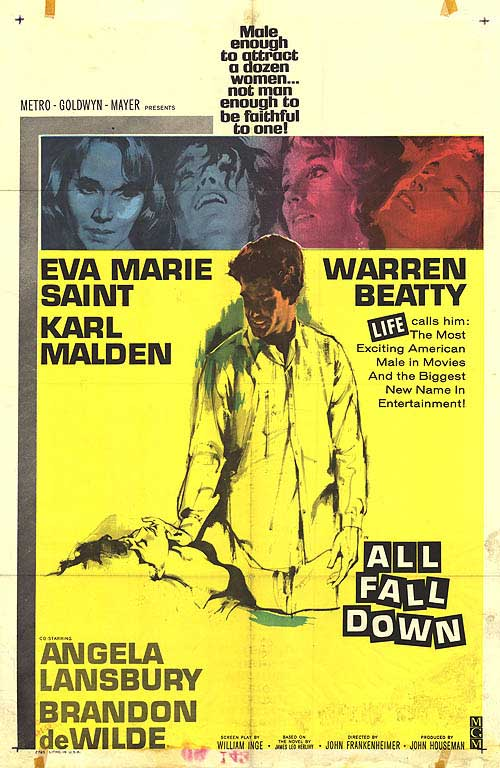
Berry-Berry (Warren Beatty) is the malcontent son of Annabell and Ralph Willart (Angela Lansbury, Karl Malden) who is unable to hold down a steady job, is in constant brushes with the law, and beats up his girlfriends. Yet women seem attracted to his rugged good looks, his parents continue to dote on him and overlook his flaws and his younger brother Clinton (Brandon De Wilde) idolizes him. All that changes when Echo (Eva Marie Saint) comes to visit. Clinton falls for her, but when she meets Berry-Berry she instead goes for him. When he mistreats her Clinton finally sees his brother for who he is and decides to take matters into his own hands.

Although overall this is a great production one of the biggest problems I had with it is the name for the leading character. Who names their kid Berry-Berry? I have never heard of that name before and it sounds corny and silly even annoying every time it comes out of one of the character’s mouths. I was almost surprised that the actors didn’t crack-up every time they had to say it. I felt there should have been an explanation for it, but none ever comes. In my mind giving a kid that stupid name is probably the whole reason he became so troubled and difficult in his adult life.

As for the character itself I wanted more of a history to see why he became the way he did. There is no backstory and in that regard the film seems weak and even frustrating. Despite being billed as the star Beatty is not really seen all that much especially during the first hour and in some ways the film comes off more like an ensemble drama. Also, having women fall for him after literally just setting their eyes on him seemed exaggerated and overdone.

Beatty has all the necessary leading man qualities, but in this instance I don’t think he was right for the part. His performance is too reserved and aloof. I didn’t see him conveying the deep seated anger that the part demanded. In many ways it is De Wilde who gives a far stronger performance and steals the film. His boyish face and charm makes for a fantastic contrast to Beatty’s.

Lansbury is sensational. She was only in her thirties at the time, but plays a woman in her fifties and does so convincingly as well as putting on a good accent. Two of her best moments come when her husband brings home three homeless men for the holidays and she insists they only want money and not the comfort of human companionship that her husband believes and the way she proves it is amusing. The part near the end where she defends her eldest son despite all his ugly flaws is brief, but strong and one of the film’s defining moments.

Saint is also excellent in support and so is Madame Spivy. She was a bar owner in real life and plays one here. She had a masculine build and a very no-nonsense demeanor, which comes out when she throws the under aged Clinton out of her establishment.

Director John Frankenheimer does well with the material. The on-locations shooting done in Key West, Florida is striking particularly at the beginning. His use of a rain storm makes a particularly strong dramatic sequence even stronger. However, the screenplay was written by William Inge and based on a novel by James Leo Herlihy. Inge was a noted playwright and the script seems more suited for the stage as it is quite talky and lacking in cinematic elements.

My Rating: 7 out of 10

Released: March 28, 1962

Runtime: 1Hour 51Minutes

Not Rated

Director: John Frankenheimer

Studio: MGM

Available: DVD (Warner Archive), Amazon Instant Video

Night Call Nurses (1972)

night call nurses 1

By Richard Winters

My Rating: 2 out of 10

4-Word Review: Sex makes good medicine.

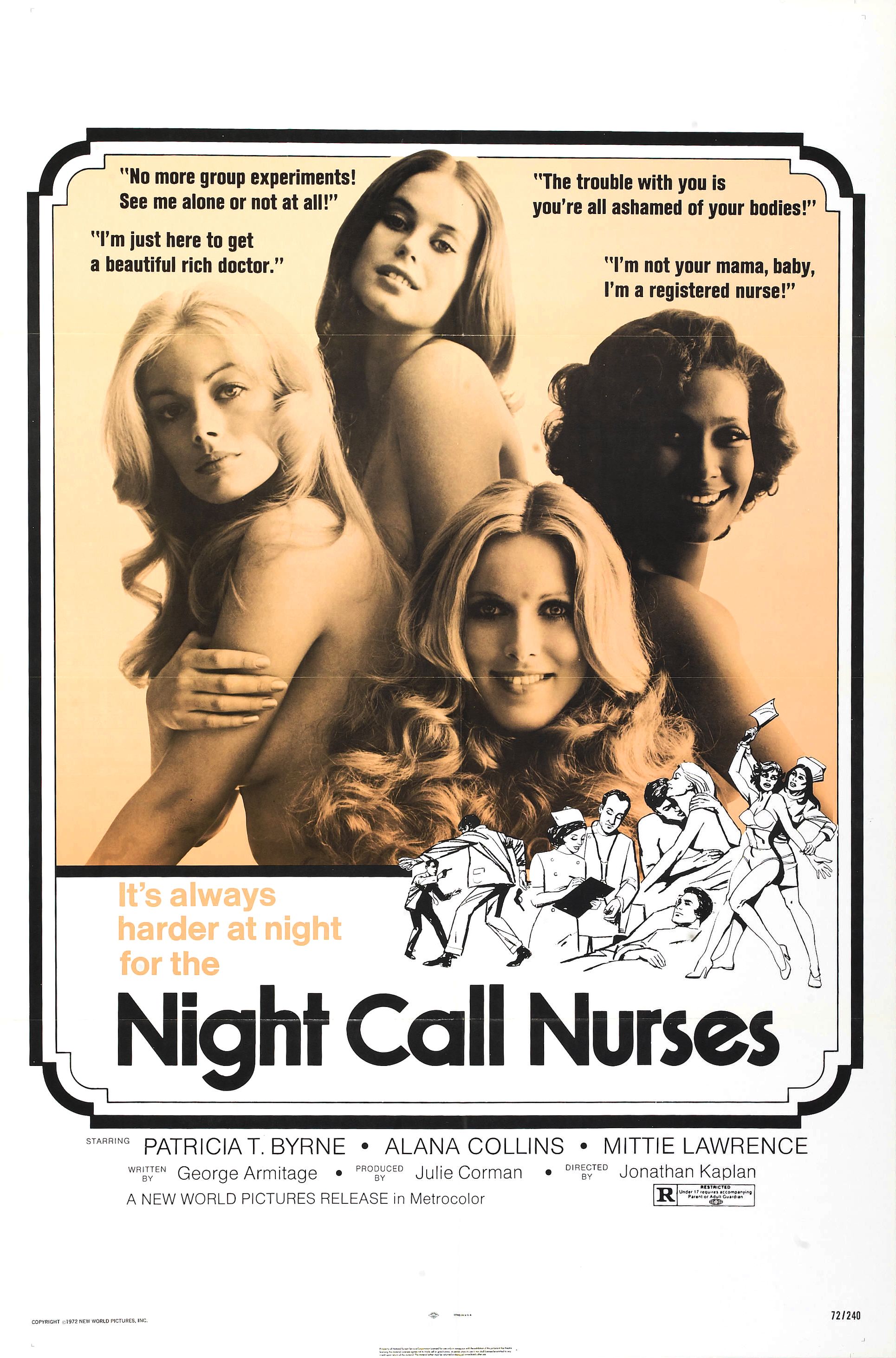
Barbara (Patty Byrne), Janis (Alana Stewart), and Sandra (Mittie Lawrence) are three young women starting out in the nursing field. The film analyzes their various and sometimes amusing predicaments while on the job as well as their sex lives.

The film moves at a decent pace, but seems disjointed with poor story and character progression. Things are thrown in just to keep it moving, but with no real connection to anything else. Amateurish production values permeate and Jonathan Kaplan’s directorial debut is for the most part best forgotten. The only mildly interesting scene involved a therapy group where all the members strip off their clothes as well as having one of the members think that she is being driven insane by the group’s instructor.

The attempts at lightheartedness and humor are strained and flat. Only one brief exchange during the entire duration managed to elicit a small chuckle from myself and it goes like this:

Male Patient: (While looking at the nurse’s nametag on her uniform) Is Janis your name, or the name of your left titty?

Janis: (While giggling) Janis is my name. Irene is the name of my left tiitty.

The acting is quite poor with everyone phoning in their parts. Alana Stewart who was at one time the wife of actor George Hamilton and later rock legend Rod Stewart as well as the mother of Ashley Hamilton and Kimberly Stewart mouths her lines in a lifeless and emotionless fashion that resembles her beautiful but blank blue eyes. However, recent pics of her are amazing as she looks like she hasn’t aged a day since she has done this and I’ll give her credit there. Despite only doing one other picture besides this one Byrne is the one that gives the strongest performance particularly her effective crying, which seems real.

There is enough nudity to satisfy the voyeurs including the opening sequence where one of the mentally-ill patients’ strips off her clothes and then jumps off the roof of a building. However, you basically only see their breasts and the sex is handled in such a mechanical and unimaginative way that it fails to titillate at all.

The Shout Factory DVD issue has a great picture quality much like Private Duty Nurses, but the sound is a problem. There is a background rumbling heard throughout that resembles talking to someone on the phone with wind blowing through the receiver, or speaking to someone in the car with the windows down and wind blowing in.

My Rating: 2 out of 10

Released: June 10, 1972

Runtime: 1Hour 14Minutes

Rated R

Director: Jonathan Kaplan

Studio: New World Pictures

Available: DVD (Roger Corman’s Nurses Collection) 

Heathers (1988)

heathers

By Richard Winters

My Rating: 7 out of 10

4-Word Review: These girls are bitches.

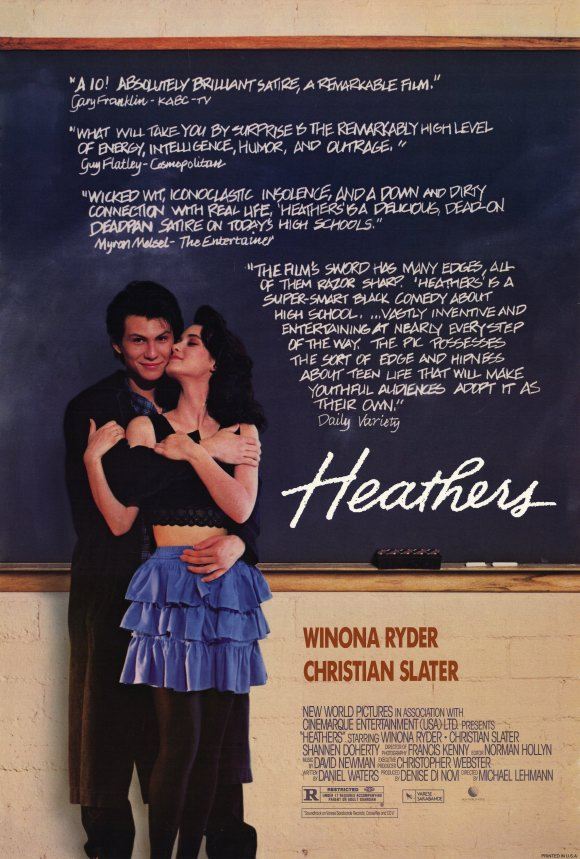
Heathers (Kim Walker, Shannon Doherty, Lisanne Falk) are three beautiful teens all with the same first name of Heather who act as the bitch queens of their Ohio high school. Veronica (Wynona Ryder) strives to be accepted into their exclusive clique and eventually does, but feels guilty about having to ignore her old friends as well as not particularly liking her new ‘friends’. In comes J.D. (Christian Slater) a rebel who decides to shake up the status system by killing off all of the snotty girls and jocks and making it look like suicides. Veronica reluctantly goes along with it, but when J.D. decides to blow up the entire school in order to make ‘a statement’ she decides things have gone too far.

Daniel Water’s dark script is incisively on-target and filled with original quotable lines of dialogue. Director Michael Lehmann gives the proceedings a nicely surreal touch with just a pinch of satire with the funeral scenes of the victims being the funniest and most creative. The characters are pretty much portrayed on the negative side, but the caricatures have a lot of truth to them and it reminded me a lot of my high school days.

What really makes this stand out from other 80’s high school movies is the fact that it transcends the teen culture by showing how the adult world really isn’t much better and this high school is simply a microcosm of a cold, screwed-up world that it inhabits. In fact Veronica’s mother (Jennifer Rhodes) says it best when she states: “When teenagers complain that they want to be treated more like adults it is usually because they are being treated like one.”

Ryder is superb and I still consider this to be the best role of her career. The fact that the character is morally dubious, but still manages to stay likable makes it all the more fascinating. Christian Slater’s Jack Nicholson impersonation is irritating, but he is still a good pick for the part. The two share some particularly good exchanges including this one:

Veronica: “I just killed my best friend.”

J.D.: “And your worst enemy.”

Veronica: “Same difference.”

I must admit that I fell completely in-love with Kim Walker as Heather #1 as she possesses an amazingly beautiful face, which would be enough to make me want to watch her regardless of acting skills. I’m surprised that her career never took off and she was relegated to supporting roles in minor productions.

kim walker 1

However, she does get two great lines including:

“Fuck me gently with a chainsaw.”

And her most famous one:

“Did you have a brain tumor for breakfast?”

Unfortunately she gets killed off much too quickly when she is tricked into drinking some drain cleaner supplied to her by J.D., but she still looks  beautiful even with blue teeth and a blue tongue. What is even sadder and more perplexing is that in real-life she died at the young age of 32 by believe-it-or-not a brain tumor.

kim walker 2

Falk as Heather #2 is attractive as well although not quite like Walker. Her career never skyrocketed either and her biggest claim to fame outside of this is that she was the model on the cover of Foreigner’s Head Games album. Doherty as the third Heather may be the most famous of the three, but she is not as attractive. For the first half she didn’t even seem all that effectual but comes into her bitchy best during the second part.

Despite the fact that the teens were not using cell phones, or texting, or had any of the other technological advances of today the film doesn’t seem dated, which is another plus. Only two scenes really stood out to me in this area. One is when J.D. shoots at a couple of mean jocks (who are characterized in amusingly dim-witted style) with a gun full of blanks and he doesn’t get into any trouble for it. Off course in 1988 school shootings were unheard of, but today the place would be put on lockdown and J.D. would not only be suspended but probably serve some jail time blanks or not. Another scene involves Veronica and J.D. planning to ‘humiliate’ these same jocks by making it look like they are gay lovers, which today would get Veronica and J.D. labeled as being homophobic.

Although I enjoyed the scene where J.D. gives Veronica the finger only to have it shot off I did find the second half not to be as slick and the concept itself seems to get stretched too thin. The script’s original ending called for a prom to take place in heaven and featuring the teens in different cliques than the ones they were in on earth, but unfortunately the suits at the studio in typically stupid fashion nixed that idea and went with a rather dopey and contrived one instead.

There is also ample argument to the fact that most investigators probably wouldn’t be fooled by these staged suicides and instead consider them the homicides that they were, but because it was all done in the satirical vein I’m willing to overlook it in what is otherwise one of the best high school movies ever made and one that enjoys a considerable cult following. There are also apparently rumors of turning the film into a TV-series where a grown Veronica returns to her hometown with her teen daughter who must now contend with a new generation of teen bitch queens named Ashley.

My Rating: 7 out of 10

Released: October 1, 1988

Runtime: 1Hour 43Minutes

Rated R

Director: Michael Lehmann

Studio: New World Pictures

Available: VHS, DVD, Blu-ray, Amazon Instant Video

Bob & Carol & Ted & Alice (1969)

bob and ted and carol and alice 2

By Richard Winters

My Rating: 7 out of 10

4-Word Review: 60’s style mate swapping.

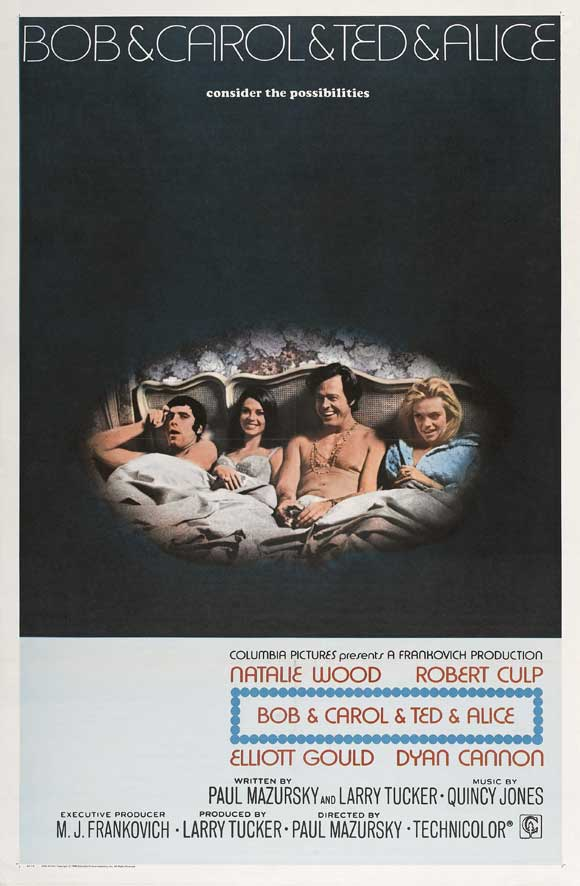
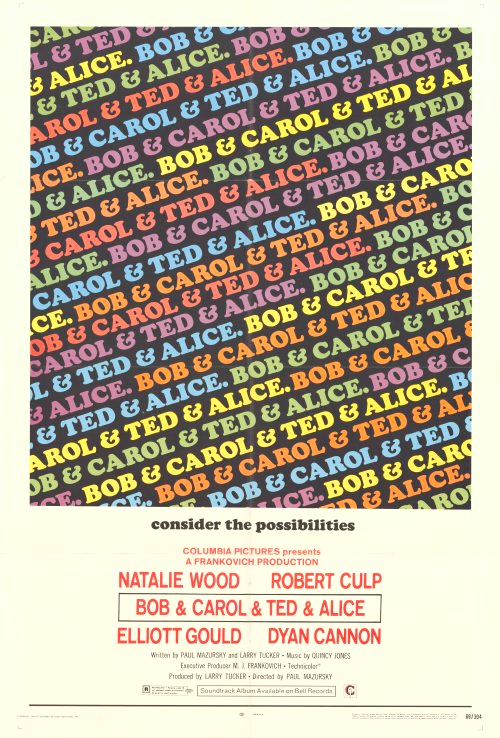
Bob and Carol Saunders (Robert Culp, Natalie Wood) attend a group therapy session at a remote cabin location. There they encounter other couples who learn to become open with their feelings and sexuality. When they return home they find that their friends Ted and Alice (Elliot Gould, Dyan Cannon) are too repressed and need to open up more with their true selves. At first the other couple is reluctant, but after spending more time with Bob and Carol and adjusting to their new way of thinking, which includes allowing their spouse to have sex with other partners they slowly come around and eventually all four have sex together.

Paul Mazursky makes a splendid directorial debut. During the late sixties most filmmakers were trying to reflect the times by making movies that featured quick edits, zany plots, and surreal elements, but Mazursky slows it all down keeping the humor on a subtle level and making great use of silence. The envelope pushing subject matter is handled in refreshingly non-judgmental way. Some films from the era would take on some of the more racy topics of the day, but still feel the need to put in a ‘moral center’, but fortunately here that is not the case. Mazursky shows a respect for his adult audience by keeping the entire thing on an uncompromised sophisticated level. When I first saw the film over 20 years ago I felt it was too talky, but upon second viewing that opinion has mellowed and I now find the long takes gives it a nice improvisational feel.

One of the best moments of the film is the very beginning where we see an aerial shot of the remote cabin where the group encounter takes place as well as the open nudity by the participants and Bob and Carol driving up through the scenic locale on a curving road. Quincy Jones’s booming orchestral score adds to the already striking ambience. The scenes from the encounter group is handled almost in a documentary style analyzing not so much what it talked about, but instead on the different emotional reactions that the members have throughout it. The scene where Bob admits to Carol that he had an affair and instead of being angered by it she accepts it, which turns them on enough that they end up making love on their bathroom floor is funny as is the opposite reaction that Ted and Alice have when Carol tells them the ‘good news’.  I also found Alice’s therapy session to be fascinating namely because it seemed quite authentic and was done by an actual licensed psychiatrist (Donald F. Muhich) who at the time was Mazursky real life therapist.

Wood gives a strong and amazing performance in one of her best and unfairly neglected roles. Having seen interviews that she gave I was aware that she was raised in a sheltered environment, so it is interesting seeing her in a part of a liberated woman embracing the new modern morality. The wild look in her eyes sizzles from the screen and she looks awesome in a bikini a well.

Cannon is good as Wood’s polar opposite a woman who is reluctant to let go of the values of her more repressed era and yet still curious about trying. Having the character evolve as the film progresses makes it  interesting.

The two male leads are okay, but the underpants that Gould wears during the final scene where they undress are overly big to the point of almost looking like adult diapers.

The only real complaint that I have with the film is that the famous scene where the four characters all go to bed together doesn’t happen until the very end, which could prove frustrating to some viewers since that scene is the film’s most famous and one that was used for its promotion. I had no problem with the film showing the various events that led up to it happening as it was essential and intelligently done, but it does not show what happens to the characters after they do it. I felt a better structure for the film would have been to have the scene where they go to bed together happen right away at the beginning and then spend the rest of the film cutting back and forth showing what lead up to it as well as scenes showing how the characters went on with their lives and how they dealt with each other afterwards.

This is a great film because it shows the 60’s experience from a middle-aged person’s perspective and the confusion that it created. People observing the new free love generation from the outside looking  in still straddled with the more repressive values of the past and unsure about how or even if they should jump in.

bob and ted and carol and alice

My Rating: 7 out of 10

Released: September 17, 1969

Runtime: 1Hour 45Minutes

Rated M (Later changed to R)

Director: Paul Mazursky

Studio: Columbia Pictures

Available: VHS, DVD, Amazon Instant Video

Private Duty Nurses (1971)

private duty nurses 2

By Richard Winters

My Rating: 4 out of 10

4-Word Review: Sex on the job.

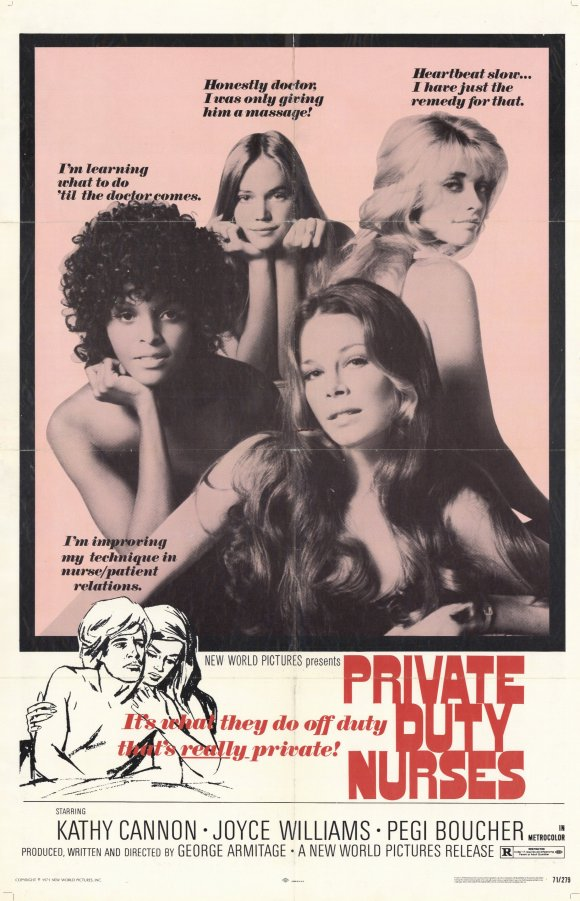
Three friends (Katherine Cannon, Joyce Williams, Pegi Boucher) join the nursing field and get their first jobs at a local hospital. Together they must deal with the pressures of the profession as well as the dating scene and some of the lecherous, cheating men that come with it.

If one approaches this thing with extremely modest expectations then it is not too bad. It is compact enough and moves at a decent pace and while not exactly compelling it isn’t completely boring either. The girls deal with a lot of problems that every generation goes through particularly on the relationship end, which gives it a certain relevancy. It is also nice see them doing some actual medical duties and in one case even saving a young child’s life.

Where it fails is in its misguided idea of trying to tackle ‘serious’ issues. The story thread dealing with Spring’s (Cannon) romance with biker Domino (Dennis Redfield) who has had several serious head injuries and is told if he gets just one more it could prove fatal and yet continues to race anyways is predictably overwrought. The thread dealing with racism has been done so much better in far superior productions that it seems almost pointless here and the way it gets resolved is a bit farfetched. The third story having to do with water pollution takes on too much and has a wrap-up that is too tidy. The dialogue during a lot of these scenes is corny and the characters are all cardboard.

The three female leads look gorgeous both with their clothes on and off. All three of them appear nude although it is basically just from the waist up. However, if you are a breast fan you should like the scenes here particularly those who enjoy ones that are natural and firm. The nudity is not prevalent, but should be enough to satisfy the skin aficionados. There is also a rape scene near the end that seems to come out of nowhere and gets a bit explicit.

The Shout factory deserves a ‘shout-out’ for their transfer. Although the sound quality isn’t the best and does feature a faint and constant clicking sound during the last half-hour the picture quality is superb. The colors are bright and vivid without any of the faded or grainy look that usually permeates most low budget transfers from the 70’s. To certain extent it comes off looking like it had just been filmed yesterday.

My Rating: 4 out of 10

Released: September 1, 1971

Runtime: 1Hour 20Minutes

Rated R

Director: George Armitage

Studio: New World Pictures

Available: DVD (The Nurses Collection)

Exotica (1994)

exotica

By Richard Winters

My Rating: 8 out of 10

4-Word Review: Obsessed with a stripper.

This is a fascinating and engrossing character study interweaving different characters and stories together until they become one. Bruce Greenwood plays Francis an accountant who frequents a strip bar and becomes fixated on a particular dancer named Christina (Mia Kirshner). Elias Koteas is the club D.J. who notices this obsession and becomes jealous since he at one time had a relationship with her. Thomas (Don Mckellar) is the nebbish pet shop owner who has a secret as well as a key between the three.

This is thoroughly compelling stuff that’s impossible to predict. The characters are believable, exposing traits you just don’t see in them at the start. Much like people you’d meet and get to know in real life each scene becomes like a piece to the puzzle.

Director Atom Egoyan may be a little too obsessed with tying everything together taking the final scene one step too far. Yet he still creates an interesting subtext. He seems to show how interconnected we all are to one another and how we can relate on different levels. The simple fact that we are human connects us no matter how ‘disconnected’ we may feel or be.

The sex club atmosphere is also taken from a different angle. He shows a much more complex and psychological motive behind it and how sex is only one element in it.

Like with Egoyan’s other films this thing is filled with a lot of philosophical banter and is quite humorless with a tendency to be a bit ‘heavy’. However, unlike The Sweet Hereafter it keeps moving and doesn’t get completely bogged down in it.

On the technical end the lighting is too washed out. The music selection is good, but oppressive. Overall though the film achieves what it wants too. It keeps your attention and remains thought provoking throughout.

My Rating: 8 out of 10

Released: May 16, 1994

Runtime: 1Hour 43Minutes

Rated R

Director: Atom Egoyan

Studio: Miramax

Available: VHS, DVD, Blu-ray

Visiting Hours (1982)

visiting hours 2

By Richard Winters

My Rating: 3 out of 10

4-Word Review: He doesn’t like women.

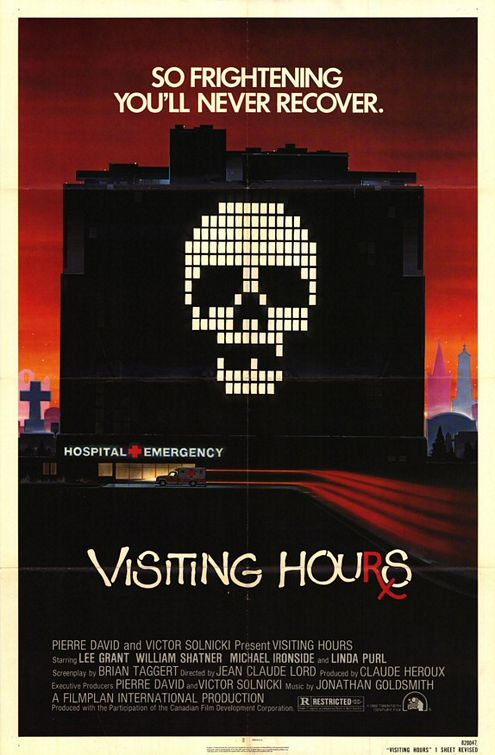
Deborah Ballin (Lee Grant) is an outspoken reporter who does a news segment dealing with domestic violence that angers misogynist Colt (Michael Ironside). For revenge he attacks her inside her home, but she manages to escape and gets treated at the local hospital. Unfortunately the psychotic Colt continues to stalk her inside the hospital, which causes her, other patients and the hospital staff to fear for their lives.

The script is predictable and unimaginative. It sticks to the tired 80’s slasher formula like it is a religion. The set-up is awkward and rushed while the rest of the film dealing with Colt’s perpetual stalking becomes prolonged and redundant. The scares lack excitement and the frights are non-existent. The only potentially interesting part that could’ve allowed this film to really stand out is when Deborah is taken into the operating room and put under anesthesia and thinks that the surgeon arriving to do the operation is Colt in disguise. The film teases the viewer with this possibility, but then chickens out.

The only novelty is having a 55-year-old actress as the heroine as opposed to the youthful, virginal looking types that get cast in these things in-part because of their screaming abilities. Having Grant playing a self-assured, confident character is refreshing change of pace for the genre, but then the film compromises even this by having Deborah’s young nurse played by Linda Purl become the target of Colt’s evil rage and by the end it’s Purl who has the most screen time.

Ironside is a competent actor and it is no surprise that he would be cast in the role of a killer due to his menacing facial features. He is talented enough to make the scenes he is in interesting despite the fact that he says less than 15 words during the whole film. Still the cutaways showing the reason for his mental illness being due to him witnessing as a child his mother throwing boiling water on his father is hooky. Also having him wear a small bell around his neck that rings every time he moves if awfully stupid for a person with a habit of stalking people.

The film has a similar concept to Halloween II that also dealt with a killer stalking a victim while inside a hospital, but here at least they use an actual hospital that is lighted the way a real hospital should be. The foot chase between Grant and Ironside that has them going to all areas of the building reminded me a little of the chase between Genvieve Bujold and Lance LeGault in the film Coma although that one is still far superior to the one here.

There are few mildly intense moments at the end that helps save this from being a complete boring waste, but still does little to make up for the rest of it that falls flat. Oh yeah, William Shatner also appears here in a pointless and dull role as Deborah’s boss.

My Rating: 3 out of 10

Released: May 21, 1982

Runtime: 1Hour 43Minutes

Rated R

Director: Jean-Claude Lord

Studio: 20th Century Fox

Available: DVD

All the Way Home (1963)

all the way home 2

By Richard Winters

My Rating: 8 out of 10

4-Word Review: Life must go on.

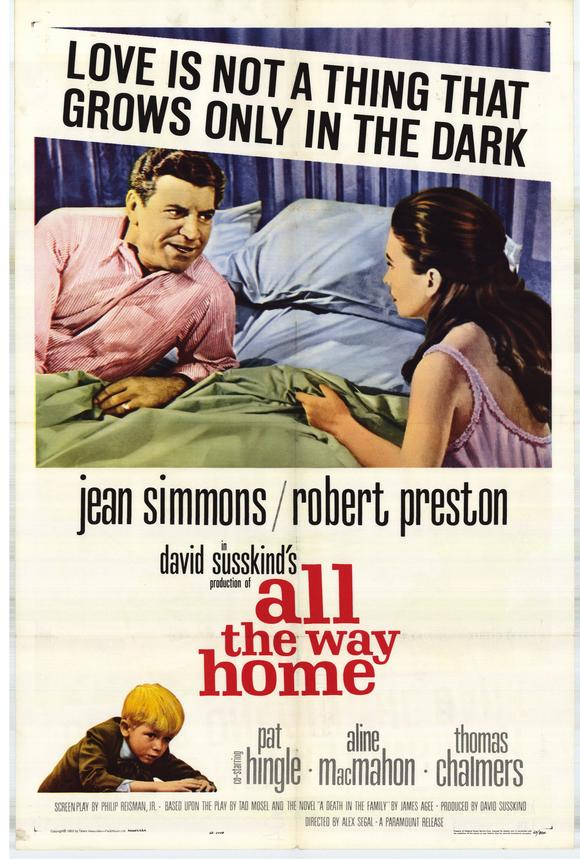
Based loosely on the childhood experiences of writer James Agee who is best known for penning the screenplay to the classic film Night of the Hunter.  The story here looks at how a southern family copes and in particular the young boy Rufus (Michael Kearney) after their father (Robert Preston) is tragically killed in a car accident.

Based on Agee’s unfinished novel ‘A Death in the Family’, which was also made into a stageplay the film makes loving tribute to the era. The sets and even the Model T car driven by the father are all authentic. In fact it was filmed near the exact neighborhood in Knoxville where Agee grew up. The mannerisms and dialogue are true to the period without any compromising for a more modern audience. The revisionism which has become so trendy in today’s period piece films is thankfully missing here. The slower and gentler pace seemed reflective of the era and I found it refreshing.

Preston gives one of his best roles second only to his signature one in The Music Man. He doesn’t get killed until the second half of the film, so the viewer gets to know and like the character and thus feels the pain of the loss along with the family members. We never see the actual accident nor given any explanation for what happened, which is just as well. Too many times filmmakers seemed compelled to have to give a reason for everything even though in life that is not always possible, so it is nice that here they did not fall into that trap. This emphasis instead is on how the family members cope and the emotional impact of the loss, which is something everyone must go through at some point and it ends up being quite compelling.

Kearney gives a terrific performance and one of the best from a child actor that I have seen. He is cute without ever being precocious. Watching him observe everyone else around him are some of the best moments in the film. It also brings up the great point that sometimes children are better at adapting to tragic events than their adult counterparts.

Durable character actor Pat Hingle gives one of his most interesting performances as Preston’s nervous and hyper brother. Preston has a great line in describing him when he says: “Talking to him is like putting socks on an octopus.”

Aline MacMahon is good as the kind, but stern aunt. I particularly liked the moment where Rufus falls to the ground in an emotional tantrum, but she restrains the others from helping him and insists that it is important that he learns to get himself up on his own. Jean Simmons as the mother and wife is also splendid, but seems to get better as the movie progresses particularly in her conversation with Rufus at the end, which is touching.

My Rating: 8 out of 10

Released: October 17, 1963

Runtime: 1Hour 37Minutes

Not Rated

Director: Alex Segal

Studio: Paramount

Available: Amazon Instant Video