Tag Archives: Nicholas Roeg

Eureka (1982)

eureka1

By Richard Winters

My Rating: 6 out of 10

4-Word Review: He discovers some gold.

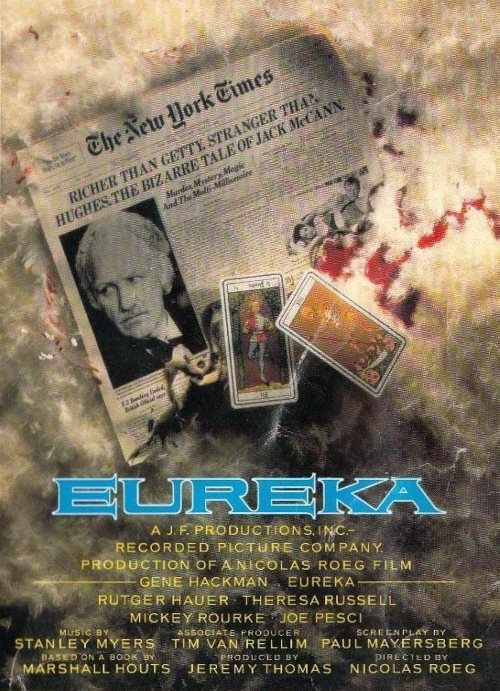
Jack (Gene Hackman) has been searching the Yukon for over 15 years in the hopes of one day coming upon some gold. Then one day he finds it and becomes super rich. 20 years later he’s living on his own island, married, and with a grown daughter named Tracy (Theresa Russell). Jack though has grown ornery through the years and has managed to alienate most of his family including Tracy’s husband Claude (Rutger Hauer) whom Jack can’t get along with and the two regularly argue to the point that it also affects his relationship with his daughter. Jack is also at odds with the local mobsters headed by Mayakofsky (Joe Pesci) who wanted to open a casino on the island and are willing to resort to any violent means necessary in order to get that done.

The film is based loosely on the life of Sir Harry Oakes who, like with the main character here, scoured many countries looking for gold for 15 years before finally laying claim to a fortune. He then retired to the Bahamas and ultimately was found murdered in 1943 in a crime that has remained unsolved. The studio though did not know what type of audience to aim the film to and thus shelved it for a year only to release it to limited theaters where it managed to recoup a paltry $123,572 out of its initial $11 million budget making it one of the biggest box office bombs in history.

As a visual exercise, given its director, its a spellbinding ride. Director Nicholas Roeg approaches it as a fable-like tale and creates the artic in a surreal type of way giving it an almost outer-worldly look and feel. To an extent this works and there’s a few memorable scenes including a barefoot man lying in the cold who blows his head-off, via a loaded gun, in one very unexpected, shocking moment that’s very realistically grisly. The death by blowtorch, which happens a bit later is effectively vivid as well. However, there’s other metaphysical elements like a mysterious stone that gets handed to Jack that alludes a bit too much to a magical quality and takes away that this is actually based on a true story and instead makes it seem like it’s all just a made-up metaphorical fable, which starts to have a pretentious quality.

The plot is too thin and the second act labors badly. Joe Pesci is a dynamic actor, but here his part is boring and he doesn’t come-off as threatening enough to give his scenes the proper tension. There’s also no insight given to why the gangsters choose to pick-on Jack, as this is a man who is quite rich and could hire his own protection and enforcers and not someone you’d think could be easily intimidated. So why bother with him at all and just find another island to build a casino on? In the real-life incident Harry Oakes went out of way to try to ban casinos from the entire island nation as he did not approve of gambling and thus caused the ire of the criminal underworld, but the movie doesn’t bother to explain this and thus makes the motivations of the bad guys confusing.

Acting-wise its a joy to watch especially Hackman. He has played so many heroes in his film career that it’s fun seeing him be a jerk and he does it well particularly when he gets on his alcoholic wife about ‘laying off the sauce’. Ed Lauter, who’s usually a heavy, is entertaining with this constant nervous look on his face as he ends up being the reluctant middle-man who gets played by both sides. Rutger Hauer is brilliant as usual giving each of his moments a creepy finesse as only he can do. Two of his more memorable bits are when he swallows a small piece of gold while in Jack’s presence and when he has a meltdown at a formal dinner party and angerly, even frighteningly, demands they all must go home.

Of course being that she’s the director’s wife you get ample visuals of Theresa Russell with and without clothes on. The two became a couple while filming Bad Timing a few years earlier and despite a nearly 30-year age difference got married. I’ve often think it’s odd though when a husband directs a movie in which she’s in bed naked with another man, in this case Hauer, who’s also sans clothes. Don’t know if many other husbands would like that idea as the erotic scenes weren’t necessarily needed though I kind of wonder if it’s not another case of the trophy wife syndrome where the old guy wants to brag to the world: look at this hot little number I get to go home to and you don’t and thus the nude scenes are just there to make all the other guys jealous.

Spoiler Alert!

The climactic court room scenes, in which Hauer is placed inside a cage during the proceedings, aren’t effective. Mainly because he acts as his own lawyer and questions Russell on the stand who goes on a long, teary-eyed, rant about her father and his perceived psychological motives, that ceases to be the proper question/answer decorum that would be expected in a regular court setting. It’s unlikely that any judge would let this go on the way it does, or that the jury, or other attorneys would be so captivated as they are and not begin rolling their eyes after awhile, or objecting to the histrionics. Having Hackman killed off doesn’t help things as he was the guy the viewer most connected with while Hauer was a creepy guy who behaved erratically and expecting the audience to suddenly emotionally side with him at the end was an overreach.

Released: May 20, 1983

Runtime: 2 Hours 10 Minutes

Rated R

Director: Nicholas Roeg

Studio: United Artists

Available: DVD-R, Blu-ray
Insignificance (1985)

insignificance2

By Richard Winters

My Rating: 8 out of 10

4-Word Review: Celebrities in a room.

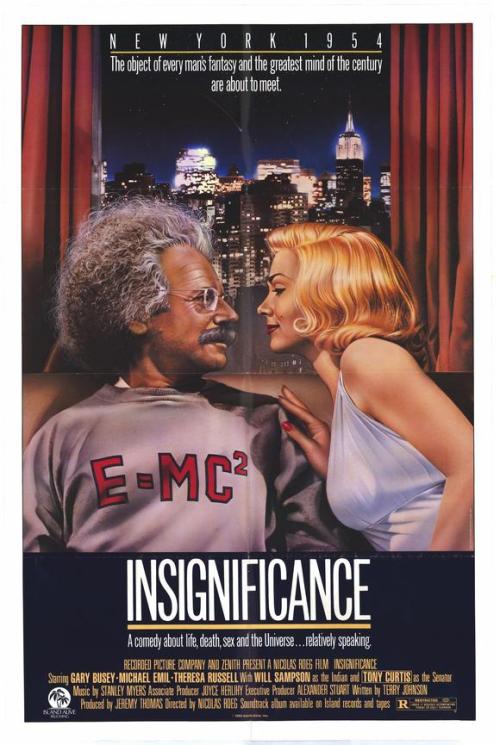
Inside a New York hotel room is a professor (Michael Emil) working on some calculations until he gets interrupted by The Senator (Tony Curtis) who tries to get him to appear before the committee trying to expose communists inside the U.S., which will be held the next day. The professor refuses and sends the Senator away, though the Senator says he’ll be back. Outside the hotel is a film shoot where the Actress (Theresa Russell) is performing a scene where a gush of wind blows up the white blouse she is wearing while standing over a street grate. After the shoot she has her chauffeur (Patrick Kilpatrick) take her to a toy store where she picks up some gadgets, which she takes to the hotel room for a visit she has with the professor where they discuss the theory of relativity. Later her husband the baseball player (Gary Busey) shows up and the two argue while the professor leaves. The next morning the senator returns to find the actress alone in bed, who he mistakenly thinks is a prostitute made-up to resemble Marilyn Monroe. When he threatens to seize the professor’s papers she agrees to have sex with him as a bribe, but the senator has a violent outburst just as the professor and the baseball player return to the room.

The film is based on the stageplay of the same name written by Terry Johnson that was performed onstage at the Royal Court Theater in London in 1982. The inspiration for the play came when Johnson found out that amongst Marilyn Monroe’s belongings that were retrieved after her death was a signed autograph picture of Albert Einstein and the idea of what the meeting between these two would’ve been like intrigued him enough to write a whole play around it. Director Nicholas Roeg saw the play and thought it would make for a great movie, but he wanted to expand it by entering in the character of Joe DiMaggio, who was Monroe’s husband at the time as well the senator, which represented Joe McCarthy.

Roeg’s superior use of visuals and non-linear, dream-like narrative is what keeps it interesting. I also liked the way Roeg had flashback scenes, which were not a part of the play, but added into the screenplay at Roeg’s request, showing traumatic moments in each character’s childhood that had an emotional impact on them and ended up defining who they ultimately became. These moments, as brief as they are, end up leaving the most lasting impression.

The acting is quite good particularly from Curtis whose career had waned considerably by this point, but his perpetual nervousness and the sweat that glistens off of his face is memorable. Busey is solid as a man who initially comes-off as a bully, but ultimately reveals a tender side. The lesser known Emil, who is the older brother of director Henry Jaglom and mostly only appeared in movies that were directed by him, completely disappears in his part until you can only see the Albert Einstein characterization and not the acting.

The only performance I had a problem with was Russell’s who goes way over-the-top with her put-upon impression of Monroe and comes-off like a campy caricature. Her breathless delivery sounds like she’s trying to hold in her breathe as she speaks and is quite annoying. Johnson had wanted Judy Davis, who had played the role in the stage version, to reprise the part for the movie, but Roeg, who was married to Russell at the time, insisted she be cast despite the fact that Russell really didn’t want to do it. While I never saw the stage play and have no idea if Davis would’ve been good I still feel anyone could’ve been better, or for that matter couldn’t have been any worse.

While the film does have its share of captivating elements it does fail to make the characters three-dimensional as they play too much into the personas that we already have of them while virtually revealing no surprises. It’s also a shame that the four are never in the room at the same time. There is one moment where the senator, the baseball player, and the professor meet in the front of the room, while the actress remains in the back behind the closed sliding glass doors, but this doesn’t count because she never interacts with the others during this segment, which is something that I had wanted to see. Overall though as an experimental, visual time capsule, it still works and the unexpected, provocative montage that occurs at the end makes it worthwhile.

My Rating: 8 out of 10

Released: May 11, 1985

Runtime: 1 Hour 49 Minutes

Rated R

Director: Nicholas Roeg

Studio: Island Alive

Available: DVD, Blu-ray (The Criterion Collection)

Walkabout (1971)

walkabout 1

By Richard Winters

My Rating: 7 out of 10

4-Word Review: Lost in the outback.

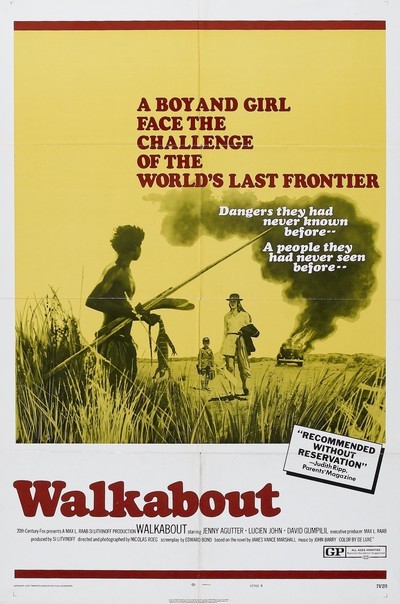
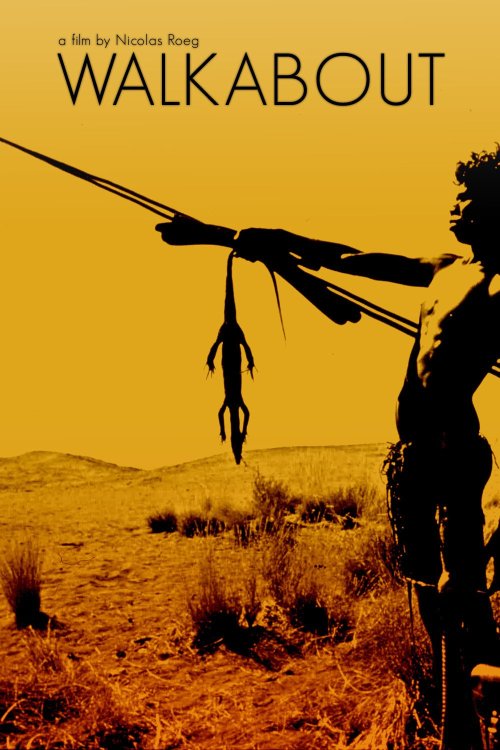
A teenage girl (Jenny Agutter) and her younger brother (Luc Roeg, but billed as Lucien John) find themselves trapped amidst the harsh climate of the Australian outback. After spending a couple of days walking in the heat they manage to come upon a watering hole, but find to their horror that it dries up overnight. Feeling almost ready to give up they spot an aborigine (David Gulpilil in his film debut) marauding through the desert as part of his walkabout where young men are cast off into the wilderness for several months as part of their journey to manhood. He helps find them water, food and shelter, but eventually the cultural differences between the three and their inability to effectively communicate become a problem.

The legendary Nicholas Roeg makes his directorial debut here and even casts his own son, who is excellent, as the 9-year-old boy.  The way the camera captures the desert by focusing on the different types of animal life and rock formations is impressive.  I also enjoyed the editing which cuts back and forth between the desert and modern civilization while examining how each are uniquely connected and commenting on how our advanced culture has made us regress and less able to survive the savage elements that our ancestors were able to.

There are also scenes of animal cruelty as the aborigine hunts a kangaroo by first injuring him and then, as the animal gives out a whimpering cry, he spears it. Later the viewer is shown scenes involving big game hunters who mow down water buffalo for sport while graphically slitting their throats.

The film was controversial for capturing Agutter, who was only 17 at the time that this was filmed, in the nude while swimming at a watering hole. The actress felt uncomfortable doing the scene and required only the minimum of the crew to be present while it was shot. To me the scene was unnecessary as it didn’t fit the character who was prim and proper and didn’t at all come off like the type of person who would suddenly become carefree and risk being spotted by the aborigine that she really didn’t know or the ‘embarrassment’ of being seen by her younger brother. The camera stays on her naked body far longer than needed and comes off like shameless voyeurism.

I had the same issue with the scene involving researchers at a weather station that resembles footage to a soft core porn flick instead as the men ogle the only woman in their group, become overtly aroused at glimpses of her bosom and in one truly absurd moment even has one of the them sucking on her finger. I realize scientists have sex drives too, but I would think they would be able to behave in a professional capacity when on the job and not act like they hadn’t gotten laid in years and like with the swimming sequence this scene has nothing to do with the main story and could’ve been cut out completely.

The presence of the radio weakens the story as well as supposedly they’re in the middle of nowhere and miles from civilization and yet somehow are able to pick up different radio stations that come in crystal clear without any static, which would mean that they must be much closer to a city than it seems and thus hurts the desolate feeling that the film otherwise tries hard to create.

Spoiler Alert!

The film is based on a 1959 novel of the same name that was written by Donald Gordon Payne under the pseudonym of James Vance Marshall. The script though differs from the book in two major ways, one of which I liked and the other I didn’t.

The first difference involves the reason for how the two children get stranded. In the book they are victims of a plane crash, but in the film it is because their father tries to kill them, which is offbeat and sends the message that this movie will be different from any you’ve seen before, which I liked. Normally I would’ve wanted an explanation for his behavior, but by keeping it a mystery it elevates the intrigue and if anything was a far more creative explanation for their predicament than the formulaic plane crash one.

However, the way the aborigine dies is ludicrous. In the book he is stricken with the flu virus that was inadvertently passed onto him by the boy, but in the movie he ends up killing himself when the girl does not respond to his attempts at courtship, which seemed excessively rash.

Rejection is a part of the human experience and transcends all cultures. Everyone will have to deal with it at some point in their lives. If everyone killed themselves the minute they are rebuffed by someone they were attracted to then virtually no one on would make it past adolescence. The idea that a normal, healthy and otherwise happy young man with no signs of mental illness, and the film does not show him as having any so we must assume that he doesn’t, would suddenly off himself over a girl he has just met and barely knew is absurd. In reality he probably would’ve just gotten frustrated and left them stranded while going back to his own tribe where I presume he’d meet other women who he’d bond better with due to being more culturally connected and most likely would’ve found more attractive anyways.

End of Spoiler Alert!

walkabout 2

My Rating: 7 out of 10

Released: July 1, 1971

Runtime: 1Hour 40Minutes

Rated R

Director: Nicholas Roeg

Studio: 20th Century Fox

Available: DVD, Blu-ray, Amazon Instant Video