Tag Archives: Jerry Belson

Jekyll and Hyde…Together Again (1982)

By Richard Winters

My Rating: 5 out of 10

4-Word Review: Drug changes surgeon’s personality.

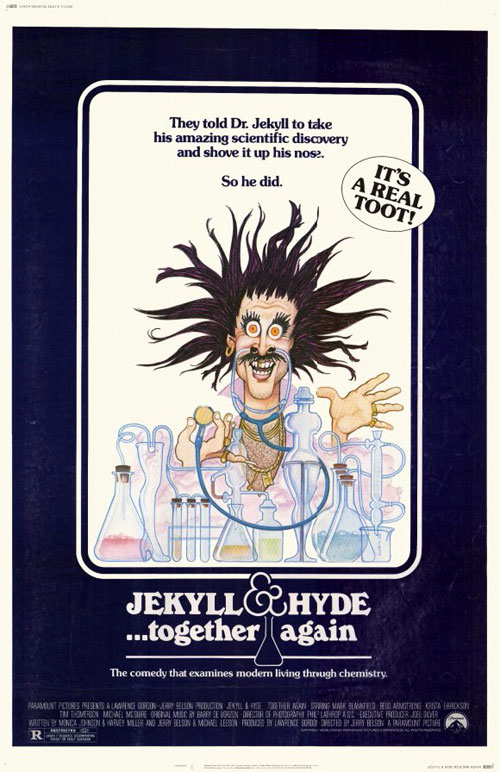
Dr. Daniel Jekyll (Mark Blankfield) is a respected surgeon who’s become tired of the pressures of his job and working for Dr. Carew (Michael McGuire) a hospital administrator whose only concern is the monetary bottom line and who wants Jekyll to perform experimental surgery on ‘the world’s richest man’ (Peter Brocco), which Jekyll resists. In private during his off-hours, he begins experimenting with a white substance while inside his lab, but the demands from his personal and private life cause him to fall asleep where he accidentally inhales the drug, which causes him to have a secondary personality. His new persona is a party animal that is more confident and outgoing to the point of being obnoxious. This split personality causes issues with the two women in his life Mary (Bess Armstrong), a snobby socialite and Ivy (Krista Errickson), a loose living sex worker. 

This marked the directorial debut of Jerry Belson, a very talented comedy writer who wrote for such classic sitcoms as the ‘Dick Van Dyke Show’ before graduating onto movies where he penned scripts for the brilliant satire Smile as well as the dark comedy classic The EndWhile those other films were consistently funny and observational this film panders more on the crude side with a lot of drug references that may have seemed hip at the time but will most likely come off as dated and in bad taste to today’s viewers. It does have a certain Airplane-like element to it where there’s a lot of visually humorous non-sequiturs going on in the background as well as amusing ‘announcements’ that gets said over the hospital’s intercom, which I found to be some of the funniest stuff in the movie. However, there’s just not enough of it to keep it afloat and there’s also a lot of juvenile silly stuff that also gets thrown in, which does nothing but tank the whole thing making it seem like its intent was to be a party movie to be enjoyed by those who are either half-drunk, or high when they viewed it.

The script almost didn’t even see the light of day and stayed stuck in turnaround for several years as most producers and studio execs were not thrilled with it, but in the Spring of 1981 with a director’s strike pending Michael Eisner, the then head of Paramount, choose this script as something that could be shot on the cheap and quickly produced, so that the studio would have something to release should the strike occur. Unfortunately, four different writers were hired on to help doctor it, which only further diluted things making it a comic mishmash that never really gels.

Blankfied, who at the time was best known for his work on the ‘Fridays’ TV-show, which was ABC’s irreverent late-night answer to NBC’s ‘Saturday Night Live’ does not play the main role, at least during his scenes as the strait-laced doctor, all that well, which further hampers things. For one thing he looks creepy when he’s supposed to be normal. As the crazy Hyde character, he’s quite funny, but as a regular guy he’s dull. Tim Thomerson, who plays the narcist plastic surgeon, has the dashing good looks of what you’d expect for a leading man while also being engaging, which is why he should’ve played the Jekyll part and then Blankfield brought in to play Hyde and the whole thing would’ve worked much better. It still could’ve on paper revolved around the split personality of the same person, but just having a different actor play each part. 

Brocco, who’s almost unrecognizable as he sports a long white beard, is good as the elderly, but arrogant rich man and McGuire has one really good scene where he goes on one long, uncontrolled laugh attack. Errickson is cute, which helps things, though it would’ve been great had there been a little nudity on her end, which with the film being so utterly sophomoric and drive-in worthy anyways, you would’ve expected some, but there actually isn’t any. Armstong though plays her part too much like a caricature and thus her moments aren’t interesting and even a bit annoying. 

The scene where Hyde steals a car with the middle-aged lady driver in it and then lodges her head inside the car’s rooftop window, which causes her screams to sound like a siren to others as the vehicle tears down the road, is a gem of a moment. Hyde’s singing performance at an awards ceremony, where he does a striptease to show that he’s got nothing to ‘hyde’, is really inspired too. There’s even a quick scene involving George Wendt as a man with a severed hand who decides he’d rather have his wife ‘sew it back on’ than the doctor. I might even give an extra point to the segment where Blankfield accidentally sniffs up the white stuff in his sleep, but some of the other jokes dealing with the late 70’s drug culture I didn’t particularly care for and hence the movie doesn’t succeed as well, which also most likely helps to explain why it fared poorly at the box office.  

My Rating: 5 out of 10

Released: October 1, 1982

Runtime: 1 Hour 27 Minutes

Rated R

Director: Jerry Belson

Studio: Paramount

Available: DVD, Blu-ray, Amazon Video, YouTube
Smile (1975)

By Richard Winters

My Rating: 9 out of 10

4-Word Review: Producing a beauty pageant.

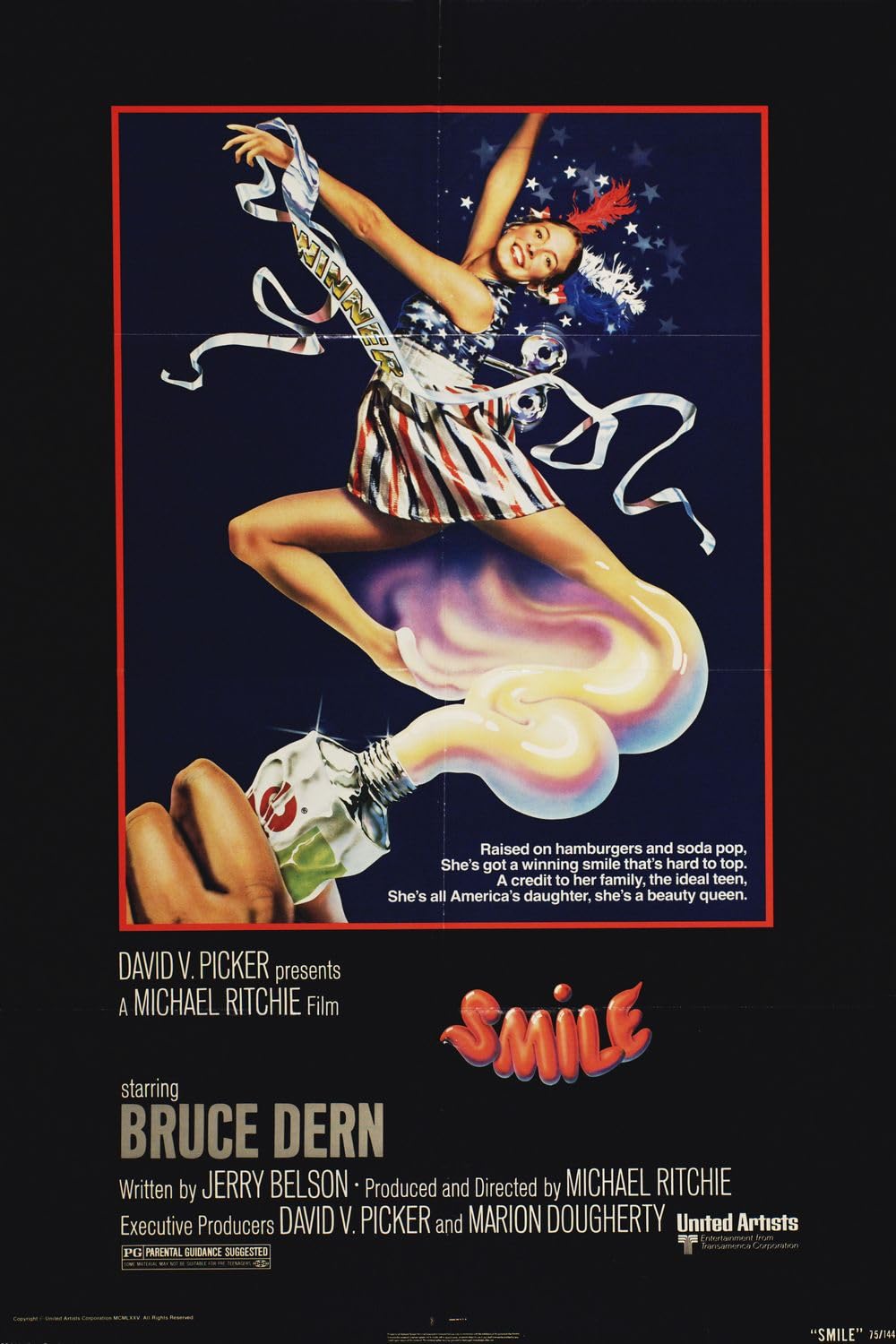
Santa Rosa, California is the site of this year’s Young American Miss Pageant. Each person that’s involved in the pageant approaches it differently. Bob (Bruce Dern), a middle-aged man who works as a car salesman, sees his position as a judge on the panel as a diversion from his otherwise mundane suburban life. Brenda, the pageant’s executive director, considers it a way to display her perfectionist qualities of control and leadership. Her husband Andy (Nicholas Pryor) views the proceedings in a much more cynical fashion and another added element to their already troubled marriage. Tommy (Micheal Kidd), the dance choreographer, approaches it as just another paycheck while Doria (Annette O’Toole), one of the contestants, considers it an opportunity to bolster her name and face even though Robin (Joan Prather), who’s competing against Doria, enjoys the whole thing just for the experience and isn’t concerned with who wins it, at least not initially.

The film marks the third entry in director Michael Ritchie’s American Dream trilogy and one of many he did dealing with competition and how this can change people in both good and bad ways with The Bad News Bears being the most famous of those. The gifted Jerry Belson wrote the script that was based on Ritchie’s own experiences as a pageant judge and many of the situations shown here were ones he went through. Unfortunately, despite the script being absolutely top notch to the extent of being one of the best satires ever written and equal to the more well-known Network that came out a couple years later the movie has not been seen by many, and the title has in recent years been eclipsed by the horror movie franchise. The is because the film’s studio, United Artists, had no confidence in the material and didn’t believe it would generate any profit and thus released it to only 4 theaters nationwide and thus few people ever saw it though in the following decades it has generated a small cult following and even a stage musical.

The finely etched, well-defined characters are what really sets it apart and each of them could be the centerpiece of their own movie if they wanted. Dern, who usually plays psycho roles, is excellent as a father who’s still clinging to his optimism even as everything around him deteriorates. Pryor equally good as his friend and counterpart who finds the suburban dream to be full of letdowns and lies and tries adamantly to break through Dern’s upbeat shield in order to get him to see the truth too. Feldon, best known as Agent 99 in ‘Get Smart’ TV-show, is terrific as well as a complete control freak and her defining moments coming during a scene in her living room, with all the furniture draped in protective plastic, and where she tries to literally goad her husband Andy into killing himself.

Even the minor characters display a unique angle and perspective on things including the janitor (Titos Vandis), who seemingly has a bottle of alcohol hidden everywhere, and makes keen observations on the others as well the music director (William Traylor) whose sarcasm and sexism knows no bounds. Geoffrey Lewis is memorable too as a marketing director who tries to promote the wholesome image of the contest only to in one really funny moment blurt his true cynical feelings about it. Prather and O’Toole though are the ones who drive it as it’s through them we see the inside mindset of those being judged and it’s interesting how at the start it’s O’Toole who’s the more jaded of the two while Prather is the wide-eyed one, but by the end after her experiences here Prather has more than been able to catch up with her.

Spoiler Alert!

The direction is done in a way that makes it seem like a docudrama where everything is captured through an unfiltered lens showing it as it happens with none of the scenes being set-up in a way that makes it feel staged, which is to its benefit. However, this gets ruined, in one of the movie’s few weak points, when Dern’s son Little Bob (Eric Shea) gets caught taking polaroids of the women in their undress. Instead of hearing the dialogue of the people when they catch him, as well as Dern’s when he finds out, which could’ve been quite revealing, music gets played over it, which is jarring as it reminds the viewer they’re watching a movie, even though it had spent the rest of the time trying to convince us we were seeing reality as it unfolded.

The ending is a bit of letdown too. Ritchie and Belson wanted the winner to be a complete surprise both to the cast and crew, which explains why the camera swerves around in a jerky style as even cinematographer Conrad Hall didn’t know who it was and thus had to try to find her when her name is announced. However, having it be a girl (Shawn Christianson) who has no lines of a dialogue, and only seen briefly in a few group shots, was a mistake. The attempt was to show how pointless these contests are and how not much thought or care goes into who’s picked, as evidenced by one of the judges seen flipping a coin before he makes his decision, but it still should’ve been someone we had seen and heard earlier. Maria O’Brien, who plays an obnoxious contestant who annoys the others so much they even sabotage her talent act, would’ve been a better choice and the film would’ve still made the same point and allowed a little more of a lasting emotional effect. With the way it gets done here the viewer leaves feeling miffed and confused.

My Rating: 9 out of 10

Released: March 20, 1975

Runtime: 1 Hour 57 Minutes

Rated PG

Director: Michael Ritchie

Studio: United Artists

Available: DVD, Blu-ray

Surrender (1987)

surrender

By Richard Winters

My Rating: 1 out of 10

4-Word Review: Pretending to be poor.

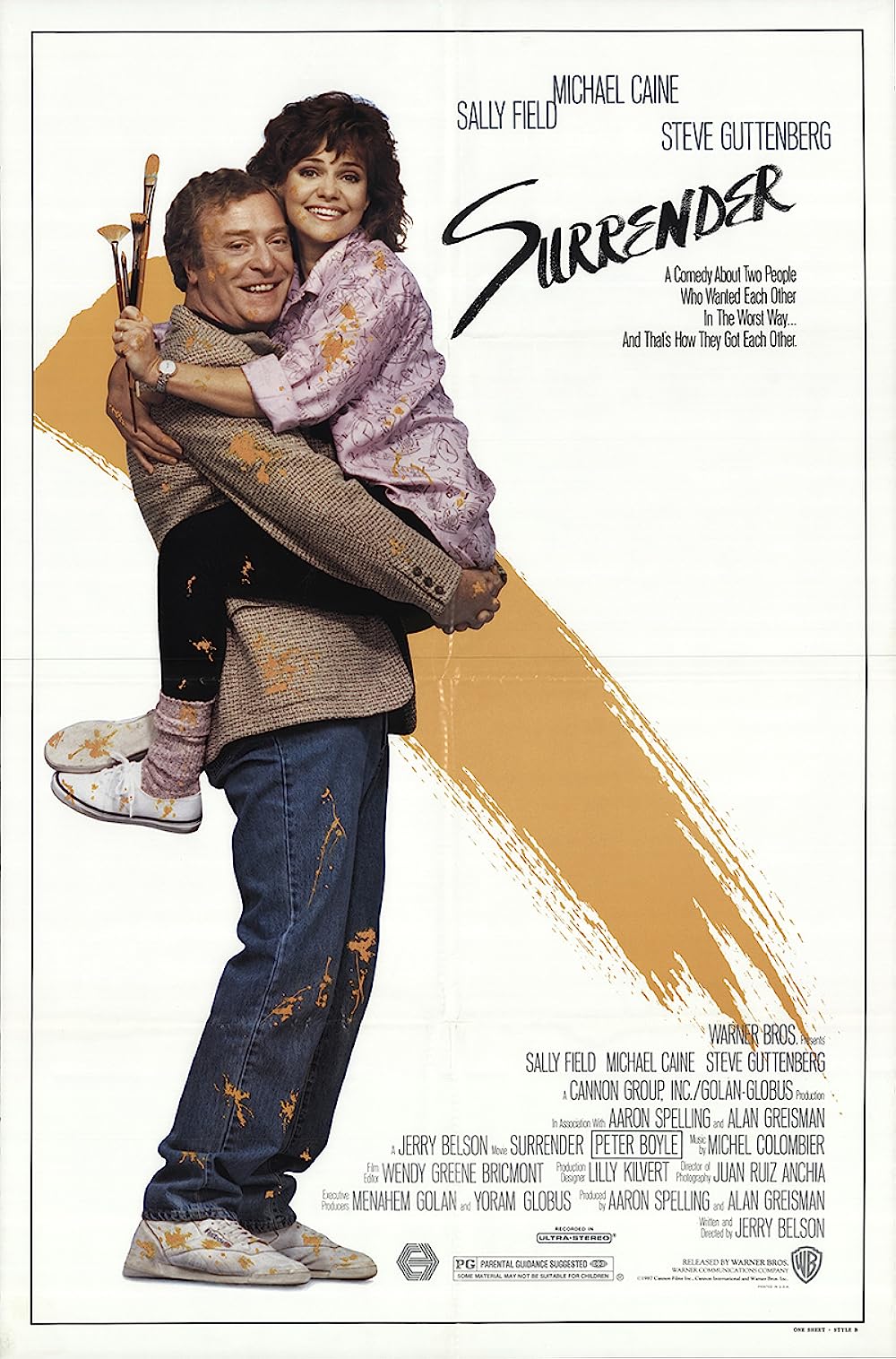
Sean Stein (Michael Caine) is a successful novelist, who after suffering through two contentious divorces, has decided that women are only after him for his money and considers them off-limits. Daisy (Sally Field) is a struggling artist, who is in a relationship with Marty (Steve Guttenberg), a successful attorney with no interest in making a long term commitment. While attending a charity ball that gets overrun by gunmen who rob the place, Sean and Daisy, find themselves tied-up together and despite the stressfulness of the situation slowly get to know each other. The next day, after they ultimately get freed, Sean asks Daisy for a date, but decides to pretend that he’s poor to make sure she loves him for who he is rather than because of his money.

While Jerry Belson wrote several successful comedies during the 70’s and based this story loosely on his own life experiences where he proudly stated that everything that happened to Sean in this movie happened to him in real-life, the pacing and basic comedy scenarios really don’t work. It starts out alright  as they’re several flashbacks showing Sean with his attorney, played by Peter Boyle, battling his ex-wives in court. The different hairstyles that they have as they go through the years is funny and the most creative thing in the movie. I was though disappointed that the two women who play the ex-wives, Louise Lasser and Iman, are never give a single word of dialogue, which wastes the talents of these well-known actresses.

After the first ten minutes though things quickly fall apart. Having armed thieves crash the party that the two are at is particularly troubling as there is no forewarning for why this is happening. People who attending posh parties usually don’t find themselves at gunpoint, so why are they here? Had there been even a fleeting mention of a group of criminals crashing area get togethers then maybe, but here we get no explanation either before, or after giving the plot a haphazard quality like the filmmakers are happy to throw in any crap they want whether it makes sense, or not. The characters respond to what most would consider to be a traumatic experience like it’s just a ‘run-of-the-mill thing’ and by the next day barely remember it, even though many people would have genuine PTSD after it was over.

Caine’s attempts to woo Sally would in most cases have the woman thinking he was a potential stalker. First he comes to her house six hours before their date saying that he couldn’t wait that long to see her and wanted to spend every waking minute with her that he could, which for any sane woman would be a serious red flag. He then kisses her without her consent and begs for immediate sex, or he might not be able to control himself and instead of calling 9-1-1 she gives him a pity fuck. Not only is this unfunny and stupid, but an insult to the viewer’s intelligence that they would find any of this to be a normal, well-adjusted way to start a healthy relationship.

I also thought Caine, who was a raving misogynist who even had signs on the front gate of his home banning women from entering, came around to liking Sally too quickly. Sure she was kind to him when they were tied-up, but an avowed women-hater doesn’t just change his ways overnight, but in this movie that’s exactly what happens, which isn’t realistic. If anything it should’ve been Sally chasing after Caine, who might’ve liked her a little at first, but so set in his ways would still decide to avoid her and only after an extended period of time, and continual prodding by Sally, would he eventually relent.

The pretending to be poor thing isn’t handled well either. I was expecting there to be a lot of comic moments dealing with Caine trying to desperately hide his wealth and background, but that never gets played out. He isn’t even forced to rent himself a seedy, little apartment in order to hide the fact that he lives in a mansion as Sally was apparently never curious about seeing his place, but how many serious relationships are there where they always go to one partner’s home and never the other?

The third act gets even more ridiculous as it has Caine insisting that Field needs to sign a prenup agreement. She’s resistant at first, and even insulted, but then eventually signs it without ever bothering to read it, which is idiotic. She also goes to Vegas and wins 2 million dollars at the slot machine her very first time playing it, which is beating insurmountable odds.

I did like the scene where Caine hands Sally a manuscript he has written, which was published into a book though he doesn’t tell her this and then becomes insecure when she doesn’t immediately like it, which being a budding screenwriter myself, I found funny and despite all the other absurdity in the film, a bit true to life. I was hoping the movie would explore this situation more, but it doesn’t making the rest of it a sore disappointment.

I was surprised why either of these big name stars agreed to do it. I know Caine was willing to be in almost anything for the money, but I’m not sure what Sally’s excuse was and if you ask me I’d find the old reruns of her TV-show ‘The Flying Nun’ to be more entertaining. It’s easy to see why this dumb thing, despite the star quality, has never gotten a DVD or Blu-ray release and nobody’s been clamoring for it either. It bombed badly at the box office too managing to recoup only $5 million of it’s $15 million budget.

My Rating: 1 out of 10

Released: October 9, 1987

Runtime: 1 Hour 34 Minutes

Rated PG

Director: Jerry Belson

Studio: Warner Brothers

Available: VHS, Tubi

The End (1978)

end2

By Richard Winters

My Rating: 7 out of 10

4-Word Review: His days are numbered.

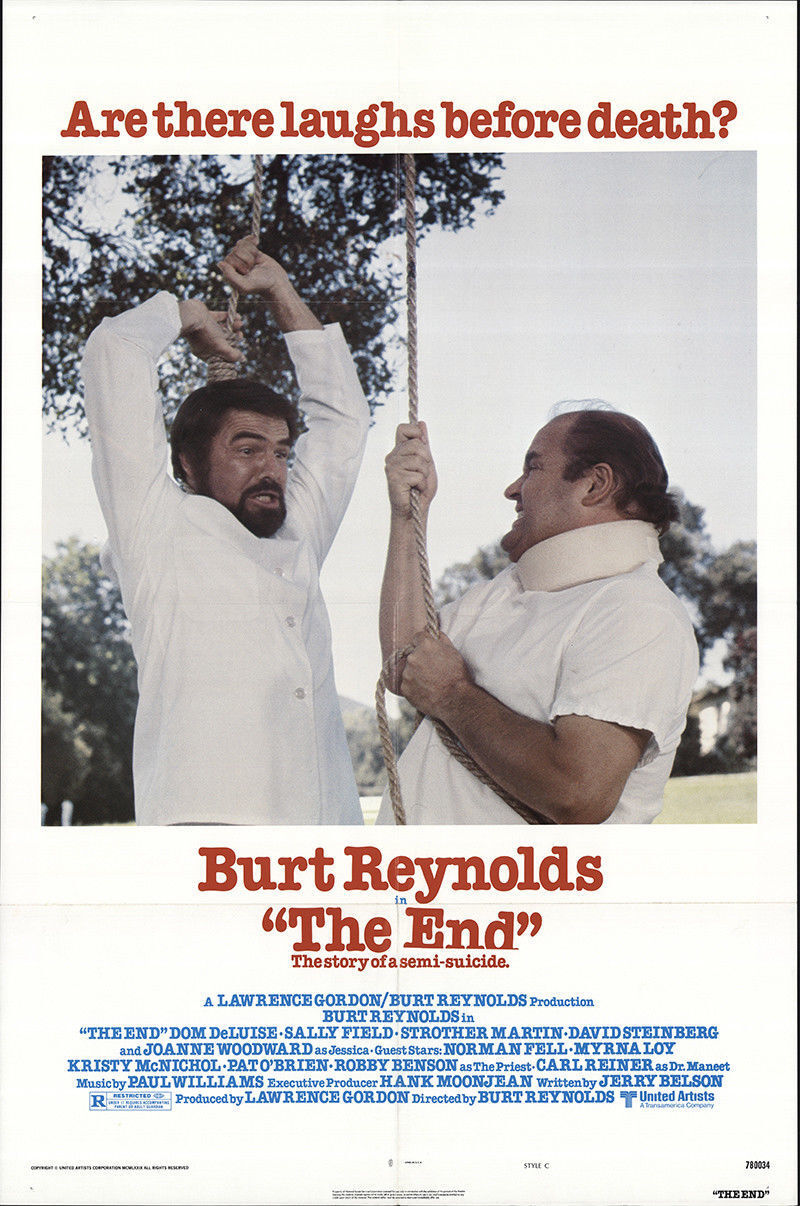
Sonny (Burt Reynolds) is a real estate broker known to make crooked deals. He gets diagnosed with an incurable disease and told he has only a limited time left. He says goodbye to his ex-wife (Joanne Woodward) who seems more interested in her new boyfriend, his daughter (Kristy McNichol) and his folks (Pat O’Brien, Myrna Loy) and even his live-in girlfriend (Sally Field) without actually telling them his condition. He then attempts suicide, but this gets him stuck in a mental hospital where he comes into contact with Marlon (Dom DeLuise) who agrees to help kill him, so Sonny can avoid going through the agony of the disease, but then after several aborted attempts Sonny decides he wants to live, or at least as long as he can, while Marlon continues to try and kill him and can’t seemingly be stopped.

The script was written by Jerry Belson, who also did the brilliant satire Smile and the original Fun With Dick and Jane, two of the funniest films to come out during the 70’s. This one is no exception, yet despite be written in 1971 and purchased by a studio, no one seemed to want to touch it. Many stars and producers felt the theme was too maudlin and wouldn’t be able to sell as a comedy. Reynolds though felt it was one of the funniest scripts he had read, and the character most closely identified to who he really was, and therefore jumped at the chance to direct and star in it though the studio was still reluctant and only agreed to finance it once he accepted starring in Hooper, which they felt was the sure money-maker though this one ended up doing quite well, surprising many, at the box office too.

Much of the credit goes to Reynolds who plays the part perfectly. Somehow he can create the slimiest of characters, and this one is a bit scummy with his admittedly shady real estate deals, and yet with his comic talent are still able to make him seem endearing. The studio had wanted the character’s profession to be a stock car racer, but this seemed too stereotypical, so I was happy that he kept it in the white collar realm and openly able to expose all of his personal flaws, which made him quite relatable. It’s also one of the rare times you get to see him with both a mustache and beard, or at least through the whole movie. The studio wanted to nix this too, but it helps give him a distinctive look.

Like with most actors turned director Burt allows for long takes, particularly during the first act, where the supporting cast is given ample time to play out their scenes without any interruption, which leads to many funny moments. I enjoyed Norman Fell as the doctor, and Robby Benson’s as a young priest who listens to Burt’s confession while he takes off his collar and puts it into his mouth, which creates a weird popping noise. These segments have an entertaining quality, but come-off more as vignettes and don’t help to propel the story along.

The second act, in which Burt ends up in the mental ward, are the best and his teaming with DeLuise is hilarious. I realize not all the critics enjoyed Dom’s take on a crazy man, Variety Magazine, labeled his performance as being ‘absolutely dreadful’, but there’s no denying the infectious chemistry he and Burt have, making the scene where he tries to drop Burt from a bell tower, or the segment where he tries to hang him up by a noose, quite memorable. The segment though where Burt goes swimming out into the ocean in an attempt to drown and then has a change of heart and tries getting back to shore and the voice-over prayer that he gives to the Almighty he order to help him back is laugh-out-loud and not only the top comedy moment in this movie, but quite possibly any movie ever.

Spoiler Alert!

The only problem I had was with the ending. In the original script the DeLuise character was supposed to kill Burt after he got out of the ocean, but Burt felt the movie needed some ‘hope’, so instead he has DeLuise attempting to chase Burt along the shoreline, in a sort of stop-action way that looks cartoonish. I felt there needed to be more of a resolution. If Reynolds does decide to live out the rest of his days what does he do with it? Does he try to mend his ways by paying back all those he had swindled? Or does he make amends with the people in his life including his ex and daughter? None of this gets answered, which is disappointing. A good movie needs a healthy character arch and this one doesn’t really have any. A better third act would’ve shown how the diagnosis had changed him and had the film not labored so much with the comical vignettes of the first half we might’ve gotten there and it’s just a shame that we never do.

My Rating: 7 out of 10

Released: May 10, 1978

Runtime: 1 Hour 41 Minutes

Rated R

Director: Burt Reynolds

Studio: United Artists

Available: DVD, Blu-ray, Amazon Video, YouTube