
By Richard Winters
My Rating: 8 out of 10
4-Word Review: Protecting a young boy.
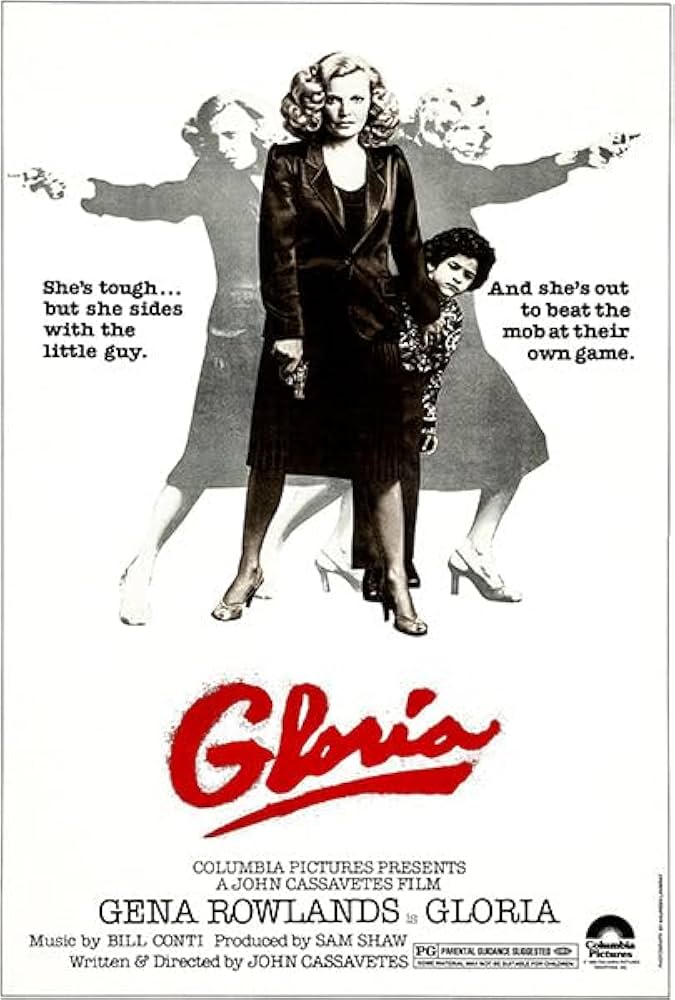
Phil (John Adams) is a young boy whose father (Buck Henry) works as an accountant for the mob and has become an informant for the F.B.I. causing him and his family to become marked for retaliation by the criminal underground. In desperation Phil’s mother (Julie Carmen) pawns the child off on Gloria (Gena Rowlands) who’s their neighbor from across the hall. Gloria initially refuses to take the child as she’s adverse to kids, but eventually agrees as she takes the boy away and into her apartment just as the mob moves in on the hit. Phil was also handed by his father the ledger listing in detail the mob’s incriminating financial corruption and when they’re unable to find it after annihilating his family they then go after the pair. Gloria, who has mob connections from her past including having been in relationship with a mob kingpin, feels she can’t go to the police and must defend the child on her own using only her street savvy and gun, but where ever they go in the city the hit men remain right behind them.
John Cassavetes, who has described this as “a thoughtless piece about gangsters and I don’t even know gangsters” was never intending to direct it and though it’s become his most popular work among mainstream audiences it was one of his least favorites and something he felt embarrassed about doing. He wrote the script simply to sell it and make enough money from it to help him finance his other projects. He completed it in early 1979 and was meant as a vehicle for Ricky Schroeder who was just coming-off doing The Champ and MGM studio was looking for other projects for him to do. Cassavetes intentionally gave it a very commercial feel, much more than any of his other scripts, because he felt it would give it a better chance to sell, but when Schroeder and Barbara Streisand, who was the original choice for Gloria, both turned it down Cassavetes then shopped it around to Columbia Pictures who agreed to take it on, but only if Rowlands played the lead and since she was his wife he then reluctantly took on the directing duties.
The film doesn’t seem like the usual Cassavetes material as I was quite impressed with the location shooting, which takes the viewer to all sorts of New York City locales and makes you feel like you’re right there with Gloria and the boy as they try to maneuver their way around the unpredictable and very dangerous urban jungle. The opening bird’s-eye shot that tracks from the city’s skyline to Yankees Stadium is downright breathtaking and the grimy, rundown interiors of the family’s inner city apartment building effectively illustrates on a purely visual level the fear, stress, and tension of living in the inner city is truly like. Leonard Maltin, in his review, labeled this as being possibly done ‘for laughs’, but I didn’t find anything funny about it except for one amusing comment Gloria makes when she gets stuck in a slow elevator, but otherwise it’s a nail-bitter all the way through.
Rowlands gives her usual stellar performance, but I was hoping for more of an arch with her character. She states right up front to Phil’s mother that she hates kids and yet is pretty much warm and friendly to the child the second she takes him back to her apartment and it would’ve been more interesting to see her cold and indifferent to him initially only to slowly warm-up to him as their shared adventure went on. Buck Henry is also surprisingly good in an unusual casting choice as he’s typically known for his deadpan humor and had very little dramatic acting in his background. It was strange though why such a small, squirmy guy who was hitting 50 would be married to such a hot young Latino woman who looked to be only 24 and I felt this needed to be explained, but isn’t. I also felt the shooting of the family should’ve been shown, it gets implied, but that wasn’t enough. Seeing them shot in graphic style would’ve really hit home how dangerous and serious these people were and would’ve made the tension even stronger.
Critics at the time of the film’s release didn’t like the kid nor his acting and in fact Adams got nominated for the first razzie award for worst actor, which traumatized him so much he decided never to pursue anymore roles and to date this has been his only film appearance. I for one happened to like the kid and yes his character isn’t exactly ‘cute and cuddly’, but real children rarely ever are. They can be as rude, indifferent, and crabby as any adult and since he was brought-up in a troubled neighborhood having him be a bit ‘rough-around-the-edges’ made sense and was realistic. The only acting that I really didn’t care for was from Basilio Franchina who plays a crime boss that Gloria used to date and while he may have looked the part his performance is stiff like he’s just regurgitating lines he’s memorized and there’s no sign of a chemistry between them and their conversation is stilted and unconvincing.
Spoiler Alert!
The mob’s ability to be constantly on the pair’s tale no matter where they went seemed a bit implausible especially being in such a big, congested city, but I was willing to forgive it since the rest of it is so good. The ending was a little problematic too as it has Gloria reappearing disguised as an old lady after it was presumed she was dead. She then reunites with the kid in the middle of a cemetery, but it leaves more questions than answers like how did the two evolve? Did they become like mother and adopted son and where did they ultimately move to since New York for them was no longer safe? This might’ve gotten answered in the sequel that Cassavetes had written, but unfortunately never got green-lit. Remade in 1999 with Sharon Stone in the lead.
My Rating: 8 out of 10
Released: October 1, 1980
Runtime: 2 Hours 2 Minutes
Rated PG
Director: John Cassavetes
Studio: Columbia Pictures
Available: DVD, Blu-ray, Amazon Video, Tubi, YouTube
 Scopophilia