Tag Archives: Comedy

Who’s Been Sleeping in My Bed? (1963)

who1

By Richard Winters

My Rating: 3 out of 10

4-Word Review: Carol Burnett does striptease.

Every time I get annoyed by many of today’s Hollywood comedies that seem to be nothing more than a stretched out idea for an episode of a sitcom, one only has to go back into time to find that the comedies of yesteryear weren’t always much better. Of course there were some classics, but a lot of vapid ones in the mix as well. In fact this one is so trite that it becomes almost agonizing to sit through. It was considered in its time to be a ‘sex farce’, but fails to deliver on either.

The old adage ‘it’s not what you know, but who you know’ has never been truer in this instance. I have attended many screenwriting classes and seminars and can verify there is a lot of good stuff out there that hasn’t been read unfortunately because the authors don’t have the right connections. In this case the screenplay was written by Jack Rose who had previous writing success with such films as My Favorite Brunette, Houseboat, and The Road to Rio. Judging from its lack of creativity Rose probably wrote this real quickly to make some fast cash and the studio heads gave it the green light simply based on his past success without ever looking at it critically.

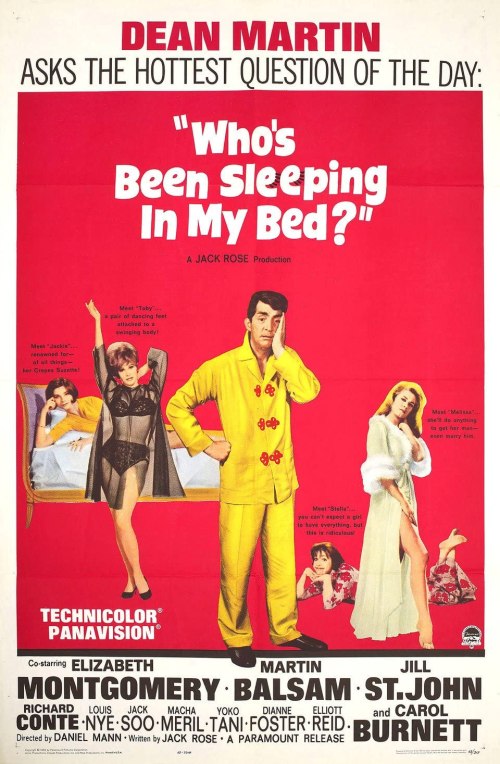
The plot, if you can call it that, has to do with TV-star Jason Steel (Dean Martin) who plays the part of a popular Dr. on a TV-series.  His TV character matches all the ideal qualities that women want in a man and thus he always has women chasing after him in real-life. He even has the wives of his friends coming on to him. With so many married women telling him how unhappy they are in their marriages he begins to fear that marriage may not be a good idea and thus calls off his impending engagement to beautiful Melisa Morris (Elizabeth Montgomery).  Melisa is devastated by this, so her goofy roommate Stella Irving (Carol Burnett, in her film debut) hatches up a kooky scheme in order to get him to reconsider.

This film gets tiring right from the beginning.  Jason goes out with his buddies every Thursday night to play poker, but then during the game he always gets a call from one of his buddy’s wives telling him they have to see him.  He leaves the game and meets them at his place and then fights off their advances. This silly scenario gets repeated four different times with all four of his friend’s wives and it’s like being told the same dumb joke over and over. This triviality ends up taking up the whole first hour before it moves into the scheme portion, which really doesn’t even measure up to a weak episode of ‘I Love Lucy’.

Out of the whole ninety minutes there are only two scenes that are mildly amusing.  One is when Jason pushes everyone into a pool and they fall in like dominoes and the other is when Stella goes to a strip club and is forced to go onstage and do a striptease when she can’t pay for her drinks, which makes great use of Burnett’s ad-libbing abilities.

Burnett and Montgomery make an interesting pair. Montgomery is a good straight-man to Burnett’s zaniness and with a better script this could’ve been ideal casting. Montgomery did this film just before she started her long running series ‘Bewitched’. She looks gorgeous and gives the film’s best performance.

There is a long list of excellent male character actors here including: Martin Balsam, Jack Soo, Richard Conte, Louis Nye, and Johnny Silver. All of them are wasted with very little to do. Except for the money I don’t know why any of them took their parts.

The satirical jabs at TV-dramas are too gentle and not even good for a chuckle.  If one is considering getting married then I would definitely not suggest it as the script takes so many potshots at the institution that it is liable to give anyone second thoughts.

Although this was made as a vehicle for Martin I feel even fans of Dino will be disappointed. It really doesn’t take advantage of his persona and he seems as bored with the material as the viewer and just going through the paces. Despite the interesting cast this is an all-around disappointment.

My Rating: 3 out of 10.

Released: December 25, 1963

Runtime: 1Hour 43Minutes

Rated NR (Not Rated)

Director: Delber Mann

Studio: Paramount

Available: Netflix Streaming

Avanti! (1972)

avanti1

By Richard Winters

My Rating: 7 out of 10

4-Word Review: Juliet shows her boobies.

Jack Lemmon plays Wendell Armbruster Jr. a conservative, set-in-his-ways businessman who travels to Italy to arrange the return of his father who died in a car accident. To his shock he finds that his father did not die alone, but instead was with his secret lady lover of twenty years. Apparently they would meet every summer and the two had been carrying on the secret affair without any of their family members knowing. Juliet Mills plays Pamela Piggott the daughter of the other woman. She comes to claim the body of her mother and after the two meet a certain romantic spark slowly begins to ignite.

This film is similar to The April Fools, which was another romantic Lemmon vehicle that was done just a few years earlier.  This film though works much better. For one thing there is a nice bit of mystery as to whether this thing will continue on or not and the ending leaves you guessing. Sometimes the best romances in life are the brief flings one has with someone that they know for only a short period of time and then move on and this film nicely captures that. The relationship grows at a realistic pace without ever being forced, clichéd, or sappy. In fact the two at first don’t even like each other.

Lemmon’s character here is much improved from the one in The April Fools. Instead of just being a bland schmuck he is more crusty, argumentative, and confrontational almost like talk show host Bill O’Reilly. His snappy comebacks and one-liners are fun and help hold the movie together. Mills (sister of Hayley, daughter of Sir John and wife of Maxwell Caulfield) is a delight as always playing a serene good-natured character similar to the one she did in her famous TV-show ‘Nanny and the Professor’. The fact that the two leads have such diametrically different dispositions helps give it a spark and make it intriguing.

Director Billy Wilder nicely captures the ambience and scenic beauty of the region and screenwriter I.A.L Diamond’s script is paced with amusing side-stories and characters. However, a 145 minute runtime is too long for such slight material and it spends a little too much time on side-stories that go nowhere. The scenes themselves are stretched out longer than they should with hardly any action and there is too much emphasis on the Neil Simon-like comical banter that ultimately makes this production seem more like a filmed stage play than a movie.

The film though does have some nice moments of humor. The part where the two go the morgue to identify the bodies and the very particular way the administrator sets out the legal documents to be signed and the way he packs them back up is amusing. There is also a scene where the two go skinny dipping and swim out to a small island. Yes, you do get to see both stars in the buff and although Mills isn’t bad, Lemon with his pale, out-of-shape, middle-aged-body, might be a bit too much for some. However, it is funny seeing him swim in the nude, but still leaving on his brown socks, which is a perfect testament to his uptight character. The best part and by far and away the funniest moment in the film comes when a boat load of sailors come by and start whooping and hollering at the nude Pamela. Wendell then tries to ‘protect Pamela’s modesty’ by taking off his wet, dripping socks and holding them over her ample bosoms while she merrily waves to the passing men. It’s a visual thing, but it had me laughing-out-loud.

I did have two issues with the film that I feel should be discussed. The first is the opening bit where Wendell gets on the plane without any luggage and wearing casual attire because he was given too short a notice to change clothes before he had to board the plane. He sees a man with a nice suit on and asks him if they could change clothes. Yes, it is a bit amusing when everyone on the plane, including the stewardesses and the pilots, crowd around the bathroom door in confusion after seeing two grown men go in, but the joke falls flat because it is not in any way believable. Who in their right mind would go into a small bathroom of a plane with a perfect stranger to change clothes with him, especially when there was no money exchanged? Most would probably think he was a kook and tell him to get lost. The first rule they teach you in comic screenwriting 101 is that for the joke to work there needs to be some grain of truth to it, or otherwise it will come off as stupid, which it does here.

The other problem has to do with Pamela and her apparent ‘weight problem’ that gets mentioned not only by her, but by the other characters as well. The truth of the matter is that she looks great and has a figure most women would die for. I noticed this same thing with the Anne Hathaway character in The Devil Wears Pavda where she was labeled as ‘fat’ when compared to the other models even though she looked terrific. Apparently Hollywood, in their never ending quest for ideal beauty, cannot bring themselves to actually cast a plain, over-weight woman in the pivotal role of a love interest even if the script calls for it so instead they get someone who is just slightly under the gorgeous level, but still way above the average woman, and then hope to pass her off as a ‘plain Jane’. The result becomes not only ridiculous, but highly annoying and even insulting especially when it continues to be brought up and discussed.

Overall romance fans should find it appealing as the story has all the necessary ingredients and fits the formula well.

My Rating: 7 out of 10

Released: December 17, 1972

Runtime: 2Hours 20Minutes

Rated PG

Director: Billy Wilder

Studio: United Artists

Available: VHS, DVD, Amazon Instant Video

Funny Farm (1988)

funny1

By Richard Winters

My Rating: 3 out of 10

4-Word Review: Novelist moves to country.

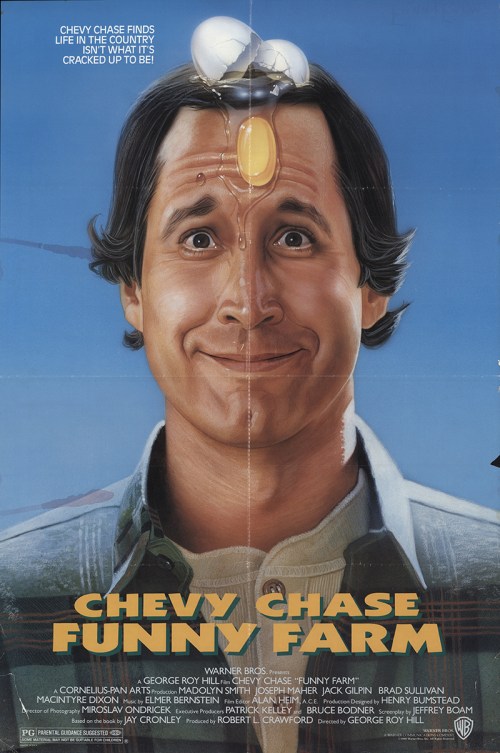
Uninspired comedy about a man named Andy Farmer (Chevy Chase) who receives an advance from a publishing company, which he uses to quit his job and buy a cabin out in the country with his wife Elizabeth (Madolyn Smith) in order to write his novel. Unfortunately the local citizens are eccentric in very clichéd ways and their time there is spent dealing with one crazy misadventure after another.

Right from the start this film proves to have no footing in reality. Publishing companies only pay advances to authors who are already published and proven. They do not shell out $10,000 to some average unpublished Joe with only a vague idea for a story. Many publishers won’t even look at a finished manuscript from someone unless they are already represented by an agent and have some sort of track record, which renders this entire premise as ridiculous.

The movie starts off too quickly with them moving to the country without any set-up. The characters themselves are extremely bland and the script does not take advantage at all of Chase’s cynical, sardonic humor, or impeccable comic timing. Smith is certainly pleasant on the eyes, but things could have been more interesting had they been played-up as spoiled city slickers like the Lisa Douglas character from the TV-series Green Acres and then forced to adjust.

The humor is sloppy and uninspired and shows no level of sophistication. It is thrown in haphazardly without any consideration for story progression, or character development.  Much of it is not funny and the whole thing seems like a stretched out episode from the old Newhart TV-series and in fact the film was shot in Vermont were that series took place. The only mildly amusing moment comes when Andy goes fishing with some of the men from town and ends up accidently throwing them all overboard and even that is worth only a small chuckle. The final segment were Andy and Elizabeth convince everyone in the town to act like people from a Norman Rockwell painting and have them study covers from old issues of the Saturday Evening Post, as  they think this will make things seem more appealing to prospective buyers, is utterly preposterous.

The only time this film has any possibilities is when Elizabeth ends up not liking the story that Andy has written. Being a writer myself and having dealt with other writers I can attest that this can happen more than you think. In fact famous horror novelist Richard Laymon stated that his number one rule of things not to do was giving your manuscripts to friends and family members to read because it can create needless acrimony. Things get dicey when Elizabeth writes a story that sells, but the sterile script by Jeffrey Boam fails to take full advantage of this scenario and the results become as disappointing as everything else.

I did like that it was shot on location. The cottage is nestled away in a scenic area and the viewer gets the feeling that they are ‘getting away from it all’ along with the characters.  Capturing it during all four seasons is another plus. I also thought that the realistic looking stuffed squirrel was cool and I wish I could find one of those for myself.

Sadly, this was director George Roy Hill’s last film. He had much more success with Butch Cassidy and the Sundance Kid, Slapshot, and The Sting to name just a few. None of his genius shows up here as it is quite mechanical and formulaic.

My Rating: 3 out of 10

Released: June 3, 1988

Runtime: 1Hour 41Minutes

Rated PG

Director: George Roy Hill

Studio: Warner Brothers

Available: VHS, DVD, Blu-ray, Amazon Instant Video

Under the Yum Yum Tree (1963)

under yum

By Richard Winters

My Rating: 3 out of 10

4-Word Review: Landlord likes pretty woman.

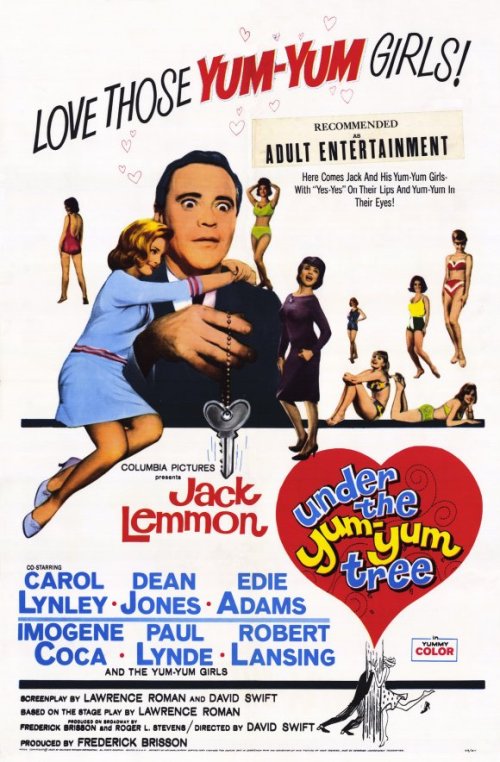
Jack Lemmon plays Hogan, an apartment landlord who charges $450 a month to men, but only $75 a month to a young beautiful woman. He then puts on his moves and most of the time ‘scores’ with his nubile tenants. He sets his sights on attractive college co-ed Robin Austin (Carol Lynley) who has just moved in.  Unbeknownst to him she is also bringing in her boyfriend Dave (Dean Jones). The two have decided to live platonically, so they can see if they can get along together before taking the big step and getting married. Hogan is unaware of her male counterpart as when she signed up she simply told him her roommate was a brunette and Hogan presumed it was female. When he finds out who it really is it puts a crimp on his plans, but he still persists anyways.

Although the premise of two young people who are in love cohabiting without having sex may seem antiquated and remnants of a bygone era, the truth is the characters and filmmakers were probably a little more worldly-wise then one might presume initially. For one thing Dave considers the arrangement to be ‘nutty’ and states ‘no one could live that way’. He also, towards the end of the film, gets her to drink some strong tequila in order to get her drunk and allow him to seduce her. The characters, particularly the apartment’s husband and wife maintenance crew (Imogene Coco, Paul Lynde) do not condone Hogan’s playboy lifestyle, but are also privately jealous of it and in the case of the Lynde character even fantasizes about it. I also thought it was a hoot when Robin asks her college instructor Irene (Edie Adams) whether her and her husband ‘did it’ before they were married and although Irene acts all aghast at the suggestion she is also careful not to specifically answer it either.  So even though things are not as explicit as today’s films the underlying leering elements are still there.

This was pretty much Lemmon’s vehicle and he does alright. He has never played the part of a lecherous cad before, so it was fun seeing him do something different and away from his otherwise clean-cut good guy image. The best thing though may actually be the way his apartment was decorated. It is painted in a garish, bright red and this includes the carpets, drapes, and bed sheets. He also wears shirts, socks, and a watch band with the same bright red color making the place look like hell and he the devil. I also got a kick out of a pair of violins that he has stored in a case and at the press of a button they rise up and play romantic music with the help of electronic, robotic hands.

Carol Lynley is sensational as the female lead and quite possibly the best thing about the movie. Her portrayal of a young female college student who is sweet and polite, but still headstrong and full of ideals seems timeless. I also liked that the college students here were portrayed as thinking, breathing young adults and not just one-dimensional, stoned party- animals.

Jones does well as the boyfriend who sees right through Hogan’s schemes and does not allow him to get the upper hand. However, some of the stunts that Hogan pulls including walking in on the couple unannounced at different times of the day and night as well as having him eavesdrop on them and even admit to it, would not go over in the real world and would likely get him sued.

The biggest problem with the film is that fact that there is really no plot. The entire movie is made up of these silly little schemes that Hogan tries to pull to get Dave out of the way and his hands on Robin. None of these are clever, funny, or imaginative. The one-joke premise gets stretched until it becomes excruciatingly monotonous. Most of these films that are based on hit stage plays at least have some funny banter and sharp one-liners, but this movie doesn’t even have that.  This all might have worked as a cute 30 minute episode on the old Love American Style TV-show, but at 110 minutes it is outrageously over-long. Even for a fluffy 60’s sex farce it’s incredibly vapid and lifeless.  Legendary comic character actors Coco and Lynde are wasted.

A young Bill Bixby can be seen briefly as a college student trying to rent an apartment.

My Rating: 3 out of 10

Released: October 23, 1963

Runtime: 1Hour 50Minutes

Rated NR (Not Rated)

Director: David Swift

Studio: Columbia Pictures

Available: VHS, DVD, Amazon Instant Video

Walk Don’t Run (1966)

walk don't run

By Richard Winters

My Rating: 6 out of 10

4-Word Review: Three is a crowd.

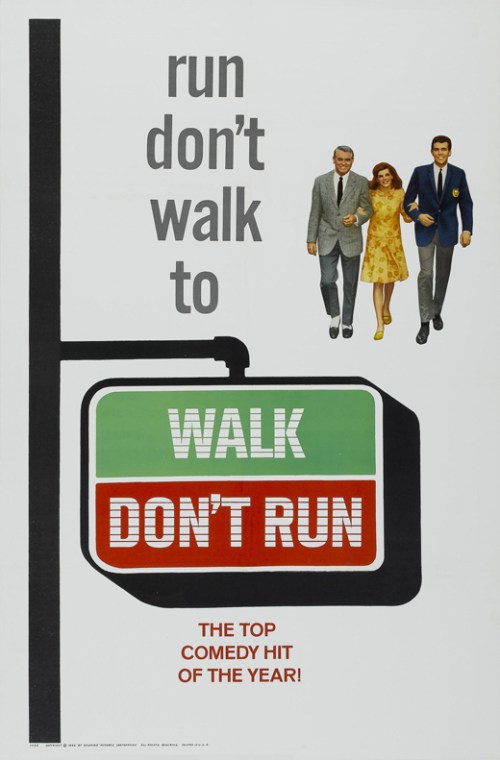
This film marked Cary Grant’s final on-screen appearance and was also a remake of the 1943 screwball comedy The More the Merrier, which was directed by the legendary George Stevens. The story is about a British businessman named Sir William Rutland (Grant) who travels to Tokyo on business during the 1964 summer Olympics and is unable to find a place to stay as everything is booked up. He spots an ad asking for a roommate on a nearby bulletin board. When he goes to the address he finds that the apartment is being rented by an attractive young lady by the name of Christine Easton (Samantha Eggar).  She at first is reluctant to accept the arrangement as she is rather old-fashioned and feels that a man sharing an apartment with a woman would not look appropriate, but William manages to talk his way in. The next day while at a business meeting William meets a young man who is participating in the Olympics, but will not tell anyone what event he is in. His name is Steve Davis and he is played by the late actor Jim Hutton, who is probably best known to today’s audiences as the father of actor Timothy Hutton as the two look almost exactly alike. Steve is looking for a place to stay as well so William invites him to the apartment, which makes Christine even more apprehensive, but after several ‘Three’s a Company’ type scenarios they eventually get along and Steve and Christine end up falling in love.

I found the first hour to be highly enjoyable.  Grant is an old-pro and goes through his role with amazing ease. Every scene he is in is amusing and I would highly recommend the film simply for his appearance alone. I felt the film started to stagnate when they introduced the romance angle. This was another situation were in my opinion the relationship was forced and formulaic and simply put in because the producers felt it would be ‘cute’. It didn’t seem to make a lot of sense why the characters would fall in love anyways since they had only known each other for a couple of days.  It is one thing if a person is desperately looking for someone, but that was not the case with Steve who is very independent and tells everyone he has no interest in marriage. There is nothing shown as to what about Christine’s personality would click with him to begin with.  Yes, she is pretty, but she spends most of the film being rather defensive towards them and more concerned with keeping a ‘proper’ distance. The two stars show no real chemistry either.

This was an unusual foray for actress Eggar as she rarely does comedy. She mainly works in horror films and thrillers and is best known for her performances in The Collector, The Walking Stick, The Brood, and The Lady in the Car with Glasses and a Gun. I felt in those types of roles she did exceptionally well, but here her comic timing seemed off and almost non-existent when compared to the two male leads.

There is also a very silly subplot dealing with Steve being accused as a spy and this culminates with a protracted scene at a Japanese police station where all the characters get interrogated by actor George Takei from ‘Star Trek’, which isn’t good for even a few chuckles. Another scenario involves Christine’s fiancé, Julius Haversack (John Standing), and William’s attempts to keep him away from Christine so that Steve can be with her. This storyline falls flat as well simply because the Julius character is so over-the-top stupid and gullible that William’s shenanigans don’t come off as being all that clever or amusing.

About the only thing that revives the film is the climactic race where the participants are required to walk and not run, hence the film’s title. I found this interesting because I had never seen or heard of this type of race before, but apparently it is a regular event at the Olympics and has been since 1928. The difference in a walking race as opposed to a running one is that the participants must always keep a part of their foot on the ground at all times. The result looks kind of goofy, like an old person trying to run, which explains why Steve was too embarrassed to tell anyone what he did.  I found this segment interesting although the story again gets too exaggerated as the other characters get into a cab and drive alongside Steve during the race, which I didn’t think would happen because there would be enough police officers and Olympic officials there to block them. However, I loved the part where William strips down to his underwear and starts fast-walking alongside Steve and then when he is finished he goes onto a bus and rides home still in his undies with everyone staring at him.

I felt like this was two story’s put into one with the first half being much better than the second. I almost wished they had just kept it focused on the three cohabitating together and not even brought in the romantic angle at all, or maybe just at the very end.  The movie is funniest when Grant is involved and any scene without him seems to fizzle. The music score by legendary Quincy Jones is cool and I wished they had played more of that as well.  It was filmed on-location in Tokyo, but you never really get a good feel of the city, or the Japanese culture. I think more filming in the downtown locations as well as certain landmarks was needed. There were also a few outdoor scenes that despite being nicely detailed where clearly done on an indoor soundstage.

My Rating: 6 out of 10

Released: June 29, 1966

Runtime: 1Hour 54Minutes

Rated NR (Not Rated)

Director: Charles Walters

Studio: Columbia Pictures

Available: VHS, DVD, Amazon Instant Video

Bank Shot 1974

bank1

By Richard Winters

My Rating: 8 out of 10

4-Word Review: A bank on wheels.

Donald E. Westlake was a prolific author that excelled in writing elaborate and ingenious crime capers that were later turned into movies including:  The Split, The Hot Rock, and Cops and Robbers. However, this one may not only be his most ingenious and funniest, but it may actually be the most ingenious and hilarious bank robbery movie made of all time. The concept is outrageously offbeat and consists of a bunch of drop-outs who decided to rob a mobile home that has been turned into a bank, but instead of stealing money out of the bank they decided to steal the entire building.

One of the great things about this movie and one that makes it so delightful to watch over and over is the fact that it doesn’t just sit on its one-joke premise and squeeze it until there is nothing left, but instead uses it as a springboard for all sorts of wild and offbeat tangents. This film is simply one wild comedic gag and set-up after another and all at a zany fast-pace. The scenes are original and work in perfect balance to the characters and rest of the story.

Some of the best ones are when the main character of Walter Upjohn Ballentine (George C. Scott) tries to break out of his prison grounds by using a bulldozer that he has stolen while the prison warden tries to somehow chase him down while driving a little bitty golf cart. There is also the scene where the motley crew crawl underneath the bank building and quietly install wheels on it and then cart the place away with the bank guards still inside.  The scene where they hide out in a crowded trailer park and the police and F.B.I. surround the wrong home is also hilarious and is their many futile attempts to break open the bank’s safe, which is supposedly burglar proof. Another gem is when the bank goes careening down a steep hill and they go chasing after it.

All the characters are wonderfully kooky. Ballentine and his group are truly social outcasts and losers. Too many films portray the supposed outsider as still being cool and hip when in reality they are anything but. Here they are dopey looking and inept. None of them could fit in if they wanted too and yet they all show a nice camaraderie to one another as well as an amazing resiliency and a ‘never say die’ philosophy even as they come upon one unexpected obstacle after another. The film nicely brings out the vivid anti-establishment, anti-authority feeling during that era that in today’s films seems diluted. The idiosyncrasies of the characters is also fun including Frank McRae as Herman X a black man who wants to use his share of the stolen proceeds to run for mayor of Anaheim where he hopes to then instill ‘some law and order’.  Joanna Barnes as a carefree hippie is engaging as is her infectious laugh.

Clifton James as ‘Bulldog’ Strieger the police warden who makes it his mission to track down Ballentine and is gang is perfect. For one thing he really does look like a bulldog and his hamminess is fun without going overboard. He has become famous for his redneck sheriff character and it has been used in many other, more famous films including two James Bond movies: Live and Let Die and The Man with the Golden Gun.  As well as Superman II and Silver Streak, but here I think he is at his funniest.

About the only thing that I did have a problem with was with George C. Scott himself. Normally he is a fine actor who usually gives brilliant, flawless performances, but here he added traits to his character that make him annoying. For one thing he speaks with a lisp. I have no idea why he decided to do this, but it doesn’t work. He also wears big bushy eyebrows, which look dumb and distracting.

The film is also too short. It runs at only 80 minutes, but I would have loved to see it keep going. The ending is also a bit of a dud. It seems like the writers wrote themselves into a hole that they had no idea how to get themselves out of, so they just abruptly ended it.

Otherwise this is a creative, highly original comedy that improves with each viewing. It’s great non-think entertainment for a slow evening that can also be enjoyed by the whole family.

My Rating: 8 out of 10

Released: July 31, 1974

Runtime: 1Hour 23Minutes

Rated PG

Director: Gower Champion

Studio: United Artists

Available: VHS, DVD, Netflix Streaming