Tag Archives: Annette O’Toole

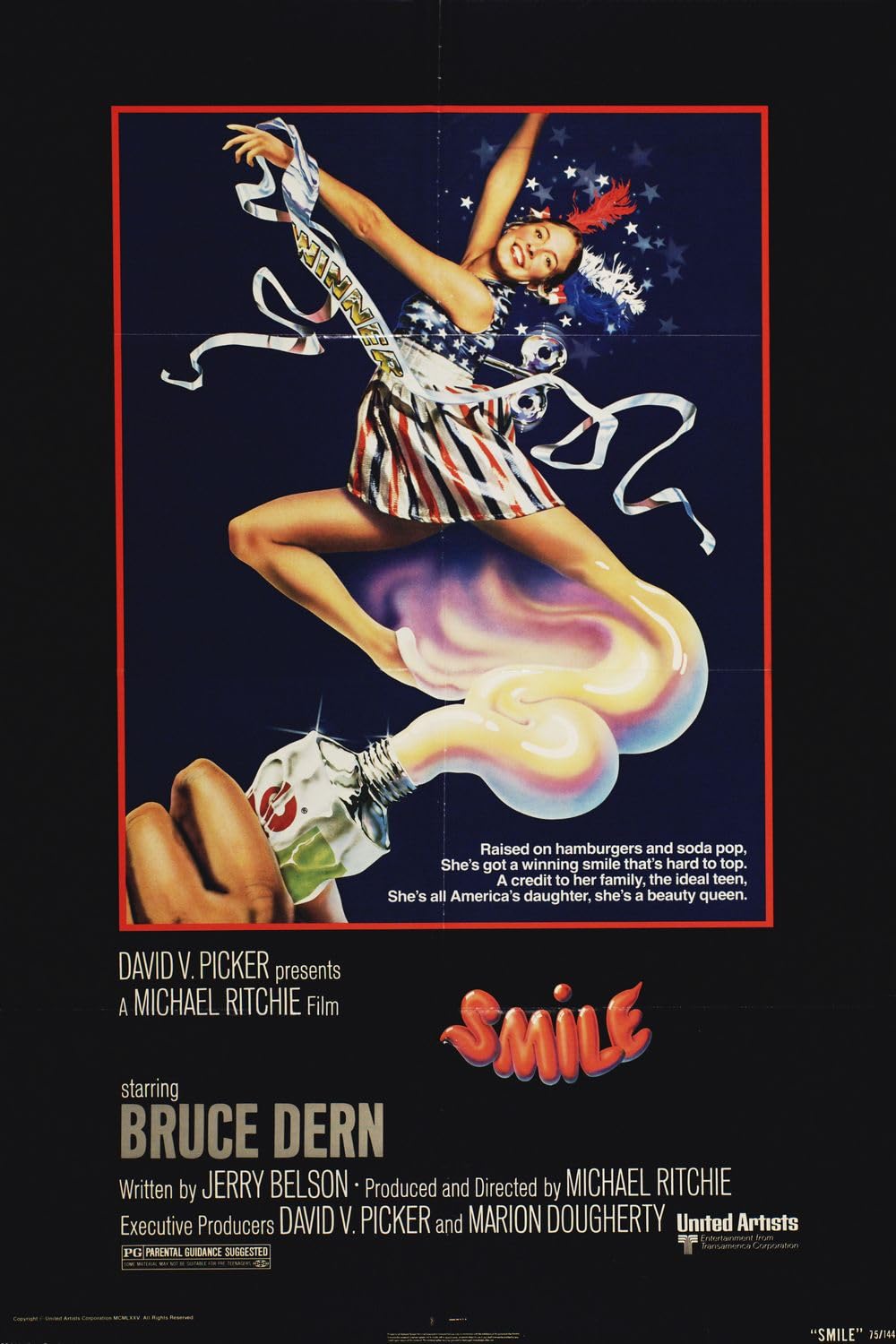
Smile (1975)

By Richard Winters

My Rating: 9 out of 10

4-Word Review: Producing a beauty pageant.

Santa Rosa, California is the site of this year’s Young American Miss Pageant. Each person that’s involved in the pageant approaches it differently. Bob (Bruce Dern), a middle-aged man who works as a car salesman, sees his position as a judge on the panel as a diversion from his otherwise mundane suburban life. Brenda, the pageant’s executive director, considers it a way to display her perfectionist qualities of control and leadership. Her husband Andy (Nicholas Pryor) views the proceedings in a much more cynical fashion and another added element to their already troubled marriage. Tommy (Micheal Kidd), the dance choreographer, approaches it as just another paycheck while Doria (Annette O’Toole), one of the contestants, considers it an opportunity to bolster her name and face even though Robin (Joan Prather), who’s competing against Doria, enjoys the whole thing just for the experience and isn’t concerned with who wins it, at least not initially.

The film marks the third entry in director Michael Ritchie’s American Dream trilogy and one of many he did dealing with competition and how this can change people in both good and bad ways with The Bad News Bears being the most famous of those. The gifted Jerry Belson wrote the script that was based on Ritchie’s own experiences as a pageant judge and many of the situations shown here were ones he went through. Unfortunately, despite the script being absolutely top notch to the extent of being one of the best satires ever written and equal to the more well-known Network that came out a couple years later the movie has not been seen by many, and the title has in recent years been eclipsed by the horror movie franchise. The is because the film’s studio, United Artists, had no confidence in the material and didn’t believe it would generate any profit and thus released it to only 4 theaters nationwide and thus few people ever saw it though in the following decades it has generated a small cult following and even a stage musical.

The finely etched, well-defined characters are what really sets it apart and each of them could be the centerpiece of their own movie if they wanted. Dern, who usually plays psycho roles, is excellent as a father who’s still clinging to his optimism even as everything around him deteriorates. Pryor equally good as his friend and counterpart who finds the suburban dream to be full of letdowns and lies and tries adamantly to break through Dern’s upbeat shield in order to get him to see the truth too. Feldon, best known as Agent 99 in ‘Get Smart’ TV-show, is terrific as well as a complete control freak and her defining moments coming during a scene in her living room, with all the furniture draped in protective plastic, and where she tries to literally goad her husband Andy into killing himself.

Even the minor characters display a unique angle and perspective on things including the janitor (Titos Vandis), who seemingly has a bottle of alcohol hidden everywhere, and makes keen observations on the others as well the music director (William Traylor) whose sarcasm and sexism knows no bounds. Geoffrey Lewis is memorable too as a marketing director who tries to promote the wholesome image of the contest only to in one really funny moment blurt his true cynical feelings about it. Prather and O’Toole though are the ones who drive it as it’s through them we see the inside mindset of those being judged and it’s interesting how at the start it’s O’Toole who’s the more jaded of the two while Prather is the wide-eyed one, but by the end after her experiences here Prather has more than been able to catch up with her.

Spoiler Alert!

The direction is done in a way that makes it seem like a docudrama where everything is captured through an unfiltered lens showing it as it happens with none of the scenes being set-up in a way that makes it feel staged, which is to its benefit. However, this gets ruined, in one of the movie’s few weak points, when Dern’s son Little Bob (Eric Shea) gets caught taking polaroids of the women in their undress. Instead of hearing the dialogue of the people when they catch him, as well as Dern’s when he finds out, which could’ve been quite revealing, music gets played over it, which is jarring as it reminds the viewer they’re watching a movie, even though it had spent the rest of the time trying to convince us we were seeing reality as it unfolded.

The ending is a bit of letdown too. Ritchie and Belson wanted the winner to be a complete surprise both to the cast and crew, which explains why the camera swerves around in a jerky style as even cinematographer Conrad Hall didn’t know who it was and thus had to try to find her when her name is announced. However, having it be a girl (Shawn Christianson) who has no lines of a dialogue, and only seen briefly in a few group shots, was a mistake. The attempt was to show how pointless these contests are and how not much thought or care goes into who’s picked, as evidenced by one of the judges seen flipping a coin before he makes his decision, but it still should’ve been someone we had seen and heard earlier. Maria O’Brien, who plays an obnoxious contestant who annoys the others so much they even sabotage her talent act, would’ve been a better choice and the film would’ve still made the same point and allowed a little more of a lasting emotional effect. With the way it gets done here the viewer leaves feeling miffed and confused.

My Rating: 9 out of 10

Released: March 20, 1975

Runtime: 1 Hour 57 Minutes

Rated PG

Director: Michael Ritchie

Studio: United Artists

Available: DVD, Blu-ray
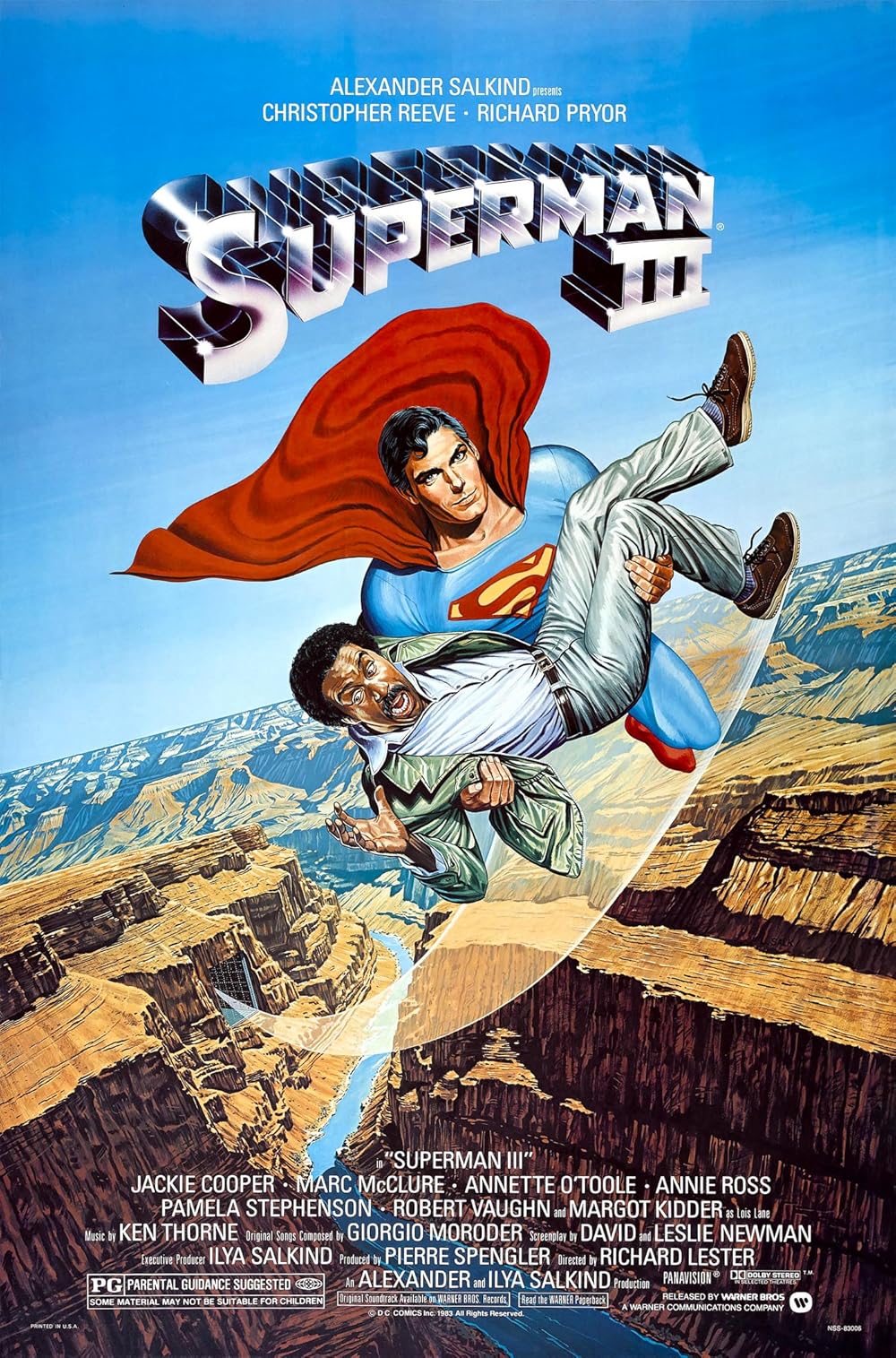
Superman III (1983)

By Richard Winters

My Rating: 2 out of 10

4-Word Review: Computer whiz corrupts Superman.

August ‘Gus’ Gorman (Richard Pryor) is an unemployed man looking for a job and comes upon the idea of training to become a computer tech when he sees it advertised on the back of a book of matches. Much to his surprise he excels as a student and is soon able to use his newfound computer knowledge to hack other programs including the payroll department at his company where he’s able to give himself a large, unearned monetary bonus. Ross Webster (Robert Vaughan), the company’s CEO, becomes aware of what Gus is doing, but is so impressed by his computer skills that instead of firing him he hires him to hack a weather satellite that will cause a rain storm in Columbia that will destroy the coffee crops and allow Webster to corner the market, but Superman intervenes and tempers the storm, so it isn’t as bad. This causes Webster to realize how detrimental to his plans Superman is and orders Gus to come create some synthesized Kryptonite in order to impair Superman’s ability. Gus researches the elements that make up Kryptonite on his computer and finds all of them except for one, so he arbitrarely adds tobacco in it for good measure. Instead of weakening Superman it turns him into an uncaring, sinister person who ‘drops-out’ of the hero saving lifestyle and becomes an anti-social person who shows no concern for others.

When Richard Donner, who had directed the first installment and 75% percent of the second one, got fired, he was replaced with Richard Lester. Lester had a far different vision for the Superman films. He disliked what he considered the ‘dark tone’ that Donner had given the first two and wanted a humorous quality put in. While I don’t mind some campiness Lester clearly goes overboard including the segment done over the opening credits that features unending slapstick that makes a mockery of the Superman franchise and drives the whole thing down to such a silly level that I wouldn’t have blamed anyone if they had walked out of the theater and demanded their money back.

Pryor was a big fan of the first two Superman movies and said as much when he was a guest on the ‘Tonight Show’. The Salkinds, who had proved already to have an unhealthy proclivity to the so-called ‘star power’ by casting Marlon Brando in the first film and paying him an outrageous sum even though his acting was subpar and a lessen known actor could’ve done a better job at half the price. No one ever came to a Superman movie simply to see Brando nor any other big-name actor, but for whatever reason the Salkinds didn’t understand this, so when they heard Pryor was interested in being in one of their films and he was a trop draw at the box office at the time, they admittedly signed him up.

Pryor, for his part, is highly engaging, but his schtick is out of place here. The script centers too much on his character making Superman seem like he’s only a co-star in his own movie. The character he plays makes no sense either as he’s portrayed initially as being a dumb guy who can’t hold down any job and then suddenly becomes a super genius with computers. However, there needed to be something shown in his background that would connect this, like he was really good with math, or coding, but instead it’s never explained. The movie makes it seem like it’s ‘dumb luck’ that he’s such a programming whiz and even he himself doesn’t understand it, which is just plain ridiculous especially as he continues to become more and more sophisticated with it.

While I liked the gaudy set design of Webster’s penthouse, and his rooftop ski slope, as a villain he’s a complete bore and seems too similar to Lex Luthor and his ditzy lady friend Lorelei, played by Pamela Stephenson, coming-off as being simply a younger version of Luthor’s main squeeze Miss Tessmacher. Webster’s evil sister Vera, played by Annie Ross, is equally dull and I have no idea why she was even put into the story as she adds little and doesn’t play-up her domineering persona enough to be even remotely interesting or amusing. Her character shows the same flaw as Pryor’s where she becomes really good at running a complex computer system too easily and too quickly.

The Lois Lane character gets minimized to the extreme where we see her briefly at the start and then quickly at the end. Supposedly this was due to a falling out that Margot Kidder had with the producers, but the Salkinds insisted it was more because they wanted to explore Superman’s romance with someone else, but Lois and Clark Kent’s relationship had gotten quite intense during Part II, so there needed to be some explanation with why now they were in the ‘friend zone’ like maybe perhaps she had found another boyfriend. The film though never bothers to come-up with any answer making it feel like there was no story cohesion between this one and the other two. Annette O’Toole, who plays the new love interest Lana Lang, is benign and the romantic chemistry between her and Kent is nil. 

David and Leslie Newman’s script lacks understanding in regard to technology and extreme naivety with the way Pryor’s character is able to use his computer to hack into other programs. Viewers today, who are much more sophisticated about the topic, will find the stuff here to be quite antiquated. The way the giant supercomputer gets completed is absurd too as it’s never shown who builds it. Was it done by just the four villains single-handedly, or by a large crew? Even if a crew did do it, it would take months if not years to construct and yet here it’s done in seemingly a day, or two. When Gus and Webster create an economic crisis by redirecting oil tankers you’d think the U.S. government would certainly get involved and investigate and would have computer experts on hand to trace back how and where the hacking occurred and at some point the two would eventually, at the very least, come under suspicion and yet here that never happens, nor even gets touched upon.

Spoiler Alert!

Some have complimented Reeve’s performance as the evil Superman, which is good, but the giant showdown that he and Clark Kent have in which they use they’re individual superpowers to try and take the other down, is too reminiscent between Zod’s gang and Superman from part II and thus comes off as redundant instead of exciting. 

I didn’t agree with Pryor’s character getting off-the-hook at the end either. Yes, he did ultimately save Superman’s life, but he also stole money and got involved in nefarious projects that broke many laws, so instead of being transported to a new location where he could get another job and ‘start fresh’ he should’ve been taken to a prison to serve his debt to society. Even if he was at heart ‘a nice guy’ he still did some wrong things and should’ve had to pay some sort of consequence. 

My Rating: 2 out of 10

Released: June 17, 1983

Runtime: 2 Hours 5 Minutes

Rated PG

Director: Richard Lester

Studio: Warner Brothers

Available: DVD, Blu-ray, Amazon Video, YouTube

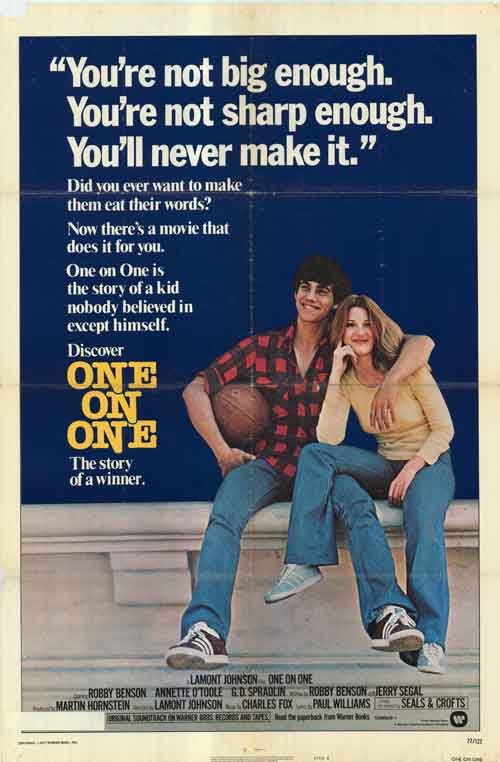
One on One (1977)

By Richard Winters

My Rating: 6 out of 10

4-Word Review: A college basketball star.

Henry Steele (Robby Benson) becomes the star of his small town high school basketball team, which is enough to get him a scholarship to a university in California on their team. Once there he becomes overwhelmed by the demands of his coach (G.D. Spradlin) as well as the under-the-table ‘business side’ of college athletics. The disappointed coach eventually asks him to rescind his scholarship, but Henry refuses leading to many brutal practices where the coach tries to make life a living hell for him, which he hopes will get Henry to finally quit, but to everyone’s surprise Henry perseveres and shows more grit in him than anyone ever imagined.

The script, which was co-written by Benson and his father Jerry Segal shows a revealing look of the underside of college sports making it quite compelling to watch particularly the first half-hour where Henry gets introduced to many things he hadn’t come into contact before including getting involved with ‘payouts’ to college benefactors, drugs, wild parties, amorous secretaries (Gail Strickland) and even romance with his tutor Janet (Annette O’Toole). The film has a nice year-in-the-life approach where the viewer feels like they are following Henry around by his side and experiencing the same first-hand situations as he does. It also examines the discrimination that athletes go through, which is rarely tackled in other films, dealing with Janet’s boyfriend Malcolm (James G. Richardson) who mocks Henry and other athletes like him for being ‘unintellectual’ and trained to passively obey all rules handed to them by their coaches while unable to think for themselves.

Benson’s performance of a wide-eyed, naïve small town lad works and the viewer can’t help but chuckle at his initial inability to handle the many new challenges he’s faced with while also remaining sympathetic to his ongoing quandary. Many actors may not be able to pull off such a feat, but Benson, who’s a far better performer than people may realize, does so flawlessly particularly the times when his character fights back and grows from a hayseed kid to a full grown man.

Spradlin has the perfect look and voice for a college coach and he coincidentally played a coach in North Dallas Forty, which came out that same year. However, his facial expressions reveal too much of his inner feelings particularly that of concern and worry where an actual coach would try to mask these vulnerable feelings from their players in order to prevent them from ‘reading’ what they are thinking and maintain more control.

Henry’s relationship with Janet comes off as forced. The two clearly were on opposite ends of the intellectual plain and I didn’t see what if anything that they actually had in common. Having Henry read ‘Moby Dick’ one of her favorite novels didn’t seem to be enough of a catalyst to have her suddenly fall-in-love with him. She brought in other athletes into her apartment to tutor and since she was paid $265 an hour I’d doubt she’d give that up, which most likely could cause tensions with their relationship, but this never gets addressed.

The songs by Seals and Croft don’t help and the film would’ve been better had they not been involved. They had some great chart toppers during the ‘70s, but slowing up the film by having a montage with their songs played over it takes the viewer out of the drama and unwisely reminds them that they’re just watching a movie instead. The Seals and Croft sound doesn’t coincide with a spots theme at all and it’s too bad that the Hall and Oates hit of ‘One on One’ hadn’t been released earlier  because that song would’ve been a better fit.

Spoiler Alert!

The ending has a dreamy/sports clichéd feel particularly the way Henry comes off the bench and scores all the points as the team scratches and claws their way from behind, which could be enough to make some viewer’s eyes roll, but the fact that all the fans run onto the court afterwards is what had me. This was only an early season game and usually fans only do this during a crucial late season contest or championship. Henry’s team was expected to go undefeated and they were losing to a team that they were favored to beat, so if anything the fans would’ve been annoyed that the game was so close and not inclined to rush the court, but more thankful that they had avoided a potential loss and then critical that the squad was not living up to expectations.

Having Henry stand-up to the coach at the end and leave the team may have been emotionally satisfying for a few seconds, but in the long run he’d be better off had he stayed. If he joined a new team he’d have to start all over again proving himself to the new coach and teammates while here he had finally gotten that out of the way. He’d also have to move to a new school, which would’ve hurt his relationship with Janet.

End of Spoiler Alert!

Overall though as sports movies go this isn’t bad and pretty realistic most of the way. Fans of college basketball should enjoy it as it gives one a sort-of behind-the-scenes view of the inner workings of college athletics.

My Rating: 6 out of 10

Released: June 28, 1977

Runtime: 1Hour 38Minutes

Rated PG

Director: Lamont Johnson

Studio: Warner Brothers

Available: DVD-R (Warner Archive), YouTube

Foolin’ Around (1980)

foolin around 2

By Richard Winters

My Rating: 4 out of 10

4-Word Review: Redneck falls for hottie.

Wes (Gary Busey) is a college student who has moved from Oklahoma to Minnesota to attend the university. Desperate for some extra cash he takes part in a program run by the student science department where he gets strapped to a chair and given an electrical shock every time he gives a ‘right’ answer. The procedure is facilitated by Susan (Annette O’Toole) who’s an attractive coed there. Wes is immediately smitten, but finds himself in an uphill battle as she is already engaged to Whitley (John Calvin) an obnoxious stuck-up social climbing man whose equally arrogant mother (Cloris Leachman) wants her to have nothing to do with Wes and tries to completely shut him out of her life.

Although far from a critic darling this obscurity still manages to have a few funny scenes. The best are Wes’s encounters with Whitley particularly when Whitley tries parking his car in wet cement or trying to subdue an out-of-control carpet cleaner in his office. Wes’s conversation with Susan’s grandfather (Eddie Albert) high up on the edge of a skyscraper under construction is nerve-wracking particularly when Albert walks out to the end of a beam hundreds of feet up and then challenges Busey to do the same. The film also has a unique car chase that features an automobile made to look like a giant hot dog as well as a hang gliding segment through the Minneapolis skyline that is downright exhilarating.

Busey does well as an amiable doofus in a part that seems best suited for his acting ability. O’Toole is at the peak of her beauty and Leachman manages to get a few choice moments as the meddling mother. Tony Randall is fun as a snooty butler with a French accent and it’s great to see William H. Macy in an early, but brief part near the beginning.

The on-location shooting done in the state of Minnesota adds some verve particularly the segment done on the sidelines of an actual Vikings-Rams football game. Unfortunately the script is threadbare with certain gags that become labored and lame and a romantic angle that is sappy and contrived. It is also hard to believe that Susan would for even a remote second consider marrying the Whitley character who is a one-dimensional arrogant asshole to the extreme. It is even more absurd that she would fall in-love with Wes as she is clearly out of his league both physically and intellectually and it’s about as farfetched as Busey ever one day winning the Academy Award.

My Rating: 4 out of 10

Released: October 17, 1980

Runtime: 1Hour 40Minutes

Rated PG

Director: Richard T. Heffron

Studio: 20th Century Fox

Available: VHS