Tag Archives: 70’s Movies

Two-Lane Blacktop (1971)

By Richard Winters

My Rating: 9 out of 10

4-Word Review: Drifters on the road.

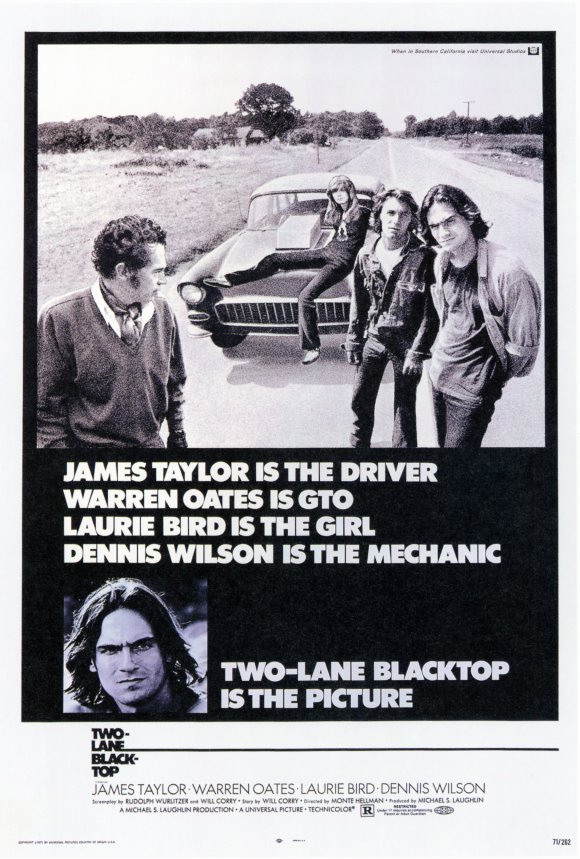
This is a cult film if there ever was one as there seems to be no other category to put it into. It has a quality and style all of its own and the same existential mindset as Easy Rider, which can encompass you with its moody, desolate, and surreal atmosphere.

The story focuses on two young men (James Taylor, Dennis Wilson) who are given no names and drive a ’55 Chevy. They make a living challenging others to races and bet a middle-aged man (Warren Oates) that they can make it to Washington D.C. before he does. The race, like many things in life, becomes only a concept that gets increasingly more fleeting as it goes on.

The two young men are remnants of their fractured society and can only relate to the world around them when it is through their car. They subconsciously use the car to differentiate them from the pack and cover up there otherwise empty existence. The vehicle becomes more like a person while they become more like an inanimate object. They are unable to convey any deep emotion or thought and, like the stick shift in their car, only able to function with certain people.

Oates is interesting in a different sort of way. He is a man desperately seeking attention and yet is alienating at the same time. His fabrications about his life become more and more outrageous and compulsive until one wonders if he knows the difference anymore “If I don’t get grounded soon, I’m going to fly into orbit”. We realize he is running from something, but unlike other stories this mysterious past may be nothing more than loneliness and failure. He drives aimlessly simply as a way to avoid it and stopping would only allow it to catch up. The hitch-hikers he picks up along the way and conversations he has with them prove to be some of the film’s most compelling moments.

Laurie Bird plays the hippie girl that shuffles herself between the three. She inadvertently brings out some of their most dormant feelings as well as their flaws. She is quintessential in her role and her face is etched with the anger, alienation, and innocence of the youth from that era.

This as evocative a picture as you will ever find. The widescreen, remastered DVD version shows the wide open outside shots in almost crystal clear fashion. Watching James Taylor walking down a lonely, nameless small town street captures the youth’s detachment better than just about anything else. Of course this is a picture that is completely dependent on personal taste. Some will say it speaks to their soul, while others will watch it and see nothing. I know when I was younger it seemed boring and aimless, but I watched it again many years later and it made perfect sense.

The film also gives you a chance to hear interesting variations of popular rock songs. They are played in the background of certain scenes and include: “Hit the Road Jack”, “Maybellene”, and “Me and Bobby McGee”.

My Rating: 9 out of 10

Released: July 7, 1971

Runtime: 1Hour 42Minutes

Rated R

Director: Monte Hellman

Studio: Universal

Available: VHS, DVD (Criterion Collection), Blu-ray (Region B)

The House That Cried Murder (1973)

By Richard Winters

My Rating: 5 out of 10

4-Word Review: The bride goes nutzo.

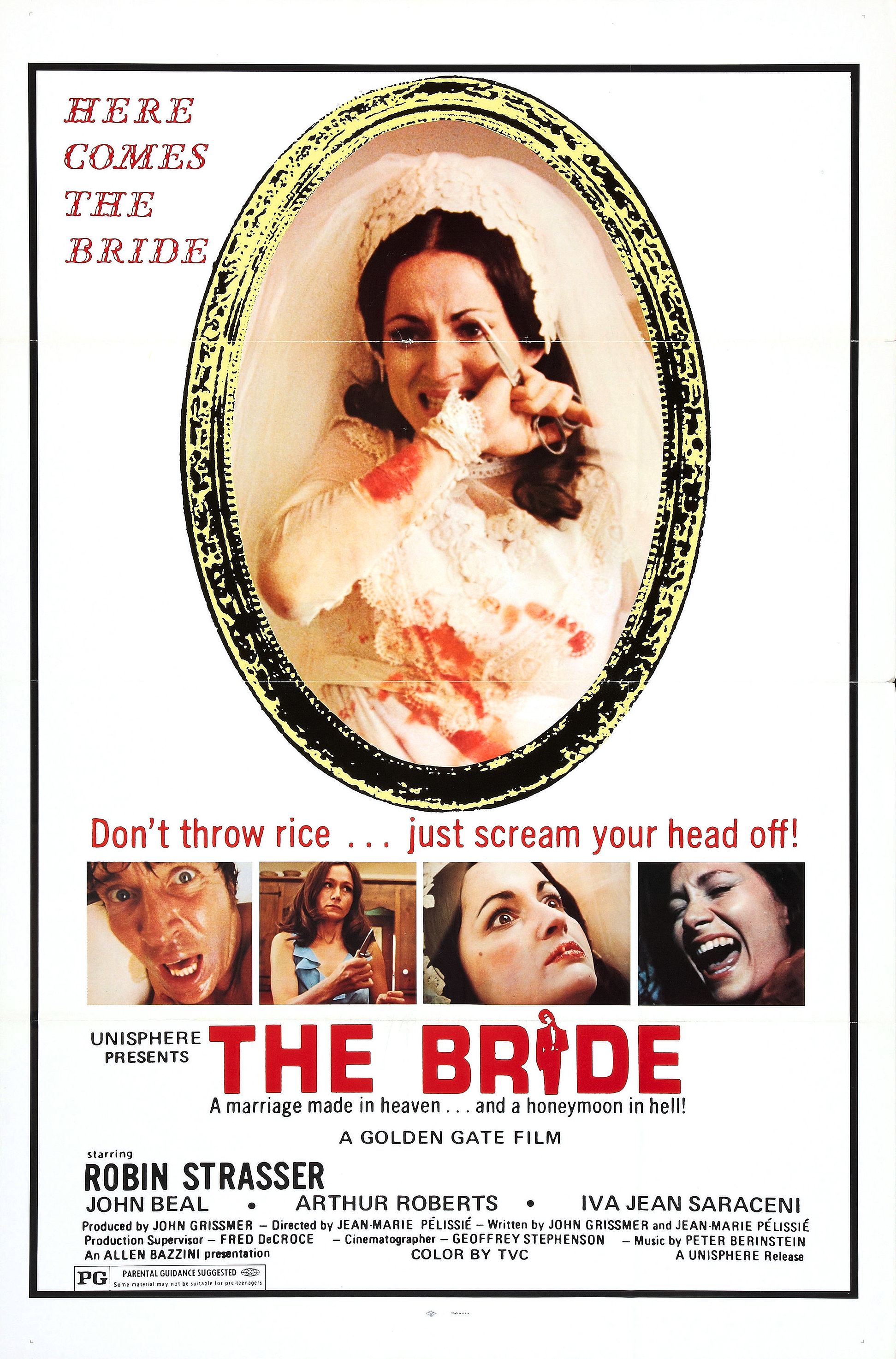
Despite a low budget this is an intriguing horror film with a unique vision. Barbara (Robin Strasser) is a young headstrong woman who designs an ominous looking, modernistic home, which she then has built. She plans on moving into it with her fiancé David (Arthur Roberts) who is caught fooling around on their wedding day, which sends Barbara into reclusion. Soon David begins experiencing strange occurrences, which leads him back to the house where an odd climatic sequence ensues.

This film stands out from the other low budget, cardboard horror movies of the 70’s simply because director Jean-Marie Pelissie shows a good understanding of the genre and how to effectively create eerie sequences. The house itself is an odd spectacle that looks like something designed by Frank Lloyd Wright while drunk. It’s erected in a large, empty field which gives it a very pronounced presence. The inside of the place was unfinished, and Pelisse uses the large windows of the home to casts unusual shadows along its white plastered walls and gives it a spooky look  as the camera goes spinning around it. Some of the imagery used during a nightmare sequence is equally creepy.

Strasser herself is quite frightening and flies into authentic looking rages easily. One good segment has her walking in front of all the wedding guests wearing a blood stained gown while behaving erratically. She then runs off with only hints that she may or may not be lurking in the shadows, which nicely taps into the fear of the unknown and mysterious.

The unfaithful groom is a good character with all the qualities that you love to hate. He is good looking, but amoral. He uses people while climbing the social ladder, but is quite dumb in the process. He tells his bride that he will be gone “for only a minute” and then has the audacity to go to an upstairs room of the house where they are having the wedding party and fools around with his former girlfriend, but doesn’t think to lock the bedroom door. When he gets his eventual comeuppance you have no problem seeing it.

As Strasser’s father John Beal is unimpressive. He is supposed to be a man of money and power, but instead comes off like a wimpy old man. Iva Jean Saraceni,,who portrays David’s old girlfriend Ellen, looks too much like Strasser, which doesn’t help.

Although this film has potential the low production values almost destroy it. The lighting is flat and certain segments are so dark you can barely see what is happening. Many scenes were filmed in small, cramped looking rooms with tacky props in the background. The music used during the scary scenes is good, but the soundtrack played over the rest of the film sounds like a bad rendition of Herb Alpert and the Tijuana Brass.

If you’re into cheap 70’s horror flicks then this is one you should check out. It definitely has some distinctive moments and is an interesting forerunner to A Nightmare on Elm Street since Barbara terrorizes David and his girlfriend through their dreams.

My Rating: 5 out of 10

Alternate Title: The Bride

Released: December 14, 1973

Runtime: 1Hour 25Minutes

Rated PG

Director: Jean-Marie Pelissie

Studio: Golden Gate Productions

Available: VHS, DVD

Marathon Man (1976)

By Richard Winters

My Rating: 7 out of 10

4-Word Review: Dentist doesn’t use novocain.

            Thomas ‘Babe’ Levy (Dustin Hoffman) is a post graduate student at Columbia University and part-time marathon runner who spends a harrowing 48 hours being tortured and terrorized by a sadistic Nazi war criminal. It all starts when his brother Henry ‘Doc’ Levy (Roy Scheider) who works for a secret government organization known as ‘The Division’, secretly tracks Dr. Christian Szell (Laurence Olivier) a dentist at Auschwitz who has traveled to New York in order to collect a cache of diamonds. When Doc moves in too close Szell stabs him and despite being covered in blood Doc manages to make it all the way to Babe’s apartment before collapsing. Szell fears that Doc might have told Babe something before he died and has his men kidnap Babe where they then tie him to a chair in an abandoned warehouse and Szell tortures him by drilling into his teeth forcing Babe to use his running skills in an effort to escape.

This is an original thriller that stays intriguing and intense throughout. In the first thirty minutes alone the viewer is treated to some interesting and exciting scenarios including watching two elderly men drag racing with each other in their antique cars down a crowded neighborhood street. There is also an exploding baby carriage and an exciting fight sequence where Doc battles an attacker who tries to strangle him from behind with a metal wire. This scene is unique in that it cuts between seeing the action up close as well as viewing it from the point-of-view of an elderly man watching from across the street.

Director John Schlesinger shows visual flair with a variety of camera angles and settings. I particularly liked the part where Doc meets Szell at the red steps statue in the Arco Plaza. Having the climactic showdown between Babe and Szell take place in a pump room at the reservoir in Central Park gives the sequence added energy and distinction. I also enjoyed Babe’s cramped, drab, and cluttered apartment that had a very lived-in look and resembled exactly what a bachelor pad with someone on a low income would look like. The scene taking place at a country house is memorable simply for its extreme remoteness. I was disappointed though that although Schlesinger does a great job in setting up the atmosphere of the scene by doing a long shot looking out at the barren landscape the weather suddenly goes from cloudy to sunny in the minute it takes for the bad guy’s car to pull up the driveway. I realize certain scenes are sometimes shot over several days and this is not the first movie to have sudden weather changes during outdoor shots, but it is distracting nonetheless.

The infamous torture scene didn’t work for me. I appreciated the set-up especially the prolonged way that Szell plugs the drill into a wall outlet while talking to Babe in a calm tone. Constantly asking Babe the question ‘Is it safe?” has become a classic line and the fact that the dental torture gets extended when you think it is over is well done. Still, it didn’t seem violent enough and although pain is implied I didn’t think that the viewer really ‘feels’ it. I wanted more shots from Babe’s point of view especially as Szell sticks his metal instruments into Babe’s mouth. A close-up of Babe’s tooth and seeing the drill touch it would have helped as well. Also, Babe needs to scream in pain a lot more, he does it once briefly, but someone going through that would be doing it constantly.  Apparently the producer’s cut out portions of this scene when it upset the test audiences who saw it, but I would like that footage put back in as I feel it would make the movie stronger and give it an added kick that otherwise is missing.

Olivier is tremendous in the villainous role. His face exudes evil and this is one of his best later career roles. Scheider has his best role here and I found Marthe Keller impressive as Babe’s girlfriend. She wears an attractive hairstyle and I couldn’t get over how diametrically opposite she was compared to her character in Black Sunday that was done the very same year. She is definitely an under-rated actress that deserves more accolades as well as more parts in American productions. However, the way Babe pursues her for a date seemed to border on ‘creepy’  and overly aggressive and act as a turn-off to most women.

The film does seem derivative at certain points especially the way it portrays New York as an urban hellhole, which was quite common during the 70’s. The fact that Babe avoids confrontation and is picked on by a Hispanic gang that lives across the street seemed too reminiscent of Hoffman’s earlier film Straw Dogs. There are several flashback sequences showing Babe as a child that is done with faded color and no dialogue and look too similar to the childhood sequences done in Midnight Cowboy, which was an earlier Schlesinger/Hoffman project. Hoffman, for what it is worth, gives another one of his dedicated performances, but this film really does show in glaring detail how very puny he is and I really could have done without having to see his naked rear.

The electronic score is nice and the part where Szell gets recognized by an elderly concentration camp survivor on a busy city sidewalk and who then begins to chase after him is memorable. However, when it is all over I still felt it didn’t completely click. I’m not sure what it is. I know the ending was changed from the one in the book, but I liked this one better and felt Babe’s revenge on Szell was creative. Although controversial and edgy for its time, the torture scene seems too toned down for today’s standards. Either way, if you are looking for a competent and entertaining thriller this should fit the bill, but it is not a classic.

My Rating: 7 out of 10

Released: October 8, 1976

Runtime: 2Hours 5Minutes

Rated R: (Violence, Language, Adult Theme, Brief Nudity)

Director: John Schlesinger

Studio: Paramount

Available: VHS, DVD,  Blu-ray, Amazon Instant Video 

Chilly Scenes of Winter (1979)

By Richard Winters

My Rating: 8 out of 10

4-Word Review: Can’t get over her.

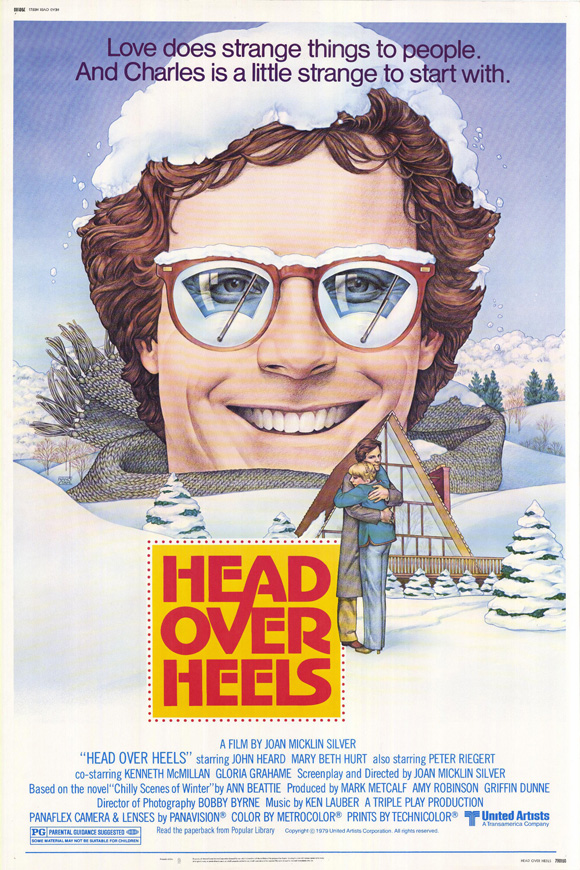
            Charles (John Heard) meets Laura (Mary Beth Hurt) at his job and immediately becomes smitten.  She is married and upfront about it, but since it is not going well she decides to go out with him. They soon move-in together, but it only lasts for a couple of months before Laura goes back to her husband. This is a crushing blow to Charles who obsesses about her constantly and tries any way he can to win her back.

This is in many ways a dated movie and normally I would consider that a detriment, but here I found it to be an asset. It is refreshing and fun to see a person drink a little on the job, or playfully touch a female co-worker as he walks past them and not have it become an immediate sexual harassment lawsuit. There is also the part where Laura invites Charles back to her home after only their first date, which could be considered reckless, but it’s nice to go back to an era that was more trusting and not everyone was labeled a potential psycho until proven otherwise.

There is of course the subject of stalking which is what Charles does, but here it is natural and actually kind of sweet. Some of it may be considered a little ‘creepy’, or even pathetic, but none of it is menacing, or done with criminal intent. To me this makes more sense and is more realistic to expect that when someone has strong feelings for someone else and spent special times with them that they would have trouble ‘moving-on’ when the other person breaks it off and their inability to do so shouldn’t necessarily make them ‘crazy’, or ‘maladjusted’ and this film very effectively shows that.

This is a terrific movie about relationships. The characters are real and relatable. The situations they go through are universal and the best thing is that it stays that way until the bitter end without pulling any punches. Anyone who has gone through difficult relationships will appreciate the honesty and it’s a real shame they don’t make movies like this anymore.

Heard is excellent and plays an extension of the same 60’s radical character begrudgingly moving into adult life that he did in Between the Lines, which was his first collaboration with writer-director Joan Micklin Silver. A young Peter Reigert is appealing as Charles’s roommate Sam. Kenneth McMillan, a looks- challenged character actor who usually plays slimy people, is surprisingly likable as Charles’s stepdad. Legendary screen actress Gloria Grahame, in one of her last roles, is highly amusing as Charles’s crazy mother. I was never quite sure what any of her scenes had to do with the main story, but her presence was fun anyways.

The film also contains some offbeat scenes and an original sense of humor. This includes the scene where Charles makes a miniaturized replica model of the home that Laura lives in and then uses dolls to play the parts of Laura and her husband and child. There is also the part where Charles meets Laura’s husband under the guise of being a home buyer and then stands up in front of him and states his undying love for his wife as well as a goofy conversation that he has with a wacky elderly lady roommate when he visits his mother in the hospital. The best though is the running conversation that Charles has each day with the blind cashier at a candy counter that gets better and better as the movie progresses.

The film nicely captures the wintry Utah landscape and although the original title for the film was Head over Heels this other title works much better and not only fits the season in which the story takes place, but also the ever difficult and complicated dating scene as well.

My Rating: 8 out of 10

Alternate Title: Head over Heels

Released: October 19, 1979

Runtime: 1Hour 32Minutes

Rated PG: (Brief Nudity, Adult Theme)

Director: Joan Micklen Silver

Studio: United Artists

Available: VHS, Netflix Streaming

The Little Girl Who Lives Down the Lane (1976)

By Richard Winters

My Rating: 3 out of 10

4-Word Review: She is all alone.

Rynn (Jodie Foster) is a 13-year-old girl living alone in a big house in the countryside. Her father has leased the place for three years from nosy landlady Mrs. Hallet (Alexis Smith) and her adult son Frank (Martin Sheen) who continually makes lecherous advances towards Rynn. No one has seen her father and when anyone asks for him she comes up with excuses, which starts to make everyone in town suspicious. She meets fellow teen Mario (Scott Jacoby) who she lets in on her secret and the two devise a plan that will rid them of the meddlesome Hallets.

Although she has stated in interviews that this is the least favorite out of all the movies that she has done I can’t think of anyone more perfect for the part of an independent headstrong young woman than Foster, who has always carried that persona. Despite the vast age difference she easily carries the picture from her older co-stars. There is even a nude scene involving her character although it was done by her older sister Connie working as a body double. This was done despite her adamant protests as was a scene where she goes to bed with Jacoby, which she has said made her extremely uncomfortable and probably explains her dislike for the film.

Sheen is menacing as the perverted Frank, who enjoys ‘younger girls’ and his ongoing banter and advances with Rynn is consistently creepy and tense. Alexis Smith is excellent as the mother and her worn face and attitude gives her a witchy presence and it is too bad she couldn’t have remained for the entire movie. I also found Jacoby engaging and amiable and I really enjoyed his character, which I found a bit surprising since he is best known for playing dark, sinister characters in Rivals and the TV-movie Bad Ronald.

The on-location shooting, which was done in both the Canadian province of Quebec and in Maine, is excellent and gives one a nice taste of small town life on the east coast. There is some nice synthesized music that gives the film a dark tone. The premise is offbeat and to some extent, at least during the first half, it is enough to keep you intrigued.

My main issue with the film is the fact that not enough happens. Almost all the action takes place in the main room of the house, which eventually becomes dull, especially visually. There are no scares, or shocks and the twists aren’t all that clever, or surprising. In fact the final twist I saw coming long before it happens. There are times when cutaways would have been helpful and spiced things up particularly when Rynn talks about a visit from her mother and her ‘long red finger nails’, which we never see and is just described. The conclusion leaves A LOT of unanswered questions making this thing empty and incomplete. The final shot is one very long take of a close-up of Foster staring at a subject while the credits role by, which eventually becomes annoying and it would have been better had they done a freeze-frame instead of forcing her to sit and stare at something way longer than humanely possible. Also, composer Mort Shulman is badly miscast as the policeman. His acting abilities are clearly limited and he shows no presence or authority and makes the scenes he is in weak.

It is hard to know what genre to put this in. It is really not scary and the mystery angle has too many loopholes to being taken seriously. The story, based on a novel by Laird Koenig, seems rather tame despite some dark elements and geared more for teens, or young adults.

My Rating: 3 out of 10

Released: December 25, 1976

Runtime: 1Hour 40Minutes

Rated PG (Brief Nudity, Mild Cursing)

Director: Nicholas Gessner

Studio: American International

Available:  VHS, DVD, Netflix Streaming

Bunny O’Hare (1971)

bunny

By Richard Winters

My Rating 2 out of 10

4-Word Review: Bette becomes a hippie.

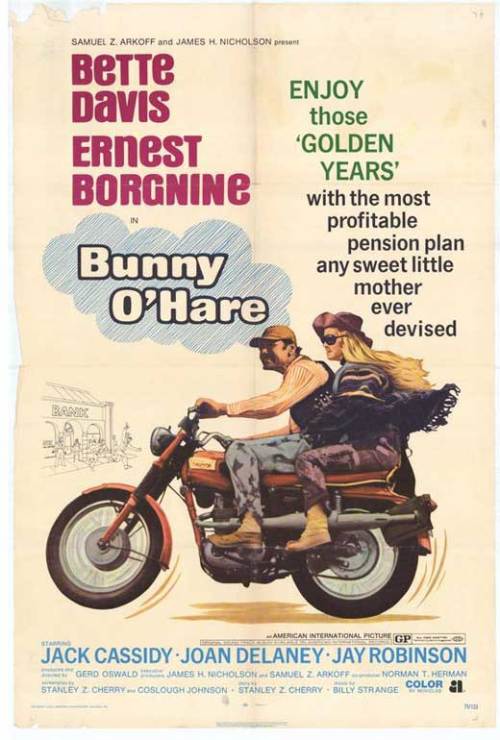
Extremely odd Bette Davis vehicle made in her later years when her career had crested and she was forced to be less choosy about her projects. The story has to do with a lonely widow named Bunny O’Hare (Davis) who losses her home to foreclosure and is rendered homeless. She meets an older man named Bill Gruenwald (Ernest Borgnine) who is an escaped bank robber. Together they dress up as hippies and rob banks throughout the state of New Mexico in order to survive.

Davis is exceptional. Usually she plays cold, manipulative characters, but here she gives a perfect, touching performance as a nice old lady. She is terrific in every scene that she is in and the only bright spot in what is otherwise a misfire. Borgnine though seems wasted and thrown in only as a stock character.

The story really has nowhere to go. The intention was to make the film a mixture of social satire and slapstick, but it fails on either end. The novelty wears off quickly and it soon becomes derivative. Initially their ploy to rob the banks seemed clever as Bill releases a bird into the bank, which causes such a distraction that they are able to rob it without detection, but it becomes tiring when it gets played-out again and again. The police are portrayed as being universally bumbling and making it seem like a six-year old could rob a bank and easily get away with it. I also did not like the banjo music being played as they are trying to get away from the cops as it seems too similar to the much better film Bonnie and Clyde and in fact the original title for this movie was going to be ‘Bunny and Claude’.

The casting of Jack Cassidy as Lieutenant Greely, the policeman who becomes obsessed with capturing them, should’ve worked.  He was very adept at playing cold, cunning, slightly offbeat characters as evidenced by his Emmy Award winning performances on the old Columbo TV-show as well as the cult TV-series He and She. He was the husband of actress Shirley Jones and the father of Shaun and David Cassidy whose career was unfortunately cut short when he ended up dying in a fire in 1976 after falling asleep with a lit cigarette. His unique talent here is stifled because the character is portrayed as being unrealistically dimwitted and saps any possible energy from the scenes that he is in.

Actress Joan Delaney makes a terrific addition as his female counterpart R.J. Hart. She is young, attractive, and hip. She plays off of Greely’s old, regimented ways quite well and it is a shame that, with the exception of a very brief appearance in the 1991 comedy Scenes From a Mall, this ended up being her last film.

The New Mexico landscape is nice, but I got the feeling that the location shooting had not been scouted out sufficiently. The police station didn’t look authentic at all. It seemed like scenes where shot in any building that they were able to attain a film permit. The lighting consists of one bright spotlight put on the subject while the sides of the frame and the background are dark and shadowy. Sometimes, in a good movie, this is done for artistic effect, but here I felt it was more because that was all they could afford. This one is for Bette Davis completest only.

Well known character actors John Astin and Reva Rose appear as Bunny’s two grown children, but are essentially wasted. The then acting governor of New Mexico, David Cargo, plays one of the state troopers.  Larry Linville, who would later become famous for playing Major Frank Burns on the classic TV-series M*A*S*H, can be seen very briefly at the end, but has no lines of dialogue.

My Rating: 2 out of 10

Released: October 18, 1971

Runtime: 1Hour 28Minutes

Rated PG

Director: Gerd Oswald

Studio: American International Pictures

Available: Netflix Streaming

Happy Birthday, Wanda June (1971)


happy birthday wanda june

By Richard Winters

My Rating: 5 out of 10

4-Word Review: Macho men are annoying.

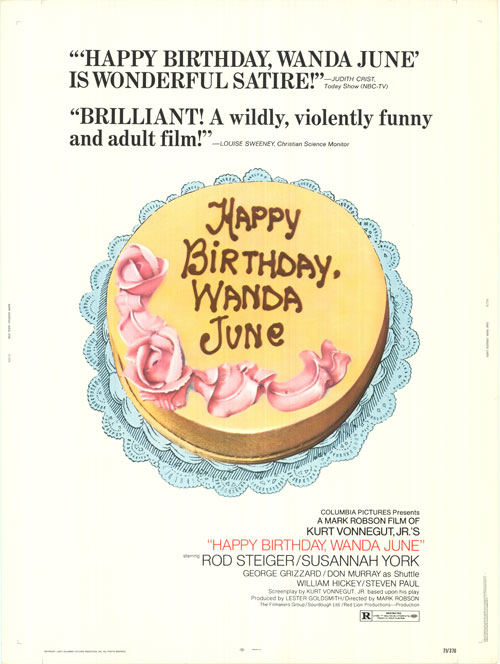
Since today is my birthday I’ve decided to spend the next two days reviewing films with a birthday theme. Today’s review is based on a play by celebrated writer (and Indianapolis native) Kurt Vonnegut Jr., who also wrote the screenplay.  It examines what happens when an egotistical man and war hero from the past (Rod Steiger) returns home after abandoning his family eight years earlier.

Vonnegut’s script takes a lot of shots and makes some great comments about the empty bravado of the male image and the male’s changing role and expectations in modern society.  The protagonist, Harold Ryan, is deftly written as a relic from the past harboring all the age-old macho characteristics and clinging onto embellishments of the past while unable to evolve, or even communicate with those around him. Dr. Woodley (George Grizzard) represents the more educated and new-age man who is peaceful, sensitive, and cultured. The story revolves around the two battling for the same woman (Susannah York) and culminates with an interesting and off-beat symbolic type of showdown.

Director Mark Robson does an adequate job of implementing a cinematic quality to what is otherwise a filmed stage play. The cutaways involving dead characters that are now in heaven and speak directly to the camera help, but there needed to be more of them and more evenly placed. I would have also liked a few scenes shot outside and in the daytime as the perpetual indoor scenery becomes stagnating and claustrophobic.

Steiger, normally a very good and diverting actor, seems miscast here. He is never convincing as a tough guy and it affects the story’s impact. York, another fine actress if given the right role, doesn’t seem right for her part either although she does look surprisingly sexy in a skimpy waitress outfit during a flashback scene.

I did like the child performers and felt that they did better than their adult counterparts. Steven Paul is excellent as Paul Ryan who initially idolizes his father until exposed to his many flaws. Pamelyn Ferdin is cute as Wanda June, the girl who gets hit by an ice cream truck and spends the entire time jaunting through heaven. Ferdin later became a famous animal activist and was runner-up for the Regan MacNeil role in The Exorcist. Linda Blair was of course great, but Ferdin’s uniquely piercing gaze always made me wonder if she might have ended up playing the part better.

William Hickey is engaging and amusing as Harold’s best friend. Don Murray almost steals it from everyone as Herb Shuttle a very vapid man whose pathetic attempts at trying to be macho are hilarious and make up most of the film’s humor.

The one thing that eventually ruined it for me was the main character who is too obnoxious. At least Archie Bunker in ‘All in the Family’ had a vulnerable side, but the guy here is ignorant without being funny and having to watch the callous way he treats everyone is straining and unpleasant. Also,the musical score is dreary and almost non-existent.

My Rating: 5 out of 10

Released: December 9, 1971

Runtime: 1Hour 45Minutes

Rated R (Adult Theme, Language)

Director: Mark Robson

Studio: Columbia

Availability: None 

Taking Off (1971)

taking off 1

By Richard Winters

My Rating: 9 out of 10

4-Word Review: Running away from home.

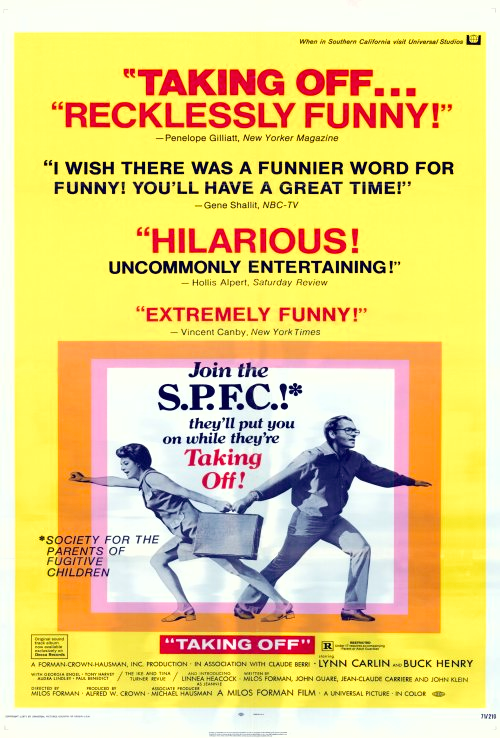
This is a thoroughly entertaining gem that takes a look at the early 70’s American culture through a foreigner’s eyes in this Milos Forman’s first American feature. The comedy bounces playfully from the wry, to the absurd and even the satirical without ever losing its charm.

The film examines what happens when parents Larry and Lynn Tyne (Buck Henry, Lynn Carlin) find that their daughter Jeannie (Linnea Heacock) has run away. Instead of focusing on the teen, as most films tend to do, it instead looks at the parents. It shows that the adolescent years can be as awkward for the father and mother as it is for the teen and parenting is a journey much like growing up is. I especially liked the part of the message showing how people in their forties have a need to run away and find themselves too.

The film matches its unique perspective with offbeat humor. You get to see parents smoking pot for the first time in order for them to experience what the kids go through. Another scene has them getting together for a wild game of strip poker. There are also amusing cutaways of auditioning singers, which is where the daughter runs away too. One of the singers is a sweet young thing who sings a soft melody that is laced with the word ‘fuck’ and has to be heard to be really appreciated.

Both actors who play the parents are excellent. Balding, bespectacled Henry fits the mold as the overworked, henpecked father/husband quite well and it is fun to see him display isolated moments of unexpected rebellion. Carlin conveys a nice characterization of an overwrought mother who wants to communicate with her daughter, but has no idea how.

Jeannie is the one we learn the least about, which is actually to the film’s benefit. This isn’t just the Tyne’s daughter, it’s everybody’s daughter complete with all the trials and tribulations that every parent goes through with their teen. In fact the film’s most definitive moment is probably the freeze-frame shot of disdain on the daughter’s face as her parents try to entertain her and her boyfriend with a song from ‘their’ generation. It’s the type of look that defines the parent/teenager relationship no matter if it’s today, tomorrow, or a hundred years from now, which may help to make it accessible to today’s viewers despite an overabundance of early 70’s period flavor.

Characters actors Audra Lindley, Paul Benedict, and Vincent Schiavelli are terrific in support. This also marked the film debuts of Georgia Engel and Kathy Bates. Ike and Tina Turner appear as themselves.

My Rating: 9 out of 10

Released: March 28, 1971

Runtime: 1Hour 33Minutes

Rated R (Language, Adult Theme, Brief Nudity)

Director: Milos Foreman

Studio: Universal

Available: DVD (Region 2)

SSSSSSS (1973)

ssss

By Richard Winters

My Rating: 6 out of 10

4-Word Review: Man turns into snake.

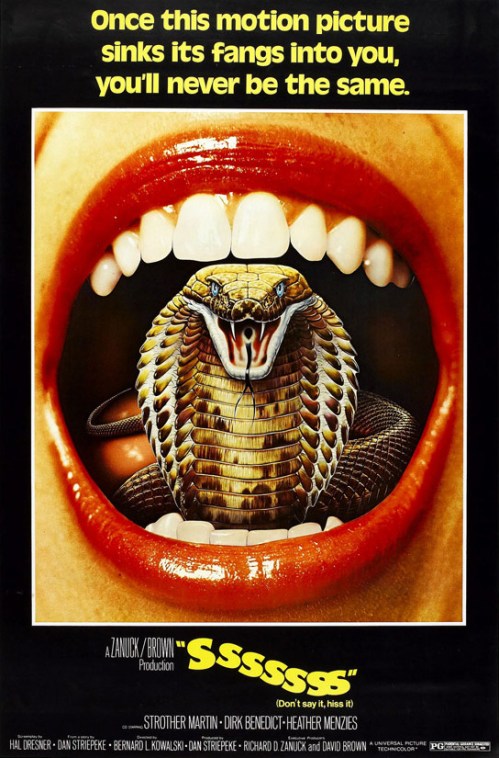
            Dr. Carl Stoner (Strother Martin) hires a college student named David Blake (Dirk Benedict) to work as his lab assistant on his research of snakes. David also finds himself attracted to the Dr.’s daughter Kristina who also works with her father on his research. However, unbeknownst to both of them the kindly Dr. has come up with a serum that can change a man, over the course of several weeks, into a king cobra snake.

Although clearly done on a limited budget, this film really impressed me in a few areas. The first was that the actors performed with actual snakes. The snake handling that Martin did was simply amazing. I found myself captivated in one scene where he takes a live Black Mamba out of its cage and grab its head and then force feeds it through a special type of mechanical tube. Another scene has him taking a King Cobra out of its cage where, while in front of a viewing audience, he is able to grab its head and make it secrete its venom into a jar. To top that off the film climaxes with a mongoose attacking and killing a cobra, which is quite violent. I almost wished that this had simply been done as a nature documentary as it could have been just as frightening and fascinating. The chilling throaty sounds that the King Cobra makes, which is all perfectly natural, would be enough to scare most people. There is even a segment where actor Reb Brown gets bitten by a snake on his foot and it is done in slow motion.

Another thing that was impressive was the make-up effects done by John Chambers. Benedict really starts to look like a snake and the final transformation is incredible.

The areas were the film is limited is in the horror portion itself. For one thing it takes too long to get going. The metamorphosis doesn’t start to get interesting until the final fifteen minutes.  The David character seems much too passive and trusting as he allows the Dr. to continue to inject him with the fluid even after he starts to have weird side-effects. The Dr. character is not menacing, or creepy enough to be scary.  For most of the movie he seemed pretty cool and I found it hard to cheer against anyone who is able and willing to handle snakes the way he does. The music is another problem as it is too soft and melodic without the jarring and foreboding undertones that is needed to help accentuate the tension. The setting is bland we get no sense of the locale outside of the Dr.’s residence, which looks too much like a studio back lot. The entire production has a cheap TV-movie quality and it is photographed in a flat, unimaginative way.

The side-story involving the budding romance between David and Kristina is uninteresting and unnecessary. The segment where the two go skinny dipping and their genitals are strategically covered by trees and plants at every conceivable camera angle looks cheesy.

            If you are into snakes, or make-up used for special effects, then you may find this film satisfying.

My Rating: 6 out of 10

Released: July 2, 1973

Runtime: 1Hour 38Minutes

Director: Bernard L. Kowalski

Rated PG

Studio: Universal

Available: DVD, VHS

Harry and Tonto (1974)

harry1

By Richard Winters

My Rating: 6 out of 10

4-Word Review: Old man and cat.

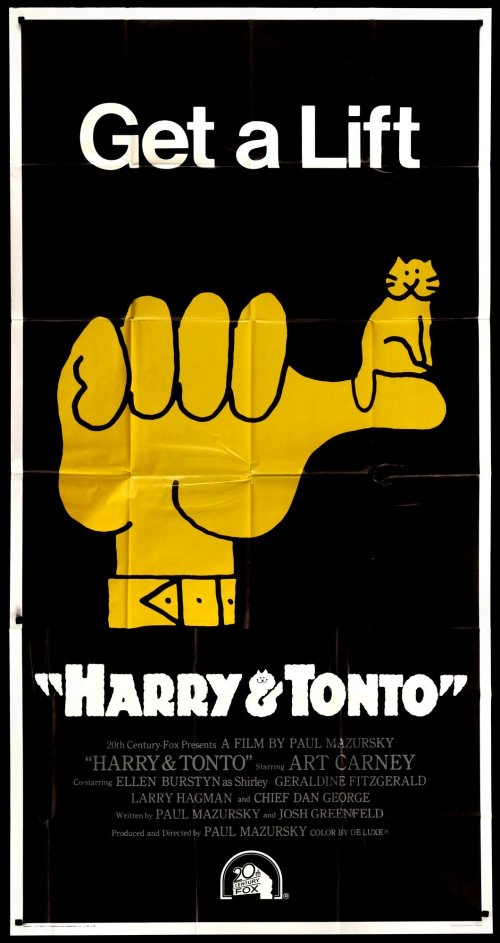
Harry Combes (Art Carney) is a 72 year old retiree living in a small New York apartment with his pet cat Tonto and finds out that the complex is about to be torn down and he must leave. At first he moves in with his son (Phil Bruns) and his family, but it does not work out. He decides to take a cross-country odyssey with his cat where he meets a variety of interesting people in this senior citizen variation of Easy Rider.

One of the great things that sets this film apart from others that deal with aging is that there is no death, dying, illness, or senility here. Instead of learning to adjust to the ending of one’s life, our character instead realizes that old-age is just another stage in a person’s existence and full of new experiences and possibilities. I thought it was cool and interesting how he meets a 15 year old teen girl runaway (Melanie Mayron in her film debut) named Ginger and the two set out to try and find themselves as well as search for life’s answers. They share a lot more in common than one might expect and only prove that life is a continual exploration no matter what stage you are in.

The Harry character is refreshingly laid-back and easy going unlike most elderly characters who tend to be betrayed as stuck in a bygone era. Although he does reminisce about the ‘old days’ with his friends, he does not expound on boring stories of yesteryear with young people, nor act like he has all the answers simply because he is older. He approaches everyone in a non-judgmental way that allows each person he meets to be themselves. He proves to be a lot more flexible and open-minded than the other, younger adults in the film including his own children.

There were only a few scenes involving the Harry character that I didn’t like. One is when he refuses to leave his apartment even as the wrecking ball crew stands outside. The police end up having to be carry him out while he still seats in his favorite chair, which seemed forced and unrealistic. There is another scene where he is at the airport ready to board a plane, but he refuses to allow, for no particular reason, the security to search the cage that has his cat in it even though it is accepted procedure.  This may have been writer-director Paul Mazursky’s way of showing that Harry could at times be set in his ways, but to me it went beyond being simply stubborn and more into the irrational and was not consistent with his behavior in the rest of the film.

The script has a lot of amusing and even touching slice-of-life vignettes as well as characters that are quirky, but not absurd.  The scene with Harry meeting an old Indian medicine man named Sam Two Feathers that is played by elderly Indian actor Chief Dan George is well handled. George had no formal acting training, but his raw delivery is an inviting change of pace.  I also enjoyed at the very end when he meets a woman with a bounty of pet cats that his played by comedian Lenny Bruce’s mother. Again, she had no acting training, but the scene captures her natural out-going personality and it is fun.

I felt Phil Bruns gave an outstanding and overlooked performance as Harry’s older son Burt.  The constant nervous and stressed-out expression on his face seemed to be a perfect composite of the middle-aged suburban male that is overrun with job demands and family responsibilities.  Larry Hagman is good as well in a brief, but memorable appearance as Harry’s other son Eddie. He spends the first part of his visit with Harry trying to impress him with how ‘good’ things are going only to end up breaking down when it becomes painfully obvious that he is desperate and broke.  Even director Mazursky gives himself a cameo as a gay prostitute who makes a pass at Harry.

If the film has any faults it is the fact that it is too amiable. I would have liked to have seen a little bit more action and comic misadventure. I thought it could have been funny and intriguing to see Harry inside a hippie commune, which is where he takes his two teen passengers. Instead he lets them off without going himself, which seemed like a missed opportunity.  There is another part where he inadvertently hitches a ride with a high-priced hooker (Barbra Rhoades) who immediately starts to get ‘horny’ when he Harry gets in. She drives the car off the road and parks it in the middle of the dessert and then the film cuts away. I think this could have been hilarious had this scene been extended. I was also disappointed that the very talented Ellen Burstyn is seen only briefly playing Harry’s daughter Shirley. This was even more of a shame because Burstyn gets cast against type here playing a character that is rather edgy and opinionated and there was strong potential for some good drama.

There are a few extended conversations where Harry discusses with some of his old friends their inability to perform sexually and how they hadn’t had sex for well over twenty years.  With the advent of Viagra, a product that was invented and manufactured right here in good old Indianapolis, these types of topics are no longer as relevant and make the film seem dated.

Of course the one thing that holds it all together and propels the movie from beginning to end is the outstanding Oscar winning performance of Carney, who until then was best known as the comic side-kick Ed Norton from the classic series The Honeymooners. Although he seemed perfect for the part he was not the Producers first choice and had to lobby hard to the get the role.  He was actually only 55 years old when the film was made and to help compensate he openly wore his hearing aid, which gets shown a lot, as well as dying his hair gray.

His win on Oscar night in 1974 became an historic upset. He was going up against very stiff competition that night including Dustin Hoffman for Lenny, Jack Nicholson for Chinatown, and Al Pacino for The Godfather Part 2. When Carney’s name gets called the look of shock on his face is very apparent as even he was not expecting it.  The moment is worth a look and can be seen on YouTube for those who are interested.

My Rating: 6 out of 10

Released: August 12, 1974

Runtime: 1Hour 55Minutes

Rated R

Director: Paul Mazursky

Studio: 20th Century Fox

Available: VHS, DVD