Category Archives: Thrillers/Suspense

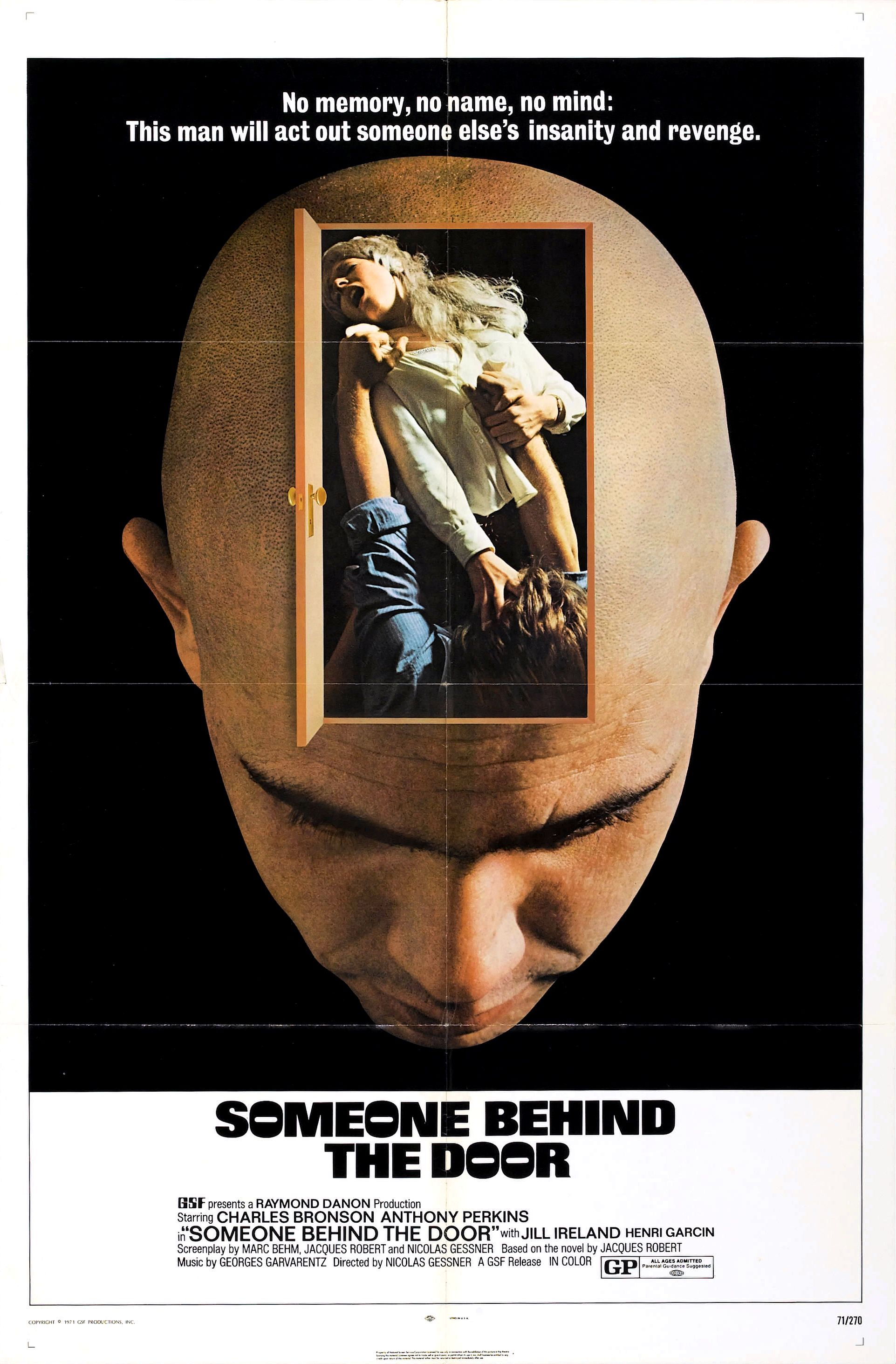
Someone Behind the Door (1971)

someone behind the door 3

By Richard Winters

My Rating: 5 out of 10

4-Word Review: Chuck has no memory.

This review will kick-off a two month long tribute to movies done in the 70’s by Charles Bronson with his wife Jill Ireland. Each Friday I will review one of their films, which will run through April. The only ones that will not be reviewed during this stretch are Love and Bullets, which was already done during our January tribute to Rod Steiger and The Mechanic and Hard Times, which will be done at a later time.

This film is one of the more unusual ones that they did and although not completely successful may still interest Bronson fans simply for a chance at seeing him in an offbeat part. The story concerns neurosurgeon Laurence Jeffries (Anthony Perkins) who takes in a man (Charles Bronson) who has lost his memory and has no idea who he is. Laurence decides to exploit this issue by brainwashing the man into thinking that Laurence’s cheating wife Frances (Jill Ireland) is actually his own and to take action by killing the woman’s lover (Henri Garcin).

The film has a great idea, but the set-up is much too rushed. We are given no backstory to any of the characters. The film opens with Laurence leaving his hospital job and by chance bumping into the man and taking him home before we even know what his motive or plan is. I also found it a bit perplexing that the Dr. character is supposedly conniving and crafty and yet he brings a man into his house while his wife is there sleeping in another room as well as their maid downstairs, which seemed reckless. When his wife awakens the next day and tries to go into the room where the stranger is Laurence panics, but I felt he should have been aware of that potentially happening from the very beginning. He also dictates his plans into a tape recorder, which seemed like prime material to be used for evidence later on.

The psychological side of the story is shallow and transparent. The way Laurence tricks the man into doing his evil bidding was too easy. I realize that the man has lost his memory, but it seems like he has lost his entire brain as well. The character is too child-like and gullible. I also thought that if the man cannot remember his wife and doesn’t know her from anyone else then why would he care if she is fooling around with someone, or get so over-the-top angry about it.

Bronson can be perfect in certain roles, but this is not one of them. Yes, he has a certain likable quality here simply because he plays such a vulnerable and trusting wide-eyed innocent, but the angry emotions that he displays are too rehearsed and over-acted.

Ireland on the other hand is attractive and alluring and comes off well though her part is minimal.  The nude photograph of her lying on a sofa that is shown in close-up is sexy.

The film has very little action especially for a Bronson vehicle though the part where the Bronson character sexually attacks Ireland and then the film intercuts this with him simultaneously attacking another woman on a lonely beach is interesting. The ending though is pathetic as it leaves everything wide-open while resolving nothing. The sequence where the camera cuts quickly back and forth between Perkin’s face and then Ireland’s, which is shown continuously over the closing credits is irritating and almost like the filmmaker’s wanted to drive the viewer as crazy as the kooky characters.

With that said I still found the film to be entertaining most of the way. The idea is a fascinating one and it kept me guessing throughout. Director Nicholas Gessner does an adequate job of taking advantage of the gray countryside to create a nice moody feel. A definite mixed bag.

My Rating: 5 out of 10

Released: July 28, 1971

Runtime: 1Hour 33Minutes

Rated R

Director: Nicholas Gessner

Studio: Lira Films

Available: DVD, Amazon Instant Video

Night Watch (1973)

night watch 2

By Richard Winters

My Rating: 3 out of 10

4-Word Review: Murder in the window.

Ellen Wheeler (Elizabeth Taylor) is an emotionally unstable woman recovering from a nervous breakdown. Her first husband died in a car crash along with his young lady lover. Now her second husband John (Laurence Harvey) is fooling around with Ellen’s best friend Sara (Billie Whitelaw). One night Ellen witnesses a murder at the abandoned house next door, but because of Ellen’s past mental state no one believes her. Even the police doubt her story, which starts to send her over-the-edge.

I saw this play about a year ago with a group of friends at a local church. It was written by Lucille Fletcher best known for having done Sorry Wrong Number, which was later turned into a classic film starring Barbra Stanwyck. Although the play started out slowly the twist ending was impressive and something no one in the audience had predicted, but what I liked even better was that when you went back and thought about it, it made perfect sense. I thought at the time that it would make a great movie and was interested in seeing what this film did with it. I felt that there was no way they could screw up such a great story, but somehow they managed to do it.

Director Brian G. Hutton adds a lot of elements to make it more cinematic that should have helped it, but it really doesn’t. I liked the flashback sequences showing the car crash of the first husband as well as Ellen visiting the hospital and identifying the bodies. These segments have a good nightmarish visual quality to them, but Hutton goes back to it too often and eventually wears it out. I also liked that the film shows the police inspecting the inside of the abandoned home, which in the play you never see, but I felt they could have done a lot more to make the place seem more distinct and creepy. There is also a skirmish between two people inside the place at the end that you can hear, but not see because it is too dark and shadowy, which was annoying. The music is effectively creepy, but it also has a ringing quality that quickly becomes irritating and gets way over-played.

This was just one of the many misfires that Taylor did during the 70’s that helped extinguish her otherwise illustrious career long before it should’ve. This one fares slightly better than the others, but not by much. Her affected British accent could seem annoying to some and sounds kind of like the put-on one that Madonna sometimes does although for the record Taylor’s is better than hers. Liz’s emotionalism is a bit too theatrical and may come off as unintentionally funny to certain viewers although seeing her go completely nutty is impressive and fun.

Harvey is all wrong as the husband. His cold, detached presence can work in certain roles, but definitely not in this one. In the play that I saw the actor cast in this part looked more middle-aged with a spare tire stomach, balding head, and graying sideburns, which is what I felt the role called for. This is a character that is overburdened with a stressful job and unstable wife and yet Harvey shows none of this. His slick black hair and turtleneck shirts, which were fashionable at the time, make him look like someone still going out to the trendy nightclubs to pick up young chicks… or guys.

Whitelaw is one of the best British character actresses of all-time, but her talents are wasted with a part that doesn’t allow her to show any range. Her blonde hairdo is nice, but Taylor’s histrionics dominate the proceedings and unceremoniously push Whitelaw into the background.

The play had a lot of humor especially with the Mr. Appleby character played here by actor Robert Lange. Unfortunately the movie turns it into a serious drama making it seem more like a soap opera instead of a mystery. I came away from this feeling that the live production that I had seen was far more entertaining and intriguing. I would suggest to viewers to skip this film and wait for a chance to see it done as a play as the movie does not do the story justice.

night watch 1

My Rating: 3 out of 10

Released: August 9, 1973

Runtime: 1Hour 39Minutes

Rated PG

Director: Brian G. Hutton

Studio: AVCO Embassy Pictures

Available: DVD (Warner Archive), Amazon Instant Video

Windows (1980)

windows 3

By Richard Winters

My Rating: 1 out of 10

4-Word Review: She’s obsessed with her.

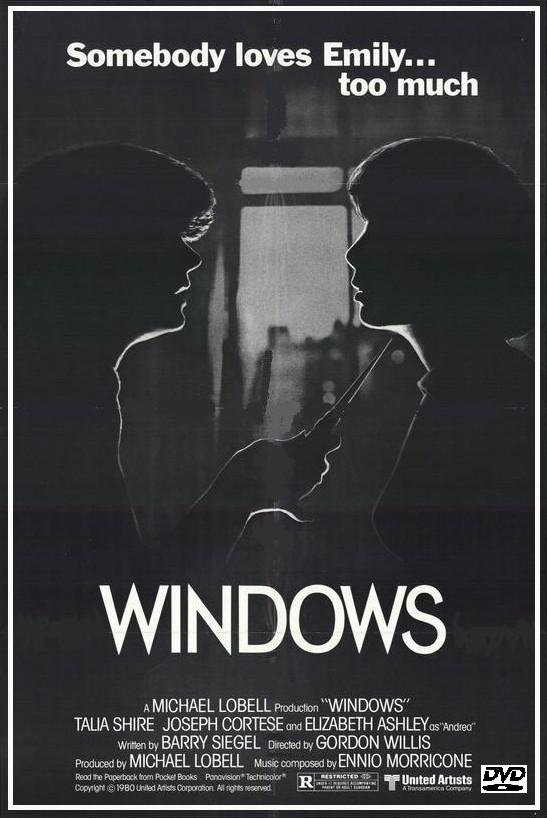
Emily (Talia Shire) is attacked in her apartment by a rapist (Rick Petrucelli) and when the police come to investigate the crime she starts to fall in love with Bob (Joe Cortese) the handsome police captain. Little does Emily know that her friend Andrea (Elizabeth Ashley) was behind the attack. She is a closet lesbian with a secret psychotic obsession for Emily who hired the man to rape her and record it, so Andrea could get-off on listening to the sounds of Emily moaning during the struggle. Now that Emily is going out with Bob it makes Andrea angry and her behavior becomes more dangerous and erratic.

For a thriller this film is extraordinarily low-key to the point that it also comes off like a drama, but fails on both ends. There is no mounting tension and little if any scares. The only one that they do have is when Andrea sticks Emily’s cat into a freezer and later it drops out of it like it was a Popsicle, which is actually unintentionally funny. There is also hardly any music. Ennio Morricone was hired to be the composer, but they don’t use him as much as they should. An amazing amount of the movie deals with the natural street sounds and ambience from life in New York, which is interesting for a while, but does nothing to elevate the tension, or create any excitement. Famed cinematographer Gordon Willis in his directorial debut seems more interested in capturing the New York skyline and creating shadowy interiors than actually making a movie with an original story, or interesting characters.

Shire is so quiet and awkward that she seems to be in a mental stupor. Her screen presence here is transparent and lifeless and it is easy to see why her leading lady status was brief. Cortese is no better as the male lead and the romantic side-story has no energy or chemistry and only helps to bog down an already boring story. Intercutting this with Andrea’s visits to her psychiatrist (Michael Lipton) successfully creates the first thriller to have no suspense whatsoever.

Ashley seems like the perfect choice for a homicidal lesbian, but the part is written in a way that doesn’t allow her to go over-the-top with it, which she should have although you do get to see her wearing quite possibly the biggest pair of sunglasses that I have ever seen. It might have worked better had the viewer not been aware from the start about Andrea’s psychosis and instead only revealed it at the end as a twist.

The climatic sequence between Emily and Andrea would be laughable if it weren’t so mind numbingly stilted and prolonged. The scene goes on for almost twenty minutes and features the two women standing in front of a window with Emily weeping incessantly while Andrea rambles incoherently. How anyone who was involved in the making of this movie would think anyone would flock to see this dull and contrived thing should have their brains checked. Has an air of pretense to it like it is trying to be a ‘sophisticated’ thriller, but it is pointless. If ‘Mystery Science Theater’ were still around this would be a great candidate for it.

My Rating: 1 out of 10

Released: January 18, 1980

Runtime: 1Hour 36Minutes

Rated R

Director: Gordon Willis

Studio: United Artists

Available: DVD, Amazon Instant Video

Wolf Lake (1978)

wolf lake 1

By Richard Winters

My Rating: 2 out of 10

4-Word Review: He doesn’t like deserters.

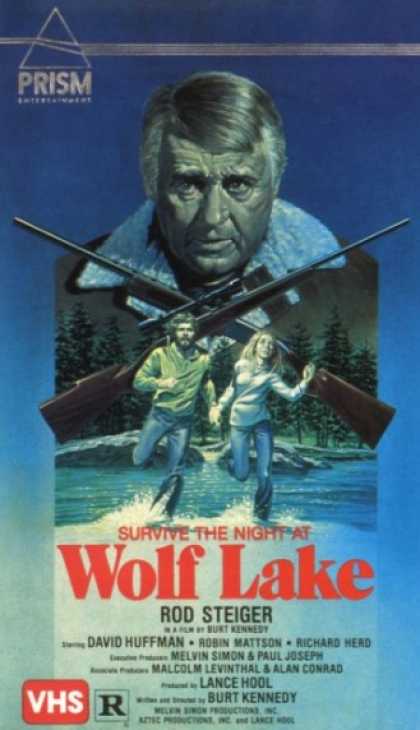
Charlie (Rod Steiger) is a hard-bitten conservative man who lost his 23-year-old son in the Vietnam War. He likes to vacation with a couple of his middle-aged buddies Wilbur (Jerry Hardin) and George (Richard Herd) at a remote Canadian hunting lodge. However, this time when they arrive they find that the regular lodge owner is not there and instead it is being run by a young man named David (David Huffman) and his pretty girlfriend Linda (Robin Mattson). Charlie and David almost immediately are at odds as they both share a wide variance in age and political leanings. What is worse is the fact that David is a war deserter and once Charlie finds out about this he flies into a rage of psychotic proportions, which culminates in a violent night of terror for both David and his girlfriend.

The film was written and directed by the normally reliable Burt Kennedy who is better known for doing westerns. After watching this I think he should have stayed in that genre as this film is too formulaic and one-dimensional. There seems to be too much emphasis to conform to the horror movie/slasher style formula of that era with a plot set-up that is too brief and character development that is almost non-existent. The story shows its cards too quickly and then proceeds to just plod on and on until it climaxes with a predictable and boring finish.

Charlie and David’s arguments and confrontations fail to elicit any type of tension. Their shouting matches are rhetorical and redundant and their points-of-view are handled at a superficial level that allows for no new insight, or intellectual debate. Charlie is so limited in his stubbornness that he becomes annoying instead of threatening, or scary.

The final 25 minutes when the two sides wage a proverbial war between their two cabins is the only time that there is any action. However, by then I was completely bored with the proceedings and so emotionally detached from the third rate material that it was a strain just getting through it. The film’s ultimate message is heavy-handed and done so much better in other films on the same subject that it renders this excursion as pointless.

Steiger is wasted. The character he plays is poorly defined and doesn’t allow him to take full advantage of his acting abilities. He gets stuck with another one of his many wigs this one looking like the same type of gray haired rug that actor Ray Milland used to wear in his later years. The producers should have just allowed him to appear bald as it would have fit this type of part better and even made him look creepier and more menacing.

Huffman is the best thing about this movie and it is a shame that his life and career were cut short when he was murdered in 1985 while trying to chase down a suspected purse snatcher. His performance here is nicely understated, which helps carry the picture as he is the only character that is multi-faceted.

Although the story takes place in Canada and the landscape certainly looks Canadian I was surprised to learn that it was actually filmed near the city of Creel in Chihuahua, Mexico, which due to its high elevation has a climate that is more similar to the North’s.

SPOILER ALERT

There are actually two different versions of this film. There is this one and another one entitled The Honor Guard. In that one there are no flashback scenes like there are here and in the end Charlie ends up killing David and his girlfriend while in this version Linda shoots Charlie before falling over dead herself. I actually liked the flashbacks that are used as it gives the film what little suspense it has and also shows a bit of cinematic flair. However, the scene where Linda miraculously comes up with a gun and killing Charlie before keeling over looked cheesy and clichéd and I might actually have voted for the alternate ending.

My Rating: 2 out of 10

Released: May 3, 1978

Runtime: 1Hour 25Minutes

Rated R

Director: Burt Kennedy

Studio: Melvin Simon Productions

Available: VHS

Hennessy (1975)

hennessy

By Richard Winters

My Rating: 6 out of 10

4-Word Review: Blow up the Queen.

This review will be the first in a month long series analyzing movies from the 70’s that starred Rod Steiger. Steiger was an interesting performer with a long and varied career who always brought a unique intensity to all of his roles. He performed in a wide variety of movies from Hollywood pictures to foreign films and from big productions to the low budget as well as going from the leading man to character actor. Every Friday during the month of January I will select films of his that will hopefully be able to spotlight a little bit of all of these.

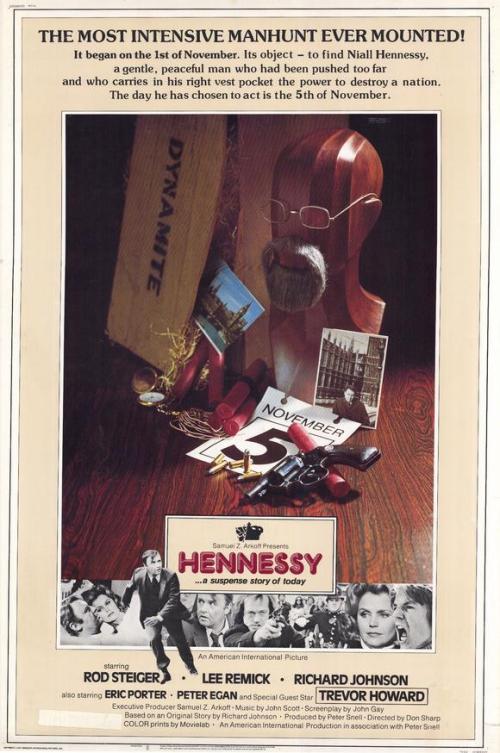
Today’s film deals with the story of Niall Hennessy (Steiger) an Irishman with ties to the IRA. When his wife and daughter are killed during a riot in Belfast he plots revenge with a plan to blow up the House of Parliament with the Queen Elizabeth inside.

The movie has a great concept, but the execution is a bit lacking. For one thing the police immediately pinpoint Hennessy as the man they are looking for as well as figuring out his plan. How they were so easily able to do this not only seemed a little farfetched, but also sapped a lot of the intrigue and tension out of the story. Having the police come to this conclusion more slowly would have plotted the suspense out longer and been more interesting.

This also opened the door to a few loopholes the biggest one being that they know Hennessy wants to blow up the Parliament so one would expect that the police would have their men staking out the place and on alert to spot Hennessy if he came near the premises, but instead Hennessy is able to go on a guided tour and able to canvas the building unheeded. Another scene later on has Hennessy trapped in an upstairs apartment by the police who have surrounded the building and yet he is somehow able to escape even though it is never shown how.

The scene showing his family getting killed during a bomb attack is not effective. We see the mother and daughter leave a nearby building and then the film cuts away from them and goes back to the fighting in the street only to go back to the two a few minutes later lying in the street motionless. However, there is neither blood on them nor any type of make-up effects to show injury making it look more like two people lying down with their eyes closed. Seeing them actually hit by the bomb and screaming would have been more jarring for the viewer and allowed them to get more emotionally attached to Hennessy’s plight. Also, when Steiger is shown standing over them I was expecting him to let out another one of his patented primal screams much like he famously did in The Pawnbroker, but here he doesn’t and the sequence is quite brief making me wonder why would they hire an actor known for his onscreen intensity and emotionalism if they aren’t going to allow him to do what he does best especially when the scene calls for it.

Steiger for the most part does well with the part although he is surprisingly restrained during most of it. It is a bit of unusual casting given that he wasn’t Irish or a native of the region however, the accent he uses is alright and I kind of got a kick out of the way he runs especially at the end. His biggest obstacle though was his wig. Rod became bald as he aged and instead of just appearing that way in his roles, which he finally did during his later years, he instead wore a variety of wigs for his parts. Some of them were okay and some weren’t and the one used here definitely wasn’t.

Richard Johnson is quite good playing the relentless Inspector Hollis and I liked seeing him with a moustache. The talented Lee Remick appears as Kate Brooke a lady friend to Hennessy who allows him to hide out at her home and although she has a few good lines she is ultimately wasted. Legendary Trevor Howard is wasted as well and only seen briefly as a police commander.

The best part about the movie and the one thing that gives it distinction is the ending when Hennessy goes into the parliament building with a bomb strapped to his body. Actual footage of the Queen is shown and it looks so authentic that many people thought she had been involved in the production, but she really wasn’t. Their ability to crop this footage in with the action is well done and almost seamless and certainly helps to heighten the tension. Seeing a young Prince Charles looking bored with the proceedings and the elaborately decorated interior of the building as well as its many large and majestic hallways and rooms is fun and interesting.

My Rating: 6 out of 10

Released: July 31, 1975

Runtime: 1Hour 43Minutes

Rated PG

Director: Don Sharp

Studio: American International Pictures

Available: Amazon Instant Video

Unman, Wittering, and Zigo (1971)

By Richard Winters

My Rating: 7 out of 10

4-Word Review: These students are killers.

John Ebony (David Hemmings) leaves his job in advertising to follow his dream of becoming a school teacher. He gets a job at an all-boys private school in rural England replacing a teacher who died accidently by falling off a cliff. His pupils soon tell him that they were the ones who killed the teacher and they will do the same to him if he doesn’t do as they say. John can’t find anyone who believes him even his own wife Sylvia (Caroline Seymour) laughs it off. Soon John finds himself a virtual prisoner of his own students and forced to follow their dictates while he tries to figure out who the ringleader is and bring them to justice.

Director John Mackenzie does a terrific job of building the tension slowly. The film works at a deliberate pace allowing the viewer to see things from John’s point-view-of. The slower pace keeps things realistic and therefore more effective. Geoffrey Unswoth’s cinematography is vivid. I loved the way the steep cliffs are captured at the beginning and a camera is thrown off the cliff making the viewer feel like the victim as they see the landscape swirling on screen before completely submerging in water. A nightmare sequence where John dreams of being accosted by the boys in much the same way as his predecessor is visually exciting. The on-location shooting at an actual private boy’s school in Wales only helps to add to the authenticity.

The students themselves are quite effective and much better than their counterparts in the similar Child’s Play where they came off as too robotic. Here they have more diverse personalities. Their snarky behavior and the taunting both to their weaker peers and to John was so on-target that it made me feel like I was right back in high school. Their polite and formal facades are a thin veil to their sinister side that becomes increasingly more apparent as the film goes on. The pinnacle comes when they lock Sylvia in a darkened gymnasium and threaten to gang rape her. The lighting, done exclusively with flashlights and the frenzied action make this a memorably creepy moment.

John makes for a solid protagonist. The viewer can feel and understand his unique quandary and the character is believable enough to help make the movie engrossing from beginning to end. My only quibble would be near the end when the boys ask him to come with them to look for one of the students that have disappeared and he agrees. I thought this was a little hard to believe as it was right after they had tried to attack his wife and the search was being done near the cliffs, which would put John at a vulnerable risk.

The twist at the end is a bit of a surprise and is overall satisfying. Despite what is stated in the review in Leonard Maltin’s ‘Movie and Video Guide’ there is no revelation of any kind after the closing credits. I have seen this film now twice from two different sources and both times the only thing that comes after the credits is the Paramount logo.

My Rating: 7 out of 10

Released: June 13, 1971

Runtime: 1Hour 42Minutes

Rated PG

Director: John Mackenzie

Studio: Paramount

Available: Amazon Instant Video

Child’s Play (1972)

By Richard Winters

My Rating: 5 out of 10

4-Word Review: Private school is murder.

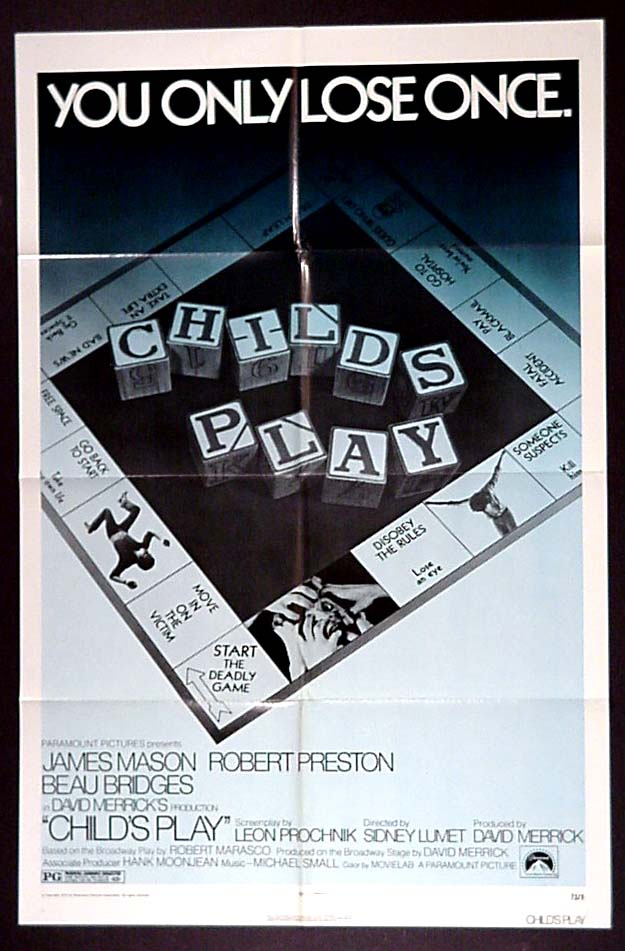
If you are looking for a review about the Chucky doll then you will have to wait as that will come at a later time. This is the first film to use that title and it is based on the Broadway play by Robert Marasco who in turn based it loosely on an early Ingmar Bergman movie called Torment. The story deals with an exclusive all-boys school where bizarre unexplained random acts of violence begin to occur between groups of students. New teacher Paul Reis (Beau Bridges) becomes determined to unravel the mystery and begins to suspect that it may have something to do with a long running feud between two of the school’s older instructors Joseph Dobbs (Robert Preston) and Jerome Malley (James Mason)

The film opens right away with a nice creepy tone and a foreboding score that immediately got me wrapped up into it. The dark, shadowy lighting of the interiors helped accentuate the sinister feel. It is also great to have the film shot in an actual boy’s school instead of building sets to recreate the look. Just hearing the floorboards creak underneath the feet of the actors as they walk around helps to create an already strong atmosphere.

Mason is terrific. I think it is impossible for the man to ever give a weak performance even if the script itself is poor. He is captivating every time he is on the screen and his ability to display wide ranging emotions without flaw never ceases to amaze me. Everything always seems to come so naturally with this man in all of his performances that you never see the acting, or technique behind it. It is a shame this movie is so obscure because watching his performance alone makes the film worth seeing and the desperate, lonely character that he plays is interesting in its own right.

Preston doesn’t seem as strong. He is a good actor at times, but not for this type of part and having him wearing a moustache doesn’t help. Supposedly the part was originally intended for Marlon Brando, who would have been more interesting, but he ended up backing out.

Bridges is okay as the protagonist, but he has played the role of a wide-eyed idealist coming into an ugly situation while oblivious to all of the dark aspects a little too often making it an annoying caricature.

The movie fails in the fact that it cannot hold the tension and there are too many talky scenes with little action in-between. The students come off as robotic like and the scenes involving them attacking another student inside a gymnasium looks staged and rehearsed. Director Sidney Lumet would have done better had he used a hand-held camera and gotten right in the middle of the fray making it seem more spontaneous and vivid.

I also had a hard time believing that so many students could get effectively brain washed and sworn to secrecy. I could buy maybe a few, but having so many seemed implausible and ruined the film for me. However, the explanation for the cause to the violence is an original one that I wouldn’t have thought up myself. Also, the surprise twist at the very end is kind of cool.

A similar film to this one entitled Unman, Wittering, and Zigo that also came out in the 70’s and dealt with murder at an all-boys private school will be reviewed next Friday and fares a bit better.

My Rating: 5 out of 10

Released: December 12, 1972

Runtime: 1Hour 40Minutes

Rated PG

Director: Sidney Lumet

Studio: Paramount

Available: Amazon Instant Video

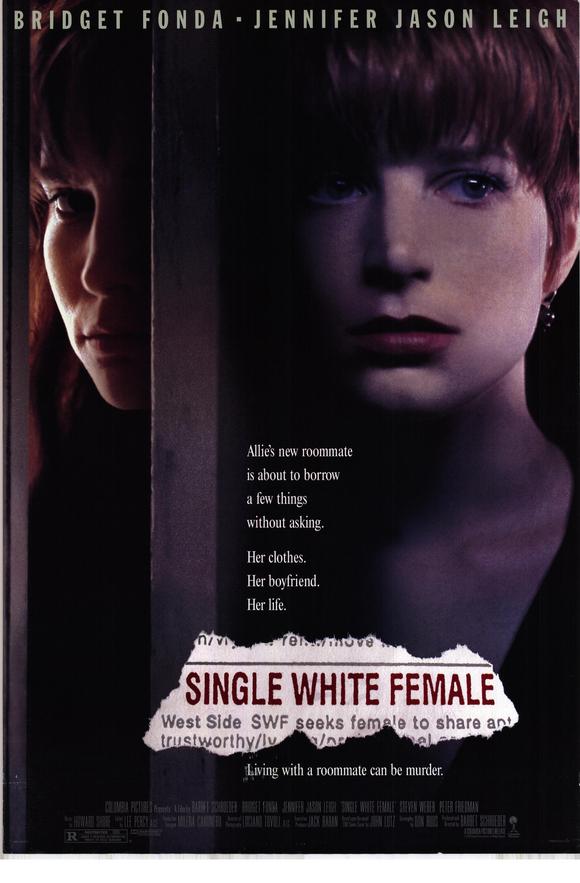
Single White Female (1992)

By Richard Winters

My Rating: 7 out of 10

4-Word Review: A roommate from hell.

Allison (Bridget Fonda) is a young entrepreneurial business woman who breaks up with her boyfriend and decides she doesn’t want to be in her apartment alone. She finds Hedra (Jennifer Jason Leigh) for a roommate and things go well until the relationship with her boyfriend is rekindled. Hendra then starts to become possessive until it eventually culminates into full blown psychosis.

This thriller really never gets going until the final thirty minutes when it climaxes with a real rock ’em, sock ’em, duke it out showdown, which is full of clever twists and good action. The first third though stagnates. In some ways this is good because it avoids being a formulated thriller that feels the need to always telegraph its punches. The viewer is as in the dark as to Hedra’s psychosis as Allison is. Things work so slowly that at times it almost seems like a drama. In some ways it might have been better had it stayed that way. There are some good ingredients here for an insightful look of two young women from different backgrounds trying to forge a friendship. Having it turn into your general psycho/thriller seems almost like a cheap gimmick that prevents it from being a deeper and more original piece.

Another thing that separates this from the other psycho/thrillers is the fact that the two are on equal footing. Unlike most thrillers the bad guy doesn’t have any unfair advantage over the other or the good guy isn’t impeded with any type of handicap. It all just comes down to smarts, inner strength and determination, which makes it interesting. It’s almost like giving them both a pair of gloves and then putting them into the ring.

Fonda is likable enough. She is normal, but not in a boring way and has vulnerabilities that she must face. Leigh has always had an interesting ‘clenched jaw’ like delivery. Usually this has a sexy appeal yet when she becomes psychotic it makes her more frightening. Leigh is also portrayed as the ‘frumpy’ one, but with her long hair and young girl look she actually is more enticing. Fonda of course is also attractive, but not with the hairstyle that she has here. Both have some good nude scenes.

There are some loopholes. One involves the murder by the heel of a shoe which gets lodged in the victim’s eye socket. This has an almost one in a million chance of happening especially at the angle it is done in. The assailant (Leigh) is a woman who is already shorter than the victim who is male. Added was the fact that she was sitting down while the victim was standing. Logistically she would not have been able to reach his eye and even if she had it would have taken so much effort to reach up there that she wouldn’t have had enough strength to drive it in the way she did especially in the split second that this movie has it happen in. Also, when one is wrestling with a perpetrator who has a gun that they drop it is a good idea to grab the gun before making a run for the door especially when it is in easy reach.

My Rating: 7 out of 10

Released: August 14, 1992

Runtime: 1Hour 47Minutes

Rated R

Director: Barbet Schroeder

Studio: Columbia

Available: VHS, DVD, Amazon Instant Video

The Hand That Rocks the Cradle (1992)

By Richard Winters

My Rating: 8 out of 10

4-Word Review: Not a good nanny.

Claire (Annabella Sciorra) is a young mother who feels that her doctor (John de Lancie) molested her during her exam. She goes to the authorities, which brings out more complaints from other patients. This leads the doctor into killing himself and causing his widowed wife (Rebecca De Mornay) to miscarry. In revenge the widow decides to destroy the life of the woman who brought up the charges and does so by posing as the family’s nanny named Peyton Flanders.

Just when you think that the old psycho formula has gone stale this film comes along that injects a whole new life into it. That is not to say that there is anything new here because there isn’t yet it is a pure thriller that captures the formula well and hits it on all cylinders. It builds the suspense slowly but consistently without throwing in any cheap teasers. You really ARE on the edge of your seat as the tension grows. The climatic sequence is well mounted, but the best part is that it creates a villain that is not only a threat, but also someone you hate, really hate! You look forward to the inevitable showdown and become emotionally involved in its outcome.

De Mornay makes a terrific bad lady. Usually villainess females work of their sensuality, but not here. Yes it is intimated, but it is incased in a very cold and calculating exterior. The character is deliberate and spins an elaborate web while coming up with some clever deaths for her victims with the best one being the death by greenhouse. Her icy stares reminded me of the legendary Bette Davis.

The good guys aren’t quite as interesting and in many ways are a bit boring. The husband/father (Matt McCoy) is especially bland and almost transparent. Sciorra’s beautiful and very angelic face helps, but she seems to get rattled too easily. Julianne Moore, as Marlene a family friend, is the only one who offers anything in the way of tenacity to her personality.

The Ernie Hudson character, who is mentally handicapped, is a nice addition. It shows sensitivity to those with disabilities and doesn’t exploit it simply for entertainment. His final showdown with De Mornay is another one you just can’t wait to see. The kids are adorable and it’s nice to see that they too can be resourceful when they need to be and can’t be so easily brainwashed either.

In all fairness there are some logic loopholes that should be mentioned. One is the obvious fact that this woman makes up her past in order to get the job as the nanny. When she applies for the position you would think that a careful and responsible family such as this one would check her references carefully and find her discrepancies. Also there is the fact that the De Mornay character was at one time a prominent doctor’s wife. This would give me the impression that she would have had a large circle of friends and they would have all wondered what happened to her or at the very least spotted her in her new identity since she apparently only moved to the other side of town.

Still, this is a solid thriller that is perfectly made for fans of the genre and deserves to be on the list with the best.

My Rating: 8 out of 10

Released: January 10, 1992

Runtime: 1Hour 50Minutes

Rated R

Director: Curtis Hanson

Studio: Buena Vista Pictures

Available: VHS, DVD, Blu-ray

Misery (1990)

By Richard Winters

My Rating: 6 out of 10

4-Word Review: She’s his biggest fan.

Paul Sheldon (James Caan) is a writer who has just finished his latest novel. On the way back to his publisher (Lauren Bacall) he gets stranded in a freak snowstorm and ends up being ‘saved’ by Annie Wilkes (Kathy Bates) who is his ‘number one fan’. He is injured so she takes him to her nearby house where she proceeds to make him a helpless prisoner to her tormented and delusional mind.

The story has some interesting underlying elements. The film doesn’t really explore them, but does at least touch on it. It is the metaphor of the artist and the public. He is an educated man and yet his stories appeal to those with less education and what he puts into his work isn’t always what they take out of it. He doesn’t really like these stories and wants to expand his craft, but can’t because the formulaic stuff is what sells. In a way Paul was already trapped by Annie long before he ever got to her house and it is a sad dilemma a lot of artistic people have to deal with.
Bates as Annie plays the part really well. She is the ordinary, bland looking woman that you would never think about or consider dangerous. Her strange, erratic behaviors are slowly revealed until in the end the complete monster inside is unleashed. Screenwriter William Goldman, director Rob Reiner, and Bates herself show a good understanding of the character and what makes her tick. They create a woman who is complex, real, frightening, and at times even sad and pathetic.

Caan is a good competent actor however any one of number of actors could have played the part and maybe even done better. Yet you really sense and feel his confinement and ever growing frustration and when he finally revolts at the end you love it!

On the whole the thriller is pretty standard. There are some tense moments, but it is also routine and by the numbers. I thought it was too well lighted as a good psychological thriller always works best with a lot of shadows. The room Paul is trapped in looks more like it was done on a sound stage than in a real home and the film needed a few more unexpected twists.

My Rating: 6 out of 10

Released: November 30, 1990

Runtime: 1Hour 47Minutes

Rated R

Director: Rob Reiner

Studio: Columbia Pictures

Available: VHS, DVD, Blu-ray, Amazon Instant Video