Category Archives: Thrillers/Suspense

Hitch-Hike (1977)

By Richard Winters

My Rating: 5 out of 10

4-Word Review: Couple picks up killer.

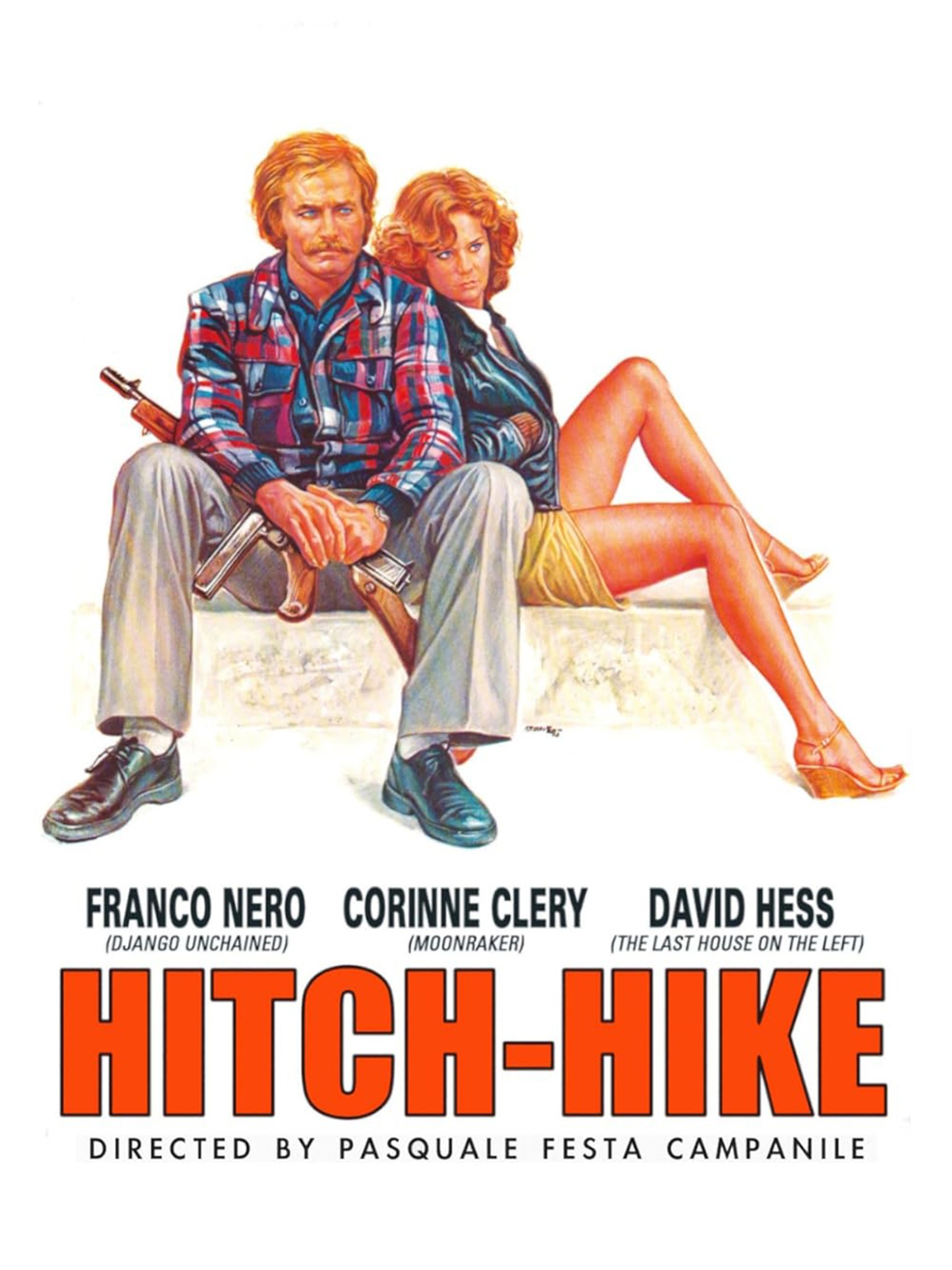
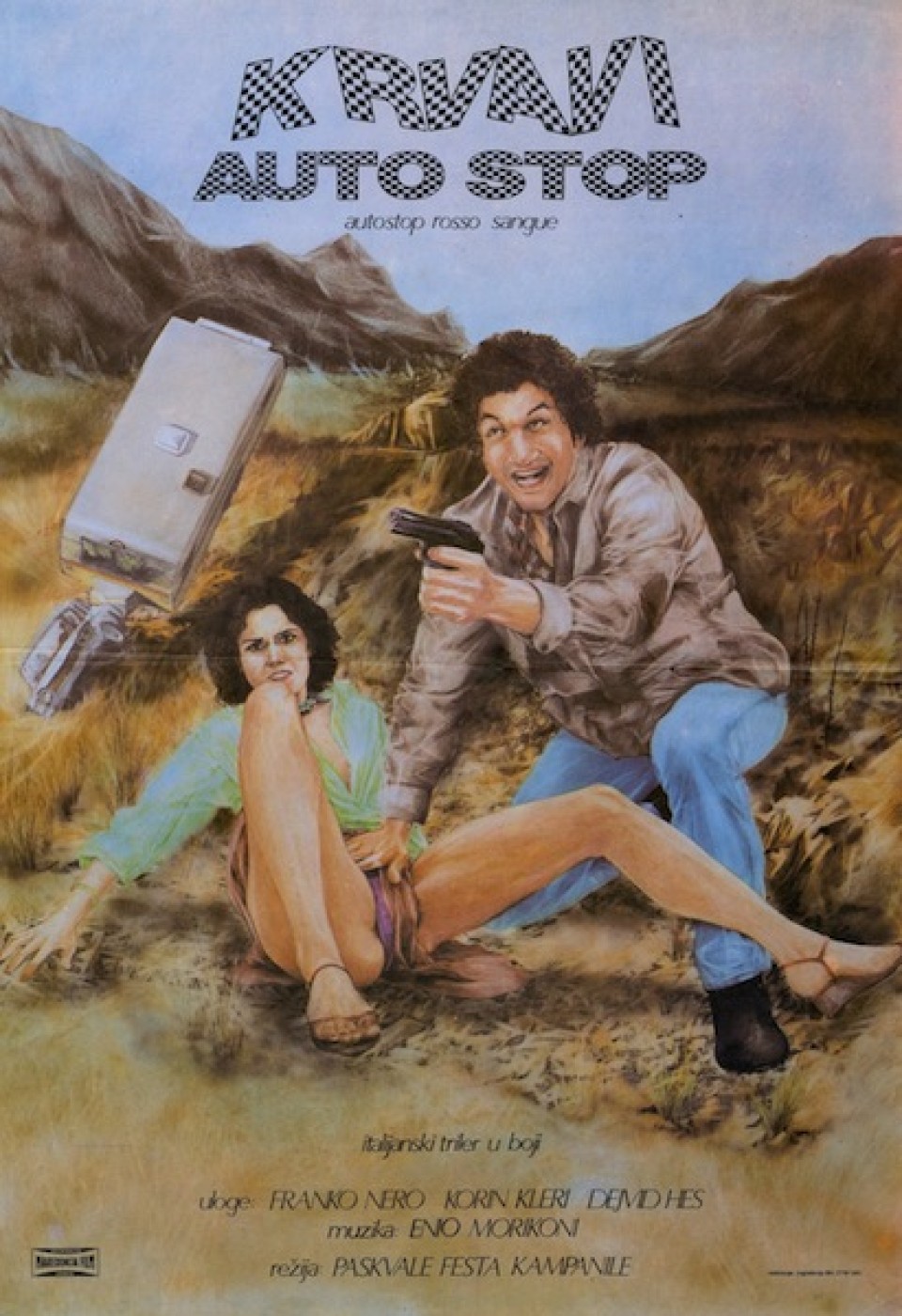
Walter (Franco Nero) and his wife Eve (Corinne Clery) are constantly bickering about Walter’s alcoholism. They go on a trip to Los Angeles and on the way pick-up Adam (David Hess) whose car is stranded on the road. Unbeknownst to them he’s a robber who has doubled-crossed his partners and absconded with a suitcase full of $2 million dollars. It doesn’t take long before Adam has a gun to both of their heads demanding they take him to Mexican border where he plans to escape while also killing them in the process. As the two try desperately to figure a way out they are also being secretly followed by the two young men whom Adam betrayed and who are now intent on extracting a revenge.

One of the biggest problems I had with the movie is that it’s supposed to take place in California but was actually shot in the mountains of Gran Sasso in Italy, which looks nothing like the state. I realize that California has a varied topography but the locales here are screaming southern Europe and the highway signs are done in blue, which anyone living in the U.S. would know is fake as here they’re green, which only accentuates the off-kilter look of the production. Since where they’re driving to makes no real difference to the plot I would’ve just had it be some city in Italy like Rome, which would’ve helped the authenticity.

The other problem I had is that, at least the version I watched, it’s spoken in Italian. Normally I prefer movies that are subtitled versus dubbed, but I could’ve sworn years ago I saw it in English, but what’s available on YouTube, which is the only service currently streaming it, doesn’t offer that, which is a big shame. Not so much because of Nero or Clery, but more Hess as his own voice is not used, which then defeats the whole reason for having him. He’s best known for playing the sadistic killer in The Last House on the Left, and he has an excellent way of being menacing, but because we don’t hear him actually speak in his native tongue all of that gets lost and the creepy energy that was supposed to be there by casting him gets completely wasted.

Spoiler Alert!

The story, which is based on the unpublished novel ‘The Violence and the Fury’ by Peter Kane, doesn’t get off to a good start as it features two people, particularly Nero, who are not likable, and thus the viewer really doesn’t care about their predicament making the tension mediocre at best. There are also elements that are stolen from better known movies like the mysterious truck that keeps chasing them during their drive, with the identity of the driver hidden, that’s taken straight from Duel. Loopholes abound as well as we later learn that Hess is the driver of the truck, but how was he able to avoid being shot by his cohorts earlier with a gun aimed right at him and how was he able to hijack the truck as he had been without any vehicle? Maybe he was able to hitch a ride with a truck driver, just like he did with the couple, and then do away with the driver once inside, but this is stuff that needs to be shown as otherwise it comes-off like the filmmakers are just making up the rules as they go with no concern whether it’s logical.

The twist ending is limp as it features Nero setting the car on fire with his injured wife inside and putting Hess’s dead body next to hers in an attempt to make it look like both he (Nero) and she died in the blaze, but there were such things as dental records back then, so after the coroner examined the charred bodies he/she would determine that it wasn’t really Nero who died and thus the authorities would continue to search for him. Seeing him then become a hitchhiker himself leaves open too many questions and comes off like a cop-out where the filmmakers ran out of ideas and thus decided to just end it there.

End of Spoiler Alert!

The moment where Nero is forced to watch Hess make love to his wife, and witnessing the humiliation and anger in his eyes, is the film’s best moment. Watching Clery, the only person you sympathize with, is entertaining both with her clothes on and off. However, the film lacks any character development, and the plot is quite strained with a lot of moments where the story, much like with the car ride, doesn’t seem to be going anywhere and if anything, just driving itself around in circles.

My Rating: 4 out of 10

Released: March 4, 1977

Runtime: 1 Hour 44 Minutes

Rated R

Director: Pasquale Festa Campanile

Studio: Explorer Film ’58

Available: DVD, Blu-ray, YouTube

The Premonition (1976)

By Richard Winters

My Rating: 3 out of 10

4-Word Review: Wanting her child back.

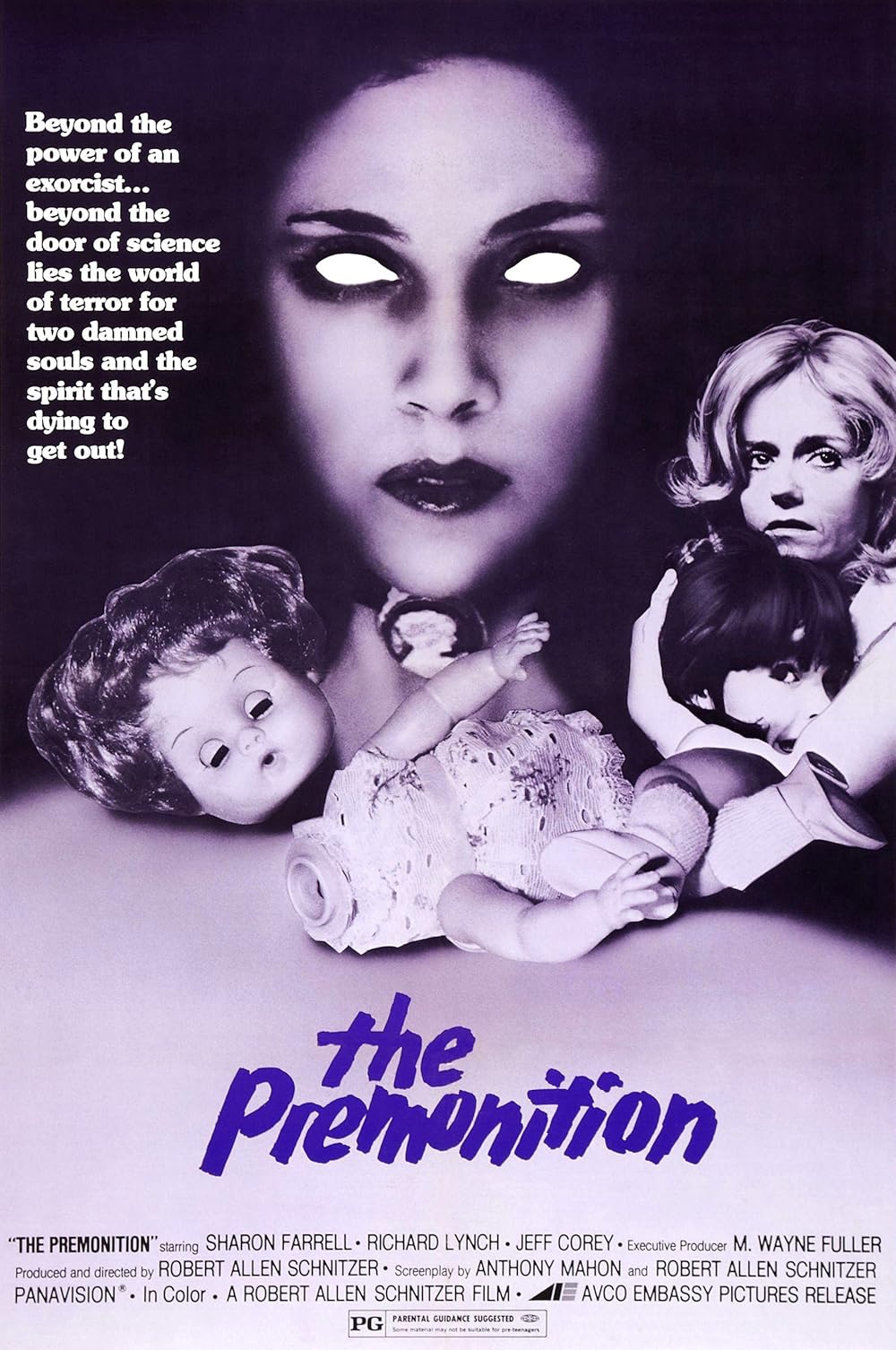
Andrea (Ellen Barber) is a woman who was institutionalized and lost custody of her child Janie (Danielle Brisbois). Janie was then adopted by Sheri (Sharon Farrell) and Miles (Edward Bell) who became her foster parents. Andrea though gets released from the hospital and manages, along on with her boyfriend Jude (Richard Lynch), who works as a circus clown, to track down where Janie is currently living. Andrea wants Janie back and the two conspire to kidnap her, but their initial attempt backfires. Jude becomes irritated at Andrea’s inept abilities to retrieve the child, along with her obsession over a doll that she treats as being a real baby, which sends him into a rage that ultimately kills her. Now, Sheri begins having weird visions of Andrea tormenting her from beyond the grave, but when she complains to her husband about it he refuses to believe her insisting that it’s simply hallucinations from all the stress.

Odd film that seems to be a hybrid between sci-fi and thriller, with just a drop of dramatic character study, that doesn’t fully work despite some moments of potential. The on-location shooting, done in Jackson, Mississippi, allows for some visual flavor, but the story isn’t fleshed out enough to be impactful. There are some shades of an early version of Nightmare on Elm Street, but the film doesn’t go far enough with it. In fact, on a creepy level, it’s very low. The one and only slightly scary moment comes when an eviscerated, ghostly Andrea appears in Janie’s bedroom and tries to scare Sheri, but the scene is too brief and doesn’t go anywhere. The only other ‘spooky’ parts entails when Sheri watches her bathroom mirror fog up as well as the windshield of her car, but that’s literally it. No other scares or shocks to speak of making it confusing trying to figure out what type of audience the producers were going for.

Story-wise it’s muddled. No explanation given for how Andrea and Jude where able to track down where the kid was currently living and Andrea’s ability to get inside the house, where she simply turns the knob of the front door and is able to sneak right in, was too easy. Most people lock their doors at night, and this couple especially should’ve since Andrea had already been spotted by Sheri harassing Janie earlier at the school playground, so having them forget to do this makes them seem dumber than dumb it also hurts the tension. Forcing Andrea to come up with creative ways to get in the home, like maybe trying to slide through the basement, or attic window, would’ve given this segment more intrigue.

There’s also no suitable reason for how Sheri is able to receive the premonitions that she does, or how Andrea is able to give them off. Did Andrea at some point dabble in the occult? Or has Sheri always showed signs of ESP all her life and therefore making her susceptible to Andrea’s ‘messages’? None of this gets even remotely addressed, which ultimately makes the movie poorly thought out. 

Spoiler Alert!

The ending is particularly goofy as it features Sheri performing a musical piece written by Andrea in an attempt to appease Andrea’s angry spirit and get Janie back. However, this all gets done late at night while on the steps of the Mississippi state capitol where a small piano has been placed that Sheri plays while in front of a crowd of curious onlookers. The police then stand-by waiting for any ‘suspicious’ people to arrive, so they can be arrested, but the chances that the authorities would allow such an insane ‘show’ to take place on government property, or believe in evil spirits and visions to begin, with is highly unlikely.

End of Spoiler Alert!

I did though enjoy the acting. Farrell is quite good as the distraught mother and Brisebois, who’s probably best known for playing Stephanie on the ‘Archie Bunker’s Place’ TV-show, is cute and looks to be no more than 3 or 4. Lynch is fantastic playing against type as his character has moments where he seems genuinely concerned and I loved the scene where he dresses in mime make-up and does a silent routine while taking someone’s picture. The best though is Barber who’s unnerving as the unhinged woman, and I wished her role had been bigger.

Unfortunately, there isn’t a payoff. Too many questions get left open and the story doesn’t explore enough angles to make anything that occurs here either memorable or riveting. Some may say this was a precursor of better, more well-known thrillers/horror/sci-fi films to come, and they may have a loose point, but it doesn’t do enough with the material to deserve any recognition. 

My Rating: 3 out of 10

Released: May 5, 1976

Runtime: 1 Hour 34 Minutes

Rated PG

Director: Robert Schnitzer

Studio: AVCO Embassy Pictures

Available: DVD, Blu-ray, Amazon Video, Tubi

Pretty Poison (1968)

By Richard Winters

My Rating: 7 out of 10

4-Word Review: Manipulated by attractive teen.

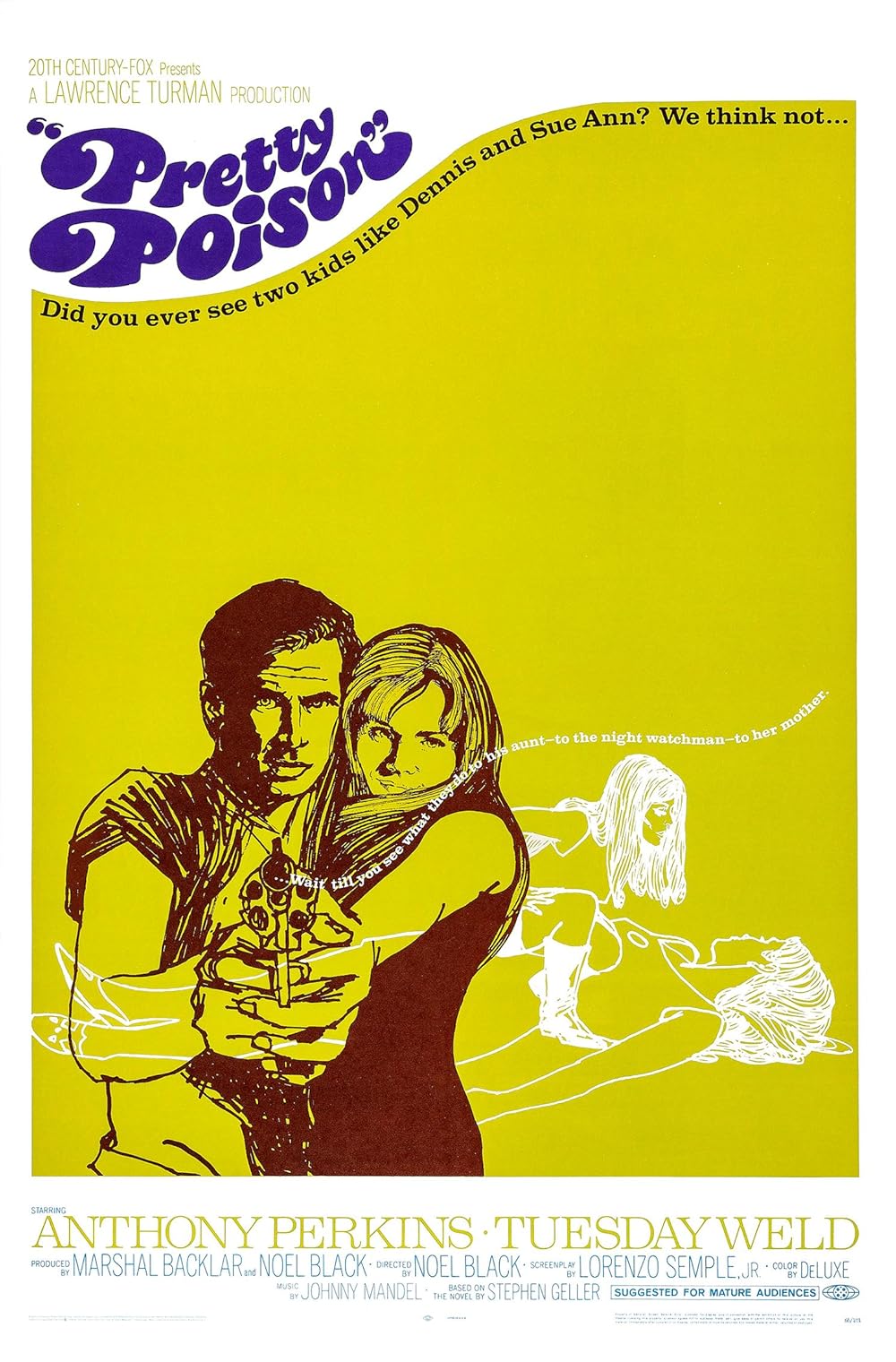
Dennis (Anthony Perkins) has been released from the mental institution after serving several years there for setting a home on fire. He gets a job at the local factory but finds it boring and begins to escape into fantasies. He spots pretty 17-yeard-old Sue Ann (Tuesday Weld) while she rehearses with her high school marching band and immediately becomes smitten. He’s never had experience dating anyone, so he decides he’ll pretend to be a CIA agent on a secret mission as a way to impress her and get her attention. He’s disgusted at the way the factory where he works at dumps pollution into the river and thus comes up with a scheme to destroy it using her help, but when a security guard spots them, Sue Ann kills him. Dennis is shocked with Sue Ann’s brazenness and realizes she’s not as innocent as she appears. He tries to cover-up the killing but finds that Sue Ann’s only getting started as her next target is her mother (Beverly Garland). Will Dennis try and stop it, or figure that appeasing her murderous desires may be the only way to keep her from going after him?

The film is based on the 1966 debut novel ‘She Let Him Continue’ by Stephen Geller and directed by Noel Black, who was just coming off the success of his award winning short Skaterdater and this was considered perfect material for his feature film debut. He described the story as “a Walter Mitty type who comes up against a teenybopper Lady MacBeth”. It was shot on-location in Great Barrington, Massachusetts, which gives it a quant small town atmosphere where supposedly ‘nothing ever happens’ and Beverly Garland gives a terrific supporting performance as the caustic mother.

However, Black had no background in working with actors leading to many confrontations behind-the-scenes between he and Weld and keeping the shooting production on schedule proved equally challenging, which got the studio to believe they’d hired a director who was in over-his-head and helped bring in added pressures. When the movie finally did get released, it fared poorly at the box office. Black felt this was because of the recent assassinations of Martin Luther King and Robert Kennedy, which made the studio timid to distribute it and thus few people saw it though in recent years its acquired a small cult following. 

One of the elements that really makes it work is Perkins who gives a splendid performance. Initially I thought it was a mistake to cast him as he would seem too much like his earlier, more famous character of Norman Bates, but he plays this part much differently. Here he comes off as smarter and less crazy. He does dabble in make believe at times but only does it to mask his insecurities and lack of life experience. Watching his emotional arc where he goes from feeling confident, thinking he’s in control with this supposedly naive young teen, only to ultimately have to grapple with his slow realization that it’s really she who’s pulling-the-strings is the most captivating thing in the movie. 

Weld seemed initially to be perfectly cast as she had already shown a propensity at playing characters quite similar to this one in classic episodes of ‘Route 66’ TV-show and ‘The Fugitive’. However, her age clearly belies her as she was 24 at the time it was filmed and looking nowhere near 17. Having a true teen playing the role may have made what she does even more shocking. She later said in interviews that she hated working on this project mainly because Black wouldn’t let her improvise her lines and you could see she just wasn’t fully into it, and it diminishes somewhat the full effect.  

Spoiler Alert!

While it’s intriguing the whole way the ending, which has Dennis calling the police and allowing himself to be put into jail, didn’t have quite the bang I was hoping for. Dennis had fallen hard for Sue Ann to the extent he felt she had ‘changed his life’ and gave meaning to his otherwise lonely existence. When people are in love with someone, they tend not to see the same red flags that others do, so even though she does some evil things I was expecting him to make excuses for it. Like she killed the nightwatchman not so much because she was a sociopath, but more because of her ‘love’ for him and knowing it would help him in his ‘secret mission’. The murder of the mother could’ve been approached the same way in his mind. She killed her only so they could be together, and he would view it as an ‘unselfish’ act versus a selfish one.

Seeing someone who starts out a bit cocky thinking he can ‘trap’ others with his fantasies only to learn that his own fantasy had trapped him would’ve been quite ironic. He could still be convinced of her love even as he’s arrested and thus his final meeting with her, in which he realizes that she’s betrayed him by going to the police, would’ve had more of an impact.

I didn’t feel that Dennis should’ve had to spoon-feed to his psychiatrist, played by John Randolph, that Sue Ann was really the killer, as the doctor should’ve been smart enough to figure this out for himself. Watching the psychiatrist then follow Sue Ann around in his car as she finds another man (Ken Kercheval) that she intends to manipulate leaves things too wide open. What exactly will this lead to? Will the doctor stop her from killing again before it’s too late, or will Sue Ann realize she’s being followed and have the doctor killed? This is something I feel the film should’ve answered. 

My Rating: 7 out of 10

Released: September 18, 1968

Runtime: 1 Hour 29 Minutes

Rated R

Director: Noel Black

Studio: 20th Century Fox

Available: DVD, Blu-ray, Amazon Video, YouTube

Straw Dogs (1971)

By Richard Winters

My Rating: 8 out of 10

4-Word Review: Man defends his home.

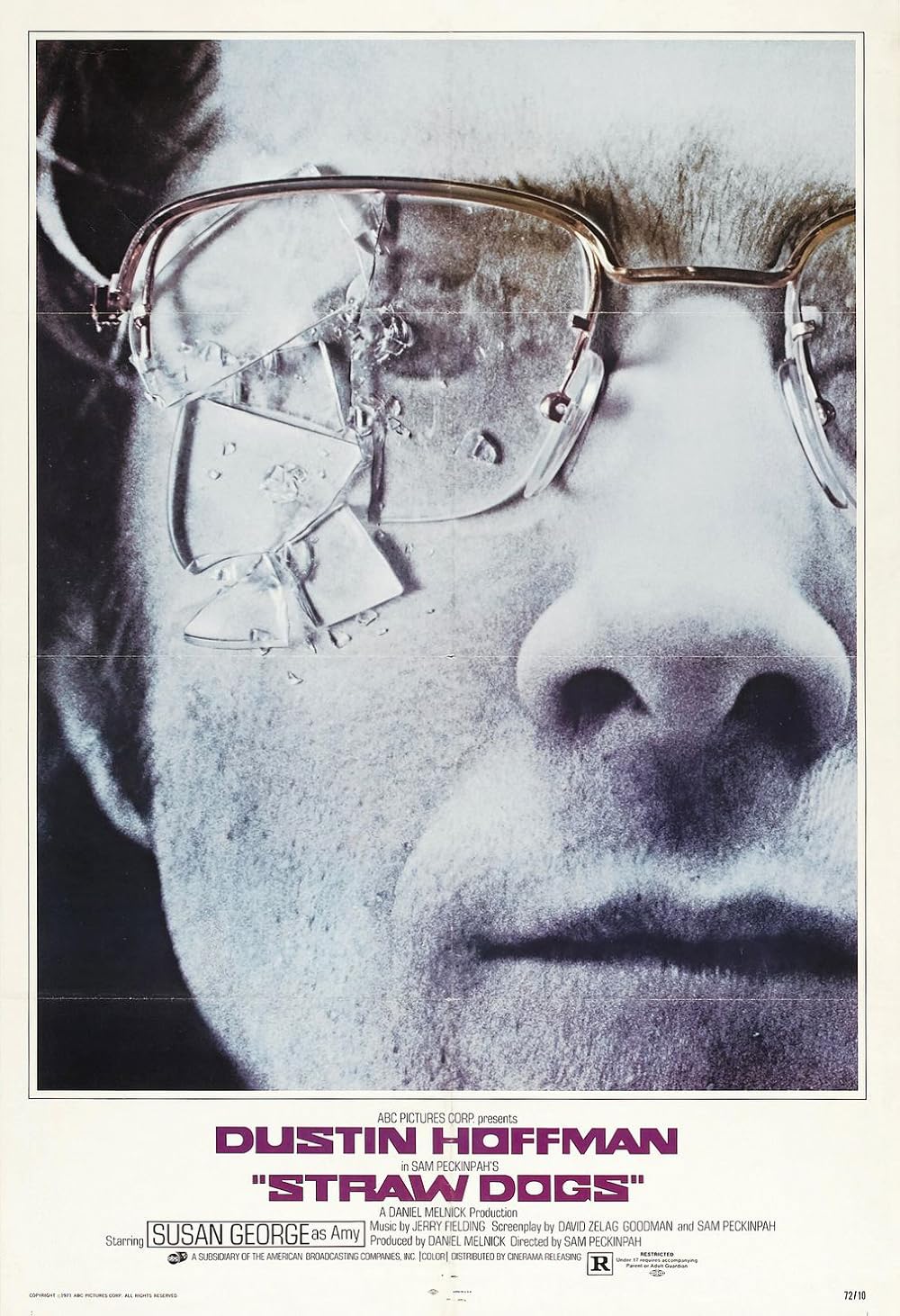
David (Dustin Hoffman), a nerdy mathematician, has been given a research grant and uses it to relocate to the rural countryside of England with his wife Amy (Susan George). They move into a farmhouse that was once owned by Amy’s father and they hire four men (Del Henney, Ken Hutchinson, Jim Norton, Donald Webster) to fix up the roof. The men though don’t work much and spend most of the time making fun of David and ogling Amy. After several bad encounters, including the grizzly death of their pet cat, David fires them and hopes that’ll be the last it, but things only get worse. When a teen girl named Janice (Sally Thomsett) disappears her violently drunken father Tom (Peter Vaughan) thinks it was caused by Henry (David Warner) a mentally handicapped man that Janice had shown an affinity for. Tom, along with the four other men, become a lynch mob determined to find Henry and bring him some ‘street justice’. David and Amy, while returning from a church service, hit Henry with their car as he’s running from the other men. David agrees to take the injured Henry into his home until a doctor can arrive, but the five men insist on getting inside to beat and kill Henry for his perceived crime. Since David had avoided having any confrontation with the men previously even when they had openly mocked him, they presume he’ll be a pushover this time as well, but David has finally decided to take a stand and will defend his home from the intruders in any way he can. 

While it was controversial at the time many now consider this the pinnacle of director Sam Peckinpah’s career and his directorial touches are supreme. The capturing of the brown empty vast landscape of nothingness, shot during the winter of 1971, brings out a surreal sense making it seem like the characters are living in a purgatory outer world where everything is dead and helps explain the deadness of the men’s souls that have been forced to endure their entire lives there. The climactic sequence where David’s home comes under siege is deftly handled. Normally in thrillers pounding music gets played during these segments to ramp up the tension, but here there’s only the sound of a distance foghorn, which makes it much more creepy, distinct, and helps accentuate the isolation. 

Some have been critical of the film’s violence especially at the time when there was activism going on that tried to stymie violent material on both TV and movies with the idea that violence was a ‘learned’ behavior and if people didn’t see it so much in entertainment, then they wouldn’t do it in real life. Peckinpah though saw it differently as he felt violence was an instinctual reaction that couldn’t just be ‘unlearned’ and that in certain situations it was necessary and not every conflict could be resolved peacefully, a message the film brings out quite well. 

While Susan George gives an excellent performance, as do the four villainous men, particularly Vaughan as their ringleader making them some of the creepiest bad guys in film history, I did find her character confusing. I didn’t understand why she’d marry a guy that she found by her own admission cowardly even bringing up that he was ‘running away’ from problems he was having at his university and his ‘hiding behind his studies’ in order to avoid it. She also shows no respect for his work and several times even vandalizes his chalk board that has his mathematical equations, so what attracted her to him in the first place? Would’ve made more sense had she initially idolized him for his academic status and then became painfully aware of his meekness as the film progressed, which would’ve made for a more interesting arch.

Spoiler Alert!

The film is based on the 1969 novel The Siege of Trencher’s Farm by Gordon Williams, but with many changes some of which worked while others didn’t. In the novel the couple had an 8-year-old girl, but in the film there is no child. To a degree it doesn’t make that much of a difference though when the bad guys attack the house it might’ve heightened the urgency more knowing that David was not only defending his ‘home’, but also the safety of his terrified daughter. The biggest change that the film does is that it creates a connection between Henry and Janice where Janice sneaks away with him during a church party where she invites him to be intimate with her, but in the process, he accidentally kills her, which seemed too similar to Of Mice and Men. It’s confusing too why this teen girl, who outside of her buck teeth seems reasonably attractive, would feel the need to throw herself at a mentally handicapped man, or get flirty with David, who is married. Why can’t she find guys her own age to fool around with? Knowing the hormones of most teen boys that shouldn’t be too hard, so without further explanation to her psyche, which doesn’t happen, her ‘inviting’ of Henry is quite unnatural and forced. 

In the book Henry is instead a child killer who’s being transported back to prison when the vehicle he’s in gets stuck in the snow, which allows him to escape. At the same time Janice, who’s mentally disabled, which isn’t made clear in the movie, runs away from a Christmas party where she ends up dying from the exposure to the cold, but otherwise it has nothing to do with the escape of Henry and is only presumed to have a connection by the five men, which makes more sense and the screenplay should’ve have kept it this way.

On the other hand, in the book none of the attacking men die and are only badly injured, but I think death gives it a more final resolution, so the movie scores there. I also liked how David is forced to resort to items he can find around the house, much like in the film Last House on the Left, which came out a year later, to fight off the bad guys versus the cliched machoism of having a big gun to blow them away and it also helps to show how intellectual wits can ultimately be used to overpower the otherwise physically stronger attackers. 

The rape scene in which the wife gets assaulted by not only one, but two men was another problematic moment as the book had no such segment. For one thing it makes it seem like she’s actually enjoying the attack, at least with the first one, and she recovers from it much too quickly and doesn’t even bother to tell David about it and able to go on relatively normally afterwards, which didn’t seem realistic and thus I think it should’ve been excised since it comes off as exploitive and doesn’t have that much to do with the main plot. 

My Rating: 8 out of 10

Released: December 22, 1971

Runtime: 1 Hour 57 Minutes

Rated R

Director: Sam Peckinpah

Studio: 20th Century Fox

Available: DVD, Blu-ray (Criterion Collection)

You’ll Like My Mother (1972)

By Richard Winters

My Rating: 3 out of 10

4-Word Review: Pregnant woman held captive.

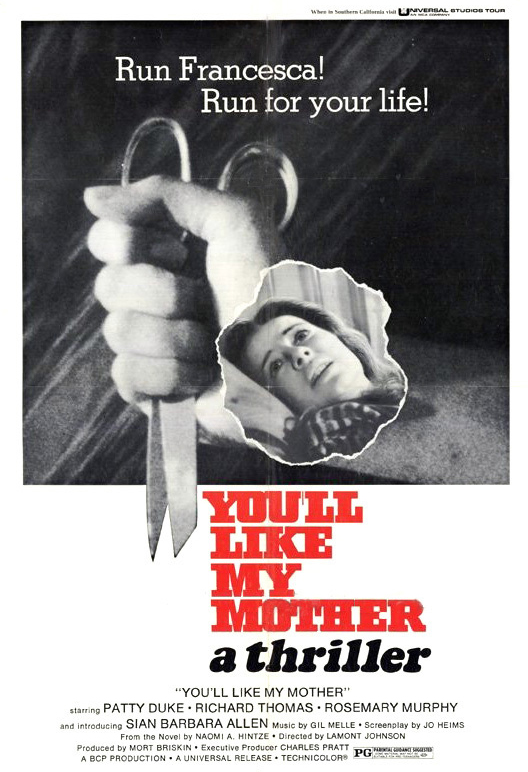
Francesca (Patty Duke) travels by bus to Duluth, Minnesota in order to meet her mother-in-law (Rosemary Murphy) after her husband dies in a plane crash in Vietnam leaving her alone and pregnant. When she arrives, she finds the woman to be cold and indifferent unlike how her husband had described her where he always insisted that ‘you’ll like my mother’. Francesca also finds out that he apparently had a sister, a mute girl named Kathleen (Sian Barbara Allen) that he had never mentioned. A snowstorm blocks her from leaving forcing her to stay in an upstairs bedroom where more troubling secrets come out including the fact that a young man named Kenny (Richard Thomas) is secretly residing in the home and has been accused in the past of being a serial rapist.

Blah thriller based on the 1969 novel of the same name by Naomi A. Hintze. The only interesting aspect about the film is that it was shot on-location at the Glensheen Historic Estate, which 5 years later became the site of a real-life crime when the mansion’s owner, Elisabeth Congdon and her nurse, were murdered by her son-in-law. The movie also marks the debut of Sian Barbara Allen, who died just recently and was quite active in TV and movies during the 70’s before retiring in 1990 in order to focus full-time on being an activist. She was, particularly in her prime, a great beauty with the most mesmerizing pair of blue eyes you’ll ever see. Unfortunately, her role doesn’t have her saying much outside of a few words she manages to mumble out and her character seems to be put in simply to help the protagonist figure out the mystery.

The story unfolds slowly and because the majority of it takes place in one building it becomes visually static. Since it was filmed in Minnesota during the winter the white stuff on the ground is real, which helps with the authenticity, but because it didn’t actually snow when it was being shot the crew was forced to use fake falling flakes in a feeble attempt to replicate a snowstorm, which they’re not able to pull off. Anyone who’s ever experience a real blizzard will see how tacky this one looks and thus the premise that ‘nobody can get through this storm’ is lost.

Patty Duke is good, but her character doesn’t do much outside of staying cooped up in room while Allen does most of the leg work. Her insistence that she didn’t need any help financially makes you wonder then why did she come at all? If it was just for a visit, she could’ve done that in the summer when Minnesota weather is more hospitable and after the baby was born. In many ways having her in need of money would’ve made more sense and heightened the dramatic tension since that would make her desperate with nowhere else to turn.

Murphy is a weak villain as half the time she’s more nervous than Duke and easily fooled making it seem that anyone could outfox her and get away. It doesn’t help that she stupidly gives away who she really is and why she’s there when she has a conversation with Thomas that gets overheard by Duke, which ruins the mystery when the film is only halfway through and thus killing what moderate intrigue there had been.

The foot chase through the snow at the end does offer some tension but waiting all the way until the finale for any action was a mistake and Duke should’ve tried to escape earlier. The plot twists aren’t enough to make sitting through worth it. It’s not adequate material for a 90-minute feature length film as there’s 30-minute episodes of the old ‘Alfred Hitchcock Presents’ with more plot wrinkles than what you get here.

My Rating: 3 out of 10

Released: October 13, 1972

Runtime: 1 Hour 33 Minutes

Rated PG

Director: Lamont Johnson

Studio: Universal Pictures

Available: DVD (Warner Archive)

The Conversation (1974)

By Richard Winters

My Rating: 10 out of 10

4-Word Review: Someone is listening in.

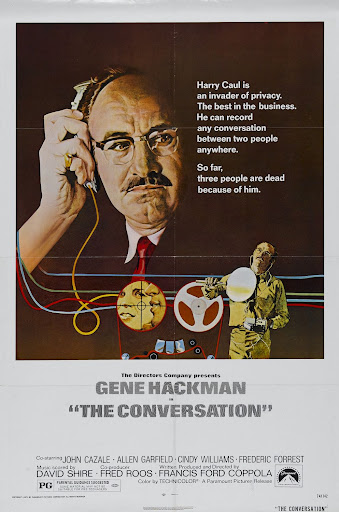
Harry Caul (Gene Hackman) is a surveillance expert who specializes in listening into people’s private conversations and has a reputation of being quite good at it. Many wealthy clients hire him to record things from their enemies that they might not be able to attain otherwise. However, one of these assignments led to the death of three people and Harry, being a highly religious man, has felt guilty about it ever since. He begins to have the same concerns with his new assignment when he overhears a couple (Fredric Forrest, Cindy Williams) who he’s recording mention that ‘he’d kill us if he got the chance’. Harry is unsure if he wants to give the tapes up to his client as he’s frightened the same scenario as before will occur. Martin (Harrison Ford) the man representing the client becomes aggressive in getting the tapes and warns Harry that they’ll get their hands on them one way or the other. Harry, a private man, soon realizes that this client is just as sophisticated in surveillance technology as he and maybe even more so as he becomes aware that his phone and even his apartment is bugged.

Inspired by real-life surveillance expert Martin Kaiser, who was a technical consultant on the production, the film deftly explores how today’s modern technology has easily evaded our private lives and how no one is safe from prying eyes and ears a concern that has become even more pronounced in the decades following its release. Many presumed that it was a testament about the Watergate break-in, which occurred a year before the movie came-out and uses much of the same sound equipment used the by criminals in the real-life event, but in actuality the script, by Francis Ford Coppola, was already complete in 1965, but was unable to get any financial backing until his success with The Godfather. 

The film scores on just about all levels especially with the way it captures San Francisco. I loved the bird’s eye-opening shot of Union Square as well as the terrific use of the fog that gets used to great effect during a memorable dream sequence. The soundtrack by David Shire is quite unique as it’s made to replicate sound waves changing frequency. I liked too that quite a bit of time is spent showing Harry inside his editing studio where he puts together the tape he’s recorded from different sources into a cohesive whole and watching him do it, even if it’s from equipment that would be deemed dated now, is impressive and makes you appreciate the expertise of the character.

Acting wise this may be Hackman’s best, and he stated in later interviews that he considers this to be his finest work, though at the time he felt it was an extreme challenge playing such an introverted person when he himself was highly extroverted, but the payoff is rewarding as he displays characteristics unlike any other role he’s played. What impressed me most was his body posture, which is hunched over, and he walks with a pensive gait, which reveals to the viewer the character’s inner angst without it ever having to be verbally explained. It’s interesting too how he’s mostly shy and stand offish during the majority of it making him seem like a wallflower, but when the subject of his sound expertise comes into discussion, he’s suddenly bragging about his state-of-the-art machinery showing how even the most unassuming of people can still have a big ego and helping to create a protagonist who’s three-dimensional.

There’s also great support from a young Harrison Ford, who appears with a scar on his chin, who despite presenting himself in a composed manner and speaking in a controlled tone of voice is quite menacing. Terri Garr is excellent as a prostitute that Harry frequents and acts as Harry’s only social outlet as well as Allen Garfield playing a huckster whose also Harry’s rival and clearly has a way about him that gets under his skin. Great work too by John Cazale who works as Harry’s assistant and their relationship runs hot-and-cold and there’s even Robert Duvall in a small, but pivotal part.

Spoiler Alert!

While the film is expertly crafted, I did find the scene where Harry’s landlady leaves him a birthday gift inside his apartment to be problematic. We see that Harry has three different locks on his door, which keenly reveals what a private person he is and how paranoid he is to protect it, and yet when he opens up his door there’s an item sitting on the floor left by his landlord. Through a subsequent phone conversation, he has with her we learn that she was able to get in by using her master key, but it’s highly unlikely that she would have three different keys for each lock.

Another issue happens at the end when Harry tears his apartment apart in desperate attempt to find the covert listening device that’s been planted by the client and is able to listen and record everything he says and does. He isn’t able to locate it despite a thorough and exhaustive search and then spends the rest of the time playing his saxophone as it’s the only thing he has left, which is where it finally dawned on me that was probably where they implanted the bug and the movie should’ve had him dismantle that too and then if he was unable to find it there, after destroying everything else, he could be seen lying in the barren, darkened room in a fetal position and completely defeated, which might’ve left an even more lasting and riveting final image.

My Rating: 10 out of 10

Released: April 7, 1974

Runtime: 1 Hour 53 Minutes

Rated PG

Director: Francis Ford Coppola

Studio: Paramount Pictures

Available: DVD, Blu-ray, Amazon Video, YouTube

Diversion (1979)

By Richard Winters

My Rating: 5 out of 10

4-Word Review: Sex fling becomes problematic.

Guy (Stephan Moore) is a writer who is happily married to Annie (Morag Hood) with a toddler son named Charlie (Dickon Horsey). Annie decides to take a trip with Charlie to visit her parents and Guy stays home to work on a writing assignment. While he’s typing away, he remembers meeting Erica (Cherie Lunghi) at a party some months earlier where she gave him her phone number. Now with the wife gone he concludes this would be a good time to give her a call. Erica is excited to hear from him and they go on a mini date before ultimately ending up in her bed. The next morning, he tries to leave but she won’t let him go easily and insists that she’s not a one-night-stand material and instead wants to have a relationship with him. Guy reminds her that he’s married, but she says he can divorce her, which Guy is reluctant to do as he still considers himself content in his marriage and simply had sex with another woman as a diversion. Erica continues to call him, and his phone is constantly ringing even after Annie returns. Guy tells her it’s a wrong number, but Annie becomes suspicious and the next time Erica calls she decides to pick-up. 

If this synopsis sounds familiar it’s because it was the basis for Fatal Attraction. Producer Stanley R. Jaffee became aware of this short film and was convinced it could be expanded into a feature length movie. He even hired James Dearden, the writer-director of this one, to write the script. However, Paramount, the studio that agreed to finance the film, ordered all existing copies of this one to be destroyed, but fortunately a few survived including a bootleg version that was recorded straight off of an A&E broadcast from several decades back. 

I’m a big fan of Fatal Attraction and didn’t feel this version was as good. Too much time is spent at the beginning of Guy taking his wife and child to the airport, which I didn’t think was necessary. The party scene where Erica gives Guy her phone number should’ve been shown in flashback and the Guy character comes off like a geek that probably would only be able to fantasize about having sex with a hot woman like Erica, but not brazen enough to follow through nor would a woman like Erica want to go to bed with him as she could’ve found a better looking guy just about anywhere. In Fatal Attraction, both participants were equally attractive and working at the same firm, so their fling was more organic and made far better sense. 

Fortunately, in this one we don’t see any of the wild sex, which I felt was good as I thought that got in the way in the remake and became a distraction from the main story. Much of the dialogue though between Erica and Guy is almost word-for-word from what gets said between Glen Close and Michael Douglas though here Erica is portrayed as being this cold psychotic while in the other one Close played the role more as a desperately lonely woman, which humanized the character and helped the story be three-dimensional. 

Spoiler Alert!

My biggest grievance is that it leaves open too many loose ends. There is one scene where Guy calls Annie, while she’s still on her trip and supposedly knows nothing about what is going on, to touch base, but Annie is strangely aloof, and Guy doesn’t know why. She had always been very peppy before, which made it seem like Erica had called Annie and informed her of the affair, at least that’s what I thought, but this never gets confirmed and Annie arrives home later back to her perky self, so why did she behave differently during that one call?

The ending works like a gimmick as it has Annie answer the phone, which may or may not be Erica, while Guy stands nervously by. However, once Annie picks-up the receiver the film cuts to the closing credits, so we never know what happens next, which to me was a cop-out. 

My Rating: 5 out of 10

Runtime: 40 Minutes

Not Rated

Director: James Dearden

Studio: Dearfilm

Available: None at this time. 

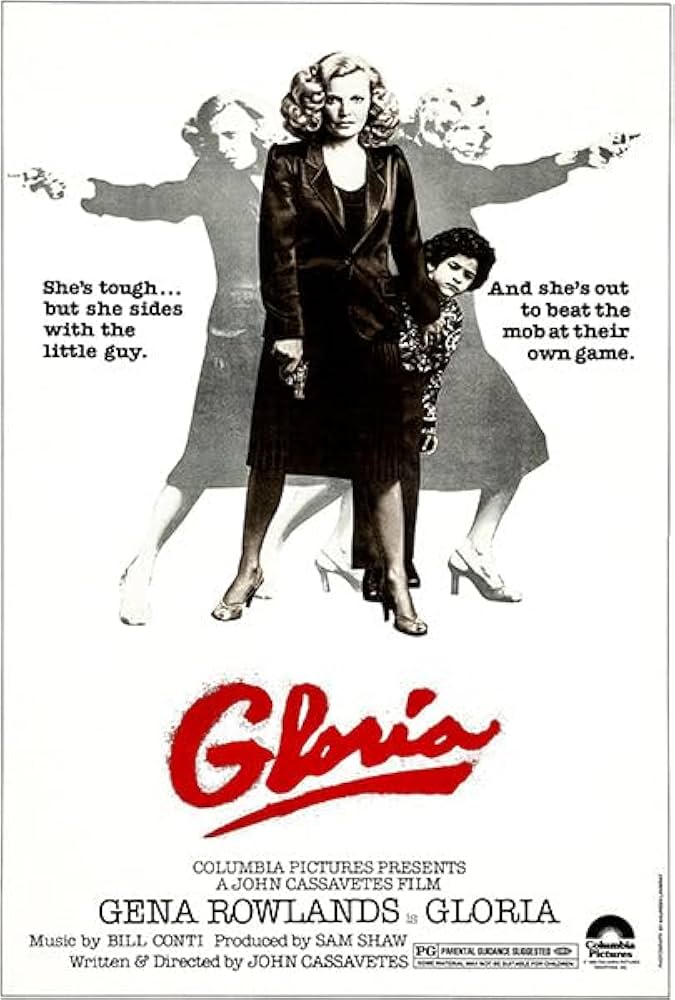
Gloria (1980)

gloria

By Richard Winters

My Rating: 8 out of 10

4-Word Review: Protecting a young boy.

Phil (John Adams) is a young boy whose father (Buck Henry) works as an accountant for the mob and has become an informant for the F.B.I. causing him and his family to become marked for retaliation by the criminal underground. In desperation Phil’s mother (Julie Carmen) pawns the child off on Gloria (Gena Rowlands) who’s their neighbor from across the hall. Gloria initially refuses to take the child as she’s adverse to kids, but eventually agrees as she takes the boy away and into her apartment just as the mob moves in on the hit. Phil was also handed by his father the ledger listing in detail the mob’s incriminating financial corruption and when they’re unable to find it after annihilating his family they then go after the pair. Gloria, who has mob connections from her past including having been in relationship with a mob kingpin, feels she can’t go to the police and must defend the child on her own using only her street savvy and gun, but where ever they go in the city the hit men remain right behind them.

John Cassavetes, who has described this as “a thoughtless piece about gangsters and I don’t even know gangsters” was never intending to direct it and though it’s become his most popular work among mainstream audiences it was one of his least favorites and something he felt embarrassed about doing. He wrote the script simply to sell it and make enough money from it to help him finance his other projects. He completed it in early 1979 and was meant as a vehicle for Ricky Schroeder who was just coming-off doing The Champ and MGM studio was looking for other projects for him to do. Cassavetes intentionally gave it a very commercial feel, much more than any of his other scripts, because he felt it would give it a better chance to sell, but when Schroeder and Barbara Streisand, who was the original choice for Gloria, both turned it down Cassavetes then shopped it around to Columbia Pictures who agreed to take it on, but only if Rowlands played the lead and since she was his wife he then reluctantly took on the directing duties.

The film doesn’t seem like the usual Cassavetes material as I was quite impressed with the location shooting, which takes the viewer to all sorts of New York City locales and makes you feel like you’re right there with Gloria and the boy as they try to maneuver their way around the unpredictable and very dangerous urban jungle. The opening bird’s-eye shot that tracks from the city’s skyline to Yankees Stadium is downright breathtaking and the grimy, rundown interiors of the family’s inner city apartment building effectively illustrates on a purely visual level the fear, stress, and tension of living in the inner city is truly like. Leonard Maltin, in his review, labeled this as being possibly done ‘for laughs’, but I didn’t find anything funny about it except for one amusing comment Gloria makes when she gets stuck in a slow elevator, but otherwise it’s a nail-bitter all the way through.

Rowlands gives her usual stellar performance, but I was hoping for more of an arch with her character. She states right up front to Phil’s mother that she hates kids and yet is pretty much warm and friendly to the child the second she takes him back to her apartment and it would’ve been more interesting to see her cold and indifferent to him initially only to slowly warm-up to him as their shared adventure went on. Buck Henry is also surprisingly good in an unusual casting choice as he’s typically known for his deadpan humor and had very little dramatic acting in his background. It was strange though why such a small, squirmy guy who was hitting 50 would be married to such a hot young Latino woman who looked to be only 24 and I felt this needed to be explained, but isn’t. I also felt the shooting of the family should’ve been shown, it gets implied, but that wasn’t enough. Seeing them shot in graphic style would’ve really hit home how dangerous and serious these people were and would’ve made the tension even stronger.

Critics at the time of the film’s release didn’t like the kid nor his acting and in fact Adams got nominated for the first razzie award for worst actor, which traumatized him so much he decided never to pursue anymore roles and to date this has been his only film appearance. I for one happened to like the kid and yes his character isn’t exactly ‘cute and cuddly’, but real children rarely ever are. They can be as rude, indifferent, and crabby as any adult and since he was brought-up in a troubled neighborhood having him be a bit ‘rough-around-the-edges’ made sense and was realistic. The only acting that I really didn’t care for was from Basilio Franchina who plays a crime boss that Gloria used to date and while he may have looked the part his performance is stiff like he’s just regurgitating lines he’s memorized and there’s no sign of a chemistry between them and their conversation is stilted and unconvincing.

Spoiler Alert!

The mob’s ability to be constantly on the pair’s tale no matter where they went seemed a bit implausible especially being in such a big, congested city, but I was willing to forgive it since the rest of it is so good. The ending was a little problematic too as it has Gloria reappearing disguised as an old lady after it was presumed she was dead. She then reunites with the kid in the middle of a cemetery, but it leaves more questions than answers like how did the two evolve? Did they become like mother and adopted son and where did they ultimately move to since New York for them was no longer safe? This might’ve gotten answered in the sequel that Cassavetes had written, but unfortunately never got green-lit. Remade in 1999 with Sharon Stone in the lead.

My Rating: 8 out of 10

Released: October 1, 1980

Runtime: 2 Hours 2 Minutes

Rated PG

Director: John Cassavetes

Studio: Columbia Pictures

Available: DVD, Blu-ray, Amazon Video, Tubi, YouTube

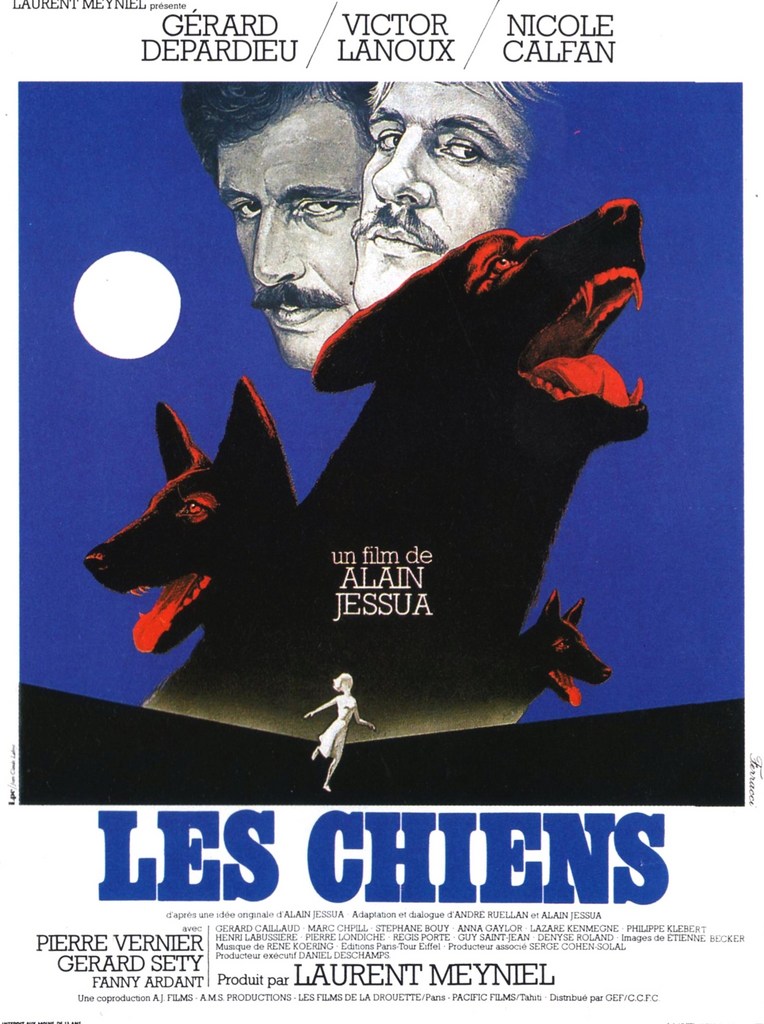
The Dogs (1979)

dogs

By Richard Winters

My Rating: 4 out of 10

4-Word Review: Canines on the attack!

Henri (Victor Lanoux) is a doctor who opens up a clinic in a planned community. He finds to his surprise that many of his patients are coming in complaining about dog bites. He then becomes aware of Morel (Gerard Depardieu) who runs a club were participants learn how to train their dogs to protect them from attacks. However, these same dogs have now become more of a menace that’s putting other citizens in the town in danger including the mayor who becomes a victim. Henri is soon at odds with his girlfriend Elisabeth (Nicole Calfan) who gets a guard dog after she is raped and she is more attached to the dog than him.

The story certainly has some interesting ingredients including the fact that the dogs themselves  aren’t really the threat, but more their owners who train them to be aggressive, which is a nice change of pace from other films from that era that would show animals attacking for seemingly no reason, or that they had become possessed by something evil. Here the set-up is more realistic and plausible and the residents are wealthy living in plush homes helps convey the idea that even ‘nice’ neighborhoods can have evil dwelling underneath and no place is ever completely ‘safe’.

Depardieu goes against type playing the villain and he approaches the part in a fascinating way where he’s not outwardly creepy at the start, but more just an awkward individual who genuinely believes, which is a mindset that he continues to have to the very end, that he’s the ‘good guy’ who’s simply helping vulnerable people find ways to adequately protect themselves. He also has a profound love for his dogs whom he likes more than people, that comes to prominence during a graphic birthing seen where the mother dog isn’t able to come through it. His performance is even more impressive when you factor in that he suffered a dog attack of his own in real-life just a few months before being offered the role and he took the part hoping it would alleviate his pent-up fears and he certainly goes all out here including allowing the dogs to attack and bite him while wearing protective clothing during the training exercises that he conducts.

On the other end, as his adversary, I didn’t find Lanoux to be half as impressive. For one thing he never comes-off seeming like much of a doctor nor ever seen wearing a white physician jacket and works inside a place that resembles a rented out business office than a legitimate clinic. He looks and behaves more like a detached business man walking through his role and never being as emotionally charged as the part demanded.

Calfan, as the girlfriend isn’t convincing either. She leaves her job late at night all alone even though she’s well aware of the crime in the area, which makes it seem like she’s foolishly walking into trouble and the subsequent rape attack gets played-out in a cliched and mechanical way. He recovery is too quick as she’s back to be her normal self again almost instantaneously without showing any of the post traumatic effects that victims of the crime typically do. Her character’s arch offers some intrigue as she at one moment ‘jokingly’ tells her dog to attack Lanoux and then at the last second calls him off, which understandably frightens Lanoux and made me believe she was mentally moving into a dark mindset and she would become the source of danger, but this doesn’t lead to anything. By the end she ‘snaps out of this phase’ and goes back to being her normal self even to the extent turning into the hero, which I didn’t find interesting at all and it would’ve been far more memorable had she slowly became the threat.

The film is too leisurely paced. We know upfront that these dogs, and the people who own them, are something to be feared, but the actual attacks take too long to get going and when they do they’re too quick and ultimately start to play-out in a redundant fashion. The chills and thrills are limited and there’s not enough surprises or twists. There are also some disturbing segments including a dog getting kidnapped and then bound with a muzzle while dangling in the air by a rope as it whimpers, which many viewers including animal lovers will most likely find highly unsettling.

Alternate Title: Les Chiens

My Rating: 4 out of 10

Released: March 7, 1979

Runtime: 1 Hour 40 Minutes

Not Rated

Director: Alain Jessua

Studio: A.J. Films

Available: DVD (French), DVD-R (dvdlady.com)

Remember My Name (1978)

remember

By Richard Winters

My Rating: 7 out of 10

4-Word Review: His ex-wife returns.

Neil (Anthony Perkins), who works as a local carpenter, is married to Barbara (Berry Berenson). While the two have their share of ups-and-downs they mostly find a way to work it out and get along. Then comes Emily (Geraldine Chaplin) whose been recently released from jail. She begins harassing the couple for no apparent reason. After she breaks the window of their home Barbara insists on pressing charges. Neil though resists while divulging that he had previously been in a relationship with her and because of certain things that occurred has a misplaced sense of guilt to cover-up for her actions. Barbara does not understand this and the two break-up while Neil decides to rekindle things, but while Emily initially seems receptive she may actually harbor ulterior motives.

Alan Rudolph does a marvelous job of directing this emphasizing the working-class existence with a pale color scheme and great use of on-location shooting, which gives the viewer a vivid and intimate portrait of the character’s lives and their environment. The use of showing that Emily had previously been in prison without actually saying it by simply using certain sounds and visuals as she sleeps is a genuinely inspired moment as is the use of the brief dialogue that reveals things slowly and deliberately using subtle hints that achieves a certain fragmented narrative.

Chaplin is brilliant and convincing in the lead and her unique colored eyes helps build a riveting psycho-like effect though with her extremely thin frame it’s hard to imagine she’d be able to take-on and even beat-up the Alfre Woodard character as she does though one could possibly justify it by saying she learned fighting skills while in jail. Perkins is also quite good, but the use of his real-life wife Berenson, who didn’t have a lot of acting training, hurts as her time on screen is rather blah including the otherwise tense confrontation that she has with Emily when Emily invades her home, which might’ve been a more interesting scene with a better qualified actress in the part.

While the first-half is quite slow I was thoroughly gripped and found the whole thing fascinating, but this tapered-off by the third act when Perkins and Chaplin rekindle things while at a restaurant. The scene gets done in amusing way as the couple keeps ordering alcoholic drinks one after the other, much to the consternation of the waiter, played by Terry Wills, but having Perkins go back immediately to Chaplin with almost no apprehension kills the intrigue. This is a woman that supposedly murdered someone before, so how does he know she can be trusted? Having him more defensive and cautious and even conflicted as he was technically still married would’ve helped continue the tension instead of deflating it.

Spoiler Alert!

The scene in which the Moses Gunn character, who was having a bit of a fling with Emily, goes back to her apartment apparently to murder Perkins who had been temporarily staying there, could’ve been done better. It’s only intimated that Gunn kills him as we see a nervous look on Perkins face as he hears somebody at the door and then it cuts away to the outside of the building with loud crashing music to display that there was violence, but I really felt it should’ve gotten played-out visually. Perhaps it could’ve been done Rear Window-style with it being captured through the windows, which would’ve stayed consistent with the film’s detached tone, but to leave the story’s most crucial moment up to speculation was a letdown.

The same can be said to Alfre Woodard’s character who promises revenge on Chaplin, but it never comes. A good physical confrontation between the two could’ve added some much needed action, which otherwise is sorely missing and makes the film seem incomplete. Having Chaplin terrorize the couple by messing up their flower garden is a bit too tame as any squirrel or raccoon could’ve done the same thing while putting a bloody animal on their doorstep, or nailing a graphic picture of the person she had killed before would’ve been far more frightening.

Overall I liked the style, but the attempt to keep things buttoned-down all the way through doesn’t work. At some point, just like with the ticking time bomb mentality of its main character, it needed to explode with violence that would’ve awakened the viewer with a shocking effect. The fact that this is only slyly hinted at is a letdown and doesn’t give the movie the strong pay-off that it should.

My Rating: 7 out of 10

Released: October 1, 1978

Runtime: 1 Hour 34 Minutes

Rated R

Director: Alan Rudolph

Studio: Columbia Pictures

Available: DVD-R, Tubi