Category Archives: Romance

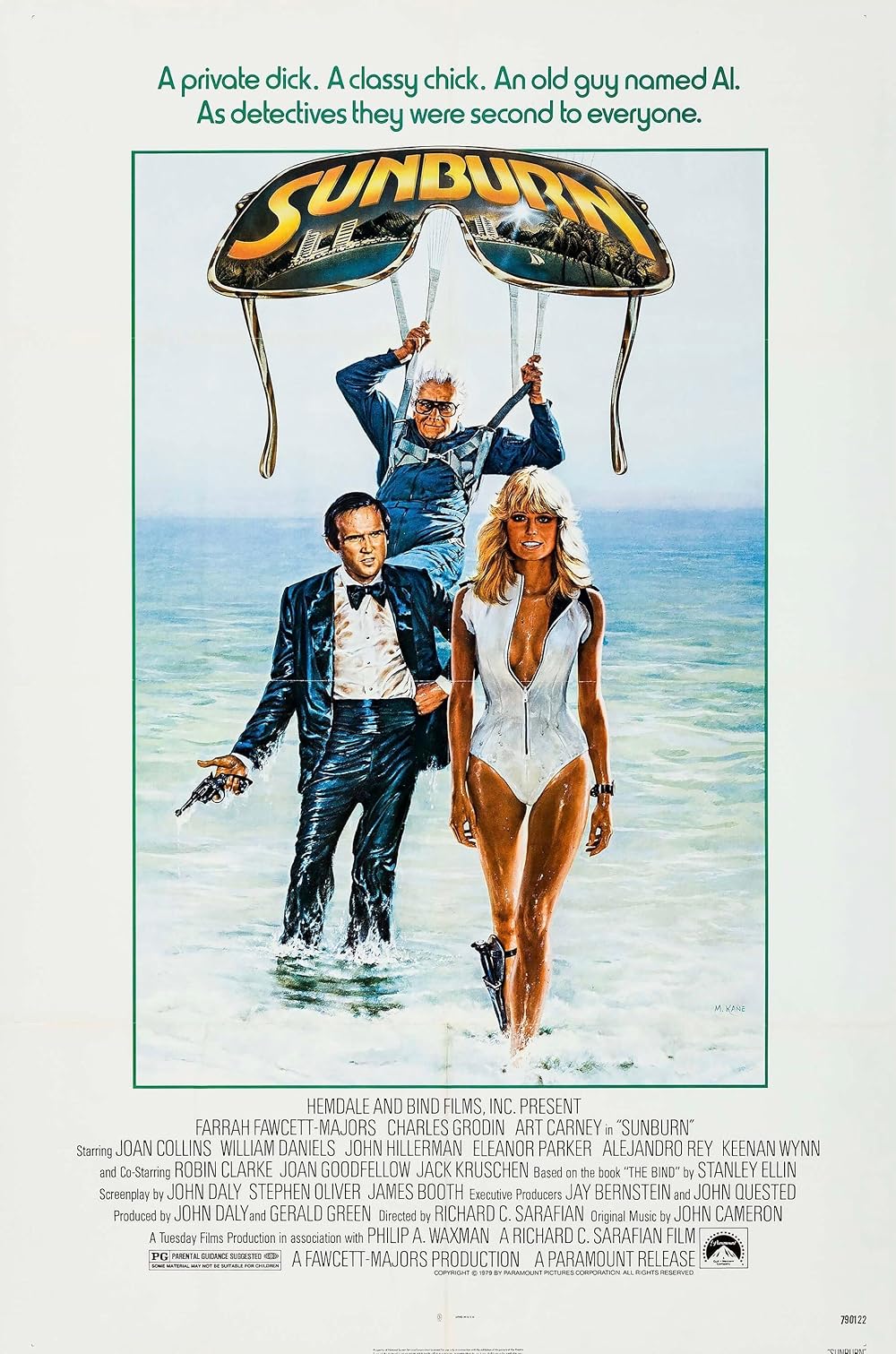
Sunburn (1979)

By Richard Winters

My Rating: 2 out of 10

4-Word Review: Couple investigates insurance fraud.

Jake (Charles Grodin) works as a private eye and gets hired by an insurance company wanting him to investigate a case that took place in Acapulco of a man who crashed his car into a building and died. The authorities have labeled it an ‘accident’, which would put them on the hook to have to pay out a large sum of money, so they’d like Jake to travel down there and find out if that were really the case, or if it could be deemed as a suicide. Jake decides to hire an actress from a modeling agency named Ellie (Farrah Fawcett-Majors) to act as his wife. Ellie takes an interest in the case and helps him search for clues while also forming a romance with him, which starts out rocky but becomes stronger as they find themselves sucked further into the mystery and the potential dangers.

The film is based on the 1970 novel ‘The Bind’ by Stanley Ellin, which had a grittier tone than the movie. Farrah’s agent Jay Bernstein felt this would be a good vehicle for her, but wanted the script turned into more of a lighter and comical story that the book did not have. This was at a crucial point in her career as the first film he got her cast in Somebody Killer Her Husbanddid badly with both the critics and public, so it was important that she prove her box office ability with this picture and when this one also bombed she fired him complaining that both movies had been ‘put together with hustle and bubble gum’.

One of the elements that really hurts it is the casting of Charles Grodin, who by his own admission was their sixth choice for the role as they had initially pursued Robert Redford and even Harrison Ford, who would’ve both been way better. Grodin can certainly be funny, but this part doesn’t give him much to work with. He has a few amusing moments when he’s trying to scare away a lizard from entering their bedroom and then in an effort ‘to protect her’ from a further ‘lizard invasion’ agrees to sleep on a nearby chair, which cause him to do nothing but toss and turn the whole night in an effort to find a ‘comfortable’ position.

His character though didn’t seem all that professional as he leaves it up to her to place a listening device into one of the suspect’s phones, but she had no background in this kind of thing, so what would happen if she screwed it up? The insurance company is promising him a lot of money so it should be up to him to do most of the legwork to make sure it gets done right and if any ditzy amateur blonde can be pulled in off the street to do what he does then what’s the point in hiring him to begin with?

Farrah does much better here than her previous film. I enjoyed her dialogue with Grodin and how just because she was hired to play his wife didn’t mean she was automatically going to be one during their off hours when he for some chauvinistic reason expects her to make him a sandwich, which she immediately declines to do. I was confused though why her character would want to get so involved in the case. She’s just there to play a part, so why not just do her job and enjoy the sun? Instead, she constantly puts herself in increasingly dangerous situations for no real reason. She’s gets paid whether the case gets solved or not, so why jeopardize her life over something that she has no emotional or financial investment in?

It’s also hard to believe that such a hot looking lady wouldn’t be in a relationship. It would’ve been far more enjoyable had there been a jealous boyfriend who secretly followed her on her mission and even threw a few monkey wrenches into the investigation, which could’ve added extra spark into a movie that’s otherwise too leisurely. For her to then fall in love with Grodin was equally dumb. The guy could’ve been her father and lacked any type of sexual pizazz. Had Redford or Ford been cast then the romance might’ve made more sense, but such a beautiful woman like her would have no reason to settle for a doofus like him and would simply be there for the payout and then be long gone.

Art Carney is great in support and actually does most of the work making it seem like Grodin’s character wasn’t even necessary and in fact having Carney and Farrah team up would’ve made it unique and more entertaining as Carney despite his advanced age shows a lot of energy particularly when he goes out onto the disco floor. The rest of the cast though gets wasted with many of them having only one or two lines making you wonder why they’d bother to sign on at all.

The film does have one memorable moment where Carney and Farrah, in an effort to escape the bad guys who are pursuing them, inadvertently crash their car into a bull fighting ring and then must avoid the bull who goes after them. This action is both humorous and exciting, but otherwise unless you’re some super Farrah fan the movie offers little else that’s interesting.

My Rating: 2 out of 10

Released: August 10, 1979

Runtime: 1 Hour 45 Minutes

Rated PG

Director: Richard C. Sarafian

Studio: Paramount Pictures

Available: DVD-R (MGM Limited Edition Collection)

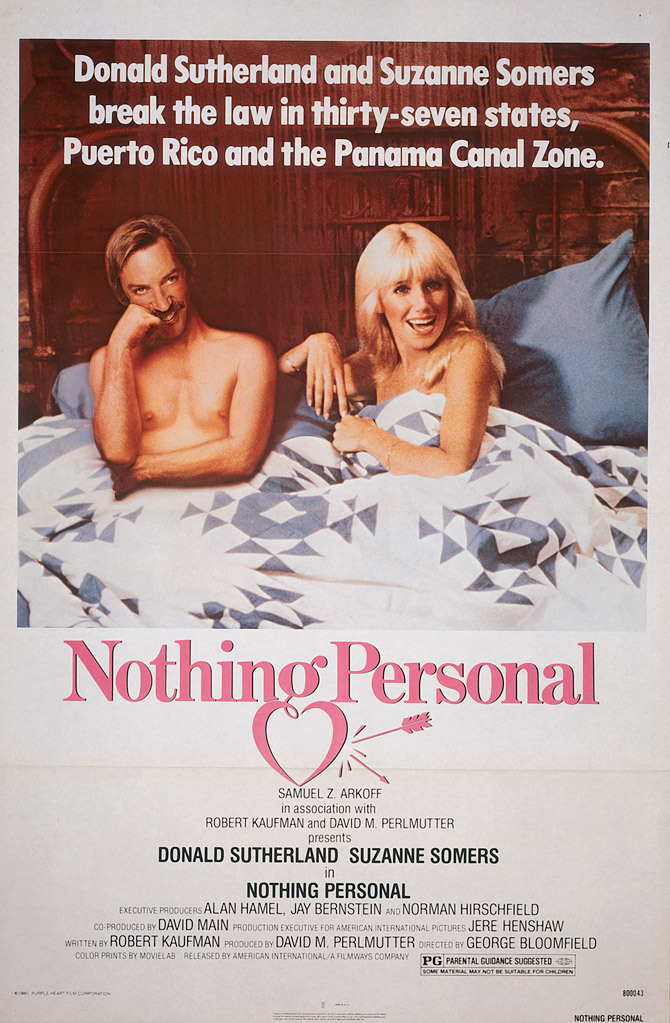
Nothing Personal (1980)

By Richard Winters

My Rating: 2 out of 10

4-Word Review: Saving seals from slaughter.

Roger (Donald Sutherland) is a college professor who becomes aware by one of his students, Peter (Michael Wincott), that seals are being systematically slaughtered by a construction company trying to build homes in an area populated by them. Roger then goes on a crusade to stop this and hires the services of Abigail (Suzanne Somers) a young lawyer bent on proving herself. The two though come up with major roadblocks when they attend the stockholder meetings of the company. While the CEO Ralston (Lawrence Dane) seems to listen to their concerns the company still decides to push through their construction agenda prompting Roger and Abigail to find other ways to prevent the homes from going up, which then causes the heads of the company to resort to nefarious means to stop them.

The screenplay was written by Robert Kaufman and sold in 1972 but then languished in the studio’s slush pile as it couldn’t find any director interested in filming it. Then in 1980 after the success of Love at First Bitewhich had also been penned by Kaufman, director George Bloomfield decided to take a stab at this one, but for tax write-off purposes it was filmed in Canada despite the setting being Washington D.C.

A lot of the issue with the movie, which was not well received by audiences or critics alike, and ended up tanking at the box office, is that it’s just not all that funny. The humor is dry and amounts to a few throwaway lines said by the characters just before the scene cuts away and if you’re not listening carefully enough, you’ll miss it though even if you do catch it it’s nothing that’s going have you rolling-in-the-aisles. Would’ve worked better had it been done as a drama, or even a thriller, as neither the comedy or romantic elements add much and in a lot of ways detracts from the main story.

While Sutherland is traditionally a good actor his presence here hinders things. He comes off initially as completely oblivious to what’s happening and only manages to get informed by Peter who’s very passionate about the cause and even interrupts a class that Sutherland is teaching to inform him about it. Sutherland immediately poo-poo’s the news and only after doing more research does he decide to take on the cause, but I felt that Peter, who gets largely forgotten and not seen again, should’ve been the one to lead the charge since he was already heavily into the issue and being a student would have more time on his hands while Sutherland was working a job and therefore shouldn’t have been able to devote his full attention to it like he does. Having a romantic relationship grow between Peter and Somers would’ve worked better as they seemed more around the same age while Sutherland looks to be more like her father.

Somers’ character is quite problematic. Initially she’s someone that wants to prove herself and be taken seriously but then turns into a complete slut almost overnight as she gets in bed naked when she invites Sutherland into her room and immediately makes overtures that she wants to get-it-on. This though is not a proper way that someone who wants to gain the respect of her peers and clients as she moves up in the business world should be behaving and therefore it’s hard for the viewer to take anything that she says or does seriously.

Too much time also gets spent on them fooling around to the point that it seems they’re more into sex than saving the seals. The movie should’ve waited until the very end to introduce some romantic overtures after they had succeeded with their mission when it would’ve been more appropriate, but the way it gets done here makes them seem like vapid juveniles with hyper hormones and not much else.

The film though really jumps-the-shark when the CEO of the company and his trusted assistant, played by Dabney Coleman, resort to criminal means in an effort to stop Sutherland and Somers from shutting down their project. Even going as far as trying to kill them by trapping them inside a barn and then setting it on fire. There are certainly CEO’s out there that can be corrupt, but they have enough money that they’d pay someone else to do their dirty work and would most certainly not be doing it themselves. Supposedly these are successful businessmen that have worked their way up the corporate ladder, so why throw it all away by so obviously going after their foes, which is something that could easily be handled through bribery.

Spoiler Alert!

The ending, which was described by one IMDb reviewer as being of the ‘surprise’ variety and makes sitting through the rest of the movie ‘worth it’, had me more confused than anything. It has Dane and company planning to build more homes on a different site that would require them to kill off more wildlife. They then get a knock at the door and when they open it, it reveals a smiling Sutherland and Somers, but it’s not clear whether they appear in order to stymie this new project or are somehow in on it. Since Dane and Coleman have annoyed expressions when they see them I think it’s meant to show the former, but the IMDb reviewer thought it meant the later and I really couldn’t blame anyone for not being sure, which makes this yet another problem for a movie that already had a ton of them.

My Rating: 2 out of 10

Released: March 28, 1980

Runtime: 1 Hour 40 Minutes

Rated PG

Director: George Bloomfield

Studio: American International Pictures

Available: DVD-R, Tubi, Amazon Video

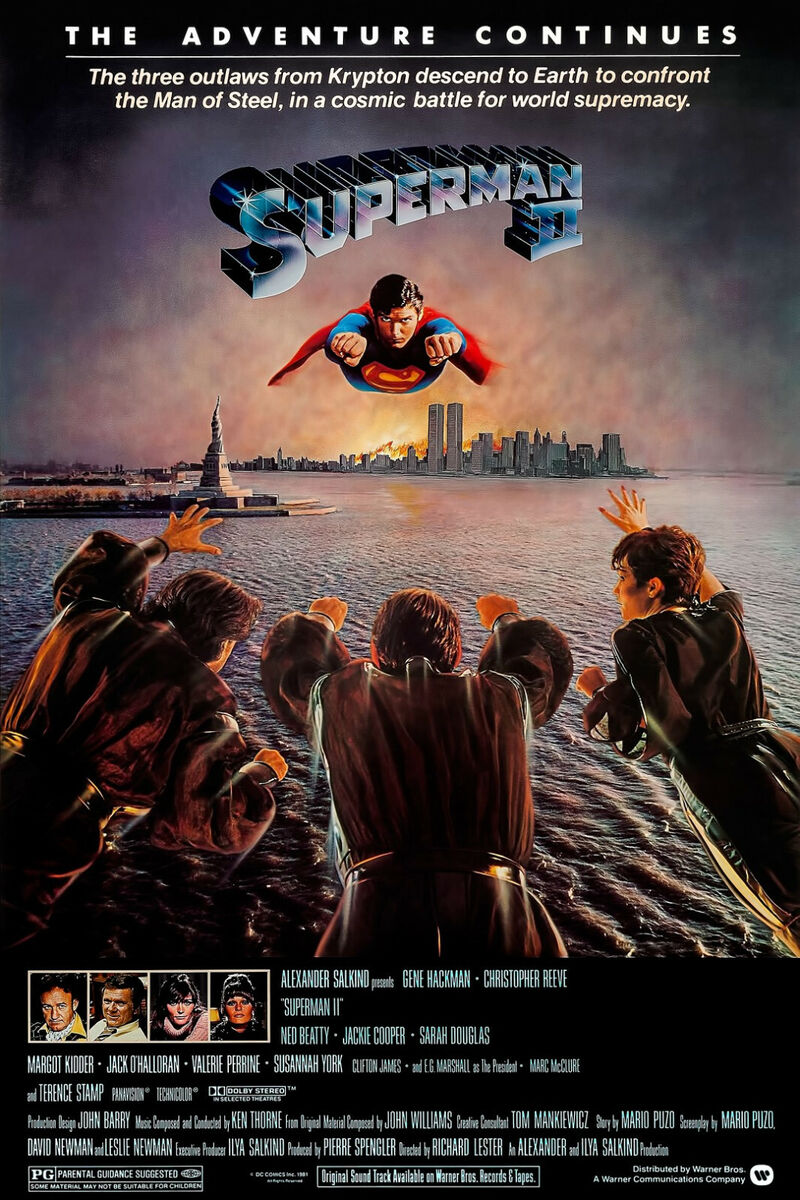
Superman II (1980)

By Richard Winters

My Rating: 8 out of 10

4-Word Review: Superman loses his powers.

Superman (Christopher Reeve) flies to Paris in an attempt to save Lois Lane (Margot Kidder) who was assigned to go there to cover terrorists who’ve taken over the Eiffel Tower and threatening to detonate a hydrogen bomb unless their demands are met. Superman manages to take control of the bomb and lift it into outerspace where it goes off, but unbeknownst to him the explosion also releases Zod (Terrence Stamp), Ursa (Sarah Douglas) and Non (Jack O’Halloran) from their imprisonment inside the phantom zone. The three now fly towards earth planning to take it over with the superpowers they’ve been given from the sunlight. Meanwhile Clark falls in love with Lois and admits to her that he’s Superman. He takes her to the artic to see his Fortress of Solitude and it’s there that he listens to a past recording of his mother Lara (Susannah York) advising him that if he wishes to marry Lois that he will then have to enter a crystal chamber where he’ll then lose his powers, which he does. Now that Zod and his evil associates have taken over the country by invading the White House he becomes powerless to do anything about it as he desperately searches for a way to regain what he gave up.

The production had many behind-the-scenes upheaval including run-ins between director Richard Donner and the producers who insisted that he was going over budget. Initially it was deemed necessary to film both the first segment and the sequel at the same time, but due to money concerns they stopped filming part 2 with 75% of it already completed in order to finish the first part and get it out to theaters. During the pause the producers then fired Donner and replaced him with Richard Lester. Lester was known more for his zany comedies and had a different directorial style than Donner. His approach was to insert campiness into the story and move it away from the dark elements. This caused several scenes to be refilmed some of which without the original cast including Hackman who refused to come back to do reshoots causing a few of his scenes to be dubbed while Brando had sued the producers for his share of the gross profits causing all of his scenes to be taken out completely and replaced mostly with York who ended up speaking the lines that he would’ve and for the most part does a far better job of it.

While the Donner version was released onto DVD in 2006 and is a bit different this review will stick with the one that was shown in the theaters and I felt is quite well done. Unlike with part 1 this one gets right to the action without the stagy back story from the first, which I found boring. The showdown between Superman and the evil three done on the streets of Metropolis as well as the massive destruction that the villains cause the small redneck town of East Houston are very exciting with great special effects that should please anyone. The comedy bits that Lester inserted I didn’t feel went that over-the-top and in some ways were helpful as it released some of the tension as these were some really nasty bad guys, who caused massive destruction, so inserting a campy chuckle here and there I didn’t feel was that out of order.

The script doesn’t have as many plot holes like in the first one. The only major issue to quibble about is when Superman goes into the chamber that sucks away his powers. Why though is it necessary that he should have to give up his powers just because he wants to get married is a whole different discussion that’s worth questioning, but I get that there needed to be a dramatic conflict, so we’ll roll with it. However, it’s never explained how Clark and Lois get themselves out of the artic and back to civilization as they ‘flew’ into the Fortress using his flight powers, but once he was made mortal, they couldn’t rely on that on the way out and without any other mode of transportation I wasn’t sure how they were able to travel and nothing gets shown, but should’ve.

Spoiler Alert!

His long trek back to the Fortress in an attempt to retrieve the powers is equally problematic as he is shown doing it completely on foot, which could take many weeks, or longer to do. He’s also shown wearing nothing more than a light jacket while he does it without any head covering, which now that he’s human, wouldn’t be enough to shield him from the brutal elements and frigid cold and he most likely would’ve died before he got there from either frost bite, or pneumonia. How he’s able to get the powers back aren’t sufficiently explained either. Supposedly it’s because of a green crystal that Lois dropped and is still there when he returns, but if the control module was already destroyed then how would this get it to work again?

End of Spoiler Alert!

The acting is again what really makes it fun. Hackman is once more excellent as Luthor as here he plays it both ways as the ‘middleman’ between Zod and Superman where one minute he’s arrogant and confident and then the next he’s nervous and pleading. It’s a shame though that Perrine and Beatty, his cohorts in crime, aren’t in it as much as I felt the three together had a great chemistry. Gotta love Kidder as a brash Lois who manually squeezes oranges for Vitamin C as she’s become a self-described ‘health nut’ all the while a cigarette dangles from her mouth. Stamp is really good too as the main villain and his intense performance is what keeps the tension going, which again is why the comedy bits aren’t a problem here, though in Part III this does become a major issue, which will be discussed in the next review.

My Rating: 8 out of 10

Released: December 4, 1980

Runtime: 2 Hour 7 Minutes

Rated PG

Directors: Richard Donner, Richard Lester

Studio: Warner Brothers

Available: DVD, Blu-ray, Amazon Video, YouTube

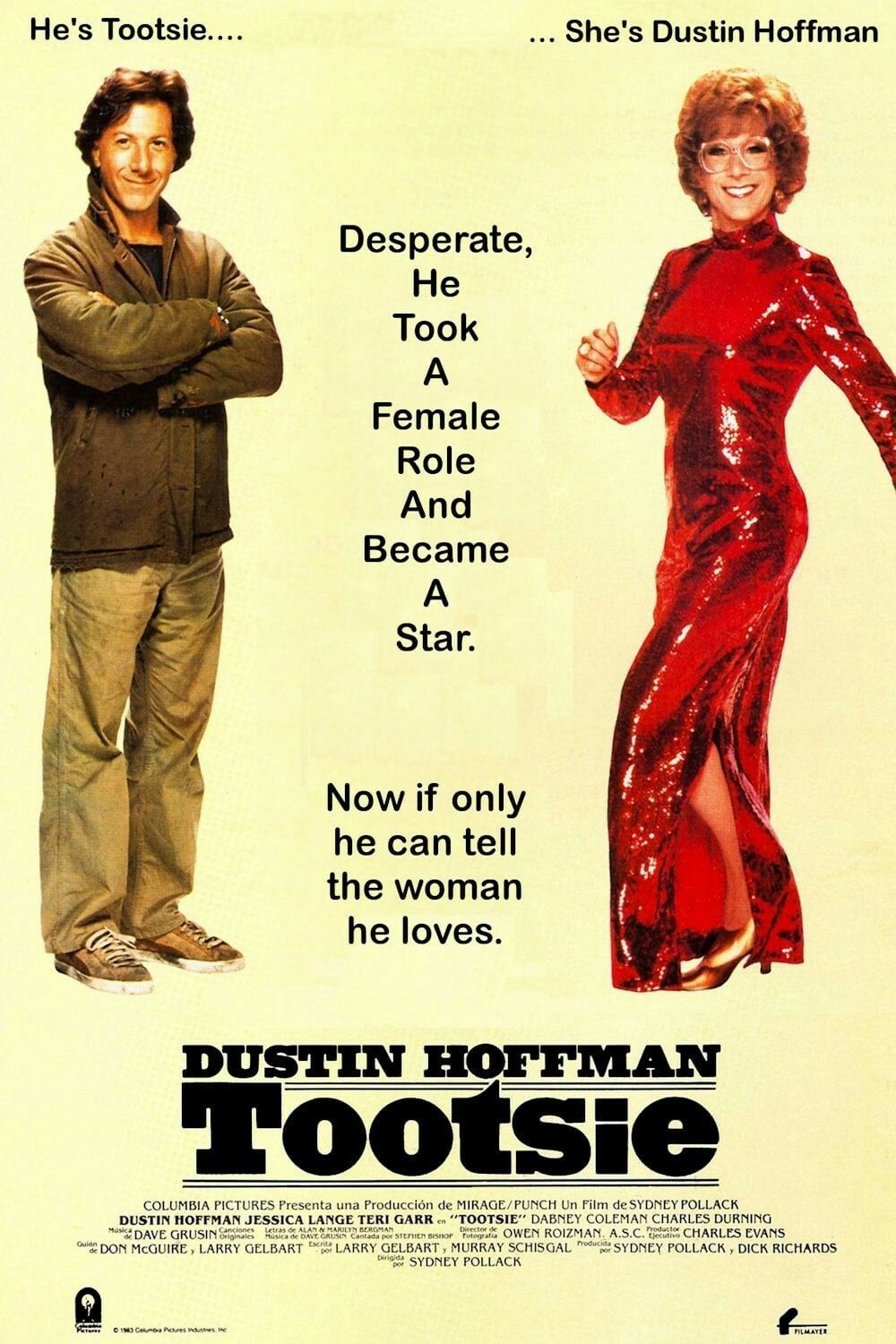
Tootsie (1982)

By Richard Winters

My Rating: 7 out of 10

4-Word Review: Pretending to be female.

Michael (Dustin Hoffman) is a talented actor but having difficulty finding employment due to his demanding nature and inability to get along with directors. His friend Sandy (Teri Garr) is auditioning for a part in a soap opera, and he helps her prepare for the role and even takes her to the audition only to learn that she was rejected before given any chance to do a screentest. It’s at this same time that he learns his agent George (Sydney Pollack) hasn’t gotten him a chance to audition for another role because in his words ‘no one will work with him’. Michael then decides to disguise himself as a woman named Dorothy Michaels in an effort to get the role that Sandy was turned down for so as to raise money to produce a play that will star Sandy. While he does get the part, he also becomes a big star with everyone believing that Dorothy really is a woman, which cause many complications in both his personal and professional life making him feel like he wants to end the charade and go back to his normal identity, but not quite sure how to do it. 

The genesis for the story began all the way back in 1970 and was based on an off-Broadway play by Don McGuire titled ‘Would I Lie to You?’ about an out of work stage actor who dresses as a woman to get a big part. Director Dick Richards adapted the plot into a screenplay, and it got shopped around for many years, but to no avail. Then in 1980 cross-dressing actor Christopher Morley played the role of a woman named Sally Armitage in the soap opera ‘General Hospital’. The part was played straight with the viewers under the impression that it really was a female, and Sally even gained the romantic interest from the character Luke, played by Anthony Geary, only to eventually reveal that she was really a man, which was a ratings hit and thus lead to renewed interest in this script. Eventually Dustin Hoffman got a hold of it and decided he wanted to take it on under the condition that was given full creative control and even hired his own people, Larry Gelbert and Murra Schisgal, to rewrite the story to his liking. 

Personally, my favorite parts of the film come at the beginning where we see Michael’s struggles as an actor as well as all of his thespian friends giving one a glimpse at just how hard the business is and how few people can make an actual living in it. Watching both him and his roommate Jeff, played by Bill Murray, working as waiters, but still talking about their acting ambitions while on that job was on-target. Garr gives a great performance as a struggling would-be actress who is full of insecurities and letdowns and a perfect composite of many young women who find the auditioning process grueling and thankless and for this reason, I felt she should’ve won the Oscar instead of Jessica Lange as her part as the love interest wasn’t as interesting, or honest. 

Murray is terrific as the roommate in an unusual part for him as his over-the-top clownish, snarky, frat boy persona is kept under wraps and instead he plays the part straight, but his sardonic responses to things are great. Director Pollack, who took on the role of Michael’s agent at the request of Hoffman and thus making it his first acting role in almost 20 years, is quite good too particularly with how his exasperated nature feeds off of Hoffman’s hyper one and their conversation inside his office is the movie’s highlight. Charles Durning has a few key moments as well playing Lange’s lovesick father who begins to fall for Dorothy though any man that would give a woman an engagement ring before they’d even been out on a single date has to be a bit loopy.

Hoffman falls into the woman role easily and it would be hard to recognize him had the viewer not known about the disguise beforehand though I felt the way Dorothy walked and moved her hands and arms made her seem like Mrs. Butterworth the animated character from the maple syrup commercials. It’s also hard to imagine he wouldn’t have been found out a lot sooner especially since he collected a weekly paycheck from the company, which would’ve required him to give them his social security number, which in-turn would’ve exposed who he really was. Being on magazine covers where he supposedly does interviews as Dorothy should’ve been equally problematic as the reporters would’ve asked him (her) about her past like what other stuff did she act in, where was she from, and where did she graduate. Stuff that’s very much standard questions in any interview and when he (she) couldn’t come up with anything or made-up stuff that could easily be background checked would’ve then raised red flags and brought the ruse to a very quick halt.

Spoiler Alert!

Soap operas were no longer broadcast as live and hadn’t been since 1963, so that story angle doesn’t fly either. Yes, I realize the idea was that it was taped and only had to done live as an emergency when one of the tapes got destroyed, but in reality, the taping would’ve been done so far ahead (usually by several weeks) that even if a video did somehow get corrupted there still should’ve been plenty of time to refilm it before reaching the actual air date. 

The ending it a bit disappointing as well. Sure, it’s nice seeing Lange putting her arm around him as they walk down the sidewalk showing that the two had made up after his secret identity was exposed, but it doesn’t answer what happened to his career. He did this whole thing to help finance a play for Sandy, so what became of that? Also, were casting agents so impressed with the way he fooled everybody that they now were willing to hire him, or was he still blacklisted? These were all major motivations for why he did the ruse, so there should’ve been clarity to what became of it. 

My Rating: 7 out of 10

Released: December 17, 1982

Runtime: 1 Hour 56 Minutes

Rated PG

Director: Sydney Pollack

Studio: Columbia Pictures

Available: DVD, Blu-ray, Amazon Video, YouTube

Perfect (1985)

perfect3

By Richard Winters

My Rating: 2 out of 10

4-Word Review: Reporter investigates aerobics craze.

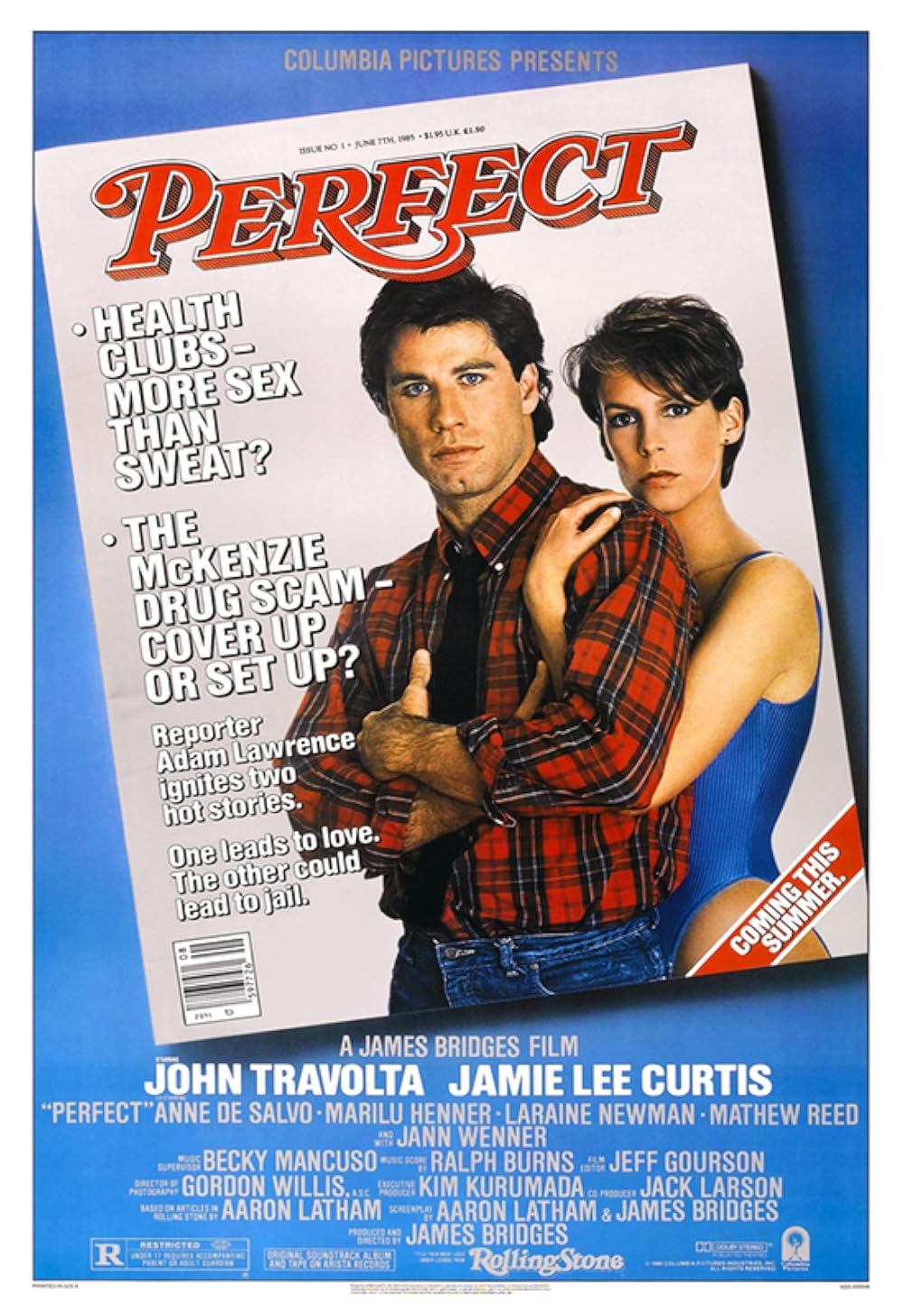
Adam (John Travolta) is a reporter working for Rolling Stone magazine who gets sent on assignment to Los Angeles. While there he becomes intrigued with the health fitness craze and believes the workout clubs are becoming like the singles bars of the 80’s. He asks his editor Mark (Jann Wenner) permission to write a secondary story focusing on this new phenomenon and he agrees. Once he begins attending the club he becomes infatuated with Jessie (Jamie Lee Curtis), one of the instructors. He asks her for an interview, but she refuses based on a past experience she had with another journalist, but Adam continues to pressure her. Eventually the two begin dating only for Jessie’s initial fears to ultimately get exposed when she reads the story he’s written about the club, before it gets sent to the press, and realizes it’s a negative take on the people in it, many of whom are her friends, which leads to a serious strain on their relationship. 

The film is loosely based on the real-life experiences of Aaron Latham who worked as a reporter for Rolling Stone during the late 70’s. He had already written the screenplay for Urban Cowboywhich also starred Travolta and was also directed by James Bridges, so this reteaming was expected to be a huge hit, but instead it lost over $8 million at the box office despite initially doing well on its opening weekend. A lot of the problem is that journalists aren’t considered likable people and most of the American public by and large despise them. The fact that this one behaves exactly the way you’d expect, being more than willing to exploit their subject, particularly with the way he treats the Marilu Henner and Laraine Newman characters, in order to get a juicy spin on a story, just makes him all the more despicable. 

His character is quite blah as well. We never learn why he wanted to get into journalism and if some backstory had been given, and not just starting out with him working in the obituary section and trying to move his way up, then he might’ve had more depth. It’s confusing too why such a good-looking, jet-setting guy, wouldn’t have a girlfriend. Maybe if he’d been through a rough break-up and thus wanted to avoid it that might’ve been understandable but should’ve been explained. Even just having some casual dates would’ve made sense but having him just all alone with no reason only adds to make the character even more transparent. 

Curtis as an actress is excellent and the movie is worth sitting through solely because of her and she’s looking really hot here too. However, her character’s responses to things seemed a bit off. She makes it quite clear upfront that she’s not interested in an interview, but Adam doesn’t take no for answer and proceeds to continue to hound her, which should make her hate him even more, but for some reason it doesn’t. Yes, he does help get her car started when her battery dies, so as a thank you she might’ve been willing to do a simple interview, but instead her repayment is to go to bed with him while still refusing to do any interview, even though I felt realistically it should’ve worked the other way. 

The concept itself isn’t intriguing. I lived through the 80’s and really didn’t care why people got into the aerobics thing. Revealing that some of those that did was because they were lonely and looking to meet someone to hook-up, isn’t exactly groundbreaking. The entire supporting cast is incredibly dull including Jann Wenner, the original co-found of Rolling Stone magazine, who essentially plays himself as Adam’s boss, but his performance is lackluster, and a professional actor should’ve been given the role. 

Spoiler Alert!

My biggest gripe came at the end where Curtis keeps going back to Travolta even as he does all the things that irritates her about reporters like secretly recording their conversations while in a car. That alone should’ve gotten her to dump him, which she does for a while, but then she returns. One forgiveness is okay, everybody deserves a second chance, but then he does it again with the negative story. Granted having the article revealing that she had an affair with her coach years ago wasn’t his fault as his editors put that into the story later on, but she had no way of knowing that. From her perspective he betrayed her trust and therefore the relationship should’ve been permanently over. She didn’t care for reporters right from the beginning and all he did was affirm her confirmation bias. It would’ve been more believable had she instead liked journalists and maybe wanted to be one herself and therefore kept given him the benefit of the doubt, but the way it gets done her makes little sense. 

My Rating: 2 out of 10

Released: June 7, 1985

Runtime: 2 Hours

Rated R

Director: James Bridges

Studio: Columbia Pictures

Available: DVD, Amazon Video, YouTube

One From the Heart (1982)

oneheart

By Richard Winters

My Rating: 2 out of 10

4-Word Review: Break-up/make-up

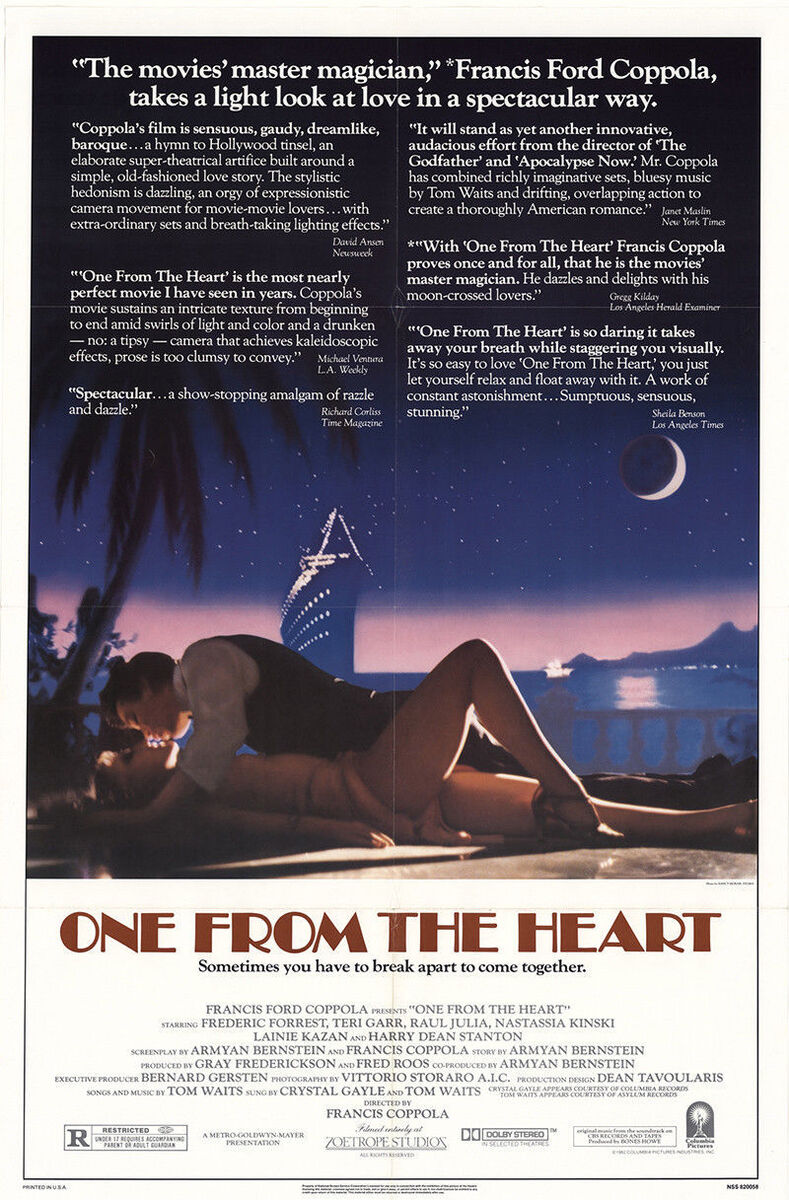
Hank (Frederic Forrest) and Frannie (Teri Garr) have been together for 5-years but while celebrating their anniversary at home the cracks in their relationship begin to show. Frannie is upset that they can never go out and wants more adventure. Hank doesn’t see this as a problem, so the two break up. Frannie meets Ray (Raul Julia) a waiter who has ambitions to become a singer. Hank gets together with Leila (Nastassja Kinski) who is much younger than him and lives the fast lifestyle. Each spends a night with their new partner, but end-up longing for their former mates when it’s over. Ray offers to take Frannie to Bora Bora, but will she really board the plane, or will Hank catch-up with her in time and convince her to move back with him?

The movie has a weird look about it and this is mainly because director Francis Ford Coppola decided he wanted to film the entire thing on the soundstage of his Zoetrope studios. This in retrospect seemed absurd as the setting was Las Vegas with one of the most flamboyant downtowns of any city, so if the real thing is already visually arresting why trump it with a fake one that isn’t half as exciting? The artificial presence kills the movie from the very start and what’s worse is that it was so painstakingly expensive to create the set design, which is massive, that it sent Coppola and his studio into bankruptcy of which it took many years to recover and all of it wouldn’t have been necessary if they had just shot it on-location, which would’ve been a thousand times better.

The lighting is one of the more annoying aspects particularly the red light that shines through the couple’s home window making it look like they live in the red-light district of Denmark, or near a police station. The outdoor scenes look as phony as you’d expect including having the night sky shown to have a ‘ceiling’ and the distant mountain vistas appearing as nothing more than a cheap matted on paintings. Everything comes-off as loopy like a great director whose ego got the best of him, and he made a massive artistic overreach for no other purpose then just to see if he could. The music interludes by Crystal Gayle and Tom Waits don’t work either. If a movie is intended to be a musical, as this one kind of is, then each song needs to sound distinct and at least moderately peppy, but here it comes-off like the same droning song that just never ends and adds little to the already goofy set-up.

The characters are poorly fleshed-out and, with the modest exception of Harry Dean Stanton and Elia Kazan, wholly uninteresting. The break-up is the biggest problem as the ‘squabble’ appears to be over nothing more than the fact that Hank didn’t take Frannie out on their anniversary, but to move-out because of something like that seems awfully trite. Normally for relationships/marriages to go really bad there needs to be a lot of anger simmering underneath the surface and this thing at best is just a tiff especially when at the beginning they seemed content with other. To make it realistic there should’ve been clear underlining animosity right away and not go from ‘happy couple’ to break-up with a snap-of-the-finger.

Not sure either if it’s exactly possible to get back together after the other partner has slept with someone else. Granted there could be some exceptions, but most people would consider it an extreme betrayal and unforgivable and certainly not something that they could just conveniently forget about and return back to the ‘happy couple’ that they were. Yes, in this instance they both cheated, but that makes things even worse. Who’s to say you can ever trust the other again? If one tiny disagreement can get each one to suddenly jump in the arms of a perfect stranger what’s to say that won’t get repeated in the future?

Garr, who appears topless in several scenes and even fully naked from the back in one moment, is okay. The supporting cast is also good especially Allen Garfield as Julia’s perturbed boss. I even found Kinski a bit mesmerizing with her singing and the way she was able to balance herself on a big orange ball that used to be the sign for the Spirit of 76 gas stations, but overall the thing is so thinly plotted, with too much emphasis being put on the garish set design, that it can all be summed up as a hopeless experiment gone wrong. Even Coppola has admitted in subsequent interviews that it’s a ‘total mess’, so if the director is warning you that his own movie doesn’t have much going for it, you’d better listen.

My Rating: 2 out of 10

Released: February 11, 1982

Runtime: 1 Hour 39 Minutes

Rated R

Director: Francis Ford Coppola

Studio: Columbia Pictures

Available: DVD, Blu-ray, Amazon Video, YouTube

Animal Behavior (1989)

animal

By Richard Winters

My Rating: 4 out of 10

4-Word Review: Cellist falls for biologist.

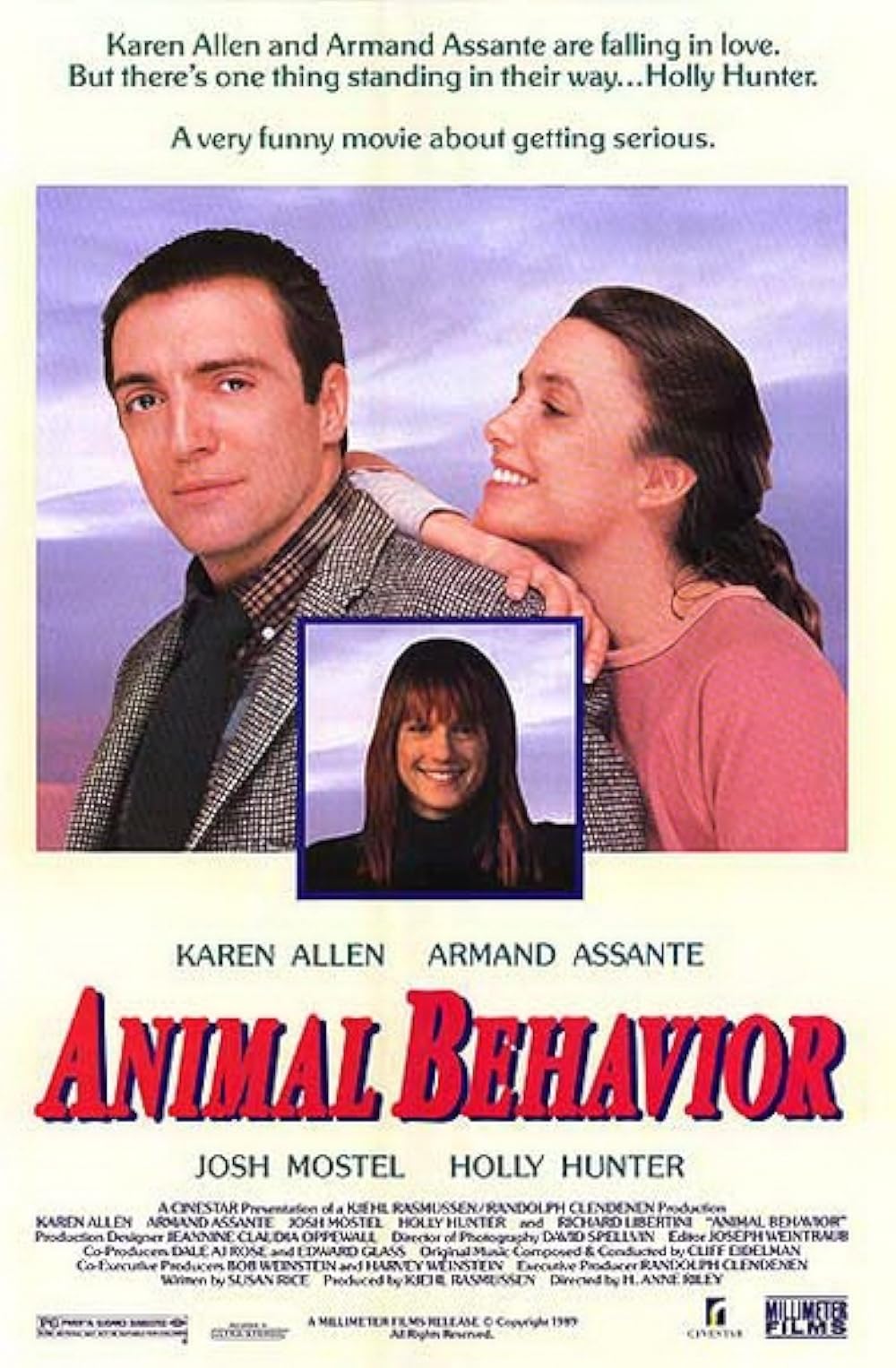
Alex (Karen Allen) is a biologist employed at a university where she is researching on finding new ways to communicate with chimpanzees including the use of sign language but finding it challenging in getting any funding. Mark (Armand Assante) works at the same school as an orchestra instructor. He meets Alex by chance and while their first encounter is awkward, he immediately takes an interest in her and tries to pursue a relationship. Alex is so involved in her work that she doesn’t pick-up on Mark’s advances initially and then when she does, she comes under the mistaken impression that he’s married which causes her to avoid him and making Mark believe that she doesn’t like him when deep down she really does.

The film, which has never been released on either DVD or streaming and can only be obtained from a very rare VHS print, is more known for its behind-the-scenes troubles than anything that goes on in front of the camera. The main issue was the squabbling, or ‘creative differences’ between director Jenny Brown and the producer Kjehl Rasmussen causing her to leave the project, which began filming in 1984. The production then ran out of money forcing it to be shelved for many years in an unfinished state before Rasmussen was able to receive enough funding to complete it with him as the director. However, out of its initial $3.5 million budget it was only able, after its limited release, to recoup a paltry $41, 526 at the box office making it a huge financial loss. It also came-out 4 years after one of its stars, Alexa Kenin who plays a not very talented cello student, died mysteriously at the young age of 23 for causes that are still unknown to this day.

Despite all of its production problems I came away finding it not too bad and enjoyed the orchestral score and the giant animated musical notes that appear during the opening credits as well as the vast New Mexico landscape. Assante is an interesting casting choice as he plays the romantic lead not in a lovesick way but approaches it instead in more as a matter-of-fact type, which you’d expect a person working in Academia might do. I did though find his ability to handle chimps as relaxed and comfortable was a bit of a missed opportunity as having him afraid of them, which is what I think most people would be like, would’ve given their young relationship more of a challenge to work through and thus more intrigue to the story.

His inability to every criticize Sheila, played by Kenin, who is a very poor cello player, made him in-turn come-off as a failure of a teacher. Granted the film wanted the viewer to like the Assante character and if his criticism of her playing was too harsh it might make them turn-on him, but the guy is her teacher and not her friend. A friend is someone that doesn’t want to hurt the other person’s feelings, but a teacher is paid to get to the source of the problem. If he is just going to allow this student to leave in a delusion that she’s a competent then when is she ever going to get better, or be motivated to improve? A good teacher is obligated to call a student’s attention to their shortcomings and by avoiding doing this he comes-off as weak and ineffective.

While Allen’s performance is also good, I had some problems with why Assante would want to get into a relationship with her. It’s clear from the get-go that she’s so into her chimps that she’s out of touch with everything else around her. Why pursue someone romantically who’s always going to put her monkeys first and make him have to constantly compete with them for her attention?

A far better love interest would’ve been Coral that gets played by Holly Hunter who is an absolute scene-stealer and gives the movie some much needed spunk. This was before she won the Academy Award, so her role is limited, but she still makes the most of it playing a single mother with an autistic child, played by Crystal Buda. She is a neighbor to Assante and the two get into a quasi-style relationship though they don’t have any sex, but I didn’t know why she didn’t want to pursue further past the friendship level as they seemed quite compatible and it would’ve allowed in more drama forcing both her and Allen to compete for the same man, which could’ve lead to some juicy confrontations.

Josh Mostel, as Assante’s friend, is fun, not so much for anything he says, but more for his big white-guy afro. The climactic sequence, which takes place in a large scale maze made out of hay bails is diverting simply because it’s never been used before, or since. However, the characterizations of the University faculty, who are portrayed as being stiff, uptight, while also a bit ‘wacky’ is too broad to be either amusing or insightful.

My Rating: 4 out of 10

Released: October 27, 1989

Runtime: 1 Hour 28 Minutes

Rated PG

Director: Jenny Brown

Studio: CineStar Productions

Available: VHS, DVD-R (dvdlady.com)

Same Time, Next Year (1978)

sametime

By Richard Winters

My Rating: 6 out of 10

4-Word Review: Affair lasts 26 years.

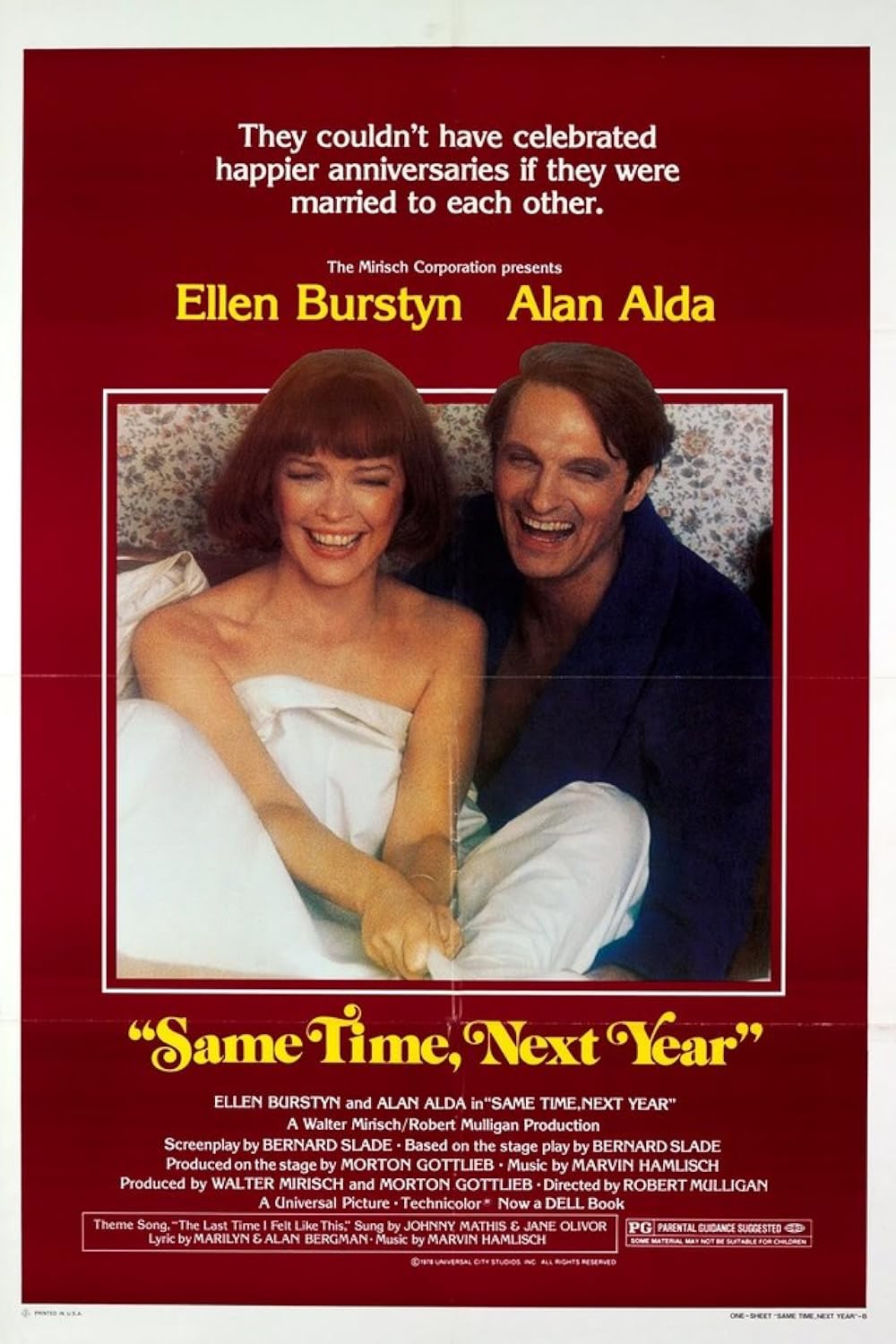
George (Alan Alda) meets Doris while staying at an inn in California in 1951. Both George and Doris are married with kids, but that doesn’t stop them from having a tryst while they’re there since neither of their spouses are with them. They decide to continue to meet each year at the same time and inside the same oceanside cabin. This reoccurring rendezvous lasts all the way up to 1977 and they go through many changes both in their personal lives and personalities, but remain in-love with the other despite never divorcing from their spouses.

While there’s a definite Neil Simon quality to the dialogue and situational comedy it was actually written by Bernard Slade who at that time was best known for creating the sitcoms ‘The Flying Nun’ and ‘The Partridge Family’. Originally it opened as a play on March 14, 1975 and starred Ellen Burstyn and Charles Grodin and ran for 1,453 performances. Slade also wrote the screenplay to which he was nominated for an Oscar.

While the interiors were filmed on a soundstage the outer portion of the cottage was built specifically for the film and when shooting was completed it was decided to move this foundation to a location in Little River, California with the interiors fitted with the furnishings that had been used on the soundstage during filming and then allowing couples to rent it out. This became so popular that the cabin was split into two with one called ‘Same Time’ and the other ‘Next Year’ and can still be rented out for a romantic getaway to this very day.

While the film stays faithful to the stage version I felt there should’ve been added context revolving around how they meet. We see them first making contact as they enter the inn to check-in and then they have dinner at separate tables before Alda invites himself over to eat at Burstyn’s, but we never hear their dialogue and instead get treated to sappy music, which could’ve easily been chucked and not missed. It also fails to answer one of the plot’s more crucial questions: why would a married woman with kids be traveling the countryside all by herself? For Alda it could make some sense as it was socially acceptable for a man to be traveling single for business reasons, but woman at that time were pretty much stuck in the home doing the majority of the child rearing, so what would her reason be for being out on the road all alone? Maybe she was visiting relatives, but you’d think if that were the case they’d let her stay at their place, or she’d bring her kids along, but either way there needed to be an explanation and there isn’t any.

The fact that they’re able to continue to do this for literally two and a half decades without the spouses finding out for the most part begs a lot of questions. What excuses were they giving their families, so that they could continue to keep meeting at the exact same time of year? Having an angry spouse secretly follow them and then unexpectedly show-up could’ve added some extra spice and if this situation had occurred in real-life most likely that would’ve ultimately happened.

While this may sound like nit-picking I had issues with the cabin setting too. Don’t get me wrong it’s scenic and I loved the outdoor moments where you get a great view of the shore and pine trees, but the interior of the place should’ve changed, or been updated with the times instead of the furniture and the placement of it looking virtually the same for 26 years. Make-up work could’ve been done on Ivan Bonar who plays the Inn’s owner and while the two stars age in interesting ways he remains ancient looking right from the start and never changes.

On the plus side I found both Burstyn and Alda to be fabulous and I enjoyed their comic, and sometimes dramatic, interplay even though their transitions in personalities proves a bit problematic. Normally as people age their attitudes and perspectives can shift, but it’s more linear and not herky-jerky like here. For instance during the 60’s Burstyn gets into the flower child movement only to, by the 70’s, become a business owner and a part of the establishment. Alda too goes from hardcore conservative during the 60’s, even admitting to voting for Barry Goldwater, to necklace wearing lib by the 70’s, which seemed like these characters were just conforming to the trends and attitudes of the day like caricatures instead of real people.

Spoiler Alert!

All of the quibbles listed above I could’ve forgiven, but the ending I found annoying. I actually liked the idea that George’s wife dies and he meets someone else and she won’t allow him to keep seeing Burstyn, so he then puts pressure on Burstyn to divorce her husband and marry him, which she refuses, so he then walks-out. This I found to be very realistic as most affairs don’t last this long anyways, so the memories and good times they had would be treat in itself and should be left at that. For Alda then to walk back-in and say it had all been a lie and they could continue to get together ‘forever’ was too far-fetched for a concept that had been pushing the plausibility to begin with. Everything needs to end at some point as even ‘perfect marriages’ will stop when one partner dies. The audience saw the first meeting, so they should’ve been treated to the last one too. Even if it meant having them elderly and entering with their walkers it should’ve been shown and the story given, one way or another, a finality of some sort.

My Rating: 6 out of 10

Released: November 22, 1978

Runtime: 1 Hour 59 Minutes

Rated PG

Director: Robert Mulligan

Studio: Universal

Available: DVD-R

If You Could See What I Hear (1982)

ifyou

By Richard Winters

My Rating: 2 out of 10

4-Word Review: Blind man finds love.

Tom (Marc Singer) is a young man attending college who also happens to be blind due to being a premature baby and put into an incubator that had too much oxygen. He meets up with Sly (R.H. Thompson) and the two become fast friends and eventual roommates. Both go on the prowl for women with Tom having the better luck as he soon gets into a relationship with a black woman named Heather (Shari Belafonte) though when he proposes marriage she bails. He then has flings with many other women that he meets at a bar where he works at, but when he meets Patti (Sarah Torgov) he begins to fall in-love despite their differences as she’s a staunch catholic while he’s an atheist.

The story is based on the early life of Tom Sullivan who became a famous songwriter and singer during the 70’s, he even sang the National Anthem at Superbowl X, as well as gust starring in several popular TV-shows of that era though today probably not that many people would know who he is. Marc Singer, best known for having starred in The Beastmaster as well as the 80’s TV-miniseries ‘V’, is also a casualty of that period and not real well known outside of those who lived through the decade. Why Singer was even cast I’m not sure as Sullivan clearly had acting experience and I would’ve thought he could’ve played himself and it might’ve been a better movie had he done it.

Story-wise it comes-off as comical vignettes spliced together and hardly seems believable, or at the very least highly exaggerated. Sullivan is given too much of a bigger-than-life vibe as where ever he goes everyone immediately gravitates to him and he becomes the life-of-the-party.  When he does seem to get into trouble he’s able to easily get out of it in circumstances that others wouldn’t. For instance he gets stopped by the police for driving a car without a license or vision, something that would get anyone else a ticket, fine, and arrest especially when his car does end up causing damage, but here the cops just shake their heads in a bemusement and walk away. He also jumps off a boat in the middle of a deep lake without a life jacket and unable to spot the life line that gets thrown to him and yet miraculously he gets out of this pickle just fine too. He’s even able to play golf against opponents with vision and beat them at their own game even catching them when they try to cheat. It’s like the guy can never lose.

The romantic/sex angle gets handled in an equally glossy way. He has a Fonzi-like quality with hot women clinging to him like he’s a magnet. Bimbo blondes and other babes prance in an out of his rented bedroom on an almost nightly basis to the point I was stunned when one of them refuses to go up to his room. This is only because she was ‘catholic’, but then after awhile she ends up doing it with him anyways with the brief delay being caused by her ‘morality’. It’s like his handicap is never a factor and in some ways almost an asset.  Some may argue this is a good thing as it shows a blind person can still live a normal life, but I don’t think there’s anything ‘normal’ here as even a good-looking sighted man isn’t able to score as frequently and consistently as this guy.

Spoiler Alert!

I have nothing against cute. Sometimes a cutesy moment or two in a movie is a good thing and can help bring in a lighthearted mood, but when it gets done constantly throughout it becomes like eating an entire carton of ice cream, which may be good for awhile, but will eventually make you puke. Even when it does finally get serious, which doesn’t occur until 90-minutes in, when he tries to save a young girl whose fallen into a backyard pool, it gets botched. Supposedly this is based on Sullivan’s true-life incident where he saved his own daughter from drowning, but I have a strong feeling the logistics were changed from the real one as here we see the girl floating lifelessly for several minutes making it look like her lungs were filled with water and beyond saving.

Of course there will always be those that may like it. There’s one commenter on IMDb who states she used to watch this over and over back in 1983 when it was on HBO and really loved it though if she went back to it now she might I suspect see it in a more critical way. Siskel and Ebert, who could never agree on anything, both voted it the worst movie of 1982.

My Rating: 2 out of 10

Released: April 23, 1982

Runtime: 1 Hour 43 Minutes

Rated PG

Director: Eric Till

Studio: Citadel Films

Available: DVD-R (dvdlady.com)

The American Success Company (1979)

americansuccess

By Richard Winters

My Rating: 7 out of 10

4-Word Review: Taking on different personality.

Harry (Jeff Bridges) is a highly passive man that gets routinely dominated by both his boss (Ned Beatty) and wife (Belinda Bauer), who also happens to be his boss’ daughter. Determined to change his ways he decides to emulate the personality of a local tough-guy, who always seems to get his way and most importantly get the women. He works with a local prostitute (Bianca Jagger) to improve his bedroom skills and then finally ‘introduces’ himself to both his wife and boss. Surprisingly the ‘new Harry’ works to perfection as his domineering father-in-law learns to back-off and no longer humiliates him. His wife too likes the change, but he plays the part so well she refuses to believe it’s the same person. When he tries to go back to his old self she rejects him wanting only to be with the tough guy who she insists must be a totally different person and she can only be happy if she’s with him and no one else.

Back in 1978 while filming Winter Killswhich also starred Bridges and Bauer, the funding for the project, which was through AVCO Embassy Pictures, was pulled leaving the shooting of the film only half completed. Director William Richert then decided to do this film in-between, using much of the same cast, in order to bring in the extra money he needed to complete the other one. The script was written in 1974 by Larry Cohen who intended it to be a vehicle of Peter Sellers, but at the time Sellers was in a career lull having starred in a lot of box office duds, so investors didn’t want to take a chance on it and Cohen was eventually forced to sell the script, which remained in turn-over until Richert finally decided to take it on. While the film failed to turn a profit and was barely released, Cohen often stated that the changes Richert did to the script helped ‘ruin’ it, he was still able to make enough through the selling of the distribution rights to resume the shooting of Winter Kills and get it completed.

On the whole there’s enough directorial touches to keep it engaging and Richert, who has a small role as one of the employees of the firm whose constant leering grin is great, clearly knows how to make it entertaining enough despite the story’s absurdities. The setting though of Munich, this was apparently one of the stipulations he had to agree to in order to get it made, is off-putting especially when the plot revolves around corporate America and is a satire on the American mindset. The heavy use of a white color makes the office interiors seem almost like a hospital and Ned Beatty, who was only 41 at the time, but with his hair dyed a tacky white color to come-off as an overbearing elderly man in his 70’s, doesn’t work at all. Since John Huston was also in Winter Kills and they were using the same cast from that one to do this one then he should’ve been cast in the part especially since he was really old and better at playing dominating characters.

Bridges is fun as he plays against his good-guy image. Some critics have considered him a bland actor whose characters are at times ‘too good to be true’, so having him turn around and be overly passive and downright wimpy who jumps in terror at his neighbor lady’s pet poodle is definitely amusing. However, the transition to the brazen alter ego is too quick and seamless. If he’s truly timid at heart then that trait should trickle through even when he’s pretending to be someone else, which doesn’t happen here, but should’ve. No explanation about how he gets this big colorful tattoo on his chest, which he wears while being the tough guy, nor how he’s able to remove so quickly when he goes back to being himself.

The biggest plus is Bauer, who started her career in Australia where she studied ballet and competed in beauty contests before coming to the US. Here she becomes the sole reason to watch the film as she’s not only gorgeous, but displays a delightful way of morphing from a spoiled rich girl persona, to demanding wife, and then back to submissive woman. Her accent helps enhance her character and plays off of Bridges well. The only issue is if she couldn’t stand her husband why did she marry him in the first place? This is a highly attractive women born into money, so there was no need to settle, so what was it about his original personality that she liked in order to get hitched? If she craved a more domineering man then why not go after that type of guy in the first place? The film fails to explain this crucial point and thus ultimately makes it shallow and empty-headed.

My Rating: 7 out of 10

Released: September 28, 1979 (Test Screening)

Runtime: 1 Hour 31 Minutes

Rated PG

Director: William Richert

Studio: Columbia Pictures

Available: DVD, Amazon Video