Category Archives: Prison Flicks

The Valachi Papers (1972)

the valachi papers 1

By Richard Winters

My Rating: 7 out of 10

4-Word Review: Testifying against the mob.

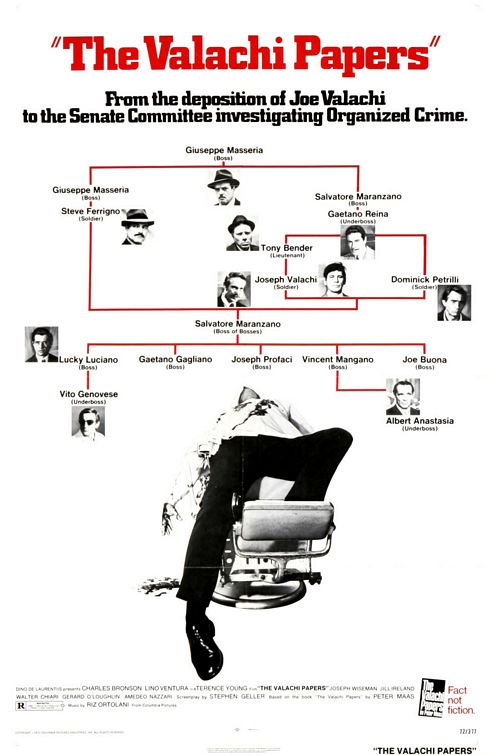
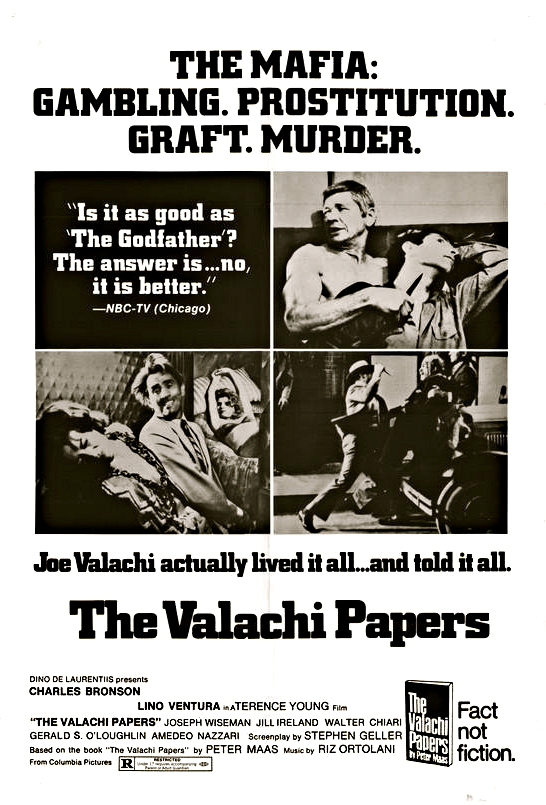
Based on the bestselling novel by Peter Maas this film chronicles the life of Joseph Valachi (Charles Bronson) who became the very first informant for the Mafia in their history. The story chronicles his life from a young man getting involved in the mafia culture to his eventual imprisonment and testifying in front of congress.

At the time of release this was compared closely to The Godfather with some critics outrageously saying it was better, but clearly it doesn’t come close. This film lacks the in-depth characterizations, lyrical quality, and an overall slick design. This film is also rather sloppily produced including one scene involving an exciting car chase taking place in the 1930’s. When the two cars go crashing through the wall of a warehouse and into the East river one can clearly see the Twin Towers of the World Trade Center, which weren’t built until 1970. There is also the Lucky Luciano character played by actor Angelo Infanti who wears a type of glasses that did not come into style until well into the 1970’s. However, as a whole the film is still amazingly compelling flick that ends up being both entertaining and somewhat informative. The music score has a terrific ominous tone to it and the prison scenes have a nice starkness.

The film was known at the time for its violence, which by today’s standards may not seem quite as startling or as excessive although the blood and bullets do come at regular intervals. My favorite was the shooting of an old crime boss inside a barbershop although the castration of a victim on top of a table inside a restaurant is pretty wild. However, for all of its violence the film does manage to have a sense of humor as well including a very amusing scene where one of Joe’s mob bosses sits in the living room of the mother of Joe’s girlfriend and asks the mother for her permission to allow Joe to marry her daughter while Joe sits nervously behind and tries to look proper.

Lino Ventura has the perfect face of a mob boss and was ideally cast. The scene of him inside the prison where he has stays in a well-furnished cell and even seems to have his own barber is funny. Joseph Wiseman displays great zest as the opposing crime boss Salvatore Maranzano and his agonizing yells of pain as he lies dying are effective.

Bronson seems perfectly cast as an uneducated simple man who is a follower and has his own quiky code of morality, which makes him strangely endearing. His wife Jill Ireland does not fare as well. She ports a brunette wig and her Italian accent borders on being horrendous to non-existent. Fortunately she is not given very many speaking lines as her British accent is constantly seeping through.

In many ways this film could best be described as an ugly cousin to Goodfellas. While this film lacks that film’s fluid directorial flair it still manages to be an engrossing true-life gangster soap opera like that one.
the valachi papers 2

My Rating: 7 out of 10

Runtime: 2Hours 5Minutes

Released: November 3, 1972

Rated R

Director: Terence Young

Studio: Columbia Pictures

Available: VHS, DVD
Breakout (1975)

breakout

By Richard Winters

My Rating: 7 out of 10

4-Word Review: Escape from Mexican jail.

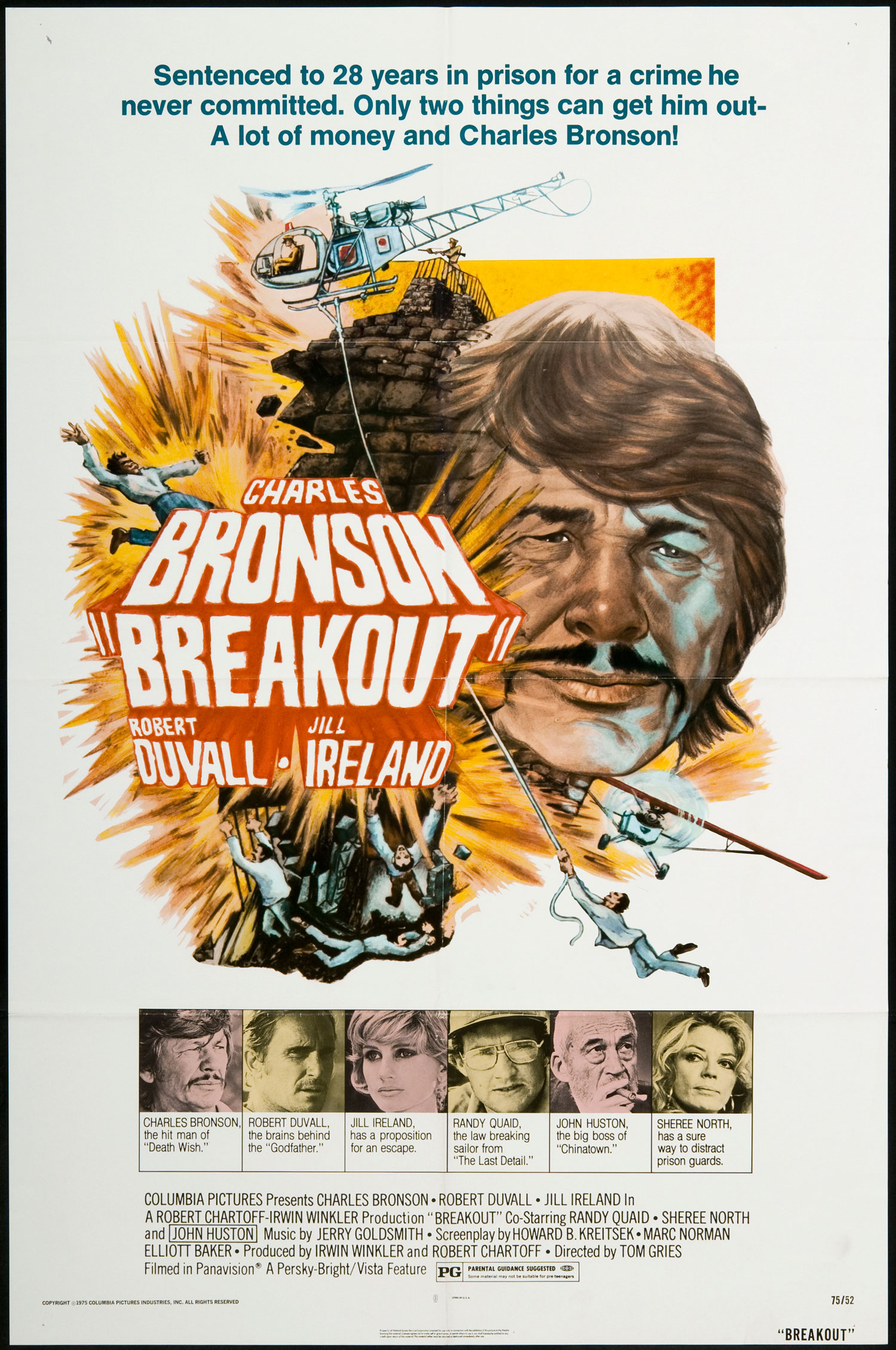
Loosely based on the actual 1971 incident involving Joel David Kaplan, who after being framed for murder and stuck inside a Mexican prison for 9 years, was able to escape when his sister hired a pilot to fly a helicopter into the prison yard and allow Kaplan to jump into it and flee. In this movie Jay Wagner (Robert Duvall) is the Kaplan character and Nick Colton (Charles Bronson) is the goofy, but lovable pilot.

Veteran director Tom Gries delivers a compact action pic that has a good mix of humor and excitement. The comedy is not forced and genuinely engaging, but once the action gets going it is entertaining as well. When the helicopter starts flying into the prison with 30 minutes left in the movie I found myself completely riveted. Gries photographs the action in a way that makes the viewer feel like they are inside the helicopter alongside Bronson. The stunts are authentic and done on-location, which is a big plus. One scene involving a man getting sliced up by an airplane propeller is surprisingly explicit and should make anyone wince when they see it.

My only quibble in the direction department is the opening where a man is shown being shot to death while Gries freezes the frame every few seconds as the victim falls down, which came off as being disjointed and distracting. There is also a shot of the dead body lying on the ground with blood stains on his white shirt. However, there are no bullet holes in his shirt and you really can’t have blood coming out of someone’s body unless you have bullet holes and if you have them piercing the skin you most likely would have them piercing the shirt, but none were found in the shot I saw.

Bronson is highly engaging and steals every scene that he is in. I was surprised how comfortable he was in a comedic role and it made me wish he had taken more stabs at comedy in his career. My favorite moment with him is his nervous, anxiety-ridden expression on his face when he tries to pilot a helicopter and finds that it is much more complicated than he realized. The running gag of him trying to pass off a bad check is also good.

Jill Ireland who plays the wife of the Duvall character and is the one who hires Nick for the job is also enjoyable. She is almost as amusing as Bronson especially with the way she becomes increasingly exasperated by the situation. The two seem to work better when they are adversarial and you could never tell that in real life they were husband and wife.

Sheree North is also great in a small supporting role. Although she was already in her 40’s when she did the part she still looks sexy in a full body shot of her in some really, really short shorts. Her very politically incorrect rape conversation that she has with Nick is good.

Duvall is wasted in a part that doesn’t allow for much range and limited screen time. I’m actually surprised that he even took the part. However, his hair style, and I’m not sure if it was a wig, or just a really good comb-over, but it completely covers up his normally bald head and makes him look twenty years younger.

Randy Quaid seems equally underused, but having the chance at seeing him in drag may make his appearance here worth it to some.

I didn’t like the part where Duvall gets buried alive while inside a coffin in his attempt to escape as it is too reminiscent of a classic Alfred Hitchcock episode entitled ‘Final Escape’, which is better and shouldn’t be touched. However, as a whole, this is a good 95 minutes of enjoyable non-think entertainment.

My Rating: 7 out of 10

Released: May 22, 1975

Runtime: 1Hour 35Minutes

Rated PG

Director: Tom Gries

Studio: Columbia Pictures

Available: DVD, Amazon Instant Video

Yesterday, Today and Tomorrow (1963)

By Richard Winters

My Rating: 8 out of 10

4-Word Review: Gotta love Sophia Loren.

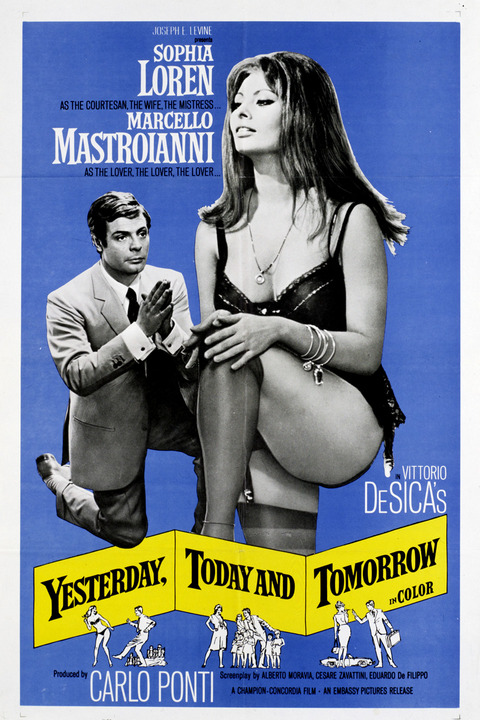
This is a delightful comedy that won the Academy Award in 1964 for best foreign film. It consists of 3 vignettes all starring Sophia Loren and Marcello Mastroianni and directed by the legendary Vittorio De Sica.

The first segment is entitled ‘Adelina’ and is a story about Adelina (Loren) who lives in poverty and sells cigarettes for a living. She is arrested for selling contraband products, but is released when it is found that she is expecting with the condition that six months after she delivers the baby she will be forced to serve her sentence. However, Adelina and her husband Carmine (Mastroianni) decide that the best way to avoid the sentence altogether is by keeping her continuously pregnant. Once she delivers one child she immediately gets pregnant with another, which creates overcrowding as well as an exhausted Carmine.

This segment is original and amusing throughout. Watching them trying to handle and maintain a household with such a large brood has its share of funny moments including one scene where Adelina tries to give one of her petulant children his medication. This setting vividly shows the poor side of Italian society, but unlike De Sica’s neo-realist films of the 40’s this one has a very engaging and even upbeat quality to it. The impoverished townsfolk become like a third character and their resiliency and support of one another proves to be a major plus to the story. Loren is fantastic in every scene she is in and makes this one special. Mastroianni is interesting playing against type as he is usually debonair and sophisticated, but here is simple and dominated.

The second story entitled ‘Anna’ deals with characters on the completely opposite end of the economic spectrum. Anna (Loren) is a spoiled rich woman who in an effort to alleviate her boredom with her husband who spends too much time working she has an affair with Renzo (Mastroianni). Renzo though fears that he is being used and that Anna has no intention of ever leaving her luxurious lifestyle to be with him.

All of the action takes place in a Rolls-Royce Silver Cloud III convertible as the two characters discuss their relationship while driving through the streets of Rome. This story is not as lively as the first and the characters aren’t as likable. However, the part where Renzo has an accident with the car and Anna’s reaction to it is quite funny.

The third and final act is entitled ‘Mara’ and deals with a prostitute named Mara (Loren) who becomes interested in Umberto (Gianni Ridolfi) a young man living next door with his Grandmother (Tina Pica) and studying to become a priest. The grandmother does not approve of Mara’s ‘profession’ and openly shuns her causing a major discord between the two, but when Umberto decide to drop out of the seminary the two work together to try and bring him back to his senses.

This story, like the first, has many amusing moments. Loren shows impeccable comic ability. I loved how the character goes from sexy seductress to a woman pleading with Umberto to go back to seminary and escape this ‘wicked world’. The shift between having Mara and the grandmother hating each other to becoming friends is equally funny. Mastroianni doesn’t have as much to do here, but still makes the most of it playing one of Mara’s customers who is just looking for a little sex, but is reluctantly thrown into the middle of the controversy.

This segment became famous at the time for a striptease that Loren does for Mastroianni. However, by today’s standards it is not much and hardly even seemed worth mentioning. I actually thought the part where Loren walks outside wearing nothing more than a towel and provocatively singing a flirtatious song to the young Umberto, who has a face that looks like it had not reached puberty, was much steamier.

My Rating: 8 out of 10

Released: December 19, 1963

Runtime: 1Hour 58Minutes

Rated NR (Not Rated)

Director: Vittorio De Sica

Studio: Embassy Pictures

Available: DVD, Blu-ray, Netflix streaming, Amazon Instant Video

Zig Zag (1970)

By Richard Winters

My Rating: 5 out of 10

4-Word Review: Framing yourself isn’t good.

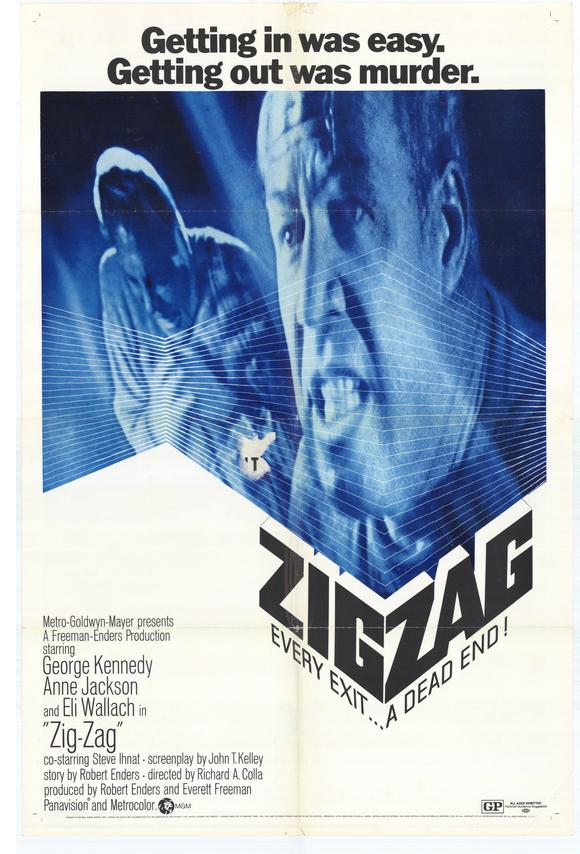
            Paul Cameron (George Kennedy) is an insurance agent and family man who learns that he is dying from a brain tumor and has only a few months to live. In order to provide money for his wife and children he sets himself up as the kidnapper of a wealthy businessman in an unsolved case that offered a $225,000 reward for anyone leading to the conviction of the culprit. After he is found guilty at his trial he faints and the doctors there decide to do experimental laser surgery to remove the tumor. The operation proves to be a success forcing Paul to go on a battle to prove his innocence, or risk spending the rest of his life in jail for a crime he did not commit.

Although he has done well in supporting roles Kennedy proves to be quite weak as a leading man as he shows almost no emotion in any of his scenes. When he is told of his tumor he takes it in a very matter-of-fact way without getting upset at all, which seemed unrealistic. His performance is dull and the few times that he does get upset it comes off as forced. His presence hurts the film and a more engaging, eccentric actor could’ve made it more interesting.

Eli Wallach as Paul’s attorney is terrific and the one thing that injects some energy. He is dynamic throughout and is fun to watch even during the slow parts. It was nice to see him doing a scene with his real-life wife Anne Jackson. As of this writing the two have now been married for 64 years, which has to be one of the longest marriages in Hollywood history.

The supporting cast features a long list of familiar character actors making it like spot-the-star. They include: Dana Elcar, Douglas Henderson, Steve Ihnat, William Marshall, Joan Tompkins, Robert Sampson, Leonard Stone, and Walter Brooke in an interesting duplicitous part.

Richard A. Colla’s direction is impressive. The film opens with a diverting cinema verite-style scene showing Paul going through the examination process before entering the prison, which seems unusually elaborate touch for what is otherwise just a gimmicky script. Another innovative part is when Paul is shown planting evidence at the scene of the crime and only the sounds and ambiance of the locale is heard without any music, which is more effective.  Unfortunately the direction and story become much more conventional towards the middle and it is not as interesting. The film tries to be too many things and does not come together as a seamless whole. The courtroom scenes were too extended for my tastes as we know Paul is innocent, but wants to be convicted anyways, so his many prolonged conversations with his exasperated lawyer who does not know of his scheme seem rather pointless. However, when Paul is cured and then goes on a mission to find the real killer it becomes exciting as the mystery itself proves to be complex and intriguing.

The twist ending did not go over well with audiences at the time of the film’s initial release. It’s a downer for sure, but after seeing so many tacky happy Hollywood endings in my lifetime I can’t say I totally hated it. As a budding screenwriter I enjoy irony and the ending here certainly has that. It’s slickly handled and although I saw it coming others may be genuinely surprised by it. My only complaint is that it’s a bit abrupt and could’ve and should’ve been extended in some way, or given a more effective closure.

If you like a movie with a lot of twists then this film may be worth seeking out. The legendary Roy Orbison sings the title tune during a party scene and it sounds like some of his best stuff. I am surprised it didn’t chart and I wished they had allowed the viewer to hear the complete son before cutting away.

My Rating: 5 out of 10

Released: September 11, 1970

Runtime: 1Hour 45Minutes

Rated PG

Director: Richard A. Colla

Studio: MGM

Available: VHS (as False Witness), DVD (Warner Archive) 

Skidoo (1968)

By Richard Winters

My Rating: 5 out of 10

4-Word Review: They were on LSD.

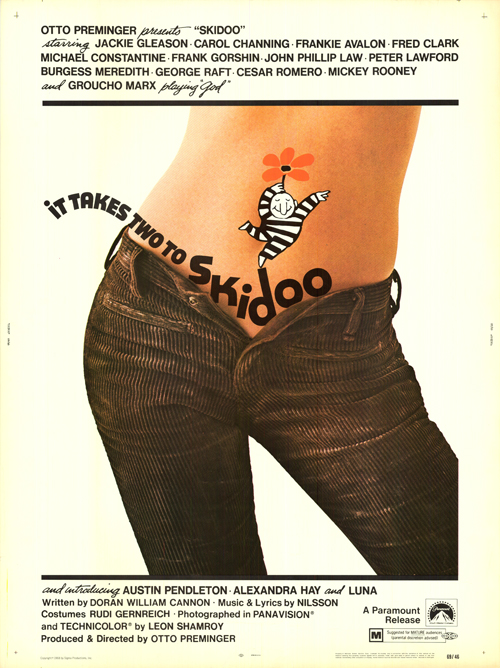
Jackie Gleason plays family man Tony Banks with mob past who is now trying to go straight yet gets sucked back in by a gangster leader named God (Groucho Marx). He orders Tony to disguise himself as a prisoner so he can infiltrate a prison system and knock off another prisoner and rival named George ‘Blue Chips’ Packard (Mickey Rooney). While in prison Tony mistakenly takes some LSD and goes on a wild drug induced trip.

Story wise it is limp. The humor is weird, but not altogether funny. It tries to satirize a lot of things yet none of it comes together. There is no singular voice or vision let alone cohesion. The pacing is poor and haphazard. It becomes so sloppy and nonsensical that you almost wonder if renowned director Otto Preminger was the one taking the LSD stuff.

The idea of mixing old school comedy with the mod hipness of the day was not new. Many films (and TV shows) of that period tried it with limited success. Yet few went to the extremes as this one. It is still a complete disaster yet odd enough to grab your attention and hold it. In some ways it’s enjoyable and even entertaining if viewed as an oddity and relic of its era.

There are a few good scenes. One involves a weird hippie speech by actor John Phillip Law where he professes a need to be ‘nothing’ which will somehow make him ‘everything’ and ‘anything’. There are also some quirky commercial spoofs at the beginning, a brief glimpse of Packard’s prison cell ‘office’, and the ‘the family tree’ of a crime syndicate. Gleason’s LSD trip really isn’t that funny, but it is still weird enough to stand out.

A lot of talented character actors are wasted with boring bit parts. Gleason though still comes through as his bombastic self. Unfortunately the same cannot be said for Groucho. He looks old and well past his prime. He mouths his lines with little or no energy. His conversation with actress Alexandra Hay seems particularly strange as he ‘talks to her’ but never once actually looks at her. Instead he looks off into another direction in a not so subtle attempt to read his cue cards. He does this in other scenes too. Some may still get a kick out of his presence because at the end he dresses as a hippie and even takes a puff of the weed. You also gotta love his mistress and her very low cut dress.

Austin Pendleton gives the best all- around performance playing the first in what has become a long line of nebbish, bookworm type characters. Carol Channing is a real surprise. She sings and even gives each one of the hippies a shampoo in her kitchen sink. There is also a freaky scene where she does a striptease and then lies half naked on Frankie Avalon’s bed. Her presence also gives Gleason a chance to write her a little love letter where states that how he misses her “even that voice of yours”.

Harry Nilsson’s music in Midnight Cowboy was perfect, but all wrong here. However hearing him sing EACH AND EVERYONE of the credits at the end is a goofy delight.

My Rating: 5 out of 10

Released: December 19, 1968

Runtime: 1Hour 37Minutes

Rated M

Director: Otto Preminger

Studio: Paramount

Available: DVD 

Family Business (1989)

family1

By Richard Winters

My Rating: 4 out of 10

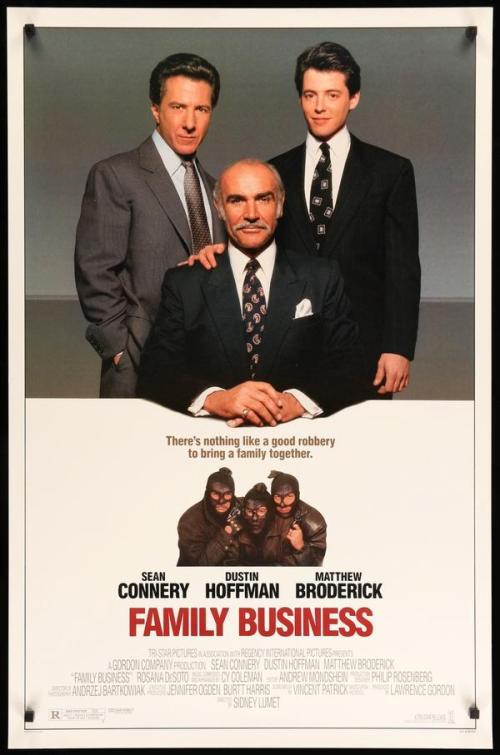
Any movie that casts Dustin Hoffman, Sean Connery, and Mathew Broderick as a father, son, and grandson team of robbers has me hooked before I have even seen the first frame. It was a great bit of inspired casting even if Connery was playing Hoffman’s father and in reality was only seven years older than him.  Throw in the fact that it was directed by the late, great Sidney Lumet and you should have a sure fire winner.

The story involves the grandfather Jessie (Connery) getting out of jail and trying to rekindle relations with both his son Vito (Hoffman) and grandson Adam (Broderick).  Vito wants nothing to do with his father as he has done time himself by getting mixed-up in some of his father’s old schemes and is now trying to go straight by working as a manager at a meat packing facility. However, Adam, who is going to college and has a promising career ahead of him, idolizes his grandfather and relishes the idea of pulling off a robbery himself. He has even come up with one that all three of them can do together. The robbery is unique in that they aren’t stealing from a bank, jewelry store, home of someone rich, or even a priceless artifact at a museum, but instead some important research materials at a science lab.

The crime itself is not elaborate and could have been easily pulled off with just one person. I was anticipating something a little more daring and exciting especially since Jessie and Vito were career criminals. It also takes too long to get to it. The first fifty minutes are spent with them endlessly arguing and rehashing the same old points.

The second part is a little more interesting as it deals with Adam getting caught while the other two are able to get away and all the dilemmas that they then face. Even here the drama becomes strained and talky.  The ending fizzles and leaves no emotional impact.  I saw a lot of similarities with this film and Sidney Lumet’s last film that he did before he died, which was Before the Devil Knows You’re Dead.  Both of these movies deal with robberies and the consequences of family members betraying one another and yet that film was far more gripping while this one falls flat.

I thought Connery was highly engaging and would have enjoyed seeing him take over the movie. Hoffman gives a solid dramatic performance, but his character is bland.

The Adam character got on my nerves. He had been given everything in life and yet refuses to appreciate it and seems almost ungrateful to his father for working so hard to give him a better life. He acts cocky about going through with the robbery and yet when they get there he is ill-prepared and confused. I understand sometimes people become curious about those that live a different lifestyle than they do and that they don’t fully understand, but I still felt there needed to be a little more balance.  I just didn’t understand why this kid would want to throw it all away just so he could be like his career criminal grandfather.

The film gives one a good taste of New York. I liked how it showed the different neighborhoods and boroughs. Not only do we get a good feel of the Bronx, but we also see Flushing, Brooklyn, and downtown Manhattan. Most films that take place in the Big Apple seem to concentrate in only one section of it while this one tried to give a broader feel.

The indoor sets are nicely realized. Everything from the trashed halls of the prison to Vito’s modernistic, sleek apartment, to the science lab and even Jessie’s small, cramped apartment looked authentic and distinct.

I did notice a few logistical errors. One is the fact that they discuss plans of the robbery in a lot of public places, which seemed just plain careless to me especially since these were ‘professional’ thieves. One discussion takes place at a bar, another on a busy sidewalk with pedestrians going by, and the third at a funeral with mourners standing right behind them. There is also the fact that they park their car on the side of the road in front of the lab and put a sign in the windshield stating that they are out of gas and will be back in one hour. I thought this seemed dumb because a policeman could come by and do a check on the license plate to find out who the owner is. Then, the next day when the robbery is reported, they would only have to put the two together to trace the culprits. There is also a scene were Vito fires one of his employees at his plant for stealing. He punches him violently in his office that is surrounded by windows and is in full view of the other workers.  The man leaves with a broken nose and bloodied face, but the workers do not react and go on with their tasks like nothing happened, which didn’t strike me as believable.

The music score is another problem.  It has a big band, show-tune type melody and sound, which might have worked for a Broadway production, but here it seems completely out-of-sync with the mood and tone of the story.

Although competently done this thing still seems like a misfire namely because the material isn’t diverting, or interesting enough for the cast that it has. I was expecting a little more razzle-dazzle and a lot more action and excitement. I almost felt that if this same story had been approached in a comic vein it might have done better.

My Rating: 4 out of 10

Released: December 15, 1989

Runtime: 1Hour 50Minutes

Rated R

Director: Sidney Lumet

Studio: TriStar Pictures

Available: VHS, DVD, Amazon Instant Video

The Mackintosh Man (1973)

mack

By Richard Winters

My Rating: 6 out of 10

4-Word Review: Infiltrating a spy ring.

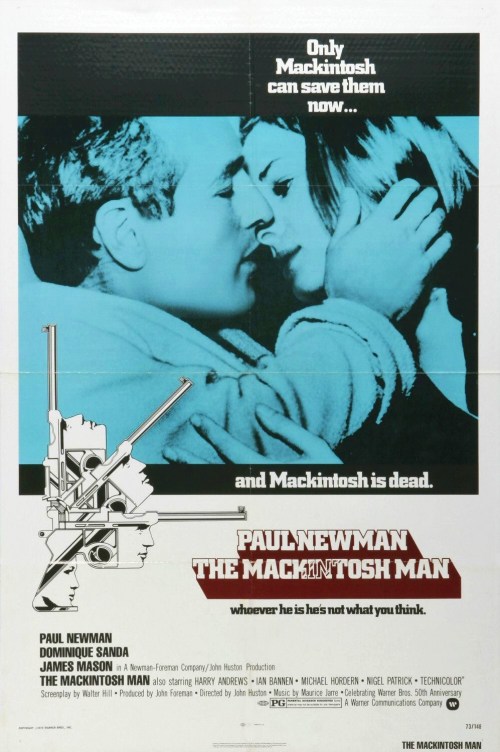
Joseph Reardon (Paul Newman) is a spy that is recruited by the British Intelligence to infiltrate a secret spy ring in order to expose a traitor from inside a high ranking government office. In order to do so he must assume the identity of an Australian criminal and allow himself to be caught and imprisoned. From there he is able to escape using the help of an inside organization that arranges the escapes for high profile prisoners. He is taken to an isolated mansion at an unknown location and trained to be a part of the criminal spy ring, but he unwittingly gives out his true identity, which forces him to make a daring escape and go on the run in the middle of nowhere.

As much as I like Paul Newman I felt he seemed out of place here and really didn’t completely fit the role. For one thing he is an American, but it is never explained why a foreigner is chosen for the operation instead of a British spy. There is also the fact that his alias is that he is from Sydney, Australia, but his Aussie accent does not sound convincing and tends to go in and out.

There is also the issue of him allowing himself to be put into prison. Normally a viewer has to relate to the protagonists circumstances in order to be wrapped up into their plight, but intentionally getting thrown in the slammer seems a bit hard to fathom. This was the maximum security type of jail with extremely small cells and prisoners asking him if he would ‘like to dance’. I realize this was part of the spy operation and spies are expected to take risks, but this seemed too reckless to me. What is going to guarantee that he is ever going to get out? This is after all a top secret organization, so how is he going to be able to hold them accountable if he gets stuck there. To me it is like asking someone to jump off a cliff and telling them there is a safety net to catch them even though they can’t see one.

The script, by the prolific Walter Hill, does have a few exciting scenes although it takes a while to get going. The best ones come when he is stuck at the isolated manor. I enjoyed how he singlehandedly overpowers them and is able to escape while setting the place on fire in the process. The shot showing the mansion on fire from a distance with the black cloud of flames rising into the grey sky had an artsy flair to it and the movie’s best moment.

I thought the barren landscape that he runs through, that doesn’t even have any trees, was cool. It reminded me a lot of the classic TV-series ‘The Prisoner’. This part also includes a viscous guard dog running after him, which is reminiscent of another memorable Newman role from the film Cool Hand Luke.  Here though he is able to exact his revenge on the mutt when he submerges it under water and drowns it, which might prove upsetting to animal lovers as looks realistic and the hound appears to struggle.

The car chase is excellent and nicely captured. Most chases seem to take place on city streets in the majority of films, so it was nice to see one done on curving, gravel roads in the countryside with Reardon stuck in nothing more than a rusty, rickety old pick-up. I loved how the camera shows in a longshot the car going over a cliff and falling several feet before landing with a loud thud. No intrusive computer effects here, nor flashy explosions. Everything was authentic with no cuts, which ends up making a much stronger impact.

A shout out must also go to James Mason as the villainous Sir George Wheeler. This guy is so effective at playing bad guys, and he does it with such ease, that it is almost scary. His ability to go from refined and dignified to vindictive is what makes him so good.

What hurts the film is a wretched music score that sounds like Russian dance music that has no place in a thriller. It is loud and blaring and does not build the mood, or tension in any way. It gets so bad that it almost ends up ruining the whole movie. The climatic sequence is a letdown as well. It features no action and it ends abruptly with a whimper.

It was a great idea to pair Newman with legendary director John Huston, but this product is not one of their best efforts for either individual. It is entertaining enough to be passable, but culminates in being just your average spy thriller.

Neman and Mason would team up nine years later to play adversaries again in the film The Verdict, which will be reviewed tomorrorow.

My Rating: 6 out of 10

Released: July 25, 1973

Runtime: 1Hour 38Minutes

Rated PG

Director: John Huston

Studio: Warner Brothers

Available: VHS, DVD (The Paul Newman Collection), Amazon Instant Video

The Longest Yard (1974)

longest1

By Richard Winters

My Rating: 8 out of 10

4-Word Review: Prisoners play football game.

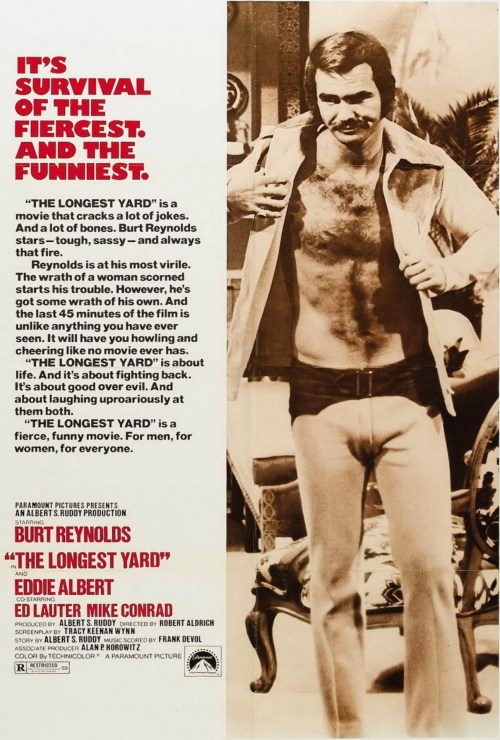
            Burt Reynolds is Paul Crewe a down-on-his-luck former professional football player who was kicked out of the league due to a point shaving scandal. After going on a long car chase with police he is thrown into the Georgia State Penitentiary where the crooked warden (Eddie Albert) tries to get him to coach the prison football team. Initially he refuses, but after some ‘convincing’ he eventually agrees to play in one game that will feature the guards versus the inmates. The prisoners use this contest as a way to get back at the guards and their brutal treatment of them while the guards approach it as a way to instill their authority.

Some consider this one of the best sports movies of all-time and I would have to agree it is up there. One of the things I liked about the movie is the way it taps into the emotional aspect of not only playing the sport, but watching it. There can be deep seated psychological reasons for why a spectator, or fan, roots for one team over the other.  The prisoners that cheer on their team use the game, as fleeting as it may be, as a sort of equalization and revenge factor to the guard’s authority and corruption. Watching the scenes showing the prisoners cheering their team as they score a touchdown is almost as emotionally charging as the action itself.  Director Robert Aldrich does a great job of using the prison setting and the game as a microcosm of 70’s society and the conflict between the counter-culture and the establishment as well as the haves and have-nots.

The game is nicely choreographed.  The hits look real and the plays are shot in a bird’s eye view just like watching an actual game on TV. The action is easy to follow and it is evident that the filmmakers have a good understanding and appreciation for the sport.  Outside of the final play that is done in slow motion there is none of the fluky, theatrical stuff thrown in that you usually see in most other films of this type. I found myself getting emotionally tied into the action even though I had seen the film many times before.

The only misgiving I had was the segment where the Richard Kiel character slams an opposing player to the ground and announces “I think I broke his fucking neck.” Of course this has become one of the film’s most popular lines and is made funnier when other players and even the game announcer repeats it several more times, but when the injured player is unable to come-to even after being given smelling salts and is carted off motionless from the field it starts to seem cruel to be laughing.

Another scene that I found surprising and had almost as much impact as the climatic contest is at the very beginning when Paul is shown arguing with his girlfriend Melissa (played by Anitra Ford one of the original models on ‘The Price is Right’ game show). She calls him a whore, which has to be the first and only time in film history that a woman has called a man that, but what is even more amazing is when he violently slaps her and knocks her to the floor.  I don’t think I can remember another time where a protagonist male character has done that to a female and yet the audience is still expected to sympathize with the male, which is interesting. The ensuing car chase is one of the better ones you’ll see and the part where he drives the car into a lake while the song ‘Saturday Night Special’ by Lynyrd Skynyrd is playing on the car’s radio and gets muffled as it goes under the water is cool.

Burt is perfect for the role. I love the glib way he delivers his lines and his laid back persona. The fact that he is an anti-hero with obvious personal flaws makes him even more fun. He seems right at home in the southern setting and filming it at an actual state prison gives the film a nice gritty subtext.

The supporting cast is unique. John Steadman as Pop, one of the prison’s oldest members, is memorable and he is the only other actor with a nose big enough to rival that of Karl Malden’s. It is nice to see Richard Kiel, one of the tallest actors you will ever see, with a speaking role.  The part where he starts to cry when he gets hit in the nose is funny.  Charles Tyner is perfectly creepy as Unger and Michael Conrad is compelling in his role as Nate Scarboro. This is also a great chance to see Bernadette Peters in an early career role as the warden’s ditzy and amorous secretary Miss Toot. She wears one of the worst looking beehive hairdos you’ll ever see although there probably isn’t a beehive hairdo that looks good anyways. Former football player Joe Kapp is good as one of the evil guards.

My Rating: 8 out of 10

Released: August 30, 1974

Runtime: 1Hour 1Minute

Rated R: (Adult Theme, Language, Violence)

Director: Robert Aldrich

Studio: Paramount

Available: VHS, DVD, Amazon Instant Video, Netflix Streaming

Straight Time (1978)

straight

By Richard Winters

My Rating: 8 out of 10

4-Word Review: Parolee can’t go straight.

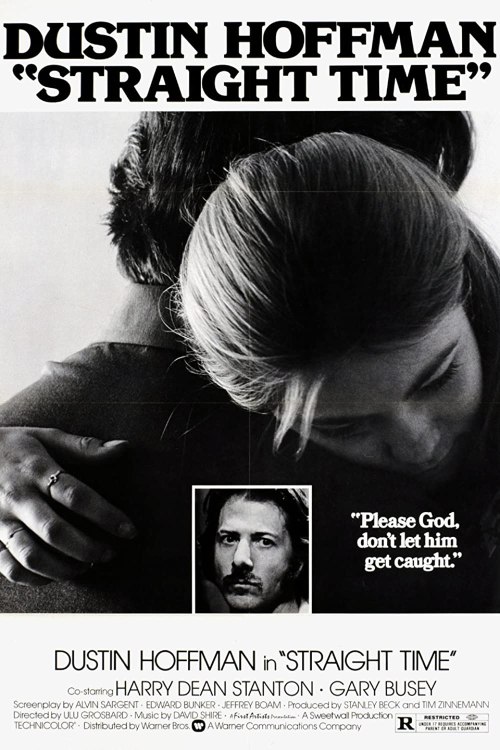
Straight Time is an engrossing, highly realistic drama detailing a parolee by the name of Max Dembo (Dustin Hoffman) who gets released from prison and cannot seem to stay away from the allure of crime despite his initial efforts. The movie is based on the novel ‘No Beast So Fierce’ by Edward Bunker.  Bunker himself was a career criminal who was in and out of jail from 1955 to 1975 and only managed to finally turn his life around when this novel, which he had written while incarcerated and deals with many of his own exploits, got published. Bunker co-wrote the screenplay and appears in a bit part playing a character with a really bad comb-over by the name of Mickey.

I found this film gripping from the second it started and infinitely fascinating the more it progressed. It gives you a whole new perspective on things as you are forced to see it from the viewpoint of the criminal and as an outsider looking in. Every facet of the story and characters is believable and the film does a very good job of being stark and searing without ever getting exploitive, or overtly shocking.  I remember back in 1977 when I toured the new county jail in the town where I grew up when it was first opened and before it housed any inmates. I remember the officer describing the rather degrading procedures all felons had to go through when they were first booked including being stripped searched and forced to take a shower nude while a fully clothed officer stood by and watched them.  The scene where Max and other criminals are ‘welcomed’ to the L.A. County jail worked exactly like that. It was so authentic and frank that it seemed almost like a documentary.

The essence of the story revolves around Max and his relationship with his parole officer Earl Frank that is wonderfully played by noted character actor M. Emmet Walsh. Earl does his job a little too well. He shows a constant distrust of Max and gives him no respect while overzealously tracking his every move until it finally forces Max to snap. It is a terrific indictment on the flawed system as it examines just how hard it is for the criminal to go straight and stay straight even if they want to. It also exposes how it seems almost designed to push the person back into crime in its refusal to ever treat the criminal as a human being. The part where Max finally has enough and overpowers Earl and chains him naked to a fence in broad daylight on a busy L.A. freeway while hundreds of cars drive by him should leave an indelible image on the minds of anyone who sees it.

The remaining supporting cast is great as well. Theresa Russell is surprisingly effective as Max’s girlfriend Jenny Mercer. Usually she has played more glamorous types of roles, but here she is perfect as a very ordinary woman who inadvertently gets caught up in Max’s eventual self-destruction until she finds herself in over her head.  I liked the fact that she wore no makeup and the camera was able to pick up her natural beauty through regular lighting. The only issue I had with her character is that it is never made clear why she would fall in love with Max so quickly and what it was about him that she liked since he shows some clear destructive tendencies right from the beginning. To me it just came off as a bit forced and phony to have an otherwise well-adjusted woman that he meets at an employment agency get so infatuated with him after just one date that she immediately agrees to move in with him, visit him in jail, and even quit her job on the spot and go on the run. I know it is standard practice in a Hollywood film for the anti-hero to always have ‘his girl’ that can be used to humanize and compliment him, but there still needs to be more of an explanation and history shown to her character in order to validate the relationship.

Harry Dean Stanton gives another great performance as Jerry Schue. He was a long-time partner to Max during the robberies he did before landing in prison. Jerry has now turned his life around. He has a nice house in the suburbs, an honest job, and a beautiful wife. However, when Max comes to visit, and the minute his wife leaves the room, Jerry begs him for a crime job that they can do together because he finds his new found life to be boring.  I thought this made a great statement as to how the sterile suburban existence is not the American dream for everyone and how it will not necessarily ‘domesticate’ those that still harbor a reckless urge.  I also found it interesting how Jerry views the art of robbery as an actual profession that he takes a great deal of pride and care in. When one of the men shows up late for a planned robbery Jerry calls him ‘unprofessional’.

The robbery scenes are filmed in a diverting way. In most films the camera gets real close to the action in order to heighten the tension. Here the action is captured from a long shot that allows the viewer to see just how chaotic and frantic a robbery really is as well as showing how the most nervous people in the place are the thieves themselves.

If I have one complaint with the film it is in the fact that the second hour becomes rather difficult to watch as it focuses solely on the self-destructive downward spiral of the main character. Max has some good qualities, which makes it all the more painful to watch. Yes, some of his anger is justified, but his insistence at ‘evening the score’ with everyone who has wronged him ends up only hurting himself. Hoffman is outstanding as usual. It is interesting to compare his role here playing a very violent character with the pacifist one that he played just seven years earlier in Sam Peckinpah’s classic Straw Dogs.

If you are looking for an intelligent, searing drama that is still relevant today then this no-holds-bar character study is highly recommended.

My Rating: 8 out of 10

Released: March 18, 1978

Runtime: 1Hour 54Minutes

Rated R

Director: Ulu Grosbard

Studio: Warner Brothers

Available: VHS, DVD, Amazon Instant Video