Category Archives: Movies with a train setting

The Boss’ Wife (1986)

By Richard Winters

My Rating: 3 out of 10

4-Word Review: She comes on strong.

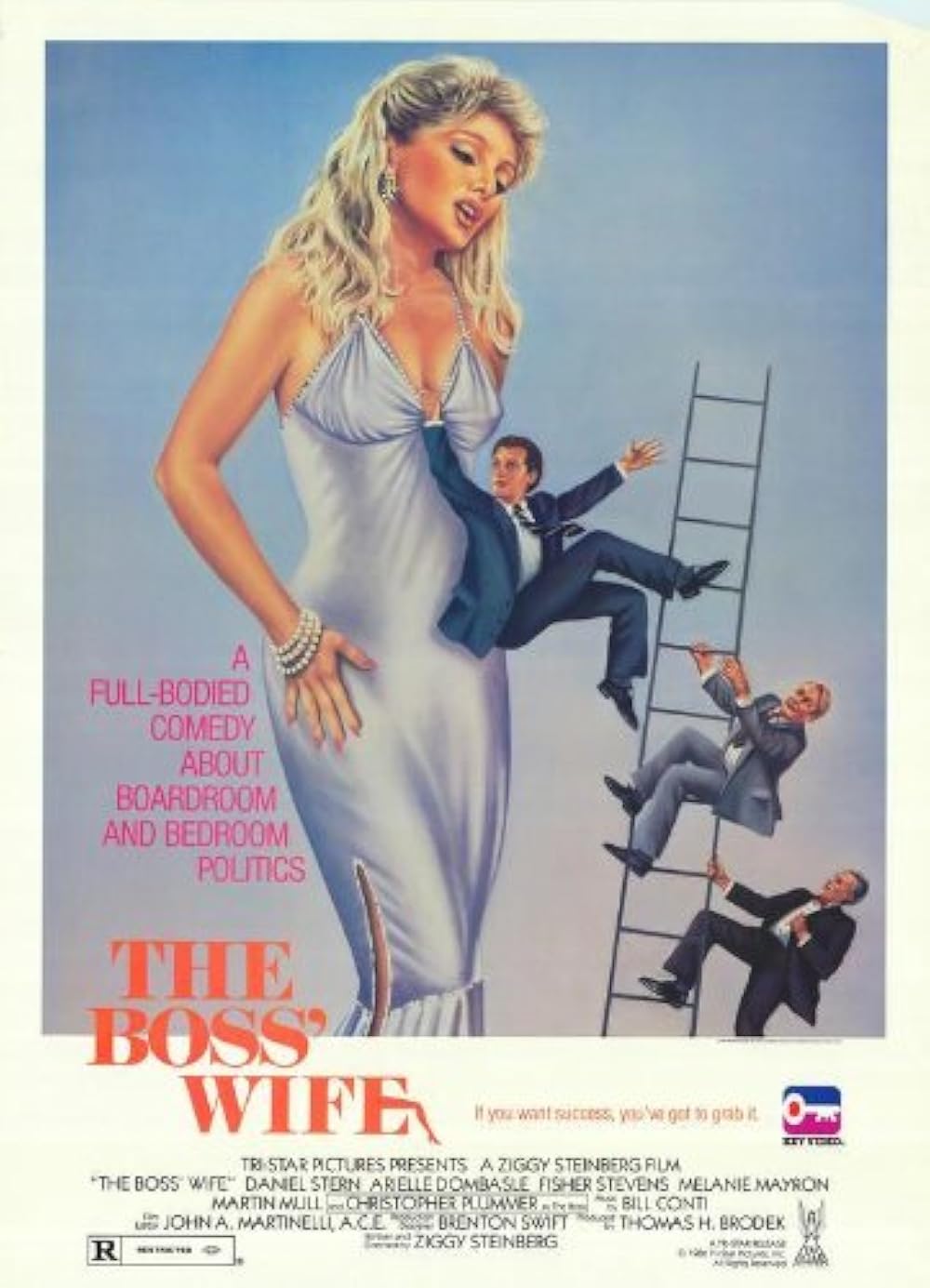
Joel (Daniel Stern) works at a stock firm and wants to impress his boss (Christopher Plummer) with some stock analytics and competes with fellow employee Tony (Martin Mull), who’s a major corporate brown noser. The boss though is not the smartest and misreads everything including thinking that Joel is a smoker, which he isn’t, and giving him the nickname of ‘smoky’. He also thinks that Joel is gay and having a fling with Carlos (Fisher Stevens), which neither is true, but this allows the boss’ wife Louise (Arielle Dombasle) to openly come-on to Joel while the boss, so worried that Joel may come on to him, feigns naivety at what his own wife is doing. Joel tries to avoid the woman because he fears that if he doesn’t, he’ll get caught, which will not only hurt his job advancement, but also his shaky marriage to Janet (Melanie Mayron). 

The film is the product of Ziggy Steinberg who started his careers in the 70’s writing for episodes of TV-shows and then graduating to feature films like Porky’s Revenge and then ultimately Another You, which to date has been the last writing gig he’s done. This film marked his debut as both a writer and director, but the results are so-so. The concept is predictable and better suited for an episode of ‘Three’s a Company’, which he also wrote for, than the big screen. While the attempt is for screwball the pacing is slow and not a lot of gags going on and as satire/parody its target is so obvious and been done so many times before that it hardly seems worth the effort as one could simply watch How to Succeed at Business Without Really Trying and get a lot more laughs. In fact, the only amusing moment comes when Plummer has a toy choo-choo train ride onto his desk carrying drinks and hamburgers and then Stern fumbling around to get ketchup on his burger, which causes a red mess on the boss’ desk.

The acting from the two male leads is adequate. Stern’s character is benign, but he plays it in a likable way making you connect to him and his quandaries. Plummer is quite good particularly with the way he roles his blue eyes every time he comes to a mistaken conclusion to something. Stevens has some good crude moments who initially starts out as Mayron’s employer only to create a haphazard buddyship with Stern while on the train. 

Dombasle though is quite possibly the film’s weakest link. She enters in almost like a fantasy figure and has little dialogue. Why this voluptuous woman would get so focused on Stern for no apparent reason doesn’t make a lot of sense. He does not stand out in any way and therefore a woman like her would overlook and even ignore him. She comes onto him in such a shameless and extreme manner even while in public you could argue she was mentally ill. Even if she’s desperate for sex cause she’s not getting enough from her older husband she could still, with her money, find ways to get it, through like male escorts, than groveling in such a ridiculous level towards a chump like Stern. Later it does come out that she is ‘attracted to men who resist’, which helps explain her motivations a little, but it would’ve been more entertaining had the Mull character paid her, or worked out some deal with her, to come onto Stern in  order to get him into trouble with Plummer, which would’ve offered a nice unexpected twist, which unfortunately the script doesn’t have. 

Spoiler Alert!

The final 10-minutes in which Plummer corners Stern in his rental home with both his wife and Stern’s and the myriad excuses Stern comes up with to try and get out of the jam is sort of funny, but it takes too long to get there. That frantic, hyper-pace should’ve been present from the very beginning and it just isn’t. Stern’s character arc where he finally concludes that the company culture is too conform-ridden for his liking is strained as well. If anything, he should’ve figured that out long before he goes to a company party and asked to where a silly hat like everyone else, which was one of the least problematic things at that place and yet this is where he suddenly decides to ‘draw-the-line’. 

My Rating: 3 out of 10

Released: November 7, 1986

Runtime: 1 Hour 23 Minutes

Rated R

Director: Ziggy Steinberg

Studio: Tri-Star Pictures

Available: DVD-R, Amazon Video, YouTube
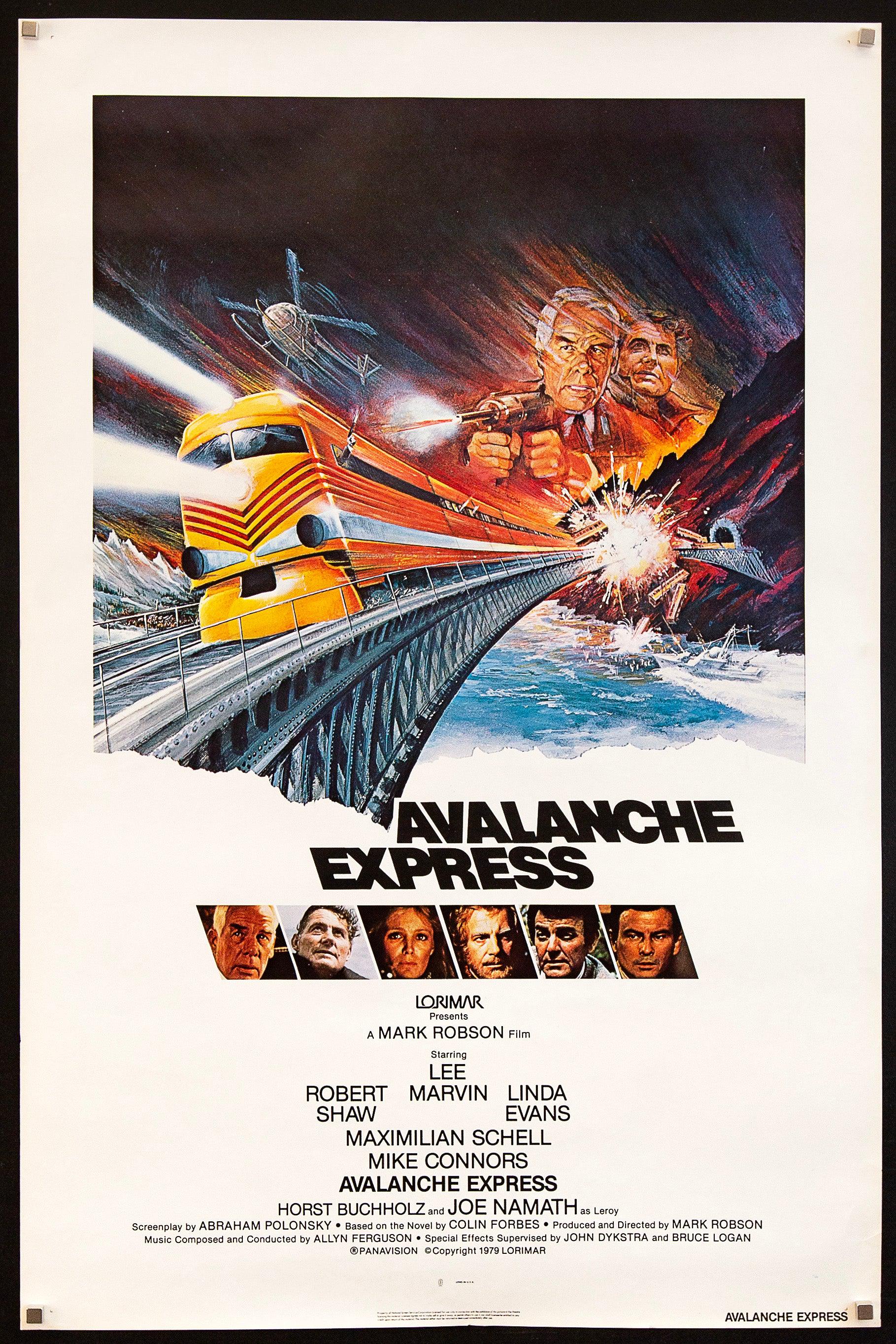
Avalanche Express (1979)

avalanche2

By Richard Winters

My Rating: 2 out of 10

4-Word Review: Defector on a train.

Based on the 1977 Colin Forbes novel of the same name the story centers around General Marenkov (Robert Shaw) a soviet agent who’s decided to defect to the west. Harry (Lee Marvin) is the CIA agent in charge of extraditing Marenkov back to the U.S., but to do so they must travel via train across Europe. Nikolai (Maximilian Schell) is a KGB agent assigned to stop Marenkov’s escape and tries many ways to stymie his trip before finally settling on creating an avalanche, which will not only impede the train ride that Marenkov and Harry are on, but if done right should completely destroy it and end the lives of everyone inside.

The film was noted for its many difficulties during the shoot including the death of its director Mark Robson from a heart attack with only 2-weeks left of filming forcing Monte Hellman to step in and complete the production. The biggest problem though was that during the post-production it was deemed that the opening scene, which featured Shaw speaking to his soviet counterparts in broken English, should be redone with Russian dialogue. However, Shaw too had already died from a sudden heart attack in August and thus was no longer able to come-in for reshoots, so they settled on his voice being dubbed by Robert Rietti for that scene. This would’ve been fine had they stopped there, but instead they came to the conclusion that for the sake of consistency Shaw’s voice should be dubbed by Rietti for the entire film, which was a huge mistake.

Shaw has a highly distinctive and wonderfully articulate delivery and for the viewer to miss out on that is downright criminal. I think most audiences could’ve forgiven that his voice sounded a bit different during the opening bit and probably wouldn’t have even cared or noticed since they were so busy focusing on the subtitles anyway. It becomes like a bait and switch, since Shaw’s name headlines the cast, but since somebody else does his speaking it’s like he’s not really in it and thus a big rip-off to his fans who came to see the movie simply because of him.

The special effects are equally abhorrent. There’s been many movies that have created fake snow scenes, but this one has to be the cheapest looking one yet. The falling flakes look more like Styrofoam and the white stuff on the ground resembles foam from a bathtub especially as the vehicles slush their way through it like it’s a white liquid. The sequence showing the train gliding down the tracks is clearly of the miniature variety and will fool no one.

The casting is a mess too especially the appearance of Joe Namath, a great football player, but a threadbare actor who has no business being in a big budget Hollywood picture. He’d be okay for a TV-movie with other B-performers, but for something that’s supposed to be taken seriously his presence makes the thing even more tacky than it already is. Even stalwart leading man Marvin fails here as he shows no emotion even when it’s warranted, like when he gets word that train they’re on is headed for disaster and yet he remains hyper stoic like he’s a robot with no feelings. Having him get shot dead early on only to return later isn’t the gotcha they thought it would be as I was predicting he’d reappear as there’s simply no way a big-name star like him would sign onto a movie just to be killed off right away.

Linda Evans is good simply because she has the ability of playing a cold, bitchy lady quite well. It could almost be described as her forte and her snippy comments and icy behavior towards Marvin during the first half are engaging and helps give the proceedings a bit of a dramatic flair. Turning the two into lovers though during the second half ruins all the underlying tension and since they don’t share much of a chemistry anyways having them remain adversarial throughout would’ve worked better.

Schell as the villain is as cardboard as he was playing the bad guy in The Black HoleHis career is long and distinguished, but his success is clearly not in these types of roles though he does at least get the film’s one good line. It comes when he’s told he must go undercover in disguise by playing someone who does not smoke. Since his character is a chain smoker, he panics that he won’t be able to go on without a cigarette and exclaims “That’ll kill me’.

My Rating: 2 out of 10

Released: October 19, 1979

Runtime: 1 Hour 28 Minutes

Rated PG

Director: Mark Robson

Studio: 20th Century Fox

Available: DVD-R (Warner Archive), Amazon Video, YouTube

Martin (1977)

martin2

By Richard Winters

My Rating: 7 out of 10

4-Word Review: Teenager craves women’s blood.

Martin (John Amplas) is a teenager, who has dreams of living long ago as a vampire, who travels to live with Tateh (Lincoln Maazel) in the outskirts of Pittsburgh. Tateh is an elderly man that is highly superstitious and immediately suspects Martin of being a vampire and puts up certain ‘repellents’ like a crucifix and garlic as a defense against him though these prove to have no effect. Martin gets a job as a grocery delivery boy where he meets Abbie (Elayne Nadeau) a lonely housewife who makes attempts to seduce him. Martin has some attraction towards her, but still craves blood and uses some syringes that he has to attack female victims by injecting them with a serum that will put them to sleep and allow him to cut their arms and drink their blood. He though internally struggles with his actions and feelings and thus calls a radio station to discuss his quandary with the DJ, which goes out over the air and he soon becomes a local celebrity known at ‘The Count’.

By the time this was ready to be made writer/director George A. Romero was deep in debt and struggling to maintain a living as a filmmaker and considering get out of the business altogether. While he had achieved great success with Night of the Living Dead he’s subsequent films failed to generate any profit and where critically panned. Many of the investors of those projects refused to give him any money to make this one fearing it would be a financial dud forcing him to scrape together a meager $100,000 on his own in order to get it produced while leaning on friends and family members, including Romero himself who plays a priest, to fill-in as cast members. However, for the most part the low budget works in the film’s favor. I liked the grainy, faded color that helped accentuate Martin’s fringe, lonely existence and the on-location shooting done in the town of Braddock, Pennsylvania gives it an earthy, rustic appeal.

The best part though is that it works against the vampire stereotypes and gives the age-old folklore a fresh new perspective. The fact that the expected vampire repellents don’t work on him kept it fun by not devolving into the tired cliches. The mystery too as to whether Martin really was a vampire, or just thought he was and no real explanation as to his ‘memories’, which get shot in black-and-white, as being just that, or instead simply fantasies, kept it intriguing. It also forces the viewer to see things from a different point-of-view as in this case it’s not the kid who thinks he’s vampire that’s the real threat, but more the ‘normal’ people around him. This leads to the movie’s best and most memorable moment where he quietly sneaks into the home of a potential female victim that he thinks is alone only to find to his shock that she’s having a secret affair with another man and the chaos that ensues, where both sides misreading the other, is both humorous and exciting while putting a new spin on how we perceive horror.

The only drawbacks are with Martin’s belief that he’s ‘careful’ during his attacks, so that he’ll ‘never get caught’, which is a bit flawed. For one thing he doesn’t wear a mask, so a witness could easily identify him later and there’s no explanation about the injecting sleep potion and how being a kid with little money he’s able to obtain it, or if it’s something he cooked-up himself and if so what did he use to make-it? It is though fun to watch the effects of it as it doesn’t work immediately and his victims will struggle with him quite a bit before they finally go under, which is another element that puts this above most other horror films as the perpetrator is usually always shown as being confident and fully in-control when attacking those he preys on while here it’s the opposite and many times comes close to the victim getting close to overpowering him, which actually heightens the tension.

Having Abie, a middle-aged woman, essentially come-on to Martin right away and even answers her door half-dressed seemed inauthentic. Maybe it’s a product of a bygone era where teens were still considered overall innocent and only the adults with dirty ulterior motives, but she seemed way too unguarded while believing that because he was shy that made him ‘harmless’. While children that are quiet that can sometimes be considered the case, but with teens who don’t say much and being loners can be perceived as anti-social and thus single women would be more defensive around someone like that instead of less.

I also didn’t care for actor Jon Amplas’ teeth as the front tooth appeared capped with a bright white crown while the ones around it where yellowish though I suppose this worked with the character as he was too poor to afford a decent dentist and some could also read into it that the white crown represented possibly a ‘fang’ of some sort. Overall though it’s quite good and helped resurrect Romero’s career. The surprise ending alone makes it worth it. Definitely one vampire movie that deserves more attention and should be listed as one of the best of its genre.

My Rating: 7 out of 10

Released: October 27, 1977

Runtime: 1 Hour 35 Minutes

Rated R

Director: George A. Romero

Studio: Libra Films

Available: DVD, Blu-ray, Tubi

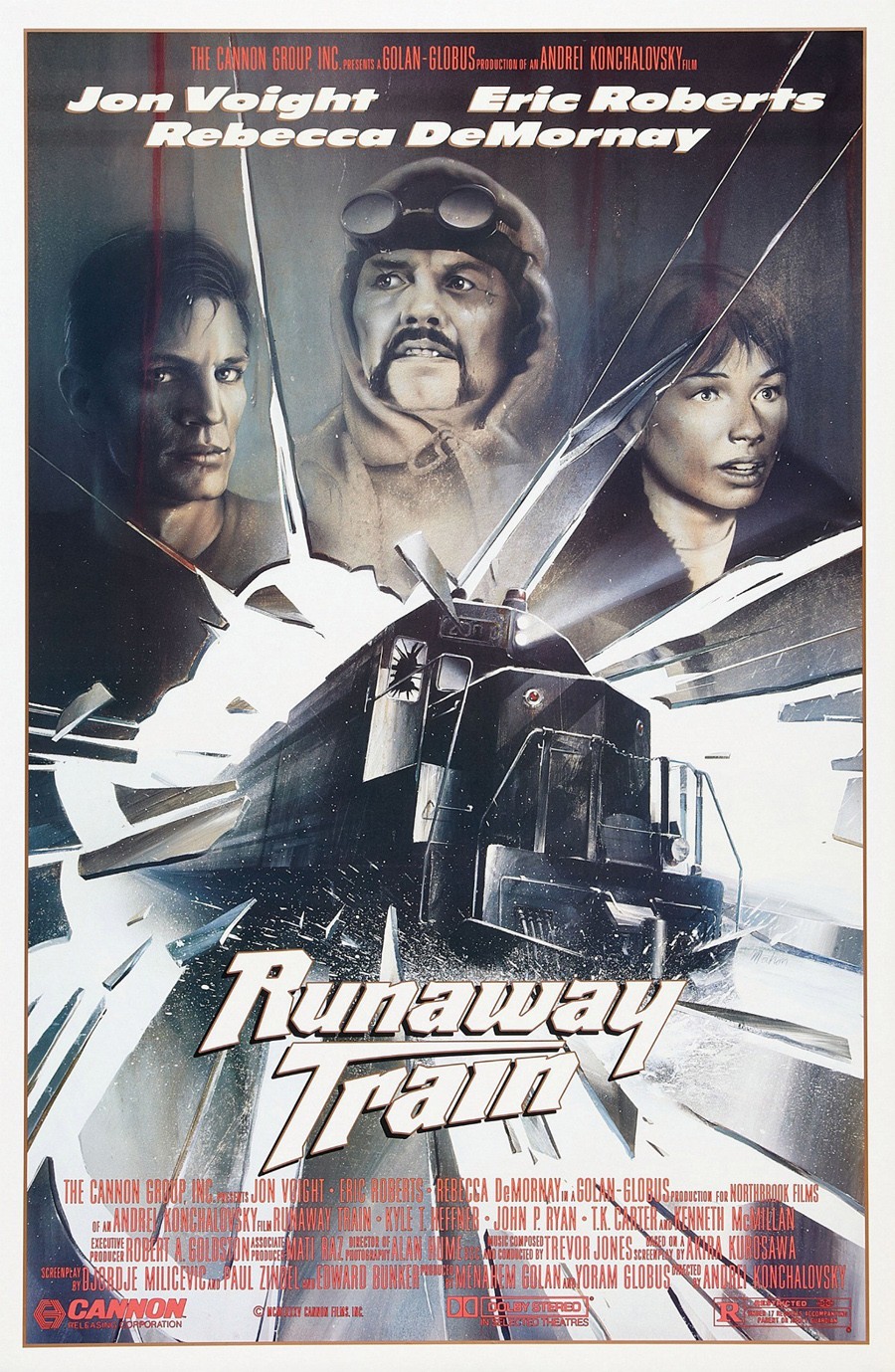
Runaway Train (1985)

runaway

By Richard Winters

My Rating: 8 out of 10

4-Word Review: Trapped on speeding locomotive.

Manny (Jon Voight) is a robber locked away in solitary confinement at a maximum security prison because of his two previous attempts at escape. He plans on making a third try with the help of a younger, more naive prisoner named Buck (Eric Roberts). Their breakout this time proves successful, but they find themselves having to fight the bitter cold and hike along the frozen Alaska landscape. They come upon a rail line and board a train by sneaking onto one of it’s four empty locomotives. However, unbeknownst to them the engineer, (Reid Cruickshanks) suffers a fatal heart attack while starting up the train and causing it to accelerate at high speeds, which is too fast for them to jump off. Later the two meet Sara (Rebecca De Mornay) an employee of the train company and three devise a plan to climb onto the lead engine and press the kill switch, but while this is going on the two fugitives are being pursued by police bounty hunter Rankin (John P. Ryan) who’s determined to board the runaway train via a helicopter and arrest Manny and bring him back to prison.

The story is based on a script by Akira Kurosawa who had read an article written in Life magazine about a runaway train and decided it would make for a good movie and planned to have this be his first American film. The shooting was to take place in the fall/early winter of 1965 with Peter Falk playing Manny and Henry Fonda as Rankin. However, the location, which was upstate New York received some early season snowstorms, which caused many production delays and eventually the financers pulled-out and film ultimately was never made. The project sat dormant for many years until 1982 when the script’s current owner managed to get Russian director Andrei Konchalovsky, at the suggestion of Francis Ford Coppola, interested in reviving it.

The film is for the most part masterfully done and quite suspenseful with kudos going to filming it in Alaska where the snow and ice are real and so vividly captured that you can almost feel the cold permeate through the big screen. Originally it was to be shot in Montana where the prison is, the same one that was also used in Fast Walkingbut the weather conditions proved to be mild and attempts at fake snow weren’t successful, so it was eventually decided to move the production further north.

I did though have some quibbles with the escape sequence, which gets done by having them hide in a cart of laundry, which is awfully predictable and unimaginative and you’d think a maximum prison such as this one would be on the lookout for such a thing making it all seem too easy. Voight having a gadget that could bend bars was equally too convenient. I realize prisoners can be adept at smuggling in many things, but if it’s so simple to get something that can literally bend steel bars then why doesn’t every prisoner use to breakout?

The casting of Voight was in my opinion a mistake, or at least not as effective as another actor in the part. He looks too thin and not threatening at all despite him wearing false teeth, tanning his skin in more of a darker tone, and putting on a fake scar around his eye, but for me this all came-off as highly affected and just didn’t seem gritty enough. While his performance improves as he gets on the train I couldn’t buy-in that this was a real bad ass as the movie wants you to believe and I really wish Voight had listened to his first instinct and not taken the role as he felt it wasn’t he type of character he could play, but eventually changed his mind when Konchalovsky convinced him that great actors play against type. I also didn’t like screenwriter Edward Bunker changing him into a bank robber as in the original script he was a killer, which would’ve made for a far more intriguing character arch as it would then attempt to humanize someone that is perceived as being quite viscous.

The train scenes are quite intense as it takes on a man vs. the elements theme with Roberts, who usually plays sleazy characters, doing quite well as the conscientious person here. De Mornay is fantastic too wearing very little make-up, which makes her look younger and almost teen-like and far more youthful than in Risky Businesswhich is a film she did 2 years before this one. My only complaint is that the character gets introduced in an awkward manner where she just literally ‘pops-in’ without any warning in the middle of it and the film should’ve given the viewer some hint that there was someone else on the train right from the start.

The scenes inside the dispatch office are highly engaging and become almost like comic relief, which for a film that’s as tension filled as this one, is a welcome addition and helps give the viewer a bit of a breather between moments on the train. I loved how oblivious the dispatchers, played by the talented T.K. Carter and Kyle T. Hefner, are initially to the situation and are seen at the start being quite laid-back. Hefner is even in the bathroom when the news hits and the film misses a great opportunity, similar to the one in Catch-22where he would be seen sitting on the toilet as he got updated on the situation. Kenneth McMillan, one of the all-time great character actors, comes-in later to lend advice and he really should’ve been given more screentime and possibly replaced Hefner altogether as he has a way to create amazing energy that his co-stars just didn’t.

Spoiler Alert!

The ending in which Manny goes down with the train, we don’t actually see it crash, but know it’s coming, with Manny raising his arms in the air like he somehow has achieved something I found disappointing. I didn’t care for it back when I first saw it during my college days and had the same response to it this time around. This was in the original script as well and was intentionally done to go against the theme of most American movies were the protagonist must always come out as the perceived winner, but either way it comes-off as all wrong for this time of film. We spend so much time watching him do whatever it takes to survive and going to great risks to accomplish it that to see him ultimately give-in to his inevitable circumstances and simply accept death to come and take him kills all the momentum that had built-up and becomes a letdown for the viewer. I kind of wonder if this is the reason why it didn’t do well at the box office as it only managed to recoup $7 million of its $9 million budget.

My Rating: 8 out of 10

Released: December 6, 1985

Runtime: 1 Hour 51 Minutes

Rated R

Director: Andrei Konchalovsky

Studio: The Cannon Group

Available: DVD, Blu-ray, Pluto TV, Roku, Tubi, YouTube

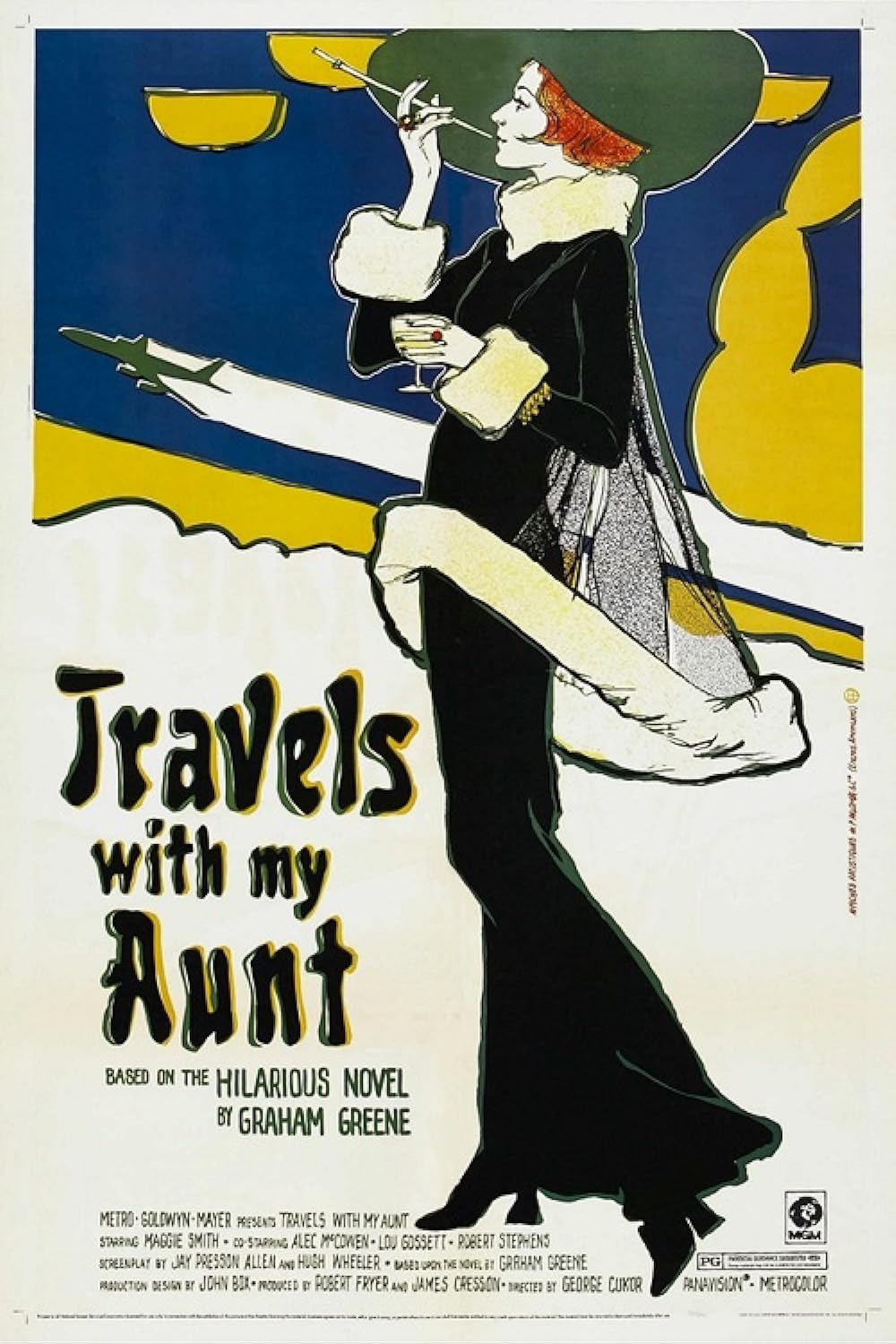
Travels With My aunt (1972)

travels1

By Richard Winters

My Rating: 4 out of 10

4-Word Review: Kooky lady cons nephew.

Henry (Alec McCowen) is a middle-aged bank manager who attends his mother’s cremation where he meets his kooky Aunt Augusta (Maggie Smith). She invites him over to her residence where he finds that she’s living with a black man named Wadsworth (Louis Gossett Jr.) who works as a fortune teller. It is here that she receives a package holding the severed finger of her longtime lover Visconti (Robert Stephens) and told that she must deliver $100,000 in ransom in order to see the rest of him alive. She convinces Henry to go with her to Paris to meet the kidnappers demands and in the process the two go on a wild jaunt across the globe that ends with them in North Africa.

The film is based on the novel of the same name by Graham Greene that was originally intended for Katherine Hepburn in the lead. Director George Cukor, whose career was winding down at this point, had worked with Kate in several projects from decades earlier and felt this role would be the right fit though she disagreed, but then decided that if she could rewrite the script, she’d consider doing it. Jay Presson Allen, who had done the original adaptation, which Hepburn didn’t like, gave full control over to her to rewrite it anyway she’d like, but ultimately the studio felt she was too old for the part especially since she was expected to play a younger version of the character during flashback sequences and they didn’t feel she at her advanced age could come effectively as someone in their early 20’s, so the part went to Smith instead.

Maggie to her credit is quite good and although she was only in her late 30’s really seems quite old during the sequences where the aunt is portrayed in the present. There’s even realistic wrinkles on her face especially around the cheekbones that gives the character the look of someone in their 70’s and 80’s. In the flashbacks she comes-off equally effective as a youthful free-spirit. Unfortunately her daffy character was for me a turn-off as she’s too much of an eccentric caricature that’s more obnoxious than amusing and building a whole film around her doesn’t work.

Henry is equally perplexing as I couldn’t understand why he’d believe this nutty lady when she tells him the mother he had always known wasn’t his biological one. For all he knew she was a goofball that shouldn’t be taken seriously unless she can supply more evidence, which she doesn’t. Most rational people would’ve kept her at an arm’s length instead of galivanting across the continent with her especially whom he had just met. In the book Henry is portrayed as being bored with his life and longing for adventure, but the film doesn’t make this clear, so his motivations and personality become muddled. Also in the book he was in early retirement, which would help explain why he had so much free time to go traveling, but the movie doesn’t bring this up either, so you wonder what he told his employer that would allow him to be off of work for so long and not get fired.

Having the Aunt and Henry bicker about, as their personalities were quite opposite, could’ve been fun, but this doesn’t get played-up. Too much time gets spent on this outlandish James Bond adventure that gets more ridiculous and unbelievable. The flashbacks bog down the pace and weren’t really needed and everything should’ve remained in the present day. The coin flip ending, in which Henry can’t decide what he wants to do moving forward, go back to his old life or continue on with his aunt, is a cop-out and only done because they couldn’t figure out how else to end it, so they do a freeze-frame of the coin in the air and the  let the viewer feel-in-the-blanks, which was far different than the novel. There Henry becomes a changed man who enjoys the excitement of getting involved in illegal activities, but because the film was not centered around him, which it should’ve been, we don’t witness any type of character arch making the whole thing quite trite and saved only by the brief appearance of Cindy Williams who plays a free-spirited hippie that he meets on a train.

My Rating: 4 out of 10

Released: December 17, 1972

Runtime: 1 Hour 49 Mintutes

Rated PG

Director: George Cukor

Studio: MGM

Available: DVD-R (Warner Archive)

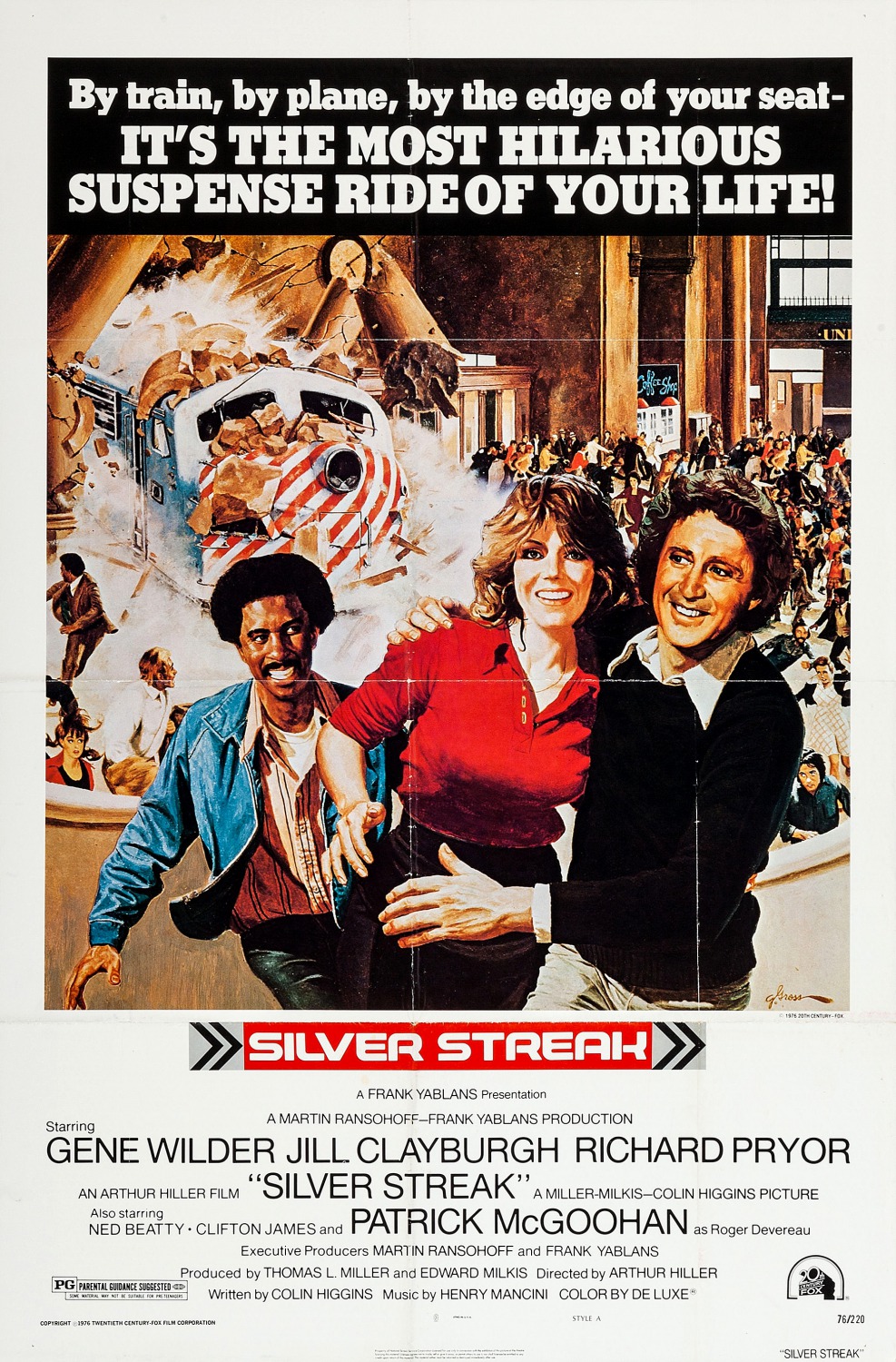
Silver Streak (1976)

silver

By Richard Winters

My Rating: 8 out of 10

4-Word Review: Murder on a train.

George (Gene Wilder) is a book editor taking a train ride from Los Angeles to Chicago. Along the way he gets into a relationship with Hilly (Jill Clayburgh) who is staying in the neighboring compartment. After a night of drinks they go back to her bed and begin making-out only for George to see a murdered body of a professor, whom Hilly works for as his secretary, get thrown off the train. Nobody else sees it except for him and everyone, including Hilly, believe it was a figment of his imagination, but George persists by doing the investigating himself. He goes to the compartment that the professor was staying in to see if he’s there, but instead he meets two men (Ray Walston, Richard Kiel) who throw him off the train. George then must find a way, in the middle of the empty desert, to get back on the train, so as to warn Hilly, whom he fears may be their next victim.

The script was written by Colin Higgins who up to that time was best known for having done Harold and Maude. He said he had always fantasized about meeting a beautiful blonde on a train and when it never panned-out in real-life he decided to write it into a story. Initially he was expecting an uphill battle to get it sold, but to his amazement it instead set-off a bidding war between Paramount and 20th Century Fox who both wanted to purchase the rights and it ended up selling for a then record $400,000. Originally Amtrak was going to be used as the setting for the Silver Streak, but the company became panicked that the film could cause bad publicity for them and ultimately refused to allow the studio to use any of their trains, so the film crew was forced to go north of the border and use the Canadian Rail System in its place while still pretending that it all takes place in the US when really all exteriors are Alberta, Canada and the skyline that gets seen in the distance that’s supposed to be Kansas City is really Calgary.

The reason the film works so well is that the comedy is on-target the whole way, but also manages to deftly blend it in with some nerve wracking action making the viewer let out belly laughs while also sitting-on-the-edge-of-their-seat at the same time. The pace is brisk with some amazing and very realistic stunt work that not only shows the train crashing through the wall of Chicago’s Central station, but also a few scenes with the character’s dueling it out on the roof of the locomotive as it’s going at high speeds. In fact the only slow spot in the entire movie is when Gene and Jilly make-out in the train car, which goes on too long and may make some people, including my conservative parents who watched the film with me when I first saw it on Showtime in 1982, as thinking this might be more a soft core porn flick than an action thriller and about ready to turn-if-off before it finally gets going with the plot.

Wilder, who was not Higgins’ first choice for the role as he intended it to be played by George Segal, is quite engaging and this was the first of several pairings that he did with Richard Pryor, who doesn’t appear until an hour in, but manages to take over quite nicely and makes a strong, memorable impression. Patrick McGoohan is sinister as the villain and one of the rare instances where in an otherwise comedy the bad guy isn’t funny and instead nasty, usually in comedies it’s considered mandatory that all the characters, even the bad guy, have some amusing moments, or lines, but McGoohan is just mean, which enhances the suspense element. Scatman Crothers, who initially seems to be playing an insignificant roles as the train’s porter, but in the end becomes quite crucial in getting everyone saved. Richard Kiel is good, though he speaks no dialogue, as one of McGoohan’s henchmen, in a role quite similar to the Jaws character that he played in two James Bond films that came out a year later, he even walks around with the same mangled up dental work in his mouth.

Spoiler Alert!

While the film works for the most part quite flawlessly I did find a few tidbits to quibble about. One is the scene where Gene accidentally bursts open the patrician door that divides his room from Jill’s who is busy dressing and doesn’t act startled when he suddenly breaks into her room, which I would think anyone, especially in a state of undress, would’ve responded with a scream and a look of shock, which would’ve made the segment funnier if she had.

Later on a police chief, played by Len Birman in a very bad impression of Mike Connors from ‘Mannix’, tells Gene that they know he’s innocent and have simply been putting-up manhunt posters with his picture on it for his own safety, so they could catch him and get him away from the evil McGoohan and his cronies who want to kill him. However, after he explains this he then hands Gene a gun and some bullets and tells him to come along with his men to help nab McGoohan who is still on the train, but how would this police chief know that Gene could handle a gun and was trained on how to shoot it, let alone even need him since his own men were well armed with rifles and could easily shoot down the bad guy themselves? There’s also another moment where the police chief shoots into a large crowd in an effort to hit McGoohan, which sends everyone into a panic and would be considered a major act of negligence for a cop to do.

Another scene has McGoohan explaining to Jill, Gene, and Richard about how he and his men never meant to really kill the professor, or at least not upfront, but when he did die that’s when they had to immediately ‘get’ a lookalike as an imposter to give everyone the idea that the professor was still alive. However, how exactly where they going to be able to find someone who looked so similar to the professor in such a quick, speedy way and then get him on the non-stop, fast-moving train?

The biggest exaggeration for me though is when Gene unhooks the back part of the train from the engine, while standing on a thin ledge and holding on for dear-life via a small metal rail and then able to successfully hop onto the train car that he had just decoupled from the other one. With them both going at high speeds I don’t think he’d be able to do it. Of course in the movie it gets done by a professional stunt man, who was able to time it, and rehearse it, to make it look easy, but in reality the average person would’ve either slipped, or missed grabbing the rail and thus fallen to the side of the tracks. This though could’ve actually been funny as we would then see Gene’s body roll on the ground and initially make it seem like he was hurt, or injured and then have him look up in aggravation and go: ‘Damn, I got thrown off the train for a fourth time!”

My Rating: 8 out of 10

Released: December 8, 1976

Runtime: 1 Hour 54 Minutes

Rated PG

Director: Arthur Hiller

Studio: 20th Century Fox

Available: DVD, Blu-ray, Amazon Video, YouTube

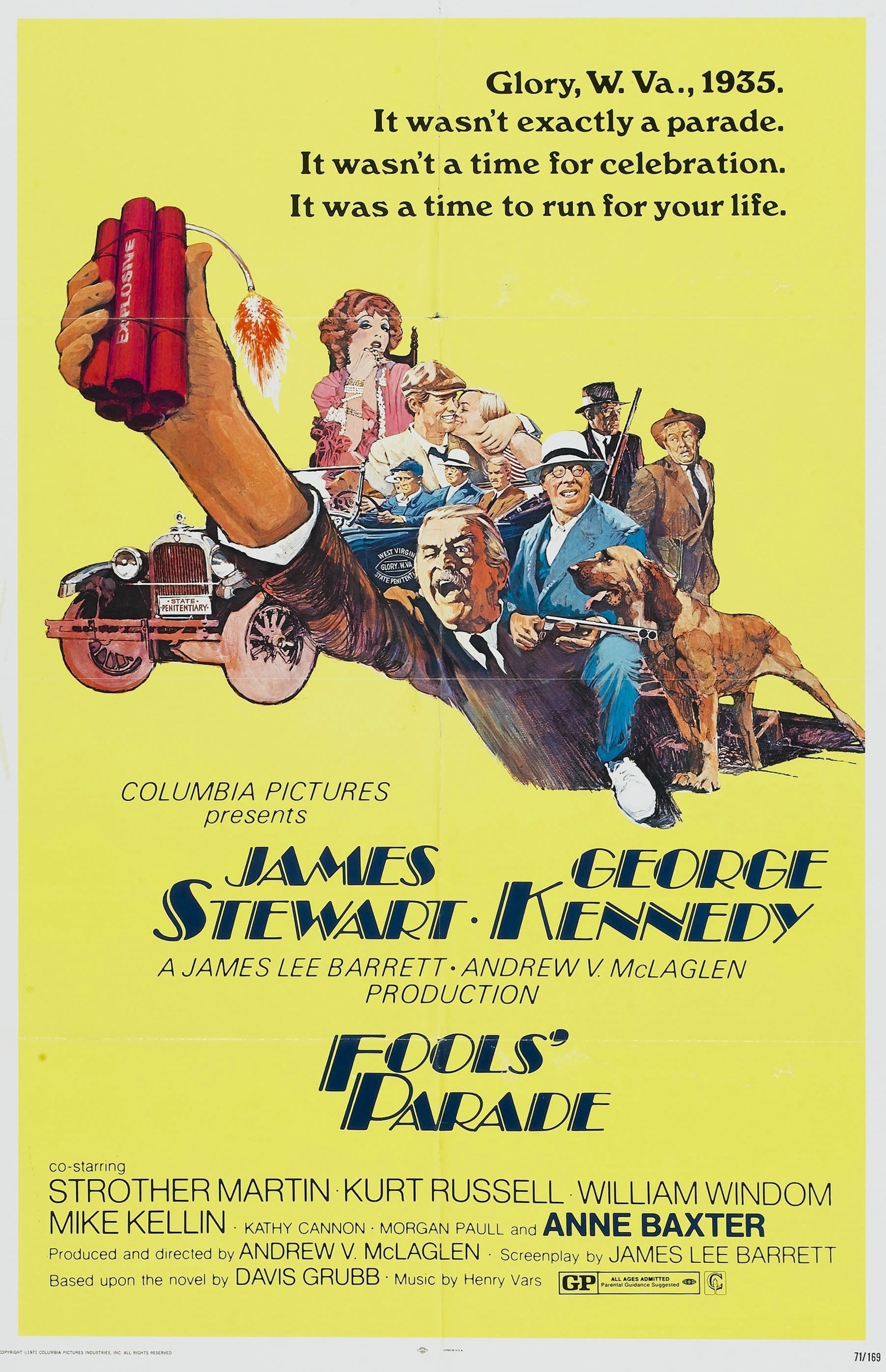
Fools’ Parade (1971)

fools

By Richard Winters

My Rating: 5 out of 10

4-Word Review: Can’t cash his check.

Mattie Appleyard (James Stewart), who lost one of his eyes during a fight years earlier and now wears a glass one, finally gets released from prison after spending 40 years behind bars. Along with him there’s bank robber Lee Cotrill (Strother Martin) and a young convict named Johnny (Kurt Russell) who both get released on the same day. Mattie’s also given a check in the amount of $25,452,32 as payment for his years of prison work. Mattie, Lee, and Johnny plan to use the money to start-up their own grocery store, but since the year is 1935 and many are poor due to the Great Depression they realize they must guard the check carefully and not cash it until it’s fully safe to. During their train ride out of town they become aware after reading the fine print that the check can only be cashed in person at the bank in the town that they’ve just left, so they take another train ride back. Unfortunately for them they don’t know that Mattie’s former prison guard Doc (George Kennedy) has already hatched a plan with the bank manager (David Huddleston) to make sure that the check is never cashed. In-fact the manager has given Doc an advance on the money to have Mattie and his friends wiped-out. Doc has hired a ‘Christian’ hit man  named Junior (Morgan Paull) to do the dirty deed, which Junior agrees to as long as it’s confirmed that people he kills are atheists, which Doc insists they are.

The film is based on the 1969 novel of the same name by Davis Grubb, who is better known for having written Night of the Hunter. It was shot on-location in Moundsville, West Virginia where Grubb was born and raised and it’s the setting that helps give the movie added character. The scenario though is rather odd and seems to want attain a certain quirky tone that it can’t quite reach. Leonard Maltin, in his review, complained about it being ‘unintentionally funny too many times to be taken seriously’. While I’ll agree the tension is lacking I do feel that this was meant to be humorous and some of it is slightly amusing, but it never gels and overall isn’t intriguing. I also felt the Russell character wasn’t needed. Maybe the producers wanted a youthful character added to attract younger members of the viewing public, but he doesn’t say, or do anything that’s funny, or helps move the story along. His romance with Chanty (Katherine Cannon in her film debut) who plays a 16 year-old who’s virginity is up for sale for a price of $100, is too forced, not believable, and adds nothing to the main plot.

There’s also several directorial errors including the first time Stewart takes out his glass eye, which was apparently so painful to wear that shooting could only last for 20-minutes at a time. In the shot we see Stewart put his hand over his eye and then it cuts to Russell’s shocked expression and then back to Stewart where the eye ball is in his hand, but we can see on Stewart’s face, just as he turns that he still has a blue eye in the socket where the glass used to be. When he removes the eye later he keeps the left eye closed in order to represent an empty socket, but the first time he doesn’t.

There’s also issues with Kennedy’s teeth. Initially I thought he was wearing braces, but then during close-ups it looks like there just supposed to be dirty, or rotting, but realistically it’s not done right. If they were truly bad teeth then some of them should’ve fallen out, or broken off instead of looking like they have been covered with black specks. There’s also a scene where he’s sitting in a car putting on his white shoes and his teeth are all white only to have in a later scene going back to them appearing dirty.

The performances are certainly a plus with Stewart’s being especially good and I admire the way he was willing to go out of his comfort zone by playing a type of kooky character he had never done before. Kennedy is also a scene-stealer in quite possibly the funniest thing he ever did. Huddleston is also solid as the corrupt bank manager and the segment where he nervously watches Stewart attempt to light a stick of dynamite inside the bank office is probably the film’s best moment. Kudos though must ultimately go to Anne Baxter who’s quite impressive as an aging, embittered prostitute who runs a whorehouse on a houseboat. I remember being blown away by her performance in The Ten Commandments and then later for her Oscar winning work in All About Eve, but her she’s almost unrecognizable in a role that is both darkly funny and sadly poignant at the same time.

My Rating: 5 out of 10

Released: June 17, 1971

Runtime: 1 Hour 38 Minutes

Rated GP

Director: Andrew V. McLaglen

Studio: Columbia Pictures

Available: DVD-R, Tubi

The Taking of Pelham One Two Three (1974)

taking

By Richard Winters

My Rating: 8 out of 10

4-Word Review: Subway passengers held hostage.

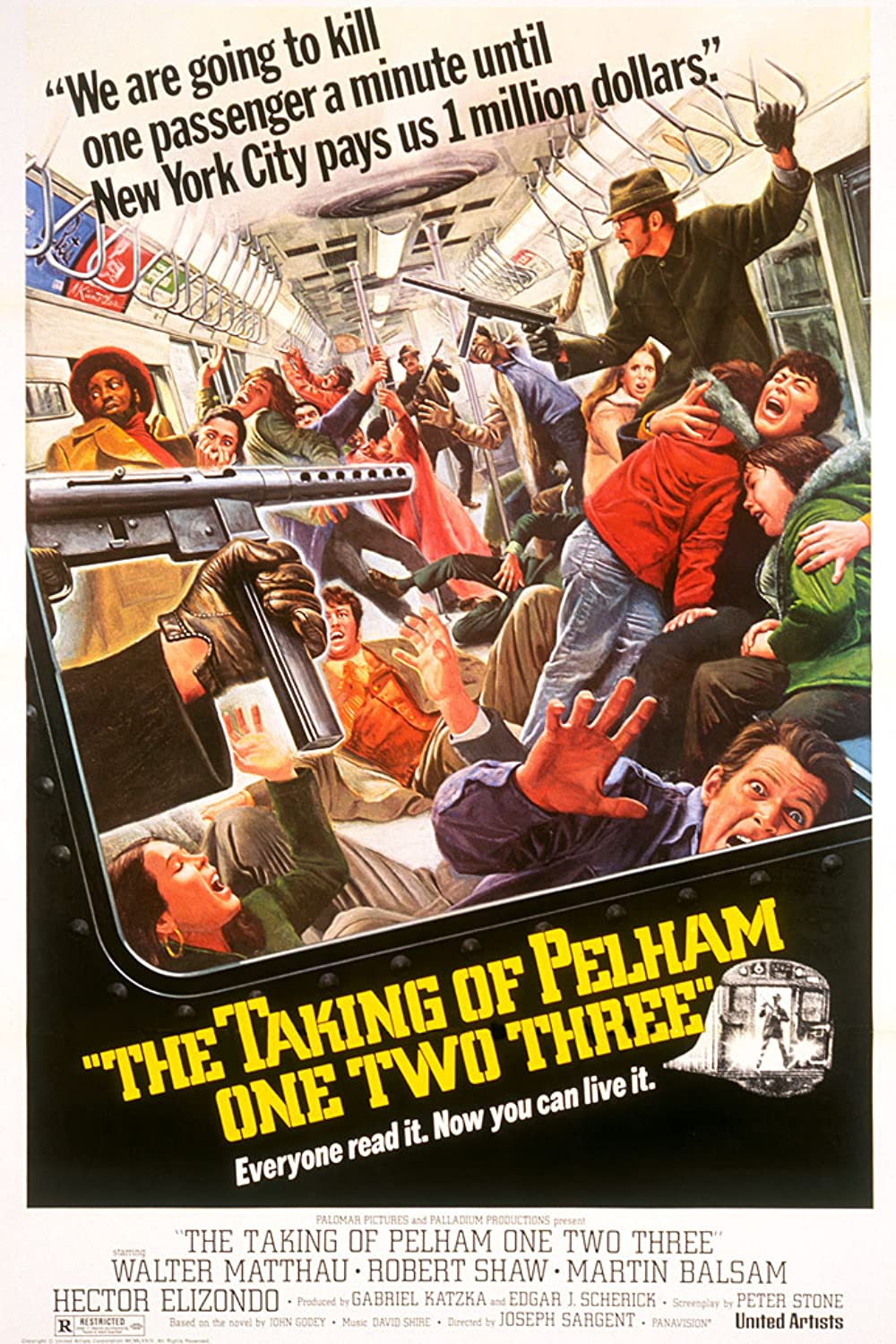
Four men wearing disguises and going by code names: Mr. Blue (Robert Shaw), Mr. Green (Martin Balsam), Mr. Grey (Hector Elizondo), and Mr. Brown (Earl Hindman) board the same subway car, this one being the Pelham 1-2-3, at different locations. Once all four are onboard they take out their guns and take over the subway car by holding both passengers and conductor hostage. For their release they demand $1 million in ransom to be paid in 1-hour and for every minute that it is late one passenger will be killed. They communicate these demands to Lt. Zack Garber (Walter Matthau) who is a part of the New York City Transit police. As Mr. Blue and Garber communicate with each other over the radio and the city races to meet the crooks demands Garber begins to try and surmise who these men are and how they’ll be able to get away with it since they’re trapped in an underground subway. Garber is convinced that it will not work and the men will eventually be caught unaware that Mr. Green, who used to work for the subway system until he was, in his mind, unfairly terminated, has come up with an ingenious contraption that can override the dead-man’s switch and allow the train to keep running even with no one at the controls.

The film is based on the best-selling novel of the same name by John Godey, who was a subway enthusiast and came-up with the plot after spending many years using the subway system. While the movie rights for the paperback were sold for $450,000, in anticipation that it’d make a great movie, the film almost didn’t get made due to the reluctance of the Metropolitan Transit Authority to allow the production to be filmed on-location.  Much of the reason stemmed from their fear that it might give ‘kooks’ the idea to pull-off a real-life heist, but eventually they caved once screenwriter Peter Stone added in the fictional contraption that could override the dead-man’s switch.

As a caper/action flick it is quite exciting from literally the first-frame to the last, but it’s some of the other added elements that make it a standout. I really enjoyed how the city of New York becomes like a third character and the unique, brash attitude of the people. Every character, no matter how small the part, has a distinct personality and memorable. My favorites were Mari Gorman as the feisty hooker, Michael Gorrin, as the elderly passenger convinced that the subway car must eventually come to a stop even as it careens out-of-control and everyone else panics. I also enjoyed Louie Larebee as an alcoholic woman, who is so drunk that she passes out when the crime begins and sleeps through the whole thing as well as Carolyn Nelson, the real-life wife of the film’s director Joseph Sargent, playing a college coed who believes she can stop the train through sheer mind control and meditation.

On the ground there’s some great character bits too including Tom Pedi as an aging, misogynist who doesn’t like the idea of having to work alongside women, nor that he should stop cursing because of it, who walks right into the line-of-fire when he stubbornly refuses to listen to the kidnappers warnings. Kenneth McMillan, is very funny as an exasperated street cop trying to direct traffic, and Dick O’Neill lends moments of drama as an outspoken transit employee who doesn’t like the idea of giving into the kidnappers demands and isn’t shy about voicing his disapproval, which leads to a tense confrontation with Matthau.

Matthau’s anti-hero take where he seems initially like nothing more than a aloof, laid-back guy, who doesn’t seem to have the cunning, or initiative to defeat the bad guys. At one point even openly insults a group of Japanese reporters who he thinks can’t speak English only to learn to his regret that they can, is excellent and in patented Matthau style seems to be able to do it without much visible effort.

Shaw is solid, but I felt there needed to be an explanation for how he got bought into the scheme, which never comes and ultimately is the film’s only real weak point. His personality is so different from the other men in the group that I couldn’t understand why he’d want to pull-off a robbery with them, nor why, being such a careful planner that his character is shown to be, he’d only realize as the crime is happening that the Mr. Gray was too much of a hot-head and not right for the job, as I’d think he would’ve observed this much earlier during the planning stage and had Gray removed before the actual crime had ever been carried out. Having scenes of the backstory spliced in would’ve helped made it more complete.

This was remade as a TV-movie in 1998 and then as another feature film in 2009 that starred Denzel Washington in the Matthau role and John Travolta playing Shaw’s part. I never saw the TV version and it’s been many years since I viewed the theatrical remake, but I remember finding it a letdown mainly because it centered too much around Travolta, who would go on long rants that bogged down both the pace and plot making it not nearly as exciting as this one.

My Rating: 8 out of 10

Released: October 2, 1974

Runtime: 1 Hour 44 Minutes

Rated R

Director: Joseph Sargent

Studio: United Artists

Available: DVD, Blu-ray, Amazon Video, YouTube

Warm Nights on a Slow Moving Train (1987)

warmnights

By Richard Winters

My Rating: 4 out of 10

4-Word Review: Prostitute on the weekend.

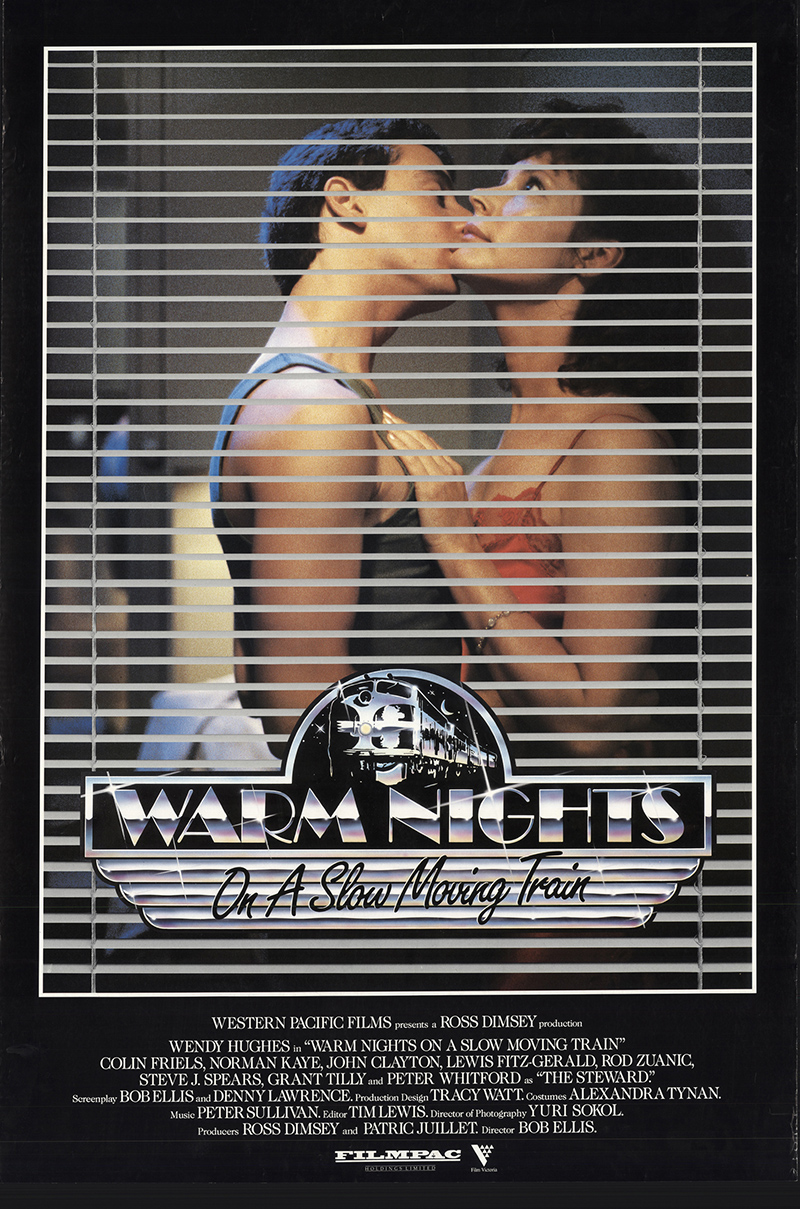
Jenny (Wendy Hughes) is an elementary catholic school teacher during the week, but on weekends she’s a prostitute riding a train that travels across the Australian countryside. She picks up lonely men that she meets at the train’s bar and takes them to her cabin for sex, but makes sure they’ve left by 3 AM. While she’s friendly and conversational with them during the night by the next day she virtually ignores them. She does this to help pay for her handicapped brother’s needs and for many years she’s able to juggle these dual lifestyles without much of a hitch. Then she meets a suave businessman (Colin Fields) who gets her involved in an assassination plot that not only disrupts her routine, but sends her precariously close to losing her freedoms.

Director Bob Ellis said the idea for the film was inspired by a long train ride that he took with actor Denny Lawrence and the two wrote the script during the duration of their trip. In order to get the needed funding it was contingent that Wendy Hughes be cast in the lead, which Ellis felt was wrong for the part, but eventually agreed to simply to get the film made. Ultimately though he and the film’s producer, Ross Dimsey, had a different vision for the story and Dimsey greatly trimmed the final cut turning what Ellis felt was one of the best scripts he had ever written into something he would later disown. The full director’s cut had been stored at his residence and he was hoping to eventually release it to the public, but it got destroyed during a house fire.

The version definitely has issues with the biggest one being the slow, plodding pace. I was also disappointed that it starts with Jenny already a seasoned hooker as I would’ve been more interested in seeing how she came up with the idea and seen the awkward moments she most assuredly would’ve gone through when she first jumped in and did it. The fact that she had no ‘Plan-B’ for the potential times when a male client might get aggressive, or not promptly leave at the agreed to time, was a weak point for me. There’s one scene where one of her johns follows her out of the train and won’t leave her alone, but she calls out to a nearby security officer to get him away from her, but if she’s a seasoned sex worker she should have another line of self-defense to use, like a gun or something, to take out if things got out-of-control and no one else was around to help her and the fact that she doesn’t have this makes it seem like she’s not as streetwise as we’re supposed to believe.

Having Jenny suddenly let down her guard and fall for one of her johns (Colin Friels) didn’t make much sense either. After years of being defensive around her clients why now get all emotional about this one who comes-off just as sleazy and aggressive and just as potentially dangerous? The assassination subplot doesn’t get introduced until 60-minutes in and the way she’s able to off the target by simply scratching the guy lightly on his back with a fingernail dipped in poison seemed much too easy.

I did like the juxtaposition of a catholic school teacher being a prostitute, but the film doesn’t explore this contradiction enough. You’d think after having done this for a long time her superiors might catch-on, or have it filter back to them, which could’ve created more conflict and added tension to a story that for the most part is too leisurely paced to hold one’s sustained attention.

My Rating: 4 out of 10

Released: May 10, 1987

Runtime: 1 Hour 31 Minutes

Rated R

Director: Bob Ellis

Studio: Filmpac Distribution

Available: dvdlady.com

The Last Detail (1973)

lastdetail

By Richard Winters

My Rating: 8 out of 10

4-Word Review: Seaman escorted to prison.

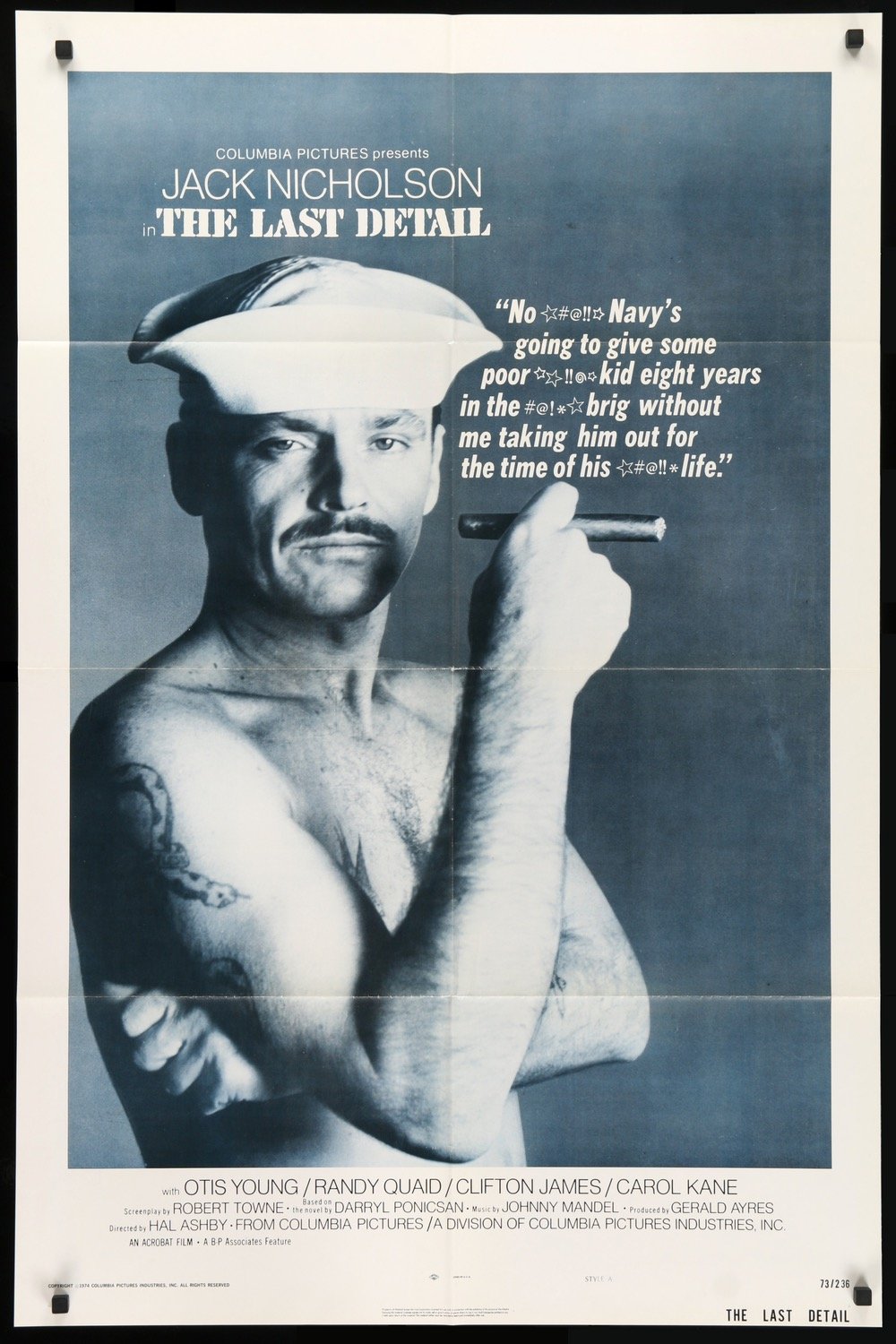
Billy Buddusky (Jack Nicholson) and Richard Mulhall (Otis Young) are two navy lifers assigned the task of escorting an 18 year-old seamen named Larry Meadows (Randy Quaid) to prison. Meadows had been caught lifting $40 from a charity fund run by a wife of a senior officer. In return he got court-martialed and given an 8-year sentence in the brig. Buddusky and Mulhall feel the sentence is too harsh and immediately take a liking to the soft-spoken young man who despite his tall height seems harmless and mile-mannered. During the trip, which is expected to take a week, the two men decide to show Meadows a ‘good time’ by taking him on many side-trips including a whorehouse where the young virgin has sex with a prostitute (Carol Kane). As the time grows near for them to turn their prisoner over to the authorities they start to feel reluctant about doing so, but the fear of being kicked out of the navy and losing all of their pay and benefits keeps them grounded in their responsibility even as Meadows tries several times to escape.

It may seem amazing to believe now, but this film, which has won over almost universal appeal both from the critics and film viewers almost didn’t get made due to the fear from the studio that the word ‘fuck’ was spoken in it too many times. Screenwriter Robert Towne, who adapted the story from the novel of the same name by Daryl Poniscan, was pressured to take most of the uses of the profanity out of the script and in fact production was delayed while both sides had a ‘stand-off’ about it with Towne insisting that “this is the way people talk when they’re powerless to act; they bitch.” Eventually the script got green-lit with all the ‘fucks’ intact, which at the time was a record 65 of them. In retrospect I’m glad Towne held his ground as without the F-word being used, or some silly lesser profanity substituted in, would’ve given the film a dated feel when being watched by today’s standards where the word is said hundreds of times on social media and sometimes even in commercials where it’s only slightly bleeped-out. This is a problem when watching other films from the late 60’s and early 70’s where goofy slang gets thrown in to compensate for the lack of the F-word, which in turn hurts the film’s grittiness and edge, which thankfully got avoided here.

The story was a problem too as many studio execs considered it too ‘non-eventful’ to make for an interesting movie, but this is the whole reason why the movie is so special as it doesn’t try to throw in the cheap antics other Hollywood films might to make it ‘more entertaining’. The film remains low-key and fully believable throughout and may remind others, as it did me, of one’s own coming-of-age experiences when they were 18 and hanging out with others who were older and more worldly-wise. Cinematographer Michael Chapman, who appears briefly as a cab driver, insistence at using natural lighting only also helps heighten the realism.

The story takes many amusing side turns that manages to be both poignant and funny including a brawl that the three have with a group of marines inside a Grand Central Station restroom, though I did wish some of the other segments had been strung out a bit more. One is when the three men attend a group encounter, which features Gilda Radner in her film debut, to a bunch of chanting Buddhists. I felt it was weird that the men just stood in the background and didn’t assimilate with the group during the meeting and begin chanting alongside the others, which would’ve been funny. The scene inside the hotel room where Buddusky can’t get his roll-out cot to fold-out right and forcing him to sleep in a uncomfortable position should’ve been played-out more too. Are we to believe that he slept that way the whole night?

Of course it’s the acting that makes this movie so special. While I never pictured Nicholson with his over-the-top persona as being someone who would be a part of the regimented culture such as the navy I ended up loving him in it and felt this was the performance he should’ve won the Oscar for. I especially got a kick out of the way he would get all fidgety when outside in the cold, which I don’t think was acting at all as it was filmed on-location in the Northeast during the very late autumn/early winter and I believe he was really freezing as he was saying his lines.

While his character is not as flashy, Otis Young is every bit as excellent as it takes a good straight-man, which is what he essentially is, to make for a good funny man. The part was originally meant for Rupert Crouse, who unfortunately got diagnosed with cancer just as the production began forcing the producers to bring in Young as a last minute replacement, but he manages to deliver particularly in the scene on the train where he loudly castigates Buddusky for his misbehavior. Quaid is quite good too even though he goes against the physical characteristics of the character, who in the novel was described as being ‘a helpless little guy’, but director Hal Ashby, who can be seen briefly during a barroom scene, choose to cast against type by bringing in a tall, hefty fellow who looked like he could defend himself if he had to, but is just too sheltered to know how.

The ending is the one segment where I wished it had been a little more emotionally upbeat. It’s still a big improvement over the one in the book where Buddusky dies, which fortunately doesn’t happen here, but it still isn’t too memorable either. The film though overall does a good job of conveying the underlining theme of how the navy men where just as imprisoned as Meadows, at least psychologically, and unable to consider life outside of the navy box that they had spent their entire lives in and where thus locked-in more so than Meadows, whose sentence in jail would only last 8-years versus a lifetime like with Buddusky and Mulhall.

My Rating: 8 out of 10

Released: December 12, 1973

Runtime: 1 Hour 44 Minutes

Rated R

Director: Hal Ashby

Studio: Columbia Pictures

Available: DVD, Blu-ray, Amazon Video, YouTube