Category Archives: Movies that take place in Chicago

Harry and Tonto (1974)

harry1

By Richard Winters

My Rating: 6 out of 10

4-Word Review: Old man and cat.

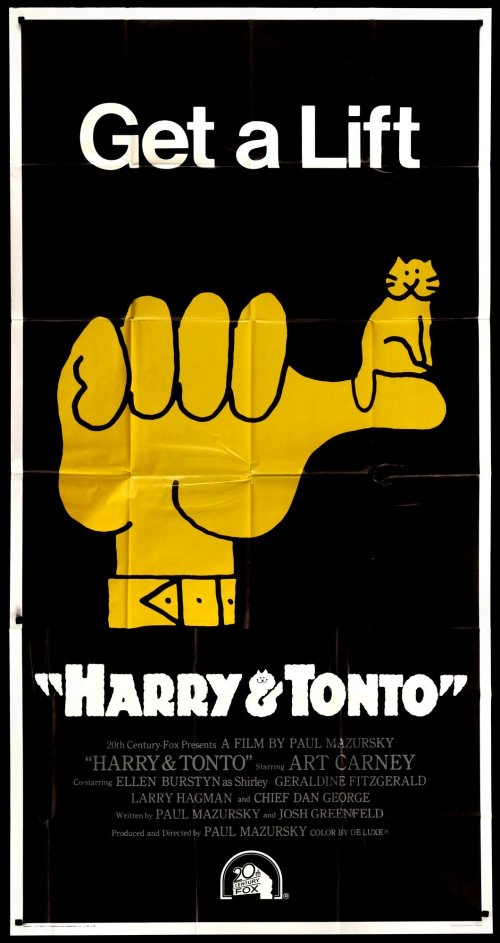
Harry Combes (Art Carney) is a 72 year old retiree living in a small New York apartment with his pet cat Tonto and finds out that the complex is about to be torn down and he must leave. At first he moves in with his son (Phil Bruns) and his family, but it does not work out. He decides to take a cross-country odyssey with his cat where he meets a variety of interesting people in this senior citizen variation of Easy Rider.

One of the great things that sets this film apart from others that deal with aging is that there is no death, dying, illness, or senility here. Instead of learning to adjust to the ending of one’s life, our character instead realizes that old-age is just another stage in a person’s existence and full of new experiences and possibilities. I thought it was cool and interesting how he meets a 15 year old teen girl runaway (Melanie Mayron in her film debut) named Ginger and the two set out to try and find themselves as well as search for life’s answers. They share a lot more in common than one might expect and only prove that life is a continual exploration no matter what stage you are in.

The Harry character is refreshingly laid-back and easy going unlike most elderly characters who tend to be betrayed as stuck in a bygone era. Although he does reminisce about the ‘old days’ with his friends, he does not expound on boring stories of yesteryear with young people, nor act like he has all the answers simply because he is older. He approaches everyone in a non-judgmental way that allows each person he meets to be themselves. He proves to be a lot more flexible and open-minded than the other, younger adults in the film including his own children.

There were only a few scenes involving the Harry character that I didn’t like. One is when he refuses to leave his apartment even as the wrecking ball crew stands outside. The police end up having to be carry him out while he still seats in his favorite chair, which seemed forced and unrealistic. There is another scene where he is at the airport ready to board a plane, but he refuses to allow, for no particular reason, the security to search the cage that has his cat in it even though it is accepted procedure.  This may have been writer-director Paul Mazursky’s way of showing that Harry could at times be set in his ways, but to me it went beyond being simply stubborn and more into the irrational and was not consistent with his behavior in the rest of the film.

The script has a lot of amusing and even touching slice-of-life vignettes as well as characters that are quirky, but not absurd.  The scene with Harry meeting an old Indian medicine man named Sam Two Feathers that is played by elderly Indian actor Chief Dan George is well handled. George had no formal acting training, but his raw delivery is an inviting change of pace.  I also enjoyed at the very end when he meets a woman with a bounty of pet cats that his played by comedian Lenny Bruce’s mother. Again, she had no acting training, but the scene captures her natural out-going personality and it is fun.

I felt Phil Bruns gave an outstanding and overlooked performance as Harry’s older son Burt.  The constant nervous and stressed-out expression on his face seemed to be a perfect composite of the middle-aged suburban male that is overrun with job demands and family responsibilities.  Larry Hagman is good as well in a brief, but memorable appearance as Harry’s other son Eddie. He spends the first part of his visit with Harry trying to impress him with how ‘good’ things are going only to end up breaking down when it becomes painfully obvious that he is desperate and broke.  Even director Mazursky gives himself a cameo as a gay prostitute who makes a pass at Harry.

If the film has any faults it is the fact that it is too amiable. I would have liked to have seen a little bit more action and comic misadventure. I thought it could have been funny and intriguing to see Harry inside a hippie commune, which is where he takes his two teen passengers. Instead he lets them off without going himself, which seemed like a missed opportunity.  There is another part where he inadvertently hitches a ride with a high-priced hooker (Barbra Rhoades) who immediately starts to get ‘horny’ when he Harry gets in. She drives the car off the road and parks it in the middle of the dessert and then the film cuts away. I think this could have been hilarious had this scene been extended. I was also disappointed that the very talented Ellen Burstyn is seen only briefly playing Harry’s daughter Shirley. This was even more of a shame because Burstyn gets cast against type here playing a character that is rather edgy and opinionated and there was strong potential for some good drama.

There are a few extended conversations where Harry discusses with some of his old friends their inability to perform sexually and how they hadn’t had sex for well over twenty years.  With the advent of Viagra, a product that was invented and manufactured right here in good old Indianapolis, these types of topics are no longer as relevant and make the film seem dated.

Of course the one thing that holds it all together and propels the movie from beginning to end is the outstanding Oscar winning performance of Carney, who until then was best known as the comic side-kick Ed Norton from the classic series The Honeymooners. Although he seemed perfect for the part he was not the Producers first choice and had to lobby hard to the get the role.  He was actually only 55 years old when the film was made and to help compensate he openly wore his hearing aid, which gets shown a lot, as well as dying his hair gray.

His win on Oscar night in 1974 became an historic upset. He was going up against very stiff competition that night including Dustin Hoffman for Lenny, Jack Nicholson for Chinatown, and Al Pacino for The Godfather Part 2. When Carney’s name gets called the look of shock on his face is very apparent as even he was not expecting it.  The moment is worth a look and can be seen on YouTube for those who are interested.

My Rating: 6 out of 10

Released: August 12, 1974

Runtime: 1Hour 55Minutes

Rated R

Director: Paul Mazursky

Studio: 20th Century Fox

Available: VHS, DVD

The Fury (1978)

By Richard Winters

My Rating: 5 out of 10

4-Word Review: Blow up the body.

Another Brian De Palma/Hitchcock wannabe, this one involving a sinister secret government agent named Ben Childress (John Cassavetes) who wants to use the amazing psychic abilities of a young college-aged man named Robin Sandza (Andrew Stevens) for his own nefarious purposes. While he is in Israel with the father and son he decides to stage a terrorist attack, which he hopes will kill the boy’s father Peter (Kirk Douglas) and allow him to whisk Robin away to an underground research lab where no one will find him. However, Peter manages to survive the attack and goes on a relentless pursuit to find his son. This occurs while a young woman named Gillian Bellaver (Amy Irving) with equally strong parapsychological traits starts to have visions of Robin and his whereabouts while attending a school that specializes in people with these abilities and eventually she teams up with Peter to help him in his quest.

I liked the opening sequence being shot on-location in Israel, which gives the film an exotic feel. The attack is well-handled and comes as a surprise without any set-up, but I felt there was a fatal flaw with the premise. This is namely the fact that with Robin’s amazing psychic abilities you would think he could figure out that his Dad was still alive and be able to find him while also outsmarting the people who are holding him.

The secret agency thing and what they are using him for is vague and we see only a few scenes with him there. I felt this should have been more detailed and less time spent with Gillian at the psychic school, which is not very compelling and rather draggy.     There are a few good action moments, but unfortunately they come at the beginning and end with a talky middle that lacks any real suspense.

However, Peter’s escape from some gunmen by jumping out of an apartment window and onto the ‘L’ tracks along Wabash Avenue in Chicago is amazingly well shot and nerve-wracking.  A scene where Robin tortures a female Dr. (Fiona Lewis) by using his telepathic powers to spin her around a room until  blood oozes from her body and sprays all over the walls and furniture deserves some merits, but I wished it had been more extended. There is also the exploding body that is the film’s final shot and possibly its best and it is shown several times at different angles. I also enjoyed the darkly humorous scene where Robin uses his powers to send a ride at an indoor amusement park out of control and throwing the riders through the window of a nearby restaurant.

De Palma’s trademark over-direction is in full gear. Sometimes it works, but other times it is a distraction. For instance he uses a lot of panning shots showing one person talking and then panning to the other person and then back again. During a funny scene where Peter breaks into an older couple’s apartment while looking for a disguise this really works, but De Palma continues to go to this well throughout and eventually it becomes annoying. There is also a foot chase that is done in slow-motion, which to me sapped the tension and excitement right out of it. He does have a few bird’s-eye view shots, which while not adding anything to the story, are still kind of cool.

Andrew Stevens, son of actress Stella Stevens, is well cast as the young man who starts out likable, but slowly becomes evil as the film progresses. Stevens has a good knack for this as he can go from nice to menacing very quickly and I first noticed this during a classic episode of Murder She Wrote. His clear blue eyes can give off a creepy stare as well.

John Cassavetes is an excellent bad guy.  He is best remembered as an independent film director with a unique vision, but with his dark features, cryptic glare, and intense delivery he can also be a very good villain. I don’t think the film made the most of it, but it was astute casting.

Although billed as the star Douglas does not have the most screen-time and there are long periods where he isn’t seen at all. This was really a vehicle for Irving, who is convincing and makes the viewer sympathetic to her quandary of having super-powers that she does not fully understand, cannot control and doesn’t really want.

It’s an interesting idea, but doesn’t go far enough with it. There weren’t enough twists to justify sitting through almost two hours. The pacing is poor and had it been trimmed to 90 minutes it would have worked better. The special effects are decent, but there needed to be more of them and they might not hold-up to contemporary standards. John Williams’s orchestral sounding score helps elevate what is really just bubblegum material.

This is a great chance at seeing some young stars in their film debuts including Darryl Hannah, Laura Innes, and James Belushi. There is also an amusing scene featuring Dennis Franz with a full head of hair playing a nervous and befuddled Chicago cop.

My Rating: 5 out of 10

Released: March 10, 1978

Runtime: 1Hour 58Minutes

Rated R

Director: Brian De Palma

Studio: 20th Century Fox

Available: DVD, Amazon Instant Video

T. R. Baskin (1971)

tr baskin

By Richard Winters

My Rating: 8 out of 10

4-Word Review: Out on her own.

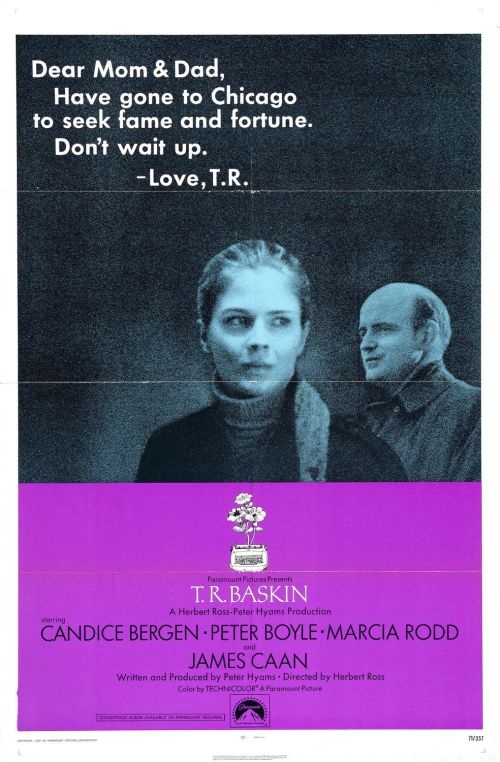
T. R. Baskin (Candice Bergen) is a young woman who leaves the nest by striking out on her own in Chicago. Unfortunately she finds nothing but a lot of loneliness, dead-end dates, crummy apartments, and soul-sucking jobs. Our protagonist becomes so emotionally beaten down that when a traveling salesman named Jack Mitchell (Peter Boyle) calls her looking for a ‘good time’, as he mistakenly is given her number under the impression that she is a prostitute, T.R. accepts his invitation simply as a chance to connect with someone. The film then cuts back and forth between conversations that she has with Jack in his hotel room as well as her experiences when she first gets into the Windy City.

Although this film does have its share of faults I was really taken aback by its strong emotional impact. The film was directed by Herbert Ross who would later do Footloose, The Goodbye Girl, and Steel Magnolias. The screenplay was written by Peter Hyams famous for writing and directing Capricorn One, Narrow Margin, and 2010 to name a few.

The film manages to recreate the monotony and isolation of day-to-day living better than just about any other movie that I have seen. Some of the best scenes include T.R.’s job interview process at an accounting firm as well as a long camera pan showing all the rows and rows of desks in the office and T.R. looking lost in the middle. There is another part where she sneaks back into the office on a weekend day in order to make silly announcements over their intercom system and the images of all the dark shadowy desks looks just as ominous. Another moving moment is when she is shown pacing her lonely apartment as well as her phone conversation with her parents where she tries to convince them that she is doing ‘just fine’, but breaks down into tears the second it ends.

The film leaves you with a strong impression. The music that was selected was first-rate and fits the mood of the picture perfectly. It is a real shame that this sleeper has never been released on either VHS or DVD and has not been shown on television since December of the 1980 when it was broadcast on Cinemax. It is well worth seeking out and certainly deserves more attention.

Bergen is terrific in the lead. This is before she attained her acerbic persona from her ‘Murphy Brown’ days and here comes off as more shy and sensitive. Her delicate and attractive features help capture the viewer instantly.

Boyle is equally good and the introspective conversations that the two have nicely runs the gamut between funny and sad. James Caan, who for some reason appears unbilled, has a nice cameo as an attractive and intelligent man that T.R. falls for only to have him callously break her heart.

If the film has any flaw it is in the fact that it is a bit uneven. It starts out with some terrific dry humor including a hilarious scene when she goes apartment hunting, but eventually the movie becomes too much of a downbeat drama. There are certainly universal truths to many of the sad situations that she goes through, but I found it frustrating that we are never shown her eventual fate. All we see is a small period in her life and then a very abrupt and unsatisfying ending. It would have been nice if the story had cut to five, ten, even twenty years down the road and allowed us to find out if she ever found ‘Mr. Right’ and some happiness.

Despite being made forty years ago this film is as trenchant and timely as it was back then. People who avoid watching older films because they believe that they are ‘dated’ are being foolish. This film has more bearing in reality and the human experience than a lot of the movies out today.

My Rating: 8 out of 10

Released: October 20, 1971

Runtime: 1Hour 30Minutes

Rated PG

Director: Herbert Ross

Studio: Paramount

Available: Amazon Instant Video