Category Archives: Movies Based on Novels

Deathwatch (1980)

deathwatch 2

By Richard Winters

My Rating: 8 out of 10

4-Word Review: Everyone watches her die.

Based on the David Compton novel this story deals with Katherine (Romy Schneider) who is living in a futuristic society where almost all diseases can be cured and death is very rare. When she is diagnosed with having a rare and incurable illness Vincent (Harry Dean Stanton) tries to get her to appear on his hit reality show ‘Deathwatch’ in which they film in documentary style a person’s slow and agonizing death, which is a huge TV hit. When Katherine tries to escape the publicity and hide from their cameras Vincent has a small camera surgically implanted into the brain of Roddy (Harvey Keitel) one of his cameramen, which then allows  Roddy to follow Katherine around and record her actions without her knowing it. The two then slowly form a relationship that culminates with tragic results.

Director Bertrand Tavernier is in top form. The movie is nicely paced and Tavernier shows a perfect grasp of the material. His use of music wonderfully accentuates the mood and tone. Filmed on-location in Scotland he captures the old buildings of the region with a stylish flair that gives the film an added personality and memorable image. Showing characters walking all alone in the seemingly abandoned streets hits home their loneliness and having the scenes done in decaying buildings and neighborhoods illustrates the decaying values and morals of the world these characters live in. The gray stormy skies brings out the pictures moodiness and the isolated shack in the middle of a vast empty field that the two hide out in captures visually the characters lost and hopeless desperation. The film becomes like an orchestral ensemble moved along by a talented conductor at the peak of his skill.

This is also a great example of using a hand-held camera sparingly and only to create a certain mood, or emotion. Too many films these days seem to have what I call ‘the shaking camera syndrome’ and it is annoying and loses the original intended effect. Here Tavernier employs it during a scene where Katherine is trying to elude the production crew and the viewer feels her frantic tension with each move that the camera makes as well as getting a great cultural feel by capturing the various street vendors along the way.

The story itself is fascinating and years ahead of its time. The issues it brings out about television, ratings, and the cutthroat ugly world of business of entertainment have never been more on-target. This film may even transcend the classic Network with its dire message and that is not easy to do. What I really liked though was the fact that the twists keep coming in layers and all of them are unexpected, but equally fascinating. The story is riveting and compelling from beginning to end.

Schneider is brilliant and beautiful as always giving another one of her impeccable performances. Her character is easily identifiable and the viewer immediately gains her sympathy. She shows an array of different emotions and traits making her a fascinating three-dimensional person. Her presence is the main ingredient that propels the film and without her none of it would have worked and her gorgeous natural smile is wonderful and manages to come on display briefly despite the ugly difficulties of her character.

Keitel is in fine form as well playing a character who finds that when one works for those who are more than willing to exploit others they themselves will eventually be exploited by them as well. Von Sydow appears near the very end and lends stature to the proceedings.

I hate to bring this up because I love the film’s visual design, but I did find it a bit odd that the story is about the hi-tech future and yet all we are shown are old buildings and other gadgets that look very much like they are from the 1980’s. The computer that Katherine works on is laughably archaic and I felt from that end they could have tried harder to create a little more of a futuristic impression. Also, the name of the network ‘NTV’ sounds a little too much like the cable network that used to show music videos.

The recent Blu-ray release from the Shout Factory is excellent and restores the film to its original runtime of 130 minutes. I highly recommend this to those who enjoy Sci-fi fare that is thought provoking and original.

My Rating: 8 out of 10

Released: January 23, 1980

Runtime: 2Hours 10Minutes

Rated PG

Director: Bertrand Tavernier

Studio: Gaumont International

Available: VHS (1Hour 57Minute Version), DVD, Blu-ray
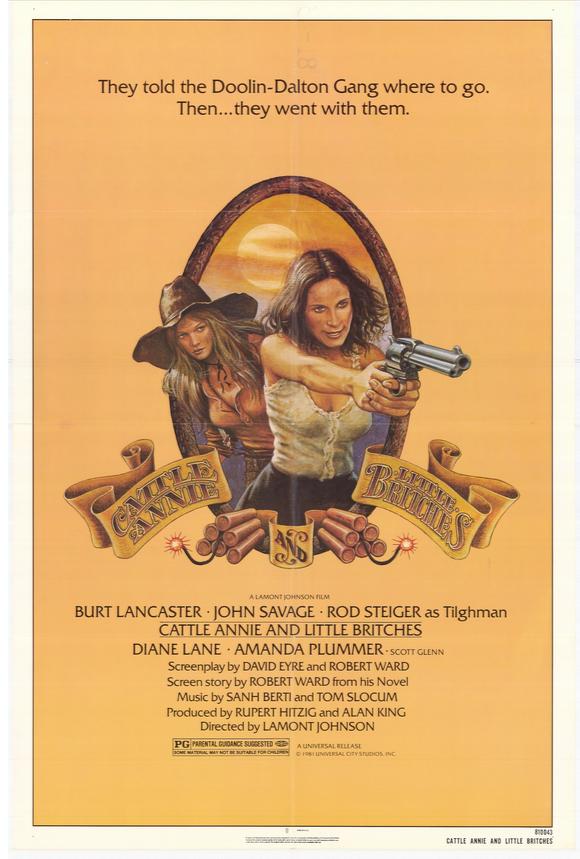
Cattle Annie and Little Britches (1981)

cattle annie and little britches

By Richard Winters

My Rating: 6 out of 10

4-Word Review: She needs a spanking.

Based very loosely on actual events this film looks at Annie McDoulet (Amanda Plummer) and Jennie Stevens (Diane Lane) two adolescent girls traveling in the Oklahoma Territory of the late 19th century looking for excitement and adventure. Annie becomes transfixed with the stories that she reads about the western outlaws particularly the ones about Bill Doolin (Burt Lancaster), but when they finally do catch up with his gang they find the men to be old, haggard, and tired as well as just one-step ahead of the relentless pursuit of famed western lawmen Bill Tilghman (Rod Steiger).

Plummer, in her film debut, is nothing short of electrifying. She is the daughter of Christopher Plummer and actress Tammy Grimes and she makes her presence strongly felt here. Her vulgarity and tenaciousness are infectious and help propel the film and easily steal every scene that she is in. She has her mother’s distinctively reedy voice and although not beautiful in the conventional sense her facial features still have an alluring quality that she makes the most of.

Lane as her cohort is good as well although not as strong, or riveting. Her plus is the fact that she is simply beautiful with perfect and delicate features of a young lady blooming into adulthood. The fact that her character is more shy and unassuming plays off well against the abrasiveness of Plummer’s and the tussle that the two have near the end is fun.

Lancaster is badly miscast. For one thing the real Bill Doolin was much younger and in fact was shot dead at the young age of 38 and yet here Lancaster was already 66 when he did the part. I also felt that the character was a little bit too good to be true. It just seemed too hard to believe that a rugged western outlaw would be so kind, gentle, understanding and wise. I suppose his fans wouldn’t want it any other way and the part seems to be written to conform to his star status, but the effect hurts the film’s overall authenticity.

Steiger on the other hand is quite strong and director Lamont Johnson makes perfect use of Steiger’s legendarily intense manner. In fact I was disappointed that he wasn’t in more of the film as his presence helps create some much needed tension in a film that at times seems too slow and laid back. His finest moment, and the best part in whole film, comes when he tackles Annie and gives her a nice long hard spanking.

The score, like the film, seems unfocused and creates an unnecessary mish-mash of moods. The vocal ballads done with a minimum of instruments is good as they have a country twang and fit the period, but there are other points when a jazzed up score with modern rock elements is played, which takes the viewer completely out of the setting. There is also too much music played when the natural sound and ambience would have been better especially with a western.

Watching the girls interacting with the gang as well as surprising them with their unexpected toughness is what makes the film interesting. The climatic sequence in which the two decide to go by themselves to get Bill out of jail and the very brazen and clever way that they do it is special. Why Universal decided to abandoned what is otherwise a pleasing little western is baffling. This film is long overdue for a DVD/Blu-ray release and fans of the cast should let the people in charge know as well as taking the studio exec, if he is still around, who decided to put the kibosh on this movie and throw him into a lake.

My Rating: 6 out of 10

Released: April 24, 1981

Runtime: 1Hour 35Minutes

Rated PG

Director: Lamont Johnson

Studio: Universal

Available: None

Topkapi (1964)

topkapi 1

By Richard Winters

My Rating: 8 out of 10

4-Word Review: Granddaddy of heist movies.

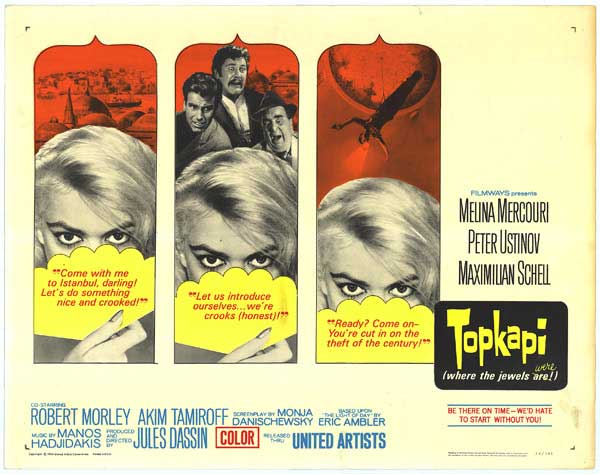
Elizabeth (Melina Mercouri) and Walter (Maximilian Schell) have formed a group of amateur thieves to help them steal an emerald dagger out of the famed Topkapi Palace in Istanbul, Turkey. Problems ensue when one of the original members of the group becomes injured and they are forced to hire on the services of Arthur Simon Simpson (Peter Ustinov) a bungling, portly small-time crook whose on-going ineptitude almost throws their well thought out plans into jeopardy.

This film has become the granddaddy of heist films and rightly so. Based on the novel ‘The Light of Day’ by Eric Ambler the story is well-crafted and nicely detailed. The plan is elaborate, but fortunately believable and plausible. Director Jules Dassin seems to have all the logical loopholes covered. The production design is plush and captivating with just the right amount of offbeat touches to keep it original and cinematic. I found myself enjoying the dry humor and characterizations interspersed in-between the planning and action. The momentum builds evenly without every feeling rushed, or draggy. The on-location shooting is a plus that not only captures the sunny climate, but also the distinct ambience and look of the region.

The climatic sequence involving the actual heist is exciting. The actors do all of their own stunts including Gilles Segal as Guilio being lowered upside down into the palace by a rope being held rigorously by Walter and Arthur and doing most of his maneuvers trapeze style. The whole scene had me holding my breath most of the way and Dassin manages to capture if all from different and interesting angles while allowing the silence to help create the tension.

Ustinov is in fine form and deservedly won the Oscar for best supporting actor. Supposedly the part was originally intended for Peter Sellers, but Ustinov gives the character a lovable quality that I don’t think Sellers could. Ustinov’s rotund physique is an added benefit and his nervous looking facial expressions are consistently amusing with the interrogation scene by Turkish authorities being his best moment. It’s nice to see the character evolve and find a confidence he didn’t think he had while gaining a begrudging respect from the others.

Mercouri sizzles. Normally I am not crazy about women with deep, throaty voices like hers, but she makes it tantalizing. The character is a self-described nymphomaniac and the expression on her face as she watches a group of men spread lotion over their half-naked bodies is worth the price of the film.

The rest of the supporting cast is okay, but I found it odd how very polished they were when Walter insisted that he wanted amateurs for the heist that had no criminal background, or record. Having them behave in a befuddled besides just Arthur would have been more realistic and expected. I also didn’t like that the Guilio never says a single line of dialogue. Apparently the character was a mute, but there is no reason given for it and in the process makes him transparent and boring.

Spoiler Alert!

The only real problem I had with the movie is the ending. As Guilio is exiting the palace a little bird flies through the window while he is closing it, which in turn sets off an alarm, which leads to the gang getting arrested. However, I couldn’t understand how the trapped bird would’ve allowed the police to figure out what happened as an exact replica of the dagger that they swipe is put onto the chest of the sultan figure. To me it just seemed like one twist too many and the scenes showing them inside the prison is campy and forced. These guys had been portrayed as being slick and sophisticated most of the way, so why turn them into clowns at the end. Possibly this was done to show that ‘crime doesn’t pay and no crime portrayed in a film should go unpunished’, which was a code most movies were forced to work under in the past. Either way it doesn’t work and kind of hurts what is otherwise a snappy piece of entertainment.

My Rating: 8 out of 10

Released: September 17, 1964

Runtime: 2Hours

Not Rated

Director: Jules Dassin

Studio: United Artists

Available: VHS, DVD (Region 1 and 2), Amazon Instant Video

Dealing: or the Berkeley-to-Boston Forty-Brick Lost-Bag Blues (1972)

dealing

By Richard Winters

My Rating: 5 out of 10

4-Word Review: Drugs are a trip.

This review was originally slated to post in February, but due to the death on Christmas Eve of Charles Durning I decided to post it now. Durning was one of the all-time great character actors who always brought an amazing amount of energy to every role he played and could do a wide variety of character types well. Although he has very few lines of dialogue in this movie he still manages to become the most interesting part of the proceedings and helps enliven an otherwise slow moving film.

The plot, based on a novel by Michael Crichton, pertains to Peter (Robert F. Lyons) who is a recent Harvard graduate hired by John (John Lithgow) to transport a suitcase full of marijuana from Boston to Berkeley, California. Peter is new at this and things do not go as planned, but he meets beautiful Susan (Barbara Hershey) along the way and the two fall in love. John next hires Susan to transport another suitcase of narcotics, but when she loses the luggage at the airport and then tries to go back and get it she is arrested by corrupt cop Murphy (Durning) who resells some of the recovered stash back out onto the street. In order to get Susan out of jail Peter plays an elaborate game of cat-and-mouse with the cop, which culminates in a violent showdown.

The story is done in a laid-back style similar to the approach taken by many European films. The emphasis is on mood and subtle nuance yet when the Europeans do it this style seems refreshing, but here it is more off-putting. I really had a hard time getting into it as the first hour is slow with too many scenes going on longer than it should. The set-up is too quick and there is not enough background, or history shown to the main character.

The second hour improves. Durning gives the proceedings some pizazz and Peter’s scheming is fun. The shootout done in the snow has flair and style.

The music by Michael Small is impressive. It is one of the most original scores I have heard and really fits the mood of the script. The best is over the opening credits.

Hershey is as always gorgeous and fans may like that she is shown topless. The part of a free-spirited hippy chick seems to be her forte and she excels. However, having her fall for a guy that is rather dull and ordinary didn’t make sense. Sure they make love right away, but I thought that was more just because it was a part of her lifestyle and she does after all go around in a dress without wearing any underwear. She just seemed to be diving into the free love atmosphere of the era. Obviously having Peter fall for her made sense because she is hot, but why would she go head-over-heels for this schmuck when there are so many other guys that would be more than willing to do it with her. The romantic angle was forced and hurt the credibility of the story.

Lithgow is okay in his film debut, but I had problems with the character. One minute he is cool, conniving, brash, and arrogant and then in the next instant he becomes scared, confused, and meek, which was too much of a quick transition.

The under-rated Lyons is excellent and makes for a terrific lead especially with this type of part. Despite being in his 30’s he looks and acts very much like a college kid from that period. His performance is nicely understated and believable throughout.

The on-location shooting in Boston is vivid and people from the area may like to view this just to see how much it has changed. The DVD transfer from Warner Archive is excellent with a nice clarity and vivid colors. The movie itself is slick, but it also has a detachment to it that doesn’t allow the viewer to get as connected with the characters, or the situations like they should and thus making it an interesting period artifact, but nothing more.

Also, Demond Wilson can be seen briefly as one of the drug dealers. He did this just before his signature role of Lamont in the hit TV-series ‘Sandford and Son’. Ellen Barber is real cute as Peter’s girlfriend and so is Joy Bang who later became a registered nurse. Normally I don’t like women with buck teeth, but with her it actually looks sexy.

My Rating: 5 out of 10

Released: February 25, 1972

Runtime: 1Hour 28Minutes

Rated R

Director: Paul Williams

Studio: Warner Brothers

Available: DVD (Warner Archive)

Up in the Cellar (1970)

up in the cellar 3

By Richard Winters

My Rating: 5 out of 10

4-Word Review: Senior citizens watch porno.

This is a variation of the film Three in the Attic and for a time was called Three in the Cellar to try and capitalize off of the success of that one. Ironically both films starred Judy Pace. In this one Colin Slade (Wes Stern) is a nerdy college student who loses his scholarship to a computer glitch. When he can’t get college president Maurice Chamber (Larry Hagman) to help him, he decides to get revenge by seducing both his wife (Joan Collins) and daughter (Catlin Adams).

The production proudly proclaims to be filmed on location in New Mexico, which is obvious from the start and nothing to really boast about since it hurts the film as a whole. Shot in wintertime it’s dusty, desolate landscape leaves the viewer with a cold, lonely feeling, which configures poorly with a story that is supposed to be lighthearted and whimsical. The big, modern cement buildings used as the campus looks like they would be better suited for a corporation than a student body. The students themselves, or what little you see of them, look all suspiciously over the age of 24.

Director Theodore J. Flicker nicely camouflages the fact that this is a very low budget production. His script is compact and well-paced. He frames and cuts his shots so you don’t notice how lacking in personality or energy it really is. Yet he also shows little connection to the student uprisings that dominated the campuses of that era and seems to view it as a sort of silly amusement. He keeps the film at this tone the whole time and thus makes it as silly and forgettable as the characters and situations he tries to satirize

Hagman comes off best. He plays it with a fun mixture of traits from two of his best known characters. He has J.R. Ewing’s arrogance coupled with Major Nelson’s frantic anxiety.

The film also has two fun and unique scenes. One has Hagman climbing up an actual radio tower to save Stern who is threatening to jump off. The second one has a pornographic movie shown to a group of unsuspecting and shocked senior citizens

My Rating: 5 out of 10

Released: August 12, 1970

Runtime: 1Hour 34Minutes

Rated R

Director: Theodore J. Flicker

Studio: American International Pictures

Available: Amazon Instant Video

How to Succeed in Business Without Really Trying (1967)

how to succeed in business without really trying

By Richard Winters

My Rating: 8 out of 10

4-Word Review: Up the corporate ladder.

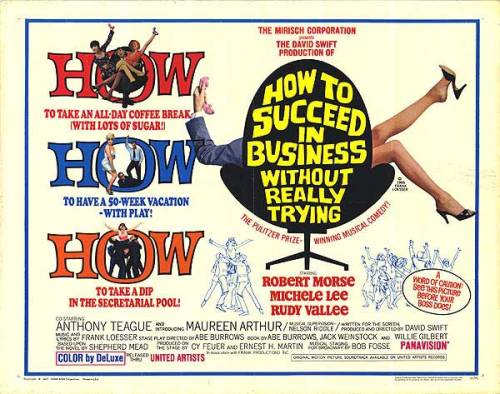
J. Pierpont Finch (Robert Morse) is a window washer looking to get ahead in the business world. By pure chance he finds a book entitled ‘How to Get Ahead in Business without Really Trying’. He reads it and follows the advice. He quickly gets a job at a large company and within days he moves all the way up from the mailroom to the head of advertising and eventually chairman of the board all without doing much work in this adaptation of the hit Broadway play, which in turn was an adaptation of the Abe Burrows novel.

This delightful film is lively and fresh even after all these years. The humor of course exaggerates life in the business world, but remains on target nonetheless. It accurately pinpoints all the universal problems and politics one goes through when working at a large company and dealing with the inside politics of getting ahead. Nothing is dated because it sticks with exposing the human foibles that come about in any generation when in a competitive and uncompromising environment, which is why I found it funny and interesting.

David Swift’s direction is top-notch. The pace is fast and furious balancing the humor and songs nicely. The sets are colorful and garish enough to accentuate the story’s farcical nature, but still bring out an office atmosphere feeling as well as the bigness of the company with large and imposing doorways including the amusing cathedral-like one that opens up to Finch’s office at the very end. At no times does the film suffer from the static staginess like most stage plays do when adapted to the screen.

The songs by Frank Loesser are upbeat and melodic and sound distinctive. My favorite one was the toe-tapping ‘A Secretary is Not a Toy’, but the showstopper ‘Brotherhood of Man’ had the best dance routines and was rousing enough to almost get me out of my seat. Rudy Vallee and Morse are also great in their rendition of ‘The Old Ivy’ fight song.

Morse recreates his role from the Broadway production. His voice isn’t necessarily the best and some of his singing seems a bit off-key, but his very boyish looks, gap-toothed grin, and bowl haircut is perfect for the part. A fun moment involving him is the scene where he prances down a busy New York sidewalk that was done with hidden cameras and the reactions from the other people on the street are genuine and real.

Michele Lee is terrific in her film debut. Her energy and perky smile are perfect as is her voice in the rendition of ‘I Believe in You’. She is probably best known to most for her starring role in the long running TV-series ‘Knots Landing’. What I can’t get over is how she continues to look like she hasn’t ever aged. A video on YouTube from her appearance at a 2011 AARP event has her looking almost the same as she does in this film. The interviewer tells her she is looking good and Lee replies ‘I always do’, which may seem conceited to some, but when one continues to look as great as she does then I suppose it is deserved.

Vallee best known as a crooner from the 1920’s is fun as Jasper Biggley the pompous head of the corporation. Anthony Teague with his devilish grin is great as the nefarious Bud Frump. I also liked the cute Kay Reynolds as Smitty and found it a shame that neither of these two talented young performers went on to do much else film-wise after this.

The only one I really didn’t like was Maureen Arthur as the ditzy and dumb Hedy Larue. Her high pitched voice and body gyrations were clichéd, over-the-top, and more annoying than funny. However, the incompetent way she takes down a dictated letter as well her reluctance to put her hand on a giant Bible during the film’s hilarious treasure hunt scene did manage to elicit some chuckles.

In 2011 the play was brought back to Broadway with Harry Potter’s Daniel Radcliffe in the lead. I wouldn’t be surprised if a remake of the film version comes out at some near point although nothing has been announced. Either way this film stands fine on its own and although never mentioned amongst the classic musicals I think it should be.

My Rating: 8 out of 10

Released: March 9, 1967

Runtime: 2Hours 1Minute

Rated NR (Not Rated)

Director: David Swift

Studio: United Artists

Available: VHS, DVD, Amazon Instant Video, Netflix streaming

The Roman Spring of Mrs. Stone (1961)

By Richard Winters

My Rating: 6 out of 10

4-Word Review: Throw keys to transient.

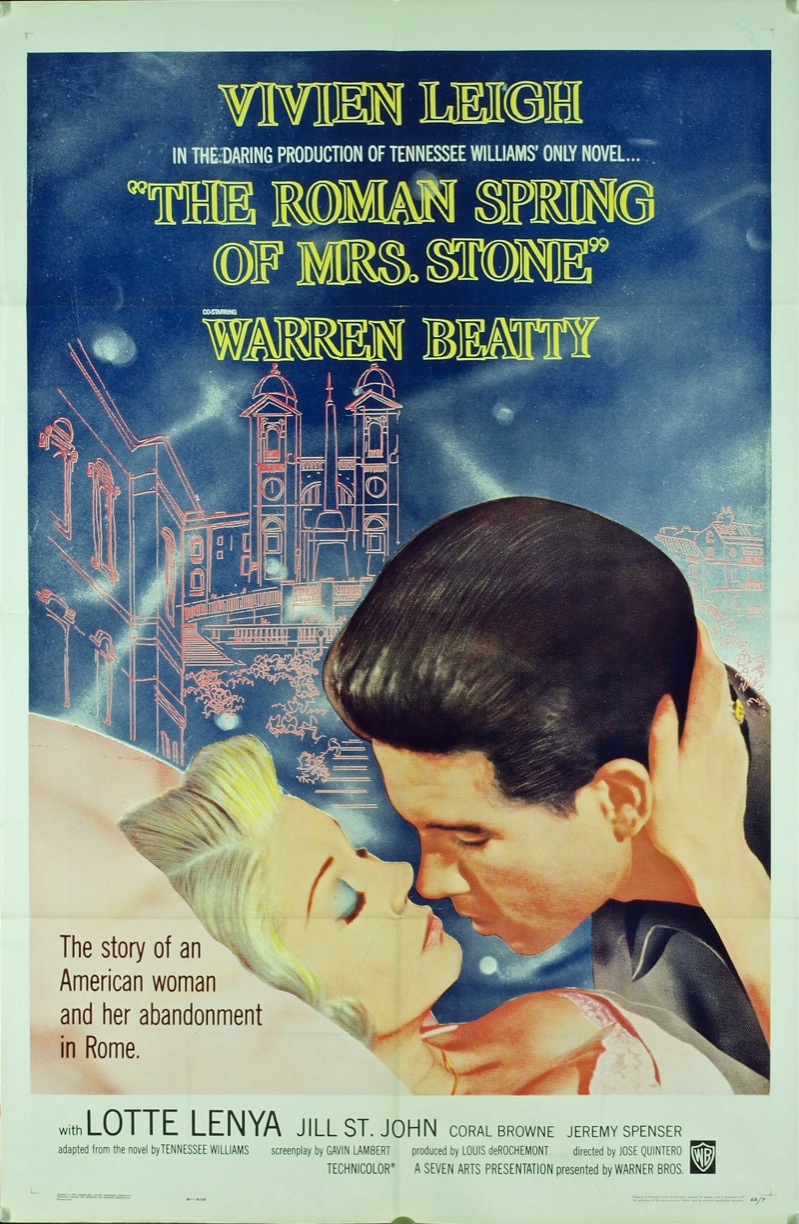
Karen Stone (Vivien Leigh) is an aging actress who is no longer getting the top roles like she used to. She and her husband decide to travel off to Rome for a retreat, but instead he dies of a fatal heart attack while on the plane. Karen then decides to remain in Rome where she leases a luxurious apartment, but becomes lonely and starts feeling insecure about her desirability.  She meets Contessa Madga (Lotte Lenya) who is known in the area with setting up young men with lonely rich older women.   She sets Karen up with Paolo (Warren Beatty) a dashing young gigolo who is only attracted to Karen because of her money and the belief that she will pay him to be her lover while Contessa will get a cut of the profit. Karen does give Paolo a ‘salary’, but remains under the delusion that eventually he will fall in love with her for real.

Although the story moves along at a slow and plodding pace and there is little if any action I still found myself captivated. The script is based on a novel by Tennessee Williams and somehow his stuff always remains strong drama no matter how talky it may appear. The characters and their situations are real. Their fragility and desperation are things many people can sometimes find themselves facing and therefore it makes an impact.

The sets are excellent. Karen’s apartment has a nice mixture of elegance and airiness. I also liked the recreation of the streets of Rome that was done inside a sound stage. Normally I prefer on-location shooting, but when the sets are built in such a meticulous way it becomes almost mesmerizing.

Leigh, in her second to last film role, is solid as usual. Some may complain that she is playing a part that is too similar to her Oscar winning role of Blanche Dubois in A Streetcar Named Desire and to some extent they have a point. It almost seemed like Leigh in her later career was becoming a bit of a caricature, but she does it so well that it is a treat nonetheless. Just watching the way she moves her eyes as she gazes at Paolo secretly flirting with another woman is memorable.

Beatty is equally good. He speaks with an authentic sounding Italian accent and has a tanned complexion. This was the role that established him as a leading man and worth seeking out for his fans.

Lenya is engaging as the wicked Contessa. Most viewers today will know her best as the villainess Rosa Klebb in the classic James Bond film From Russia to Love. I always felt that she was one of the best Bond villains, but the amazing thing is that here she ends up being almost as menacing though in a more subtle way. She exudes evilness with clarity that is both impressive and creepy.

Jill St. John is terrific as Barbra Bingham a younger, more attractive actress who makes no secret about her desire to take-over from Karen’s now fading spotlight. Her bratty, haughty behavior is effectively on-target. Apparently Leigh like her character felt intimidated by St. John’s youthful beauty and refused to say even one word to her during the production.

Spoiler Alert

My only real complaint is with the ending. Paolo abandons Karen and so in a fit of desperation she throws her apartment keys down to a transient who has been stalking her during most of the movie. The next shot has the homeless man entering the apartment and walking towards the camera, but then it fades and we are left to wonder what happened. Supposedly at the time just having a woman throw her keys down to some strange man on the street was considered shocking enough, but I wanted more of a conclusion. Did he kill her, or did they have sex and then start some sort of weird relationship? These are interesting questions that I felt should have been answered and the story’s ambiguity is frustrating.

My Rating: 6 out of 10

Released: December 28, 1961

Runtime: 1Hour 43Minutes

Rated NR (Not Rated)

Director: Jose Quintero

Studio: Warner Brothers

Available: VHS, DVD

Shoot (1976)

By Richard Winters

My Rating: 2 out of 10

4-Word Review: Hunters out for revenge.

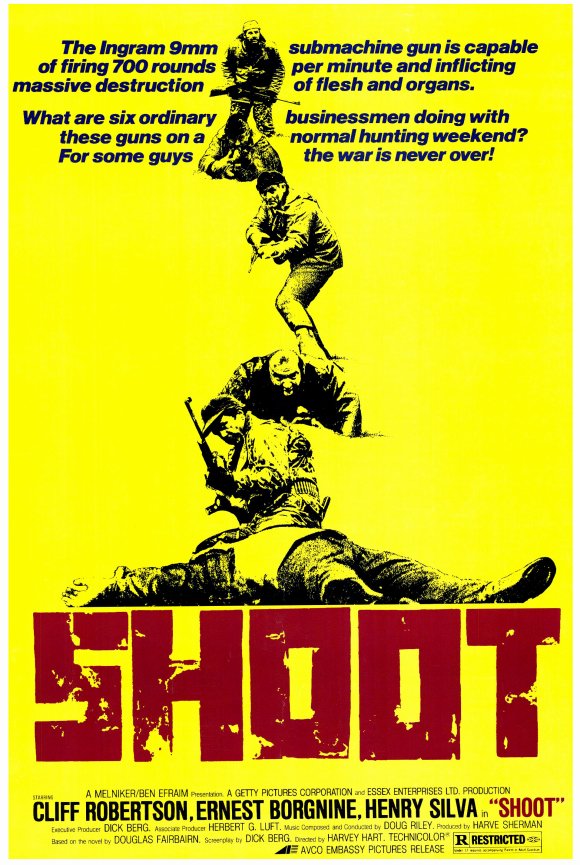
Rex (Cliff Robertson) is a man who really enjoys hunting and especially likes his guns, just watch the way he cleans and caresses it at the beginning, it’s almost obscene. He takes his buddies out on a hunting party in the woods. They come upon a group of other hunters and for some inexplicable reason they begin shooting at each other until one of the men in the other party dies. Rex and his group go back home sure that the police will be contacted and an investigation to pursue, but that doesn’t happen, so Rex thinks they are out for revenge instead. He becomes convinced that the other party plans to attack his group at the exact same spot the very next week. He gets his men ready for battle and dressed in army gear as they prepare for what they believe will be all out warfare.

Part of the problem with this film, which is based on the novel by Douglas Fairbairn, is that it doesn’t make any sense. Rex and his buddies meet the other party from across the river and then the two groups proceed to just stand there in silence like zombies before all the shooting breaks out. There is no reason for why any of it happens and I found it hard to believe this could ever occur in real-life. I am not a hunter myself, but I presume different hunting parties come into contact with each other all the time and it doesn’t end up with them trying to kill each other. I would also think that they may politely greet each other and share some sort of brief conversation in passing. Having all the men not say anything seemed odd and unfounded. The story would have made more sense had the groups spoken to one another and then somebody said something that was insulting and then it escalated. Doing it the way it is done here seems stupid and it is hard for any viewer to get into the plight of characters when there is no reasonable motivation.

The logic for the second half of the story works just as strangely. There is absolutely no reason to believe that the other hunters are planning any type of revenge at the same spot for the next week. The men don’t even know who any of them are. It would have worked better had the other group sent Rex’s group some sort of threatening message, or harassed them in some way to make the threat more real. Watching them prepare and discuss at length for a battle that may never occur is a waste not only of their time, but the viewers as well.

In between there is a long, boring middle part, which includes a scene where Rex visits the widow (Kate Reid) of the man that his group shot while under the pretense that he was an old friend of the deceased. Reid gives an interesting performance, but having her come on to Rex so shamelessly and even tells him that she wasn’t wearing any underwear seemed absurd and unnecessary. A similar scene happens in Rex’s office when the wife (Helen Shaver) of one of his friends aggressively flirts with him as well. Neither of the scenes helps propel the story, or characters and just another clue of a sloppy and unfocused script. There are a few too many shots exposing the boom microphone making me wonder if director Harvey Hart was only going through the motions on this one.

Robertson and Ernest Borgnine as Rex’s friend Lou are adequate, but the characters are painted in one-dimensional ways. The hunters are portrayed as violent prone loons with a penchant for shooting at anything and unable to display any type of sophistication, or rationale. The ultimate anti-gun, anti-violence message is heavy-handed and predictable. This was a trendy theme during the 70’s, but there had been so many better films on the subject that the producers shouldn’t have even bothered to make this one.

The on-location shooting in Ontario, Canada is poorly done. The buildings used for the interior scenes are dull and unimpressive with no visual style or sense. The outdoor scenes are flatly shot and done in the dead of winter, which gives the film a very brown, gray, and drab look. It would have been better had this been done in the summer as the green foliage would have been more scenic. There is also the issue of snow cover. On the first Saturday during their initial hunting trip there is no snow, then on the following Tuesday when Rex visits the grieving widow of the man that they shot there is a good six inches of the white stuff. Then on the following Saturday when they meet in town to get ready for their trip the snow is all gone only to again appear when they get to their hunting site.

I did like the solo trumpet soundtrack although it gets overplayed. The unexpected violent ending is indeed a surprise, but only helps in creating more loopholes. This was another attempt at cashing in on the success of Deliverance by coming up with a similar theme, but lacking the superior execution of the original. Another Deliverance-rip-off that came out in the 80’s Southern Comfort will be reviewed on Monday.

My Rating: 2 out of 10

Released: May 28, 1976

Runtime: 1Hour 39Minutes

Rated R

Director: Harvey Hart

Studio: AVCO Embassy Pictures

Available: YouTube

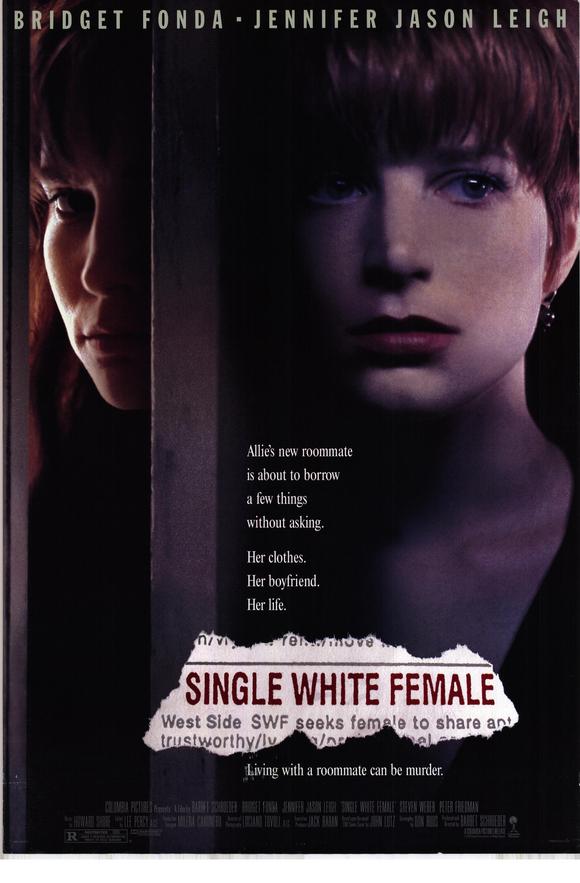
Single White Female (1992)

By Richard Winters

My Rating: 7 out of 10

4-Word Review: A roommate from hell.

Allison (Bridget Fonda) is a young entrepreneurial business woman who breaks up with her boyfriend and decides she doesn’t want to be in her apartment alone. She finds Hedra (Jennifer Jason Leigh) for a roommate and things go well until the relationship with her boyfriend is rekindled. Hendra then starts to become possessive until it eventually culminates into full blown psychosis.

This thriller really never gets going until the final thirty minutes when it climaxes with a real rock ’em, sock ’em, duke it out showdown, which is full of clever twists and good action. The first third though stagnates. In some ways this is good because it avoids being a formulated thriller that feels the need to always telegraph its punches. The viewer is as in the dark as to Hedra’s psychosis as Allison is. Things work so slowly that at times it almost seems like a drama. In some ways it might have been better had it stayed that way. There are some good ingredients here for an insightful look of two young women from different backgrounds trying to forge a friendship. Having it turn into your general psycho/thriller seems almost like a cheap gimmick that prevents it from being a deeper and more original piece.

Another thing that separates this from the other psycho/thrillers is the fact that the two are on equal footing. Unlike most thrillers the bad guy doesn’t have any unfair advantage over the other or the good guy isn’t impeded with any type of handicap. It all just comes down to smarts, inner strength and determination, which makes it interesting. It’s almost like giving them both a pair of gloves and then putting them into the ring.

Fonda is likable enough. She is normal, but not in a boring way and has vulnerabilities that she must face. Leigh has always had an interesting ‘clenched jaw’ like delivery. Usually this has a sexy appeal yet when she becomes psychotic it makes her more frightening. Leigh is also portrayed as the ‘frumpy’ one, but with her long hair and young girl look she actually is more enticing. Fonda of course is also attractive, but not with the hairstyle that she has here. Both have some good nude scenes.

There are some loopholes. One involves the murder by the heel of a shoe which gets lodged in the victim’s eye socket. This has an almost one in a million chance of happening especially at the angle it is done in. The assailant (Leigh) is a woman who is already shorter than the victim who is male. Added was the fact that she was sitting down while the victim was standing. Logistically she would not have been able to reach his eye and even if she had it would have taken so much effort to reach up there that she wouldn’t have had enough strength to drive it in the way she did especially in the split second that this movie has it happen in. Also, when one is wrestling with a perpetrator who has a gun that they drop it is a good idea to grab the gun before making a run for the door especially when it is in easy reach.

My Rating: 7 out of 10

Released: August 14, 1992

Runtime: 1Hour 47Minutes

Rated R

Director: Barbet Schroeder

Studio: Columbia

Available: VHS, DVD, Amazon Instant Video

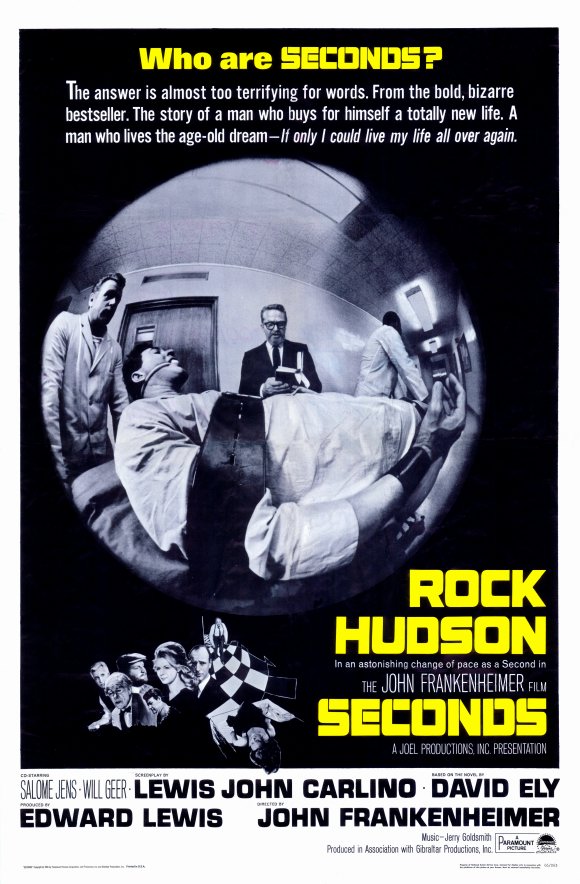
Seconds (1966)

By Richard Winters

My Rating: 8 out of 10

4-Word Review: Starting a new life.

Arthur Hamilton (John Randolph) is a middle-aged man just going through the paces of life. He is stuck in a marriage that no longer has any spark and a job that is boring. His life is confined to the basic suburban rituals and he is quietly looking for a way out. Then he gets a call from Charlie Evans (Murray Hamilton) who he thought was dead. Charlie tells him that he is very much alive, but with a new identity. Arthur goes to a address that Charlie gives him and there he is told for $30,000 dollars he can be ‘reborn’ and given a completely new identity via plastic surgery as well as a whole new life with new friends and no connection to his dreary past. He would even be given a new set of fingerprints and new teeth while the death of his former self would be created in a way that it would leave no question, or suspicion.

This story is unique and fascinating on many levels. It pinpoints the monotony of middle-aged life and views living in suburbia not as the great American dream, but more as the American trap. I enjoyed the part where one of the Doctors named Davalo (Khigh Dhiegh) tells Arthur who has now been changed into Tony Wilson (Rock Hudson) that his new identity will be that of an established painter and he will no longer have to be quarantined with any responsibility and will instead be able to live the rest of his life pursuing is own individual interests, which is probably what everyone secretly desires.

The second half of the story where Tony tries to adjust to his new ‘dream’ lifestyle is equally as interesting if not more. Tony finds that his new friends and neighbors are other ‘reborns’ who will not allow him to backtrack into his old identity and seem compelled to keep in line with his new environment whether he was completely happy with it or not. During this segment I couldn’t help but think of the characters from Easy Rider and how Tony’s situation wasn’t much different. Both longed for complete personal freedom, but the more they tried to escape the societal strings the more they seemed to be dragged back into it. The part where Tony goes back to visit his wife while under the disguise of being a long lost friend of her late husband is revealing and dramatically the strongest part of the whole film.

John Frankenheimer’s direction is superb and intoxicating. The opening sequence featuring a lot of distorted imagery is excellent and creates a terrific mood for the story. The dream sequence where Arthur finds himself in a hotel room with another woman is captured in such a way that it looked almost like a Salvador Dali painting. The use of the fish-eyed lens that is put in at certain strategic moments is effective as well as stylish. The black and white cinematography is evocative and the organ playing soundtrack is distinct and moody.

Rock Hudson has always seemed to me as a weak leading man and apparently Frankenheimer considered him ‘lightweight’ as well, but when his first two choices turned down the role he decided to go with him and here it actually worked. I felt Hudson’s blank expression and confused demeanor fit well with the character’s situation. The part where he is shown tied to a bed and struggling to get out while his mouth is gagged is convincing. Veteran actor Randolph is quite good in the beginning playing Arthur a man who seems run over by life. The close-up of his nervous and sweating face leaves a strong impression. Will Geer is also excellent in support as the founder and head of the secret organization.

The twist ending is well done although I saw it coming long before our naïve protagonist did. Unlike the book it is clearer and less vague. This is one case where the film can make a great companion piece to the book, or vice versa. This is a definite sleeper of a movie screaming for more attention and has strong cult potential.

My Rating: 8 out of 10

Released: October 5, 1966

Runtime: 1Hour 46Minutes

Rated NR (Not Rated)

Director: John Frankenheimer

Studio: Paramount

Available: VHS, DVD,  Blu-ray (Criterion Collection) Amazon Instant Video