Category Archives: Moody/Stylish

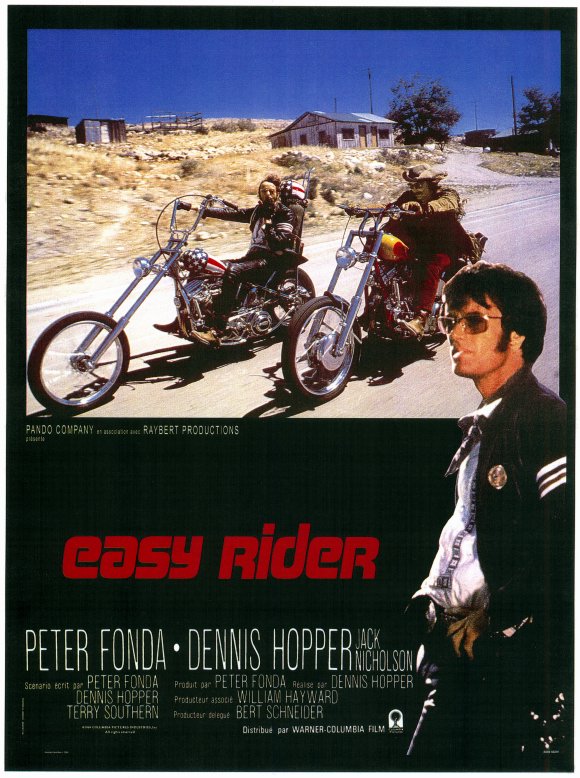
Easy Rider (1969)

By Richard Winters

My Rating: 10 out of 10

4-Word Review: Drop out of society.

This is still the granddaddy of all road movies as it perfectly captures the era and the angst of those living in it. It examines the harsh reality of life on the open road, but does it with a deep philosophical edge. Wyatt and Billy (Peter Fonda, Dennis Hopper) are two bikers making their way to the Mardi Gras when they pick up lawyer George Hanson (Jack Nicholson) along the way. They face prejudice and apathy from others who do not understand their values, or lifestyle. Although strongly linked to the 60’s many of the statements that the film makes and ideas that it brings out are as pertinent today as ever and this is one movie that should not be overlooked by the serious film fan as it is a classic and far from being just a relic.

The script, which was written by Fonda and Hopper, who also directed, portrays the open road as an odyssey of personal discovery instead of a particular destination. It brings out how one is still always trapped within the confines of the very society they may wish to escape. Above all it questions what true freedom really is, whether anyone has it, and if it can fully exist.

Fonda and Hopper are perfect. They channel their rebellious energies well. Of course it’s Nicholson who steals it playing a slightly goofy character. He exudes a charm here that’s rarely seen in his other performances. He also sports the silliest riding helmet you can imagine.

Lazlo Kovacs cinematography is outstanding. It captures the American landscape like you’re watching a travel show. The hippy commune scene is the best as it is so vivid that it makes you feel like you are right there. There is also a memorable hallucinogenic drug scene in a graveyard that is wickedly surreal and features cult favorite Karen Black in an early role.

Some may say it’s boring, but the slow pacing is deliberate and well-orchestrated. The framing and flash editing are groundbreaking in both its vision and execution. This is a definite trend setter and most importantly a classic.

My Rating: 10 out of 10

Released: July 14, 1969

Runtime: 1Hour 35Minutes

Rated R

Director: Dennis Hopper

Studio: Columbia Pictures

Available: VHS, DVD (35th Anniversary Edition) Blu-ray, Amazon Instant Video

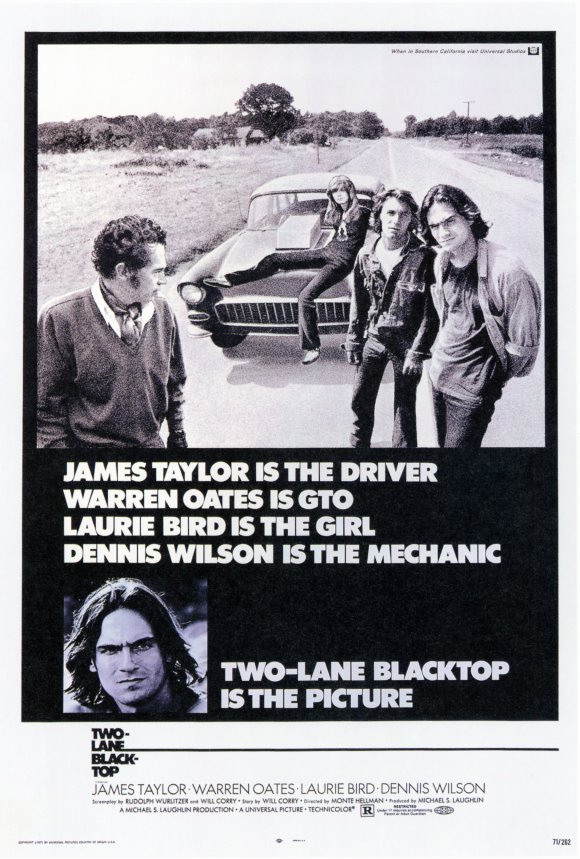
Two-Lane Blacktop (1971)

By Richard Winters

My Rating: 9 out of 10

4-Word Review: Drifters on the road.

This is a cult film if there ever was one as there seems to be no other category to put it into. It has a quality and style all of its own and the same existential mindset as Easy Rider, which can encompass you with its moody, desolate, and surreal atmosphere.

The story focuses on two young men (James Taylor, Dennis Wilson) who are given no names and drive a ’55 Chevy. They make a living challenging others to races and bet a middle-aged man (Warren Oates) that they can make it to Washington D.C. before he does. The race, like many things in life, becomes only a concept that gets increasingly more fleeting as it goes on.

The two young men are remnants of their fractured society and can only relate to the world around them when it is through their car. They subconsciously use the car to differentiate them from the pack and cover up there otherwise empty existence. The vehicle becomes more like a person while they become more like an inanimate object. They are unable to convey any deep emotion or thought and, like the stick shift in their car, only able to function with certain people.

Oates is interesting in a different sort of way. He is a man desperately seeking attention and yet is alienating at the same time. His fabrications about his life become more and more outrageous and compulsive until one wonders if he knows the difference anymore “If I don’t get grounded soon, I’m going to fly into orbit”. We realize he is running from something, but unlike other stories this mysterious past may be nothing more than loneliness and failure. He drives aimlessly simply as a way to avoid it and stopping would only allow it to catch up. The hitch-hikers he picks up along the way and conversations he has with them prove to be some of the film’s most compelling moments.

Laurie Bird plays the hippie girl that shuffles herself between the three. She inadvertently brings out some of their most dormant feelings as well as their flaws. She is quintessential in her role and her face is etched with the anger, alienation, and innocence of the youth from that era.

This as evocative a picture as you will ever find. The widescreen, remastered DVD version shows the wide open outside shots in almost crystal clear fashion. Watching James Taylor walking down a lonely, nameless small town street captures the youth’s detachment better than just about anything else. Of course this is a picture that is completely dependent on personal taste. Some will say it speaks to their soul, while others will watch it and see nothing. I know when I was younger it seemed boring and aimless, but I watched it again many years later and it made perfect sense.

The film also gives you a chance to hear interesting variations of popular rock songs. They are played in the background of certain scenes and include: “Hit the Road Jack”, “Maybellene”, and “Me and Bobby McGee”.

My Rating: 9 out of 10

Released: July 7, 1971

Runtime: 1Hour 42Minutes

Rated R

Director: Monte Hellman

Studio: Universal

Available: VHS, DVD (Criterion Collection), Blu-ray (Region B)

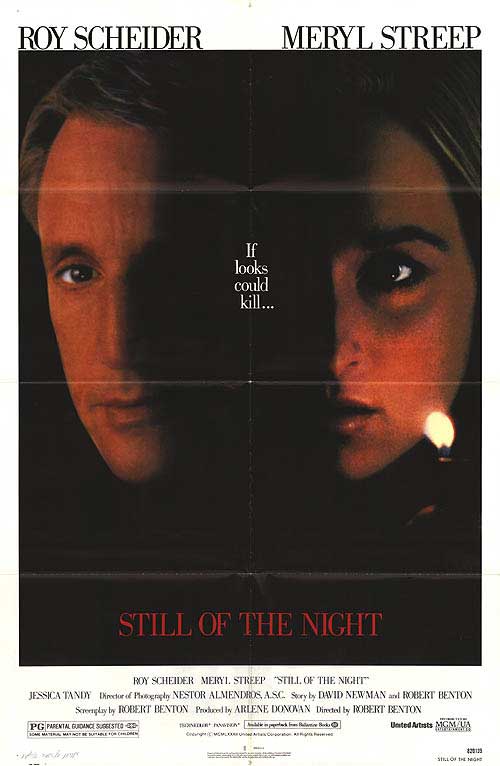
Still of the Night (1982)

By Richard Winters

My Rating: 4 out of 10

4-Word Review: This teddy bear bleeds.

Successful psychiatrist Sam Rice (Roy Scheider) finds himself immersed in a tangled web of murder and deceit. One of his patients, wealthy art dealer George Bynum (Josef Sommar), is found murdered. A mysterious woman named Brooke Reynolds (Meryl Streep) visits him and states that she was George’s mistress and Sam suspects that she may be the killer. He tries to do his own investigation, but the police start to doggedly tail him thinking he may know more than what he is letting on.

This was yet another homage to Alfred Hitchcock, this time done by writer/director Robert Benton, who is an excellent filmmaker in his own right.  This one has all of the style, but none of the substance.  The concept is slickly handled, but it misses Hitch’s flair as well as his wry sense of humor.

Normally I have never been too impressed with Scheider as a leading man.  He has always seemed transparent and his range of characters as well as emotions that he can convey are limited. Here though, as an evasive middle-man, his acting abilities work quite well and I actually found him perfect for the part.

Streep does not fare as well.  Her acting is almost always impressive and I admire her prolific career, but this is one of her few roles that takes no advantage of her talents. She seems to have an almost ghost-like presence. I didn’t find her character to be compelling, nor intriguing. I had no interest in her fate nor her relationship with Rice.

Joe Grifasi was a poor choice as the lead investigator Joseph Vitucci. He showed none of the characteristics of a seasoned police detective and looked and acted more like a disheveled kid just out of college. The rest of the supporting cast is dull and cardboard. It would have been nice if one eccentric character had been put in to liven things up.

Probably the most interesting aspect of the whole movie is a nightmare segment that the George character has that comes in the middle of the story. I liked some of the creepy imagery that was used including a bleeding stuffed teddy bear. I also enjoyed how afterwards Sam debates the dreams meaning with his mother Grace (Jessica Tandy) who also has a background in psychology, but I thought it was a bit of a stretch when she suggests he go to the police about it as dreams can be interpreted in many different ways and hold no relevancy in a court of law. I thought it became even more far-fetched when at the end Sam uses some of the symbolism in the dream to figure out the identity of the killer.

The film has a few plot holes and certain things that just don’t add up.  Some of the ones that hit me was when Brooke talks about seeing George off in a cab that night and then the next morning reading in the papers that he had been murdered, which is preposterous.  Most newspapers go to press between ten and midnight, the dead body might not yet have even been discovered until later that day, or even a few days later. There is also a segment where Sam makes a $15,000 purchase on a painting he doesn’t even want at an auction simply so he can use it as an excuse to write a note on the bidding card warning Brooke that the police are after her. Also, when Sam does not find Brooke at her apartment her friend tells him that she is at her parent’s house in some town called Glen Cove, but she is not sure of the street name and yet Sam is able to find the place in the middle of the night with hardly any effort. Also, I found some of the conversations that George has with Sam during their sessions to be unintentionally funny.

There is enough intrigue to keep you somewhat interested, but the result is mild. I did like the idea of building the tension up through slow subtle means instead of the quick shocks that you see done in a modern suspense movie, but it is still slow going. The music played over the opening credits is more suited for a romance and does nothing to create the right mood for a thriller. The lighting in literally every shot is dark and shadowy, which certainly helps with the atmosphere, but after a while it gets to be too much. I was also not impressed with the climactic sequence. The protagonist is too helpless and defenseless and does not fight back, which severely limits the action. Having it occur at an ocean-side house does create a nice ambience, but the chase that is involved there could have been more extended and the camerawork during the segment is unimaginative.

My Rating: 4 out of 10

Released: November 19, 1982

Runtime: 1Hour 33Minutes

Rated PG

Director: Robert Benton

Studio: MGM/UA

Available: VHS, DVD, Amazon Instant Video

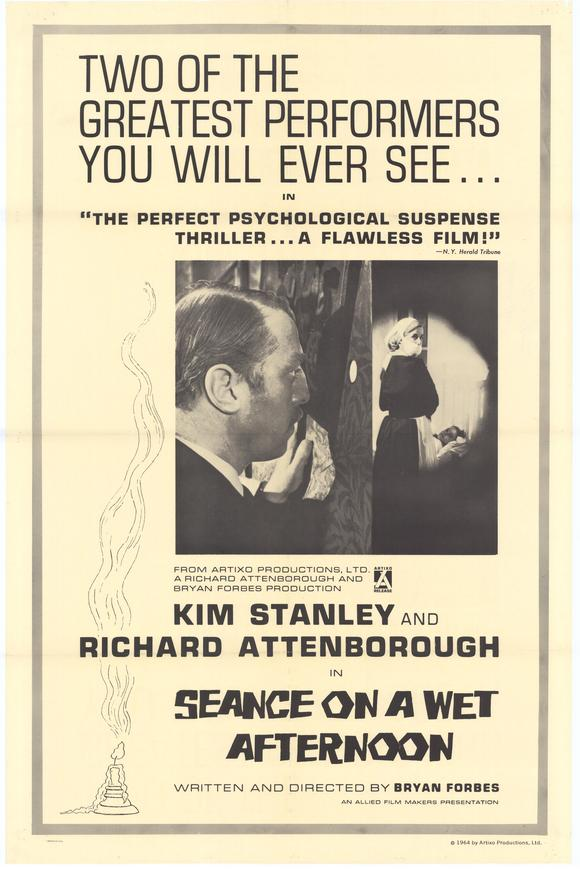
Seance on a Wet Afternoon (1964)

seance on a wet afternoon

By Richard Winters

My Rating: 6 out of 10

4-Word Review: Psychic is a phoney.

Myra Savage (Kim Stanley) is an emotionally unbalanced woman and failed psychic who comes up with an idea that she hopes will revive her career. The plan is for her husband Billy (Richard Attenborough) to kidnap Amanda Clayton (Judith Donner) who is the young daughter of a rich businessman. They will then place her at a strategic location and hold a public séance at which time Myra will ‘miraculously’ predict her whereabouts. This will then, they hope, make her famous and world renowned, but of course things don’t work out as expected.

This is indeed a unique and unusual film that taps into some rare qualities. First and foremost is the black and white cinematography. Every camera shot and angle has a certain evocative flair that is well captured and vivid. The on-location shots pick up just the right amount of ambiance and lighting with each setting. The music score is great and helps create excellent tension. You also will love the little girl that they kidnap. She is adorable without it being forced. Her matter-of-fact sensibilities are a great contrast to Attenborough and Stanley whose characters are child-like and pathetic.

Yet the film doesn’t completely work. The story is handled in a plodding and methodical way without any twists or surprises. There is very little action, some definite slow spots and the conclusion is limp.

If you watch it for the performances then you will be more intrigued. Stage actress Stanley gives a rare film appearance here. It is easy to see why she took the role even though she was known to dislike doing films. The takes are long and give almost unlimited possibilities in creating a character, which is what all stage actors enjoy. She does well and at times may remind one of another legendary actress Geraldine Page who would have also been perfect for the part. Attenborough proves almost her equal. His expressions of shock and worry are memorable. The interplay between the two is fun especially towards the end when this otherwise passive man stands up to the domineering woman.

Overall there are some unique moments, but it is just not suspenseful enough and results in being only slightly above average.

My Rating: 6 out of 10

Released: November 5, 1964

Runtime: 1Hour 55Minutes

Rating: NR (Not Rated)

Director: Bryan Forbes

Studio: Artixo Productions

Available: VHS, DVD (Region 1 & 2)

Bye Bye Brazil (1980)

By Richard Winters

My Rating: 6 out of 10

4-Word Review: Entertainers traveling throughout Brazil.

This movie is a slightly surreal comedy-drama detailing a caravan of five entertainers who travel the Brazilian countryside putting on vaudeville like shows underneath a makeshift tent.  The film works in a vignette style as it analyzes the many scenarios and difficulties that the group encounters as well as making a very strong statement to the poverty and hardships befallen on the townspeople that they meet. In fact if there is one lasting image that the film gives it is that one.

The story is pretty much character driven and the characters are all by and large highly amoral. They reflect the desperation of their audiences, which they quietly hope someday to rise above, but never do.  There are a few fleeting moments where they amazingly and surprisingly decide ‘to do the right thing’, which ends up being the film’s most memorable scenes, but most of the time they are ‘rough around the edges’ and the viewer is forced to appreciate them with all their frailties brightly exposed.

Jose Wilker plays Lorde Cigano who is the leader of the group and a lifelong con-man. He closely resembles character actor Stuart Margolin, who was famous for playing the character of Angel on the classic 70’s series The Rockford Files where he was always trying one amusing scheme after another and the character here works in much the same way. He has a few good lines as well as a funny running gag where he displays obscene toys to attractive woman he meets in order to ‘turn them on’.

Betty Faria plays Salome who does erotic dances during their performances.  She lies and cheats as much as Lorde and is more than willing to fall back to being a prostitute whenever the group is in need of money. Although she does have a few nude scenes she is really not all that attractive, or young, as she was already hitting 40 at the time that the film was made.  However, her worn looking face does help accentuate the hardened lifestyle of the character. Her best scene is when she is ‘servicing’ one of her clients who is a fat, balding middle-aged man who expounds the entire time they are having sex about the many virtues of his wife.

Fabio Junior plays Cico the young man who joins the group because he feels it is a chance to escape the sad existence of a peasant farmer only to find that life on the road can be in many ways just as grueling and thankless. Junior is a famous singer in Brazil and his chiseled, boyish good looks didn’t seem to be a realistic fit for the impoverished farm family that his character came from in the movie.  He shows no concern for his pregnant wife and spends the entire time trying to seduce Salome, which makes him irritating and unlikable.  I did though like the fact that he was the one character who evolved and became introspective at the end.

The character of Daso, which is played by actress Zaira Zambelli and is Fabio’s wife, was a bit frustrating. The film makes it clear that she is aware that Fabio is fooling around with Salome and she doesn’t seem to care. She also excitedly jumps into becoming a prostitute at her husband’s insisting when the group falls on hard times. However, I wanted more explanation, or history given to the character to help understand this, but the story does not supply any.

I was also disappointed with the handling of the Swallow character who performs feats of strength during their productions as well as acting as the group’s driver. Swallow is mute, but easily is the most likable and durable, but he runs away half-way through the picture and never returns. I would have liked the character to have stayed during the entire duration as he helped give balance to the others, or at the very least some detail to his eventual fate.

The film becomes almost a like a Brazilian travelogue as the viewer encounters everything from the small dessert towns, to the exotic rain forests. However, the budget was clearly low and I didn’t feel the cinematography captured the majestic essence of the landscape as much as it could’ve, or as I had expected. The story and situations are not all that unique, or creative, but it stays nicely amiable throughout.  The funniest part of the whole film may actually be the lyrics of the song that is sung at the very end during the closing credits. This is not a great movie, but not a bad one either.

My Rating: 6 out of 10

Released: February 9, 1980

Runtime: 1Hour 40Minutes

Rated R

Director: Carlos Diegues

Studio: Carnaval Unifilm

Available: VHS, DVD

Privilege (1967)

By Richard Winters

My Rating: 5 out of 10

4-Word Review: Teen idol is pawn.

A British pop singer by the name of Steven Shorter (Paul Jones) becomes a major hit with the young teen audience of the day and his managers realize they have a powerful and influential weapon on their hands.  They assign him to do an ad for apples and soon everyone is eating apples. They then use him as an example to support God and Country by making him sing a rock rendition of ‘Onward Christian Soldiers’.  With the help of some high-ranking church leaders they get him to introduce a Nazi type salute to everyone in order for them to show their allegiance.  Steven is aware of how he is being manipulated and is unhappy with it, but can’t seem to find a way out it.

This reminded me a lot of the Fonzi character on the old ‘Happy Days’ TV-show from the 70’s, a character with a rebel image who eventually became benign and unrealistic when the producers tried to turn him into a role model for his young audience. The film’s message is certainly a good one and as pertinent today as ever.   Unfortunately it is done in an extremely heavy-handed way that made this viewer feel like he was being hit over-the-head.

I became a fan of director Peter Watkins after seeing the pseudo-documentary Punishment Park where a group of hippies are thrown into the dessert and forced by the military to play a brutal game of survival.  That film featured some emotionally charged scenes that were amazing and the execution was so flawless that it seemed almost authentic.  This film takes the same documentary approach, but it is not as consistent with it nor as effective.  The result is a weird mishmash between the surreal and allegorical to the dramatic and satirical and it never comes together as a whole. It does contain a few moments of funny humor, but there needed to be more of it and most of it comes in film’s first half. The drama is awkward and at times clumsy. It ended up leaving me alienated with it.

I had equally mixed feelings with the lead character.  He was played by Paul Jones better known as the lead singer to the 60’s group Manfred Mann who did such hits as ‘Do-Wah Diddy’ and ‘Mighty Quinn’.  He certainly had the chiseled, boyish good looks that one would expect from a teen idol and resembled Jim Morrison from The Doors.  However, he seems passive to extreme with no ability to ever stand up for himself.  Although looks are certainly one element, a rock star also needs to have some charisma and this guy had none and I would think the public would quickly see that.  He allows his managers to almost completely dominate him and the constant shots of his pained and unhappy facial expressions become, like everything else in the film, way over-done.  I could never understand why a singer with millions of adoring fans would feel so powerless. I would think he would have a healthy ego and sense of empowerment and if was unhappy with his managers then he would simply fire them, which happens all the time in the music world.

I did think that the camera work and cinematography were excellent and probably has a lot to do with director Watkins background.  The scene at the assembly where there is a giant picture of Steven and then the actual Steven stands in front of it making it look like he is being devoured by his own image was effective symbolism.

The points that the film makes in regards to conformity, those in position of power, and the superficiality of pop idols are all right on target.  I just wished that the narrative and storyline were done in a little more sophisticated way and that the characters were more fleshed out. The works of British director Lindsay Anderson came to mind as I watched this film. A lot of his films had the same types of themes like If, Britannia Hospital, and O Lucky Man. However, those films were more cerebral and layered and the wit was more consistent and biting.

My Rating: 5 out of 10

Released: February 28, 1967

Runtime: 1Hour 43Minutes

Rated NR (Not Rated)

Director: Peter Watkins

Studio: Universal

Available: DVD

Body Double (1984)

By Richard Winters

My Rating: 6 out of 10

4-Word Review: Sex through a telescope.

During the 70’s and 80’s director Brian DePalma, a fan of Alfred Hitchcock, made a lot of stylized thrillers using many of Hitchcock’s trademark devices.  He even storyboarded every shot that he did just like Hitch. Unfortunately a lot of these films had rather flimsy plots and characters and were over-directed, drowning out what little story there was. DePalma tried so hard to imitate Hitch that he ended up showing no original vision himself and made the viewer crave even more at seeing a genuine Hitchcock film.  This film, which I first saw when it was released 26 years ago, I felt was the best of DePalma’s Hitchcock imitations. Upon viewing it a second time many years later I found a lot more holes despite one clever twist and some good camerawork.

The story is about Jack Scully (Craig Wasson) who is a struggling out of work actor who is offered a place to stay by a man named Sam (Gregg Henry). The house is a very modernistic place looking almost like the Space Needle in Seattle.  Jack is offered the home on condition that he takes care of the place while Sam is away on business.  During his stay Jack becomes obsessed with the attractive neighbor lady named Gloria Revelle (Deborah Shelton) who he watches through a telescope.  She does an erotic dance in her bedroom each night at the same time while wearing a revealing negligee. The dance itself is not real exciting and would probably bore most people after a minute or two, but Jack becomes hooked on it and watches it endlessly night after night.  Eventually he starts following the woman around during the daytime and even tries to start up a relationship with her. He also begins to notice another man, who is very creepy looking, is also following her and eventually he witnesses him murdering her, but Jack becomes convinced there is more to it.  With the help of a porn star named Holly Body (Melanie Griffith), who he meets along the way, the two set out to try and solve the mystery.

Wasson makes for an incredibly weak male lead. This helps somewhat because the character is very weak, but it is hard for the viewer to relate or care about him.  His best scenes come during his endless auditions and rather thankless treatment he receives from directors, producers, and acting coaches.  These are one of the few scenes that the film gets right as it hits the nail right on the head showing just how degrading working as a low paid, nameless actor can be in Hollywood. The porn star character is also weak as she is too cliched and predictable making her more annoying than anything despite the fact that Griffith plays the part pretty well.  The character was based on real-life porn star Annette Haven who gets listed in the credits as a ‘technical advisor’. I did like Gregg Henry though who makes for a great sleazy villain as well as Dennis Franz in a small, comic relief type role as a brash, stressed-out B-movie director.

The film also has a lot of rather implausible elements that prevents the viewer from getting as involved in it as they should. One of the biggest ones is when Jack sees Holly Body performing in a adult video that he has rented and becomes convinced that she may be connected to the case when he sees her do the same type of dance that the neighbor lady did, so in order to meet up with her he auditions as the male lead in her next X-rated production. Now I’m not completely sure how casting in these productions work, but having some guy with no experience starring and having sex with the industry’s biggest female star at the time seems to be a bit of a stretch. I would also think that a guy who was not used to having sex in front of the camera and with everyone staring at him might get nervous and be unable to ‘perform’ especially in what was still the pre-Viagra age.

The porn scenes themselves aren’t too interesting, or exciting.  This industry is no longer quite as underground, or taboo as it once was, so the shock factor is gone.  The characters and situations are handled in such a placid way that the viewer is given no real insight into the business, or the people who work in it.  The industry has evolved a lot in the past twenty-five years, so the scenes here become irrelevant.

There were a few things that I did like.  The scenes where Jack follows Gloria around in the shopping mall are pretty well handled despite the fact that I think they could have had a little more action here and there also needed to be more customers in the background.  However, the bird’s eye view, which is another patented Hitchcock type shot, showing Jack following Gloria around who is also being followed by the killer is good.  This part also features the one definitive moment from the film that I remembered after all these years.  It involves Gloria throwing away her old panties when she buys some new ones and then having Jack fish through the garbage, retrieve the panties, and put them in his pocket as a sort of ‘souvenir’.

Some of the shots during the actual murder are also really innovative especially the way the camera captures the giant drill, which is the killer’s weapon.  Probably the best shot of the entire film occurs when the killer drives the drill into the victim, which then goes through her body as well as the floorboards and then pops out of the ceiling from the floor below.  Yes, it is rather gory, but I still thought it was a really cool shot anyways.  I also thought the innovative design to the house that Jack stays in had potential, but I wished they had shown a little more of the place from different angles and given us more of a feel of the inside instead of having all the action occur in just one room.

Overall the film is slick, but very shallow and superficial.  The neighbor lady especially seems like a male fantasy.  DePalma gets too hyper with the camera.  I really don’t like his ‘spinning camera’ shots.  He spun it around Jack and Gloria as they kissed and it was tacky and cliched.  Once, in the film Blow Out, he spun the camera around so much in one scene that it started to actually make me feel dizzy and nauseous. The film has a scene during the closing credits showing how a body double is used during a film production, which is amusing and interesting, but a bit out of place for a thriller.  You walk away from the movie wondering how much more entertaining it could have been had Hitchcock himself been able to direct it.

My Rating: 6 out of 10

Released: October 26, 1984

Runtime: 1Hour 54Minutes

Rated R

Director: Brian De Palma

Studio: Columbia Pictures

Available: DVD (Special Widescreen Edition), Amazon Instant Video

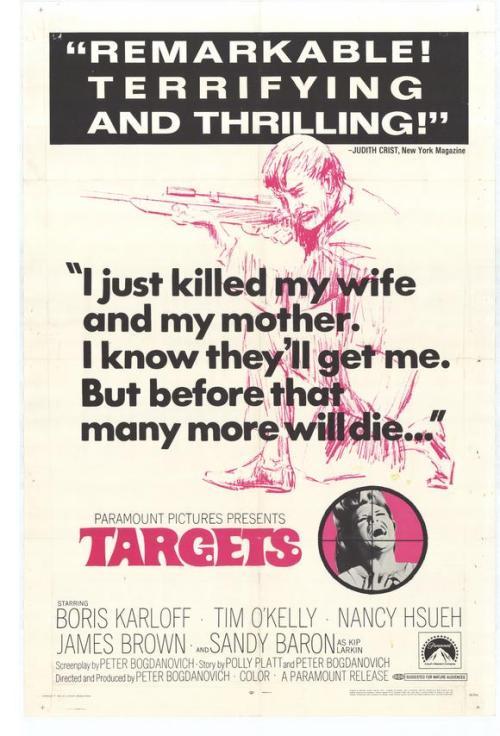
Targets (1968)

targets

By Richard Winters

My Rating: 6 out of 10

4-Word Review: He kills his family.

In 1967 producer Roger Corman gave fledgling director Peter Bogdanovich the green light to make any movie he wanted as long as he followed two stipulations.  The first one was that he had to use footage from Corman’s earlier film The Terror and the second one required that he use the acting services of Boris Karloff as Karloff still owed Corman two day’s work per his contract.  This movie is the result of that agreement, which kind of works and kind of doesn’t and seems more like two movies rolled into one.

The first story deals with a young, clean-cut man starting to have homicidal urges. The second scenario involves an aging actor played by Karloff, who decides he wants to retire despite the appeals of his agent and film studio. He plans to attend a showing of one of his films (The Terror) at a local drive-in where the sniper is waiting to shoot him.

I enjoyed the scenes involving the sniper and felt it helped elevate this film from the typical exploitation fare.  The character is based very closely on Charles Whitman, an All-American ex-marine, who on August 1, 1966, climbed to the top of the clock tower at the University of Texas in Austin and shot 32 people, killing 14. It was one of the very first mass-shootings in American history and it caused worldwide headlines.

Tim O’Kelly, the actor who plays the gunman, looks almost exactly like Whitman. What I liked about these scenes is the way it follows the character around and shows his interactions with his family. Like in real life there were no indicators, or violent past.  It is creepy watching him say grace at the dinner table, or having wholesome conversations with his wife when you know what’s going to happen.  The film goes into almost meticulous detail with the build-up and I found it gripping despite the fact that there is little action, or music.

The shootings are uniquely done.  Like in the actual incident, he shoots his mother and wife first and then puts a towel over their blood stains while carrying their dead bodies back to their bedrooms so it would look more ‘tidy’ when the police came.  This is all done with a docu-drama approach, which heightens the impact and realism.

The scenes involving the sniper shooting at people while they drive in their cars along a busy roadway are excellent as well.  It was done on an actual freeway and the viewer watches the action from the killer’s perspective through the telescope of his rifle, which is chilling. The cars veering off the road and people getting shot are vivid.  The only fault here is that Bogdanovich had the killer climb up on top of an ordinary tank at an oil refinery to do the shootings.  The clock tower in the actual incident was a very distinct structure and it would have been stronger visually had they found another one that was similar to it.

The parts involving Karloff are weak and tend to be cluttered with a lot of uninteresting dialogue.  Bogdanovich casts himself as the screenwriter for Karloff’s next proposed project.  I always thought it was a bit weird for a director, especially one that at the time was young and unknown, to cast himself in his own movie.  I know Woody Allen and Spike Lee, as well as others have done this, but it always came off as a bit narcissistic to me. However, I saw Bogdanovich in person a few months ago and he hasn’t seemed to have aged a day.

The climactic sequence in the drive-in is poorly handled. The dark lighting makes it hard to follow the action.  The final confrontation between Karloff and the killer is dull and unimaginative.  The only good points here is that it gives you a chance to see both Randy Quaid an Mike Farrell in their film debuts playing two of the sniper’s victims.

The film ends with a bird’s-eye view of the drive-in’s empty parking lot taken the next day with the sniper’s car being the only one left.  It was shot during the early morning hours so the sunlight gives it a surreal quality.  It also has a moody feel because the only sound is of blowing wind as the credits scrawl over, which I liked. However, the police would certainly have impounded his car and gone through it for clues and not have let it just sit there.

Under the conditions that he was given I think Bogdanovich did a commendable job. It is hard to know what category to put this film into.  At times it seems like a horror movie and then at other points it’s a drama. Some may even argue that it is a sentimental tale dealing with an aging actor moving into the final years of his life. Personally I wished it had gone all out as a horror film because the ingredients were there except that the tension was inconsistent. Fans of Bogdanovich may want to check this out because it is radically different from any of his later works.

My Rating: 6 out of 10

Released: August 15, 1968

Runtime: 1Hour 30Minutes

Rated R

Director: Peter Bogdanovich

Studio: Paramount

Available: DVD, Amazon Instant Video

Tetsuo, The Iron Man (1989)

tetsuo2

By Richard Winters

My Rating: 6 out of 10

4-Word Review: Man turns into metal.

This is one of the most bizarre and fascinating films ever made. It reminded me a lot of David Lynch’s Eraserhead, but with a little more linear storyline and engaging tongue and cheek humor.  It all depends on one’s tolerance as to how much they will enjoy it. Some will find it weird and alienating while others will insist it’s brilliant.

The story centers on a very strange man, played by the film’s director Shinya Tsukamoto, who has a freakish compulsion to stick scraps of metal inside his body.  He cuts his leg open and crams a metal pipe inside of it, which causes him excruciating pain.  He runs through the streets screaming and is hit by a car driven by a man (Tomorowo Taguchi) who is never given any name.  The driver and his girlfriend think that they have killed him and decide to dump the body along a riverbank and then make love in front of it. The next day the man notices while shaving that a metal nail is protruding out of his cheek. Soon metal parts start to grow from every part of his body until he is completely unrecognizable.

Despite being made over twenty years ago I found the special effects to be awesome and able to stand-up to today’s standards. The opening part where the man stuffs a metal pipe into his cut open leg appears so real that it made me cringe. The amount of metal growing out of the main character’s body becomes almost mind boggling and has to be seen to be believed.  The immense metal suit that the actor ends up wearing and having to walk around in is massive and I wasn’t sure how he could even move in it as it looked incredibly heavy.  The stop-action photography is fluid and watching the metal metamorphose in different and imaginative ways is fun. I found the grainy black and white photography to be highly effective and it helps accentuate the nightmarish vision of the story.

The story also features dreamlike segments while although not always making sense and sometimes jarring to the story, still are memorable. The scene where the main character is chased through the catacombs of an isolated train station by a woman who has turned into a robotic mass of metal is cool.  There are a few kinky elements that are shocking, tasteless, and hilarious all at the same time. They include the man’s girlfriend with a mesmerizing stare who becomes a zombie during one of these visions and rapes him with a metal pipe that has sprouted out of her vagina.  Then, a few scenes later, he turns around and rapes her with his penis that has turned into a giant whirring drill.

Although I applauded the film’s no-holds-barred creativity that seemed years ahead of its time, I did feel that it was confusing and disconcerting.  There are too many jump cuts and wild images thrown at the viewer without any explanation. It does finally come together at the end, which is good, but I would have liked a better set-up. I wanted to see more character development, which basically is none and some explanation for why all of this was happening.  A little more conventional narrative could have gone a long way. I also felt that it became too one-dimensional. Metal grows into more metal that grows into yet even more metal until it becomes almost boring. Although the running time for the picture is only 64 minutes I felt that this was actually too long and I would have wanted it shortened even more as the story seems to play itself out and have nowhere to go.

(Spoiler Alert)

Fortunately it is saved by a very satisfying over-the-top ending that nicely brings it all together.  The strange man inexplicably comes back to life and the two duel things out in the vacant city streets. The apocalyptic over-tones here are terrific and the last sequence where the two fuse together to form one giant metal mountain has to be one of the most extraordinary images ever to be put on celluloid.  Their final conversation is insanely funny.

(End of Spoiler Alert)

Again, as I stated before, this is not going to be for everyone. There is a real underground look and feel here that is going to offend some while amaze others. Nonetheless it has justifiably acquired a large cult following that seems to never stop growing and it has spawned several sequels that have all been done by the same director. This one though is still the best of the series. I recommend it to those with perverse, offbeat tastes and an extremely dark sense of humor.

My Rating: 6 out of 10

Released: July 1, 1989

Runtime: 1Hour 7Minutes

Rated NR (Intense Imagery, Rape, Graphic Violence, Language)

Director: Shin’ya Tsukamoto

Studio: K2 Spirit

Available: VHS, DVD (Special Edition)

Two Moon Junction (1988)

By Richard Winters

My Rating: 6 out of 10

4-Word Review: Voyuers will like it.

            A young woman named April (Sherilynn Fenn) who is from a well-to-do Southern family and engaged to be married meets a rugged hunk named Perry (Richard Tyson) who works as a laborer at a travelling carnival and the two immediately share a strong sexual attraction.  She considers getting out of her engagement, but her controlling grandmother Belle (Louise Fletcher) puts the crooked town sheriff (Burl Ives) on Perry’s tale in order to ‘rid them of the problem’.

Normally ‘hot and steamy’ love triangles that take place in the south seem over-done, redundant, and cliché filled, but for some reason this one works to an extent. For one thing the sex scenes, especially the one at the end that takes place at the Two Moon Junction locale, is quite explicit with an abundance of nudity by actress Fenn who is pleasing in the buff. And for the lady viewers there is even a scene featuring naked male bodies, both front and back, near the beginning of the film. If that isn’t enough there is also actor Tyson who is seen ninety-eight percent of the time without his shirt.

For sex it fares pretty well and rises just enough above the tired 80’s clichés to make it seem fresh. However, the story is rather placid and fails to dig deeper than its basic storyline.  The stylish atmosphere is nice, but there needed to be more tension and action.  I wanted the Fletcher and Ives characters to be meaner. Adding some tongue and cheek humor to a genre that even back then was becoming tired would have really helped.  There are times when it seems to want to go there but then it pulls back.  Having veteran character actors like Fletcher, Ives, Herve Villechaize, and Dabbs Greer was a real nice touch, but they needed to be given more to do. In Ives case, whose last film this was, I felt he was wasted and in that regard I came away from this thing disappointed.

Tyson works surprisingly well in the male lead.  He resembles a Fabio wannabe and I would normally have found him annoying, but he displays just the right level of cockiness to stay interesting. The fact that he also shows some negative traits helps keep the character real. However, the part where he breaks into April’s parent’s large estate and then promptly starts to take a shower seemed absurd and ridiculous. And just where did he find that bathrobe that fit him so well? Or did he bring one along with him? I suppose the plumbing might not be so good at the ragtag traveling carnival he worked at, but still.

Fenn is surprisingly strong as the female lead. This was definitely a three-dimensional character and the internal struggle that she had at being attracted to a man that she knew she shouldn’t be was nicely realized. The parts where she would breakdown into bouts of sobbing after her sexual liaisons with Perry were effective and heartfelt.

Kristy McNichol was a nice sight as a bi-sexual cowgirl named Patti Jean and she looked even better when she went topless. The fact that she revealed some latent lesbian tendencies towards April seemed to me to create interesting dramatic variables, but the film fails to go with it and the character disappears, which was another disappointment.  However, Patti and April’s dance together on the barroom dance floor created some nice provocative imagery.

It also during the opening of this barroom scene that you can spot the movie’s most revealing mistake; as the camera pans across the floor you can clearly see the shadow of the camera as well as the cameraman reflecting along the shiny wooden floorboards. It is always surprising to me the fact that if I the viewer can see a mistake like that right away how come an entire production crew misses it? Or do they see it, but are too lazy to reshoot, so they hope that it will just ‘pass-by’ the viewer? Either way it is the sign of sloppy filmmaking.

This also marks the acting debut of Milla Jovovich who plays April’s younger sister Samantha.  She was only thirteen at the time, but she already had a stunning face and it is easy to see why she caught the attention of producers and photographers as a model. However, her acting ability here seemed limited and her facial expressions where undisciplined.  She also shows little awareness of the camera, or how to play to it.

The film is superficial and lacking in many ways and it fails to have the necessary edginess that would have given it cult potential, but I still found it to be passably entertaining. Voyeurs who watch it for the sex may find it a little bit better.

My Rating: 6 out of 10

Released: April 29, 1988

Runtime: 1Hour 44Minutes

Rated R

Director: Zalman King

Studio: Lorimar

Available: VHS, DVD