Category Archives: Foreign Films

Life Size (1974)

life size 1

By Richard Winters

My Rating: 5 out of 10

4-Word Review: A sex doll obsession.

Michel (Michel Piccoli) runs a successful dental practice, but finds that his life is empty and his marriage to his wife Isabelle (Rada Rassimov) is no longer working. He has cheated on her before, but those affairs left him with the same empty feeling, so this time he decides to take a different route by purchasing a life size sex doll that looks so real that she almost seems human. He takes her everywhere and even brings her along to a visit with his mother (Valentine Tessier) so she can meet his new ‘girlfriend’.  The doll becomes the centerpiece of his very existence and he spends every waking moment he can with her until he sees footage, from a closed circuit camera that he has set-up in his house, of one of friends having sex with her while he was away. He becomes outraged at her ‘betrayal’ and decides that her punishment will be ‘death’.

The film, which can best be described as an early, distant cousin to Lars and the Real Girl, definitely has its share of unique and memorable moments. Writer/director Luis Garcia Berlanga does an admirable job of analyzing just what might happen if sexual fantasy gets taken to its most extreme level. The scenes showing Michel taking the doll to a clothing store in order to be measured and fitted with the latest fashions and marrying the doll in a makeshift wedding are by far the film’s two best segments.

However, it’s Michel’s scenes with his wife that I found to be the most unsettling. The scene where he fondles his wife’s naked breasts late at night as she sleeps while looking at a picture of the doll is quirky enough, but then later on, in the film’s most disturbing moment, she tries immersing completely into his sexual fantasy by pretending to be a sex doll herself in a desperate attempt to win him back.

What is initially considered the sexual substitute to the real thing soon becomes the preferable choice here and it reminded me of an article I read in a science journal a few years back about young men in their 20’s forced to be prescribed Viagra because they were no longer able to achieve erections with their wives/girlfriends because the proliferation of porn on the internet had somehow dulled their senses to real sex to the point that they found it to be a ‘turn-off’. Now, if you are a fan of porn then that’s great and I don’t mean to be appear like I’m trying to knock it, but I did find it fascinating that elements of that article correlated to what this film was showing and how successful this movie was at foreshadowing the phenomenon’s that we are now seeing in our modern day culture.

Although the film is adequately directed and more of a psychological study than a perverse sleaze feast it’s still not an overall success. The main issue is that the main character acts overtly freaky about the doll from the very beginning without enough backstory to tell us why and simply saying it’s due to a unhappy marriage is not enough. A far more compelling concept would’ve been to portray the main character as being more ‘normal’ by having him feel awkward about the doll and even a bit embarrassed only to grow increasingly more obsessed as the film progresses until his ultimate infatuation with it shocks even him.

Alternate Titles: Grandeur Nature, Love Doll, Tamano Natural

My Rating: 5 out of 10

Released: August 21, 1974

Runtime: 1Hour 41Minutes

Rated X

Director: Luis Garcia Berlanga

Studio: Cinema International Corporation

Available: None at this time.
The Tenant (1976)

tenant 1

By Richard Winters

My Rating: 10 out of 10

4-Word Review: He loses his identity.

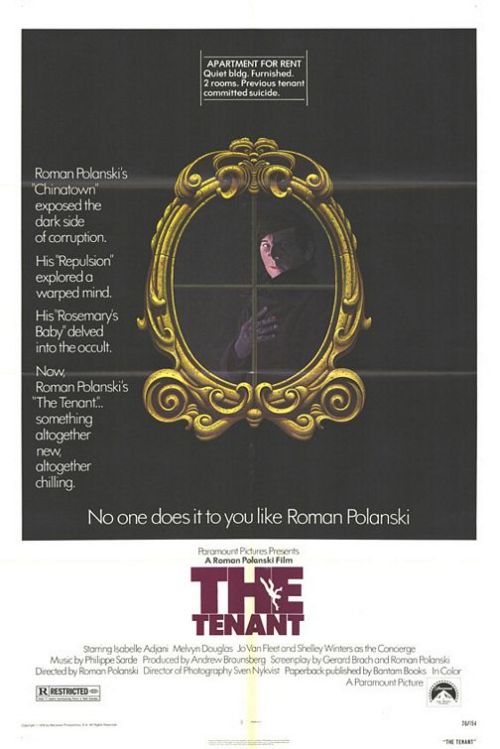
This intriguingly odd horror film may well be Roman Polanski’s best work and even better than Rosemary’s Baby as it manages to be scary in a unique way while also bringing to light many of the subtle ugliness of everyday life. Here Polanski plays a tenant who moves into an apartment were all the residents, and even the landlord (Melvyn Douglas), act slightly peculiar. The woman who lived in the apartment before him killed herself by jumping out the window and as he continues to live there he starts to feel a connection towards her while also getting the idea that somehow the other residents are in a conspiracy against him.

The film’s brilliance comes from the fact that the horror and tension is not based on any of the usual devices.  No ghosts, monsters, or psychos here. Instead the viewer gets sucked into the harsh realities of the modern urban world. The feelings of isolation, people who are cold and impersonal and apartments that are bleak and small as well as showing how these urban jungles swallow up our identities until we’re just another face-in-the- crowd.

This amazingly deep and penetrating study gets astutely underplayed with no action and little or any true scares. The tension comes through its psychological implications and the paranoia that only the Polanski character feels. Are these people really out to get him, or is it all just in his head? There are no definite answers, but theme and ideas are quite real. It’s a sort of twisted version of Rear Window and extension of Repulsion that may require a second viewing in order to completely appreciate.

Polanski scores on all levels as his performance is interesting and his ability as a director to make you feel the smallness and bleakness of the character’s apartment is also amazing. You are given a very real sense of the room’s dimensions without any inclination that it was done on a stage, or with the presence of a film crew. The eerie segments are subtle but successful with imagery that is both strange and lasting.

My Rating: 10 out of 10

Released: May 26, 1976

Runtime: 2Hours 5Minutes

Rated R

Director: Roman Polanski

Studio: Paramount

Available: DVD, Amazon Instant Video, YouTube

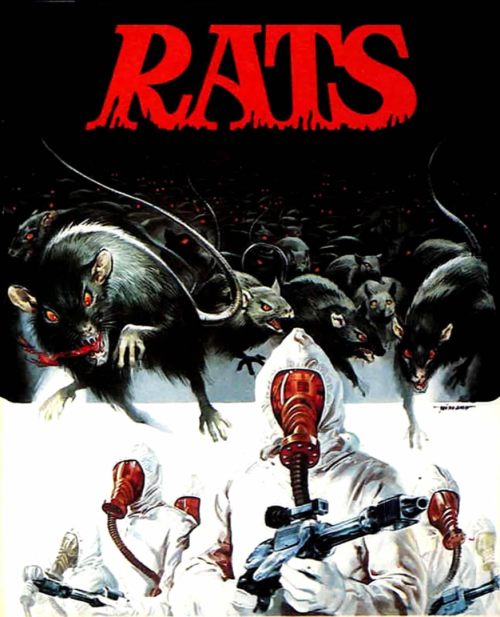
Rats: Night of Terror (1984)

rats 1

By Richard Winters

My Rating: 2 out of 10

4-Word Review: Rats rule the world!

Years after a nuclear holocaust has turned the earth’s surface into a scorched wasteland, a group of bikers known as scavengers descend into an abandoned building for shelter. Little do they know that the place is infested with large rats that, in their desperate need for food, have become particularly keen to human flesh and attack the group and devour each member one-by-one.

The film was written and directed by Bruno Mattei who was known as the Italian version of Ed Wood. The low-grade production values and uninspired dialogue quickly become apparent, which sucks the viewer into a listless and joyous experience from the get-go. The biggest issue are the rats and although I was happy to see that real ones where used this to a degree is what kills the tension because they are never seen attacking anyone. All they do is go about their normal rat behavior, which is scavenging for food while the rest of the cast, wearing tacky outfits like they are leftover members of an ‘80s punk band, make total fools of themselves trying to act frightened.

In some ways though this is the one thing that I liked, which was watching these rats scurrying around as it looks like hundreds of them were thrown onto the set forcing them to climb over each other and even climb up things, which to a strange degree is fascinating to watch. The movie would’ve been far better had it dumped its whole cheesy premise, as well as the human characters, and just turned itself into a nature documentary focusing on how rats behave and forage for food. Some are actually kind of cute and I was upset to see that a few were set on fire as no animal of any kind should’ve lost their life for this stupid thing.

In the end though the plot goes nowhere and the majority of the action takes place in what looks to be a dingy, grimy basement of a warehouse, which visually makes things quite static. The acting is atrocious and the twist that comes at the very end is quite predictable and something most viewers will see coming long before it finally does.

My Rating: 2 out of 10

Released: August 3, 1984

Runtime: 1Hour 37Minutes

Not Rated

Director: Bruno Mattei

Studio: Artist Entertainment Group

Available: DVD, Amazon Instant Video

Coup de tete (1979)

coup de tete

By Richard Winters

My Rating: 6 out of 10

4-Word Review: Soccer player gets revenge.

Francois (Patrick Dewaere) plays soccer (football) for the local amateur team in the French town where he lives. One day, while the rich owner of the team (Jean Bouise) watches, Francois has a physical altercation with the team’s star player Berthier (Patrick Floersheim), which immediately gets the owner and the rest of his teammates to turn on him. Not only does Francois get kicked off the squad, but he loses his factory job too. Francois then gets accused of rape in a crime that was actually committed by Berthier, but the police manipulate the evidence so Francois goes to jail instead. It’s only later when the team bus gets into an accident that Francois is released from prison so he can help them win, which he does, but he also has a very creative plan that he enacts on those who wronged him.

After directing the highly successful Black and White in Color, which won the Academy Award for best foreign film for 1976, director Jean-Jacques Annaud decided to take another stab at social satire. For the most part the film works well and is filled with a lot of intriguing elements. The best part is the way it pokes fun at the fans, who are just regular people that become so obsessed with their team winning that they lose sight of everything else that is important while clinging to the misguided notion that if their team achieves victory then that will somehow make up for all of life’s other transgressions.

Dewaere excels in his usual outsider role and watching him climb up some precarious apartment building walls and at one point even pull his way up a scaffold in his effort to visit his lady friends is entertaining in itself. Dorothee Jemma is attractive as the woman who initially accuses him of rape then retracts it and the side-story dealing with the quirky romance that ensues between them is enjoyable and better than the main one.

However, like with Annaud’s first film, I didn’t find this to be quite as entertaining as all the other critics seemed to. There are certainly some amusing moments and the script by Francis Veber is highly unpredictable, but in the end it doesn’t pack the intended punch. I think the main reason for this is the fact that the townspeople who screw Francois over are just too one-dimensional. They behave like unbridled jerks without ever realizing how hypocritical they really are, which makes their ultimate comeuppance not as satisfying because I could never believe that they were real people and instead just poorly crafted caricatures.

Alternate Title: Hothead (American reissue)

My Rating: 6 out of 10

Released: February 14, 1979

Runtime: 1Hour 29Minutes

Not Rated

Director: Jean-Jacques Annaud

Studio: Gaumont International

Available: VHS (Dubbed), DVD (Region 2), Blu-ray (Multi-region) (Subtitled)

Il Piccolo Diavolo (1988)

il piccolo 2

By Richard Winters

My Rating: 6 out of 10

4-Word Review: Priest befriends a demon.

Father Maurice (Walter Matthau) is a tired and aging priest who is beginning to question both his faith and existence. One day he is called to exorcise a demon from an older woman and when he does so out pops a funny looking man named Giuditta (Roberto Benigni) who claims to be the demon. At first Father Maurice does not believe him, but after seeing that Giuditta’s reflection does not appear in a mirror he begins to realize that he is dealing with some spirit from another realm. His attempts at trying to get rid of him are futile and eventually he learns to enjoy the companionship that Giuditta offers and even considers him to be a strange blessing in disguise.

There have been many parodies done of The Exorcist, but this one manages to be one of the better ones because it doesn’t stick with the formula. Instead it takes the possession angle and gives it a whole new spin while avoiding the clichés and becoming more like a whimsical character study instead of a horror rip-off.

Benigni, who also directed, is in top form and his naïve, child-like character is quite engaging and helps make him a solid scene stealer throughout. He even manages to do the impossible and upstage the always reliable Matthau, although for the record Matthau is still good and it’s fun seeing these pros with extremely contrasting acting styles work together with a chemistry that is surprisingly strong.

The film features many funny and original moments. One of my favorites is when Giuditta goes into a long, detailed conversation about being ‘inside’ the old woman for days on-end much to the shock of the staid priests at the dinner table who think he is referring to sex. Giuditta’s reliving himself late at night in a park in which his pee shoots out like water from a garden hose is hilarious as well as his over-infatuation with a the alarm on a man’s wristwatch while riding on a train.

Why this charming little gem of a movie has never been released in America despite its big name stars is hard to understand. The film’s only real drawback is that it inserts a romantic angle during the second-half in which Giuditta falls in-love with Nina, which is played by Nicoletta Braschi who later married Benigni in real-life. Although Braschi is amusing and shares Benigni’s child-like, offbeat persona, the camaraderie between Matthau and Benigni is what makes the film work and that is where the focus should’ve stayed.

My Rating: 6 out of 10

Released: July 3, 1988

Runtime: 1Hour 43Minutes

Not Rated

Director: Roberto Benigni

Studio Yarno Cinematografica

Available: VHS (English Subtitles), DVD (Italian Language only) (Region 0)

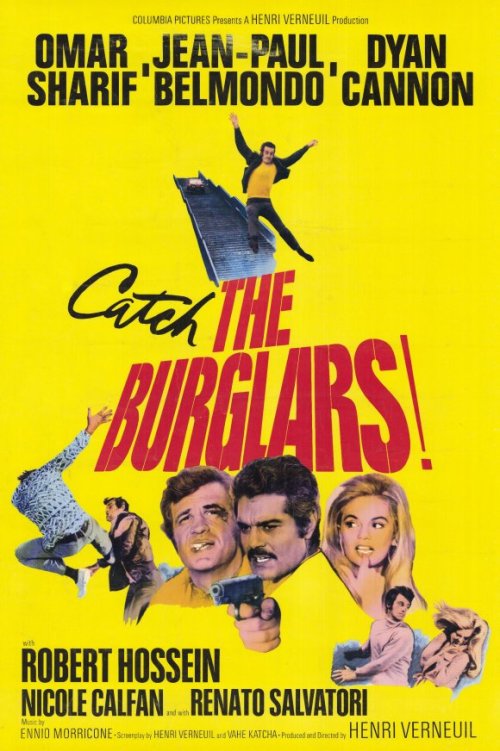
The Burglars (1971)

burglars 1

By Richard Winters

My Rating: 5 out of 10

4-Word Review: Corrupt cop hounds thief.

Azad (Jean-Paul Belmondo) and his cohorts pull off a daring heist by robbing a gem collector of his emeralds in his home by using a state-of-the-art machine that is able to create a key to the safe on the spot by simply entering in the safe’s serial number. However, things go awry when Abel (Omar Sharif), a corrupt police captain, becomes suspicious of their activity after seeing the gang’s car parked on the road. Initially he lets them off, but only so he can follow them later and then blackmail them for the jewels, or threaten them with prison otherwise.

The film, which is based on the novel by David Goodis and made 14 years earlier as The Burglar, which starred Jayne Mansfield, has all the trappings for being a classic heist film. I enjoyed watching the intricate way they are finally able to crack open the safe, which takes up much of the first half-hour. I also liked the creative action, stunt work, story twists, luscious Greek scenery and musical score by the legendary Ennio Morricone. Unfortunately none of this is able to overcome a rather plodding pace and a lingering feeling that you’ve seen it all before.

The film’s biggest claim-to-fame is its two chase sequences. The first is similar to the one done in The Italian Job as two small compact cars drive all over Athens, including on sidewalks, stairwells, and through crowds of people, which is exciting to watch. However, the fact that no one gets injured and no other automobiles are damaged even as the cars drive straight into on-coming traffic is hard to imagine. The camera also cuts to a close-up shot of the lead car driving on its rim, but somehow the vehicle is still able to continue to go several more miles on rough surfaces and high speeds, but why have a shot like that inserted if it ultimately doesn’t mean anything?

The second chase works better, which involves Belmondo hanging onto the side of a bus as it travels speedily down a crowded city street while he tries to kick shut the door of a police car that is following, which is quite realistic looking especially since it appears to be Belmondo himself and not a stunt double doing it. This one culminates with Belmondo being tossed from a dump truck and down a steep hill while other large rocks roll with him, which again is impressive, but the fact that he doesn’t even receive a scratch from it is hard to believe.

Sharif is outstanding in a rare turn as a bad guy. He commands every scene that he is in and in the process makes co-star Belmondo seem forgettable and unable to equal the same strong presence. Dyan Cannon, who is the only American in the cast, gets a pointless part as a pin-up magazine model that catches Belmondo’s eye. Her character doesn’t appear until an hour in and is not all that integral to the plot. Her voice is also clearly dubbed in the French version, which makes her acting here limited and probably not worth signing up for to begin with.

The climactic finish that entails a man being drowned inside a grain elevator is novel as is the final moment inside a giant, mobile chicken coop with thousands of loud, clucking chickens, but overall the film fails to illicit much tension and would’ve been better had the runtime been trimmed and the scenes shortened.

burglars 2

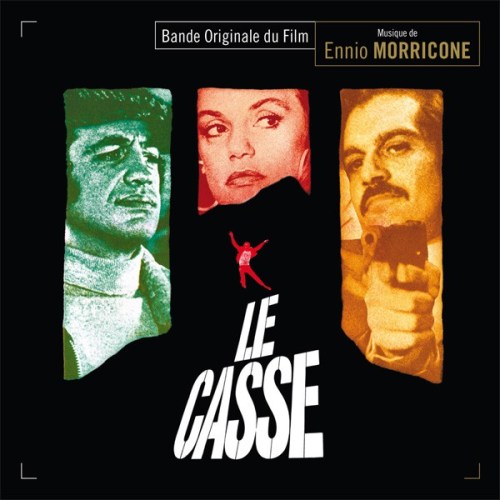
Alternate Title: Le Casse

My Rating: 5 out of 10

Released: October 24, 1971

Runtime: 1Hour 57Minutes

Rated PG

Director: Henri Verneuil

Studio: Columbia Pictures

Available: DVD-R

Quest for Fire (1981)

quest for fire

By Richard Winters

My Rating: 6 out of 10

4-Word Review: Cavemen search of fire.

After their tribe is attacked by another one and their only source of fire put out three male members from the group (Everett McGill, Ron Pearlman, Nicholas Kadi) set out to find fire from somewhere else and bring it back to the others.  Their quest is not easy as they are forced to travel through harsh terrain, escape from man eating tigers, and fight off a tribe of cannibals. They also meet up with Ika (Rae Dawn Chong) who comes from a more advanced tribe where the members live in huts instead of caves and who also harbors the secret to starting a fire, which she just might share with the others.

Filmed on-location in Canada, Scotland, and Kenya this film brings to life the true nature of prehistoric times in vivid detail and better than any other movie that has dealt with the same subject. The male actors were fitted with masks that gave them ape-like features and except for one brief moment there is no discernable line of dialogue and communication is spoken through grunts and groans as well as words not connected to modern day language. Some DVD issues do have subtitles, but to me this is taking the viewer out of the experience as the whole idea is to allow one a true sense of how things where like back then and therefore forcing one to try to understand things through the primitives means of communication during that period is the only way to do it and I’m thankful that the theatrical version and the streaming version that I saw did not offer them.

While I applaud the filmmaker’s commitment to keeping things close to the true form as possible and not willing to compromise it simply to make it more accessible to a mainstream audience I still found it to be confusing at spots and even at times boring. The opening battle between the two tribes seemed almost unintentionally funny and the loud, booming music played over most of the movie is a bit off-putting as there was clearly no music at the time of the setting, so silence or natural sounds would’ve kept it truer to the authentic tone.

There is also a scene where the men come upon the remains of some meat left from another tribe. The men are hungry and begin eating the remains only to realize that what they are chewing on is human flesh, which sickens them and they spit it out, but I wasn’t so sure that genuine Neanderthals such as the ones portrayed here would be so ‘civilized’ and instead more concerned with simply satisfying their hunger needs.

Rae Dawn Chong’s presence is a major plus and the movie gets more interesting when her character appears. She remains fully nude at all times while covered in body paint, but isn’t as erotic as you might think. The scene where she gets raped by the men late at night is brutal, but authentic to the animalistic level that I would assume sex would be approached with during that time period. The way her character ends up bonding and even forming a romantic attachment to the one of them as the film progresses is genuinely touching.

The film has a lot of lulls and may be just too unique for some. I found myself intrigued at certain parts and bored at others, but the scene where the men watch in amazement when Chong creates a fire for the first time is a surprisingly exhilarating moment where the viewer feels the same emotion that people back then must’ve felt, which to be able to convey such a feeling to a modern audience is an achievement in itself and a sign of astute filmmaking at its finest.

My Rating: 6 out of 10

Released: December 16, 1981

Runtime: 1Hour 40Minutes

Rated R

Director: Jean-Jacques Annaud

Studio: 20th Century Fox

Available: DVD, Blu-ray, Amazon Instant Video, YouTube

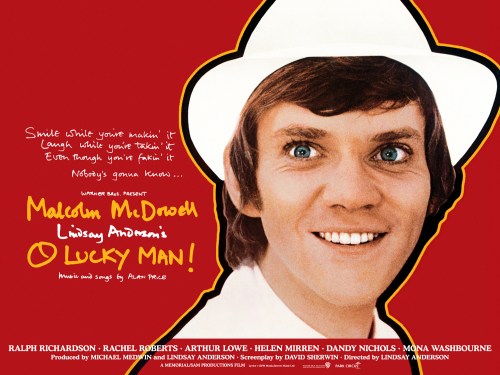
O Lucky Man! (1973)

o lucky man

By Richard Winters

My Rating: 9 out of 10

4-Word Review: A young man’s journey.

Mick (Malcolm McDowell) is a wide-eyed young man entering into the adult world and full of Horatio Alger-like illusions of working real hard and becoming insanely rich while doing it. His first job is as a coffee salesman where he is told that ‘the-sky’s-the-limit’ in regards to his earning potential, so with the carrot-on-the-string firmly in place he dives into it, but ultimately finds little to show for it. He then meets up with a rich tycoon ( Ralph Richardson) and essentially becomes the man’s lapdog assistant only to learn that this doesn’t work either. After spending time in jail he comes back out into the world as a ‘reformed’ man extoling on the idealistic virtues of humbleness only to again meet with aversion and failure.

The film, which is based on an original idea by McDowell, is essentially a broad look at society’s many socio-economic class levels and how easy it is to fall down it, but hard to move up. Some consider Glengarry Glen Ross to be the bleakest indictment on the sales profession, but having worked in the business when I was like the character here first getting out into the working world I can say that this one is even more searing and accurate.

On a wider scope the film successfully works as a critical statement on capitalism, which due to the purveying political climate of the day most American audiences are just now ready to catch up to. Mick’s journey is more his eventual disillusionment as he slowly realizes that being a ‘go-getter’ and having a ‘good attitude’ isn’t going to be enough as the system is rigged so that the individual is more likely to lose than win and can’t really function otherwise. His efforts then become exploited while helping to make someone else richer as he tolls in the bottom rung doing lateral moves into areas that have potential promise, but only produce the same results.

Although the character’s perpetual delusions of grandeur become a bit annoying McDowell plays the part well. The intent was for him to play against type from the one that he did just previously in A Clockwork Orange by portraying someone who is clean-cut, respectful and obedient, but with all the transitions that the character goes through and at one point even having him strapped to a chair in much the same way that he was in the Kubrick film it eventually comes off more like a continuation of that part than a completely different one.

The fun of watching the film is seeing the supporting cast playing dual roles. Arthur Lowe is great especially in the part where he gets put into heavy black make-up to play the leader of a fictitious foreign nation. Rachel Roberts is good too with the erotic scene where she transfers coffee from her mouth into McDowell’s and then later as a poor woman who commits suicide, which has a foreboding quality to it since Roberts ended up doing the same thing five years later in real-life.

Fans of Helen Mirren will enjoy seeing her when she was much younger and playing the part of a rebellious daughter. I also liked the way Alan Price and his band fits into the film. They do the movie’s soundtrack, which is quite good, but instead of having their music played over the action the movie cuts away and captures them doing their renditions inside a sound studio, which in any other case would be considered distracting, but here helps accentuate the film’s  already cerebral tone. It’s also amusing how the band ends up becoming a part of the story as the McDowell character almost gets hit by their van, which allows the opportunity for Price to say the film’s best line “Are we suing you, or are you suing us?”

The film is full of many surreal and original moments and is so consistently inventive that you hardly notice its three hour runtime. However, to me the best part about it is the way it attacks and criticizes the status quo, which is something that no Hollywood movie ever does.

My Rating: 9 out of 10

Released: March 26, 1973

Runtime: 2Hours 58Minutes

Rated R

Director: Lindsay Anderson

Studio: Warner Brothers

Available: DVD, Amazon Instant Video, YouTube

Steaming (1985)

steaming

By Richard Winters

My Rating: 2 out of 10

4-Word Review: Saving a steam room.

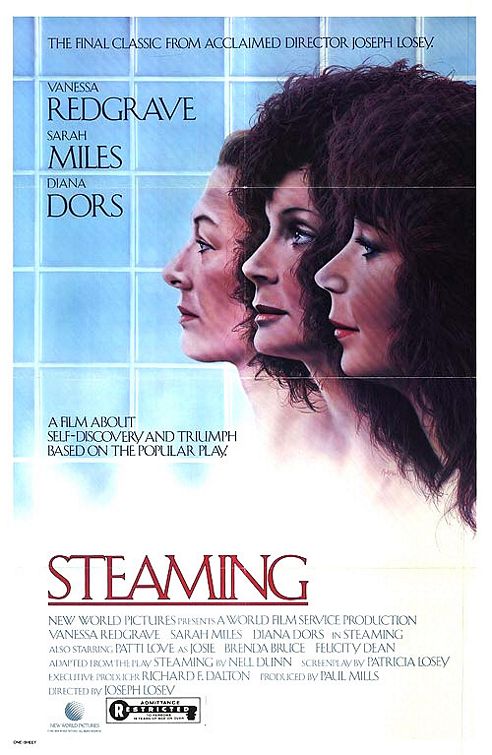
Three women (Vanessa Redgrave, Sarah Miles, Patti Love) congregate at a London steam room designed like a Turkish bathhouse. Despite their lifestyle differences they become good friends as they divulge their problems to one another and learn to lean on each other to help them cope with life’s difficulties. Then one day Violet (Diana Dors), who is the bath house owner, informs them that the place is set for demolition, which causes everyone to go on a mission to try and save it.

The film is based on the Nell Dunn play, which was highly regarded at the time, but makes for a very poor transfer to film. It starts out flat and never recovers. The dialogue has too much of a conversational quality that is not interesting and the problems that they discuss are not compelling, or original. The humor from the play is missing and the dry, somber tone only makes things even more boring. The only time it gains any traction is when it’s announced that the place is closing, but everything gets resolved in such a sitcom-styled way that it hardly seems worth the effort to watch.

The entire cast is made up of women and there is an abundance of nudity particularly from Miles, which doesn’t seem like a big deal these days. The biggest issue though is the fact that everything takes place from inside the bath house, which is gray, grimy, and rundown. The film should’ve had some segments shot from different locales if to only allow for some visual variety and to help the viewer understand the characters better by seeing how they react in different social settings.

Miles and Redgrave are wasted in drab roles and this goes likewise for Dors whose last film role this was. Love is the only one that shows any liveliness and although her character is a bit annoying she at least has an emotional breakdown near the middle, which adds some mild dramatic tension.

Joseph Losey was a competent director who made many interesting films, so it’s a shame that his career had to end with such a dud. He was already sick with cancer while he filmed this and like with Dors died a year before it was released. The disease may have sapped his creative energy and explain why this production is so ponderously sterile. It’s certainly a far cry from his other works as well as the Bruce Jay Friedman play Steambath, which had a similar setting, but a much more imaginative plotline.

My Rating: 2 out of 10

Released: September 28, 1985

Runtime: 1Hour 31Minutes

Rated R

Director: Joseph Losey

Studio: New World Pictures

Available: DVD (Region 2)

One Way Pendulum (1965)

one way pendulum 1

By Richard Winters

My Rating: 4 out of 10

4-Word Review: An absurd little movie.

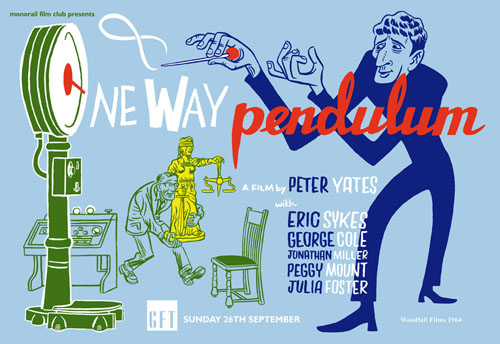
The Groomkirby family is one really absurd bunch. The father (Eric Sykes) wants to build a replica of the Old Baily courtroom in his living room and then have a trial, involving his son Kirby (Jonathan Miller) as the accused, reenacted. His daughter Sylvia (Julia Foster) wishes that she were an ape so that her arms would be longer and discusses this at length with her mother (Alison Leggatt). Kirby steals weight machines, which voices the person’s body weight, off the city streets and brings them back to the family’s attic were he then converts them into machines that sing. There’s also Aunt Mildred (Mona Washbourne) who thinks she’s waiting for a train that never comes as well as Mrs. Gantry (Peggy Mount) who’s paid to come over and eat the family’s unwanted leftovers.

The film is based on the stage play of the same name written by N.F. Simpson and was labeled as being ‘A farce in a new dimension’. John Cleese is purportedly a big fan of the movie and credits it as inspiring many of the absurd ideas that they used in their later Monty Python sketches. It was also directed by Peter Yates who went on to direct such quintessential hits as Bullitt, Breaking Away, and Year of the Comet.

The film certainly does have its share of funny and highly original moments. One of my favorite scenes is where the father carts the props that he needs to build his courtroom down a busy street of London using nothing but a wheel barrow and holding up traffic while he does it. Kirby’s ability to make the weight machines sing and sound like a genuine chorus is fun also as well as the climactic courtroom segment in which a myriad of comically absurd arguments, testimony, motions and reasoning is used until it becomes almost mind bending.

Unfortunately it all gets just a little too weird. Normally I’m a fan of the offbeat, but there still needs to be something to anchor it down and this film lacks it. The dialogue, characters and storyline are so progressively strange that it becomes downright nonsensical. The court case loses its edge as well because the father is somehow able to recreate it and the people in it in some magical way using a machine where kidnapping a magistrate and lawyers and forcing them perform in their makeshift court of law would’ve been funnier.

The movie will certainly satisfy those with inkling for the offbeat and the film seems intent to push the absurdity as far as it possibly can with a cast primed to pull it off, but it ends up being too weird for its own good and parts of it are confusing and hard to get into.

My Rating: 4 out of 10

Released: March 2, 1965

Runtime: 1Hour 20Minutes

Not Rated

Director: Peter Yates

Studio: United Artists

Available: None at this time