Category Archives: Classic

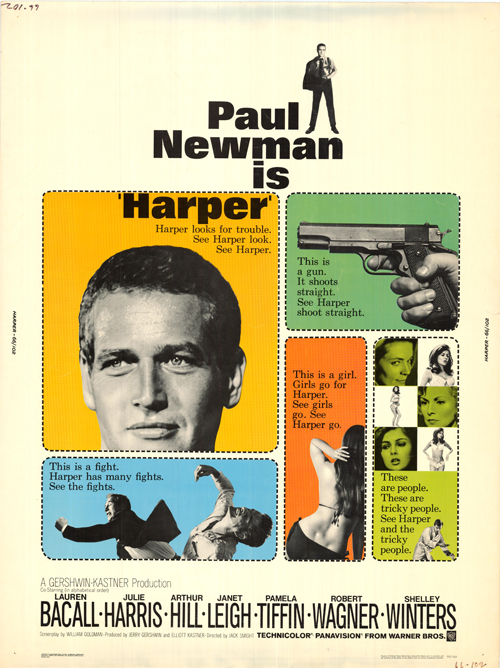
Harper (1966)

By Richard Winters

My Rating: 9 out of 10

4-Word Review: New-age private eye.

            Detective Lew Harper (Paul Newman) is hired by Mrs. Sampson (Lauren Bacall) a rich woman whose husband has gone missing. She wants a private eye to find him instead of the police due to the fact that her husband was involved in certain illegal business activities, which she doesn’t want to come to light. Harper finds himself immersed in a complex web of intrigue dealing with an array of shady characters, twists, and danger.

Newman is terrific and the Harper character is the perfect private eye for modern audiences. Watching him get out of bed in his dingy, cluttered apartment at the beginning and get ready for the day is excellent and builds characterization in a visual, subtle, and believable way. His cool, laid-back, and detached demeanor is a great contrast to the hyper, jaded, high-strung L.A. types that make up the assortment of suspects. His cynical style attaches the viewer to him right from the start and the banter that he has with everyone is marvelous.

The supporting characters are superb as well and very well-defined. Bacall gets one of her better later career roles as the bitchy eccentric wife. She gets quite a few quotable zingers particularly between her and her step daughter Miranda (Pamela Tiffin) that are close to classic. I also got a kick out of Shelley Winters playing a parody of herself as a way past her prime Hollywood star who is now overweight and an alcoholic. Harper’s attempts to get information out of her by pretending to be a hick who is totally mesmerized by her is quite amusing.

Director Jack Smight is at his directorial peak here. The on-location shooting is splendid. I particularly enjoyed the modernistic building that fronts as a church, but is really used as a cover for criminal activity. It sits out on a sandy hilltop and leaves a strong visual impression as does Harper and Miranda’s car ride along a very winding desert highway to get there. I also liked his ability to capture an abandoned airplane hangar making it almost as evocative to the eye as the foot chase that happens in it. The whole production is consistently slick with color schemes, set design and editing that are all top notch.

William Goldman’s script, which is based on the novel by Ross Macdonald is sensational and one of his best in his already legendary career. The dialogue is sharp one can view it for the lines alone and might need to re-watch it again simply to pick-up on all of them as there are so many your liable to miss some. The mystery is also intriguing and nicely layered to the point that it will keep you guessing and impossible to figure out and fortunately there is a minimum of loopholes. I saw this before and knew the outcome, but still found it an enjoyable and involving ride.

My complaints are few and fortunately do not taint the quality of the picture, which is otherwise high. I didn’t like that Harper had an ex-wife Susan (Janet Leigh) who he is constantly trying to win back. The woman seemed a bit cold and snippy and not the type I would think Harper would fall for, or want to put up with. Having him act so needy to win back her affections hurt the ruggedness of the character who is appealing because of his independent and self-assured nature. There is another scene where a man is shot dead and Harper goes through his coat pockets in order to get some clues to his identity. He finds a matchbook listing a nightclub, which Harper goes to in order to ask questions from the patrons, but I kept thinking it would have been much easier had he just went through the victim’s pants pocket and taking out his wallet and looked at his driver’s license.

If you are looking for a nifty mystery done in the best crime noir tradition then they don’t come much better than this.

My Rating: 9 out of 10

Released: February 23, 1966

Runtime: 2Hours 1Minute

Rated NR (Not Rated)

Director: Jack Smight

Studio: Warner Brothers

Available:  DVD, Amazon Instant Video

Friday the 13th (1980)

By Richard Winters

My Rating: 6 out of 10

4-Word Review: Don’t reopen the campsite.

(This review contains spoilers. Lots of spoilers)

Twenty-two years after two counselors were brutally murdered Camp Crystal Lake reopens, but as the young staff tries to get the place ready they are killed one-by-one by an unknown assailant.

I first saw this film back in 1986 and thought it was alright. I presumed I would dislike it this time, but instead came away entertained and although certainly not a perfect film it does deserve its classic status. Director Sean S. Cunningham shows more flair than a lot of critics give him credit for. I liked the idea that all the murders take place during one stormy night at a remote location. Every murder sequence has its own beginning, middle, and end and filming it at an actual campsite gives it a lot of flavor. In fact I believe that is the main element for why this film became such a big hit because it reminds everyone when they went to camp as kids and tried to frighten each other by telling ghost stories around a camp fire.

Some of my favorite aspects of the film are what most might consider minor stuff, but stands out for me. For instance when Brenda (Laurie Bartram) goes to the archery range during the storm and the killer turns on all the lights and she becomes blinded by them is an interesting visual sequence. It is just unfortunate that she was not slayed with a shooting arrow as this would have corresponded to an earlier scene where she was almost hit by one shot by Ned (Mark Nelson). They were apparently planning to this, but then for whatever reason changed their minds. I equally liked the part where the killer shuts off the power and the viewer can see the lights slowly fading from the campsite at a distance, which has a nice foreboding quality. The part where Crazy Ralph (Walt Gorney) rides off on his bicycle after warning the staff the they are doomed creates an eerie image because there is no music and the lake is amazingly still proving that sometimes less is more when creating an intended impact. Having shots from the killer’s point of view watching the staff from a distance is creepy.

I watched the film closely thinking that there would be a lot of errors due to its low-budget, but found surprisingly little, or at least none that would create any type of major distraction. I know Betsy Palmer, who played Pamela Voorhees and is exposed as the killer at the end, only participated in a few days shooting. The hand that you see that represents the killer’s during the first half of the film was not Palmer’s, so I presumed that seeing a big ring on the third finger of the left hand would prove a mistake, but when Palmer does finally appear a ring is indeed there and the filmmakers prove to be astute. I know some people consider the scene where Alice (Adrienne King) has trapped herself inside a cabin and piling all sorts of stuff in front of the door to keep the killer out is a mistake because the door pushes out instead of in. However, I don’t agree because in her panic she would not be thinking straight and putting chairs in front of the door gave her a false sense of security, which at the time she may have needed emotionally. About the only real annoying mistake I saw is the fake lightning. Clearly it is a bright yellowish light coming from a flashlight that was shown on the performers from a stagehand that was just off- camera. The effect looks stupid and when are filmmakers ever going to realize that thunder and lightning rarely occur at the same time. You will always see lightning first and then the sound of thunder will usually occur several seconds later.

Too much time at the beginning is spent on the crew getting the campsite ready. These scenes don’t build any tension, the characters are vapid and clichéd, and the dialogue is trivial. I also found Ned to be incredibly irritating as the ‘comedian’ of the group whose attempts at humor where lame to the extreme. I found it funny how his murder is one of the few you don’t see and I think that was because the filmmakers feared that viewers would end up enjoying it too much. A little more nudity during this segment would have helped it along. I found it ironic that the one cast member that does end up going topless, Jeannine Taylor, was in real-life a graduate from a conservative Christian college. There is also a part here where they kill an actual snake and it deserves some mention because it is rather gory and has hints of Cannibal Holocaust where the viewer starts to think ‘if they are willing to kill actual animals in front of the camera what’s to stop them from doing it to the people’.

I like Betsy Palmer and the final climatic segment where she terrorizes Alice who is the last remaining survivor is in many ways the best part of the whole film. However, Estelle Parsons had been their first choice and I was a bit disappointed because Parsons has a unique acting style and a more distinctive face, which could’ve given the character more depth. Still, upon my third viewing I must say that Palmer does well. The close-ups of her face are great as is her gray sweater.

The music of course is another plus. I always thought it sounded like ‘chi,chi,chi; ma,ma,ma’, but it is actually supposed to be ki,ki,ki; ma,ma,ma’ and used to reflect the voice of Jason that Pamela hears inside her head instructing her to ‘Kill her Mommy’. Composer Henry Manfredi actually said ‘ki’ and ‘ma’ into a microphone before using sound effects to get the intended distortion.

Despite the film’s reputation the killings seem rather quick and uneventful. The slitting of the throat is a Tom Savini specialty, but was starting to get old even here. The machete through the head is one of the better ones, but the shot of it is too quick. The decapitation of Pamela is far and away the best. I liked how her hands continue to move even when she is headless. Apparently this is unrealistic and would not happen in real-life, but it is a cool visual nonetheless.

My Rating: 6 out of 10

Released: May 9, 1980

Runtime: 1Hour 35Minutes

Rated R

Director: Sean S. Cunningham

Studio: Paramount

Available: VHS, DVD, Blu-ray, Amazon Instant Video, Netflix Streaming

Back to the Future (1985)

By Richard Winters

My Rating: 7 out of 10

4-Word Review: Traveling back in time.

Marty McFly (Michael J. Fox) is a 17 year old videotaping his older friend Dr. Emmett Brown (Christopher Lloyd) who is planning on entering a time machine he has invented and going thirty years into the future. Just when he is about to enter the vehicle some angry Libyan nationalists with rifles appear who are upset that Emmett took plutonium from them under deceptive means. To escape the bullets Marty jumps into the machine, which is a DeLorean car, and goes back to the year 1955. Here he bumps into his father George (Crispin Glover) who is now a teenager himself and Marty inadvertently stops him from meeting his mother Lorraine (Lea Thompson) thus putting his entire existence into jeopardy. Marty must find a way to get them together while also working with Emmett on getting him back to the 80’s.

The concept is original and creative. Director Robert Zemeckis has every plot point and tangent covered. Just when you think you have a handle on it he throws in another twist that makes it even more interesting. It moves at a fast pace and a perfect blend of action and comedy. The dialogue is endlessly amusing as it takes full-advantage of the ironic scenarios and the special effects are good. The music, especially the song ‘The Power of Love’ by Huey Lewis and the News is rousing and Huey even appears in a brief cameo as a nerdy talent judge. There are a lot of great scenes that are both funny and exciting.

Fox is terrific in the lead although Eric Stoltz was cast in the part originally, but fired after four weeks of shooting. Fox is far better as he displays an intelligence and restraint that most other teen stars don’t have. His mannerisms are a plus and the way his voice reaches a high pitch whenever he is nervous is funny.

Crispin Glover is always interesting. He has such an eccentric personality and acting style that he makes every film that he is in better. However, in the early scenes he doesn’t look middle-aged and more like a skinny teenager with horn rimmed glasses.

I had the same issue with Christopher Lloyd only in reverse. Of course he is perfect for the role. His bulging eyes almost make it seem like he was born to play the part of a mad scientist. I was however surprised that no noticeable attempts were made to make him look younger when Marty meets him in the 50’s. I expected the character to be young and just starting out, but instead he already seemed established and living in a nice house making me wonder who was paying him to tinker around his home all day on his experiments?

Lea Thompson is not completely convincing as a mature woman during the first part and she looks very uncomfortable under all the heavy make-up. However, she is certainly cute in the scenes where she is younger.

In the complaint department I do have a few. First all the characters that Marty meets during his time in the 50’s seem excessively dopey. The film is too entrenched with an 80’s mindset. The 50’s is portrayed as a quaint bygone era with no relevance. There is too much of a ‘we’ve come a long way baby’ mentality and the 80’s played-up as being way ‘cooler’ than the 50’s even though some people may disagree. It would have been nice had there been a broader, transcendent approach to the story that would have been able to compare and poke fun of each era equally instead of just dumping on the 50’s like it was a joke.

The climatic sequence in which Emmett tries to connect a wire from a clock tower, which is set to be struck by lightning, to the DeLorean, so Marty can use the electricity to propel the vehicle back to the present gets overplayed. I don’t mind some unexpected mishaps to happen, but Zemeckis becomes obsessed with throwing in every type of calamity possible every few seconds until it becomes tiring and annoying. It got to the point where I just wanted the damn scene to end not so much because I cared anymore about Marty’s fate, but more because my ‘tension meter’ had become exhausted.

SPOILER ALERT

            My third and final grievance has to do with the very end when Marty returns to the present and finds that his father has turned into a much more confident and successful man then he had originally been at the beginning. This is because due to Marty’s meddling during his time in the 50’s, George ended up confronting Biff (Thomas F. Wilson) his lifelong nemesis and knocking him out with one punch, which gave George a new found sense of confidence. This also turned Biff from a bully into a patsy and thirty years later we see him as George’s mindless assistant. Now this twist may initially sound funny, but after a second when you really think about it, the humor is lost because it has absolutely no bearing in reality. No bully is going to take on a meek role for the rest of his life simply because some scrawny guy was able to knock him out with a lucky punch. If anything Biff would have become obsessed with getting back at him and even challenging George to another fight and not giving up until they did so. Or after graduation, he would have simply left that hick town and gone on with his life and leaving that embarrassing and isolated incident far behind him. Sometimes irony can be great and I usually do love it, but too much of anything is never good and at certain points this film seems to get to that level. Also, for such an otherwise clever film you would have thought that they could have come up with a more creative name than Biff for the bully.

My Rating: 7 out of 10

Released: July 3, 1985

Runtime: 1Hour 56Minutes

Rated PG

Director: Robert Zemeckis

Studio: Universal

Available: VHS, DVD, Blu-ray (25th Anniversary Trilogy)

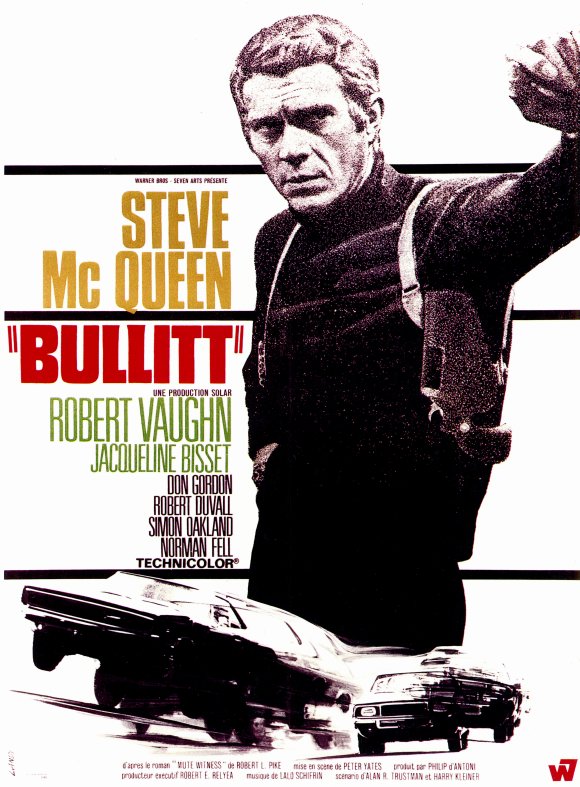
Bullitt (1968)

By Richard Winters

My Rating: 8 out of 10

4-Word Review: A great car chase.

    A police detective by the name of Bullitt (Steve McQueen) is hired to protect a state witness who is set to testify against the mob. Problems ensue when the witness is killed and Bullitt makes it his personal mission to find the killers even if it means bending the rules.

    A renegade cop going against the system may seem like an old formula now, but here it is fresh and convincing. McQueen is gritty and authentic in his role and you find yourself caught up in his mission. The mystery is intriguing and even a bit complex. The car chase is incredible and still holds up today against any other car chase out there. You are made to feel like you are in the car with him and as it goes down the steep San Francisco hills you start to think you are on a roller coaster. The camera work and cinematography is excellent and the entire production is slick from beginning to end.

    Robert Vaughan who plays Chalmers is one of the prissiest characters you will ever see and expounds a vocabulary that you won’t likely ever hear in real life. The character is incredibly pretentious and you look forward to his comeuppance, which he eventually receives although I wished it had been a little bit more.

     Jacqueline Bisset as Bullitt’s girlfriend Cathy is unnecessary and almost like an intrusion. Her little ‘speech’ that she gives along a roadway after witnessing a crime scene does nothing but bog the movie down. Supposedly she was put in to ‘humanize’ the Bullitt character and show his softer side, but he’s an outstanding character without it.

      As mentioned the slick camera work is very good, but it does start to resemble another great McQueen picture that came out around the same time The Thomas Crown Affair. The film also loses its momentum after the car chase and the climatic foot chase along an airport runway is not as exciting.

     This is still a terrific cop thriller that set the standard for all others. McQueen is always great and here he really delivers. The car chase alone is worth watching and shouldn’t be missed by any self- respecting action fan.

My Rating: 8 out of 10

Released: October 17, 1968

Runtime: 1Hour 54Minutes

Rated PG

Director: Peter Yates

Studio: VHS, DVD, Blu-ray, Amazon Instant Video

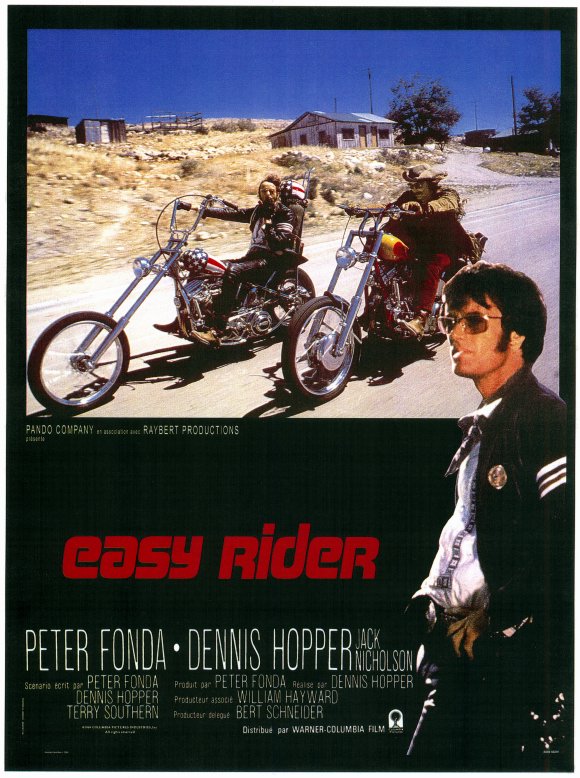
Easy Rider (1969)

By Richard Winters

My Rating: 10 out of 10

4-Word Review: Drop out of society.

This is still the granddaddy of all road movies as it perfectly captures the era and the angst of those living in it. It examines the harsh reality of life on the open road, but does it with a deep philosophical edge. Wyatt and Billy (Peter Fonda, Dennis Hopper) are two bikers making their way to the Mardi Gras when they pick up lawyer George Hanson (Jack Nicholson) along the way. They face prejudice and apathy from others who do not understand their values, or lifestyle. Although strongly linked to the 60’s many of the statements that the film makes and ideas that it brings out are as pertinent today as ever and this is one movie that should not be overlooked by the serious film fan as it is a classic and far from being just a relic.

The script, which was written by Fonda and Hopper, who also directed, portrays the open road as an odyssey of personal discovery instead of a particular destination. It brings out how one is still always trapped within the confines of the very society they may wish to escape. Above all it questions what true freedom really is, whether anyone has it, and if it can fully exist.

Fonda and Hopper are perfect. They channel their rebellious energies well. Of course it’s Nicholson who steals it playing a slightly goofy character. He exudes a charm here that’s rarely seen in his other performances. He also sports the silliest riding helmet you can imagine.

Lazlo Kovacs cinematography is outstanding. It captures the American landscape like you’re watching a travel show. The hippy commune scene is the best as it is so vivid that it makes you feel like you are right there. There is also a memorable hallucinogenic drug scene in a graveyard that is wickedly surreal and features cult favorite Karen Black in an early role.

Some may say it’s boring, but the slow pacing is deliberate and well-orchestrated. The framing and flash editing are groundbreaking in both its vision and execution. This is a definite trend setter and most importantly a classic.

My Rating: 10 out of 10

Released: July 14, 1969

Runtime: 1Hour 35Minutes

Rated R

Director: Dennis Hopper

Studio: Columbia Pictures

Available: VHS, DVD (35th Anniversary Edition) Blu-ray, Amazon Instant Video

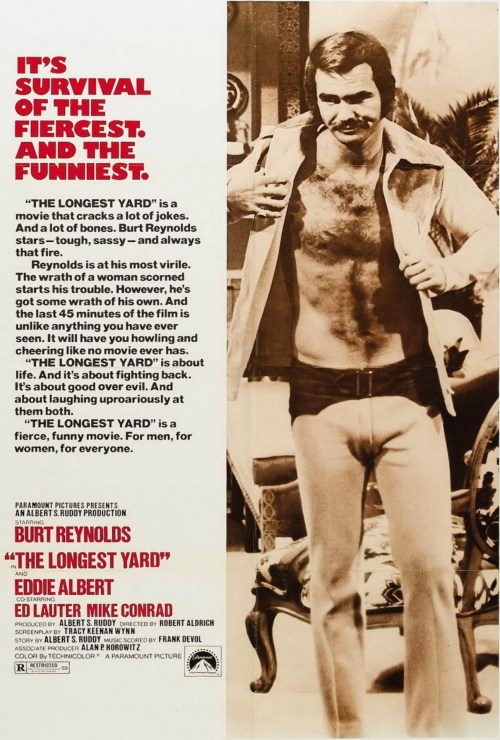
The Longest Yard (1974)

longest1

By Richard Winters

My Rating: 8 out of 10

4-Word Review: Prisoners play football game.

            Burt Reynolds is Paul Crewe a down-on-his-luck former professional football player who was kicked out of the league due to a point shaving scandal. After going on a long car chase with police he is thrown into the Georgia State Penitentiary where the crooked warden (Eddie Albert) tries to get him to coach the prison football team. Initially he refuses, but after some ‘convincing’ he eventually agrees to play in one game that will feature the guards versus the inmates. The prisoners use this contest as a way to get back at the guards and their brutal treatment of them while the guards approach it as a way to instill their authority.

Some consider this one of the best sports movies of all-time and I would have to agree it is up there. One of the things I liked about the movie is the way it taps into the emotional aspect of not only playing the sport, but watching it. There can be deep seated psychological reasons for why a spectator, or fan, roots for one team over the other.  The prisoners that cheer on their team use the game, as fleeting as it may be, as a sort of equalization and revenge factor to the guard’s authority and corruption. Watching the scenes showing the prisoners cheering their team as they score a touchdown is almost as emotionally charging as the action itself.  Director Robert Aldrich does a great job of using the prison setting and the game as a microcosm of 70’s society and the conflict between the counter-culture and the establishment as well as the haves and have-nots.

The game is nicely choreographed.  The hits look real and the plays are shot in a bird’s eye view just like watching an actual game on TV. The action is easy to follow and it is evident that the filmmakers have a good understanding and appreciation for the sport.  Outside of the final play that is done in slow motion there is none of the fluky, theatrical stuff thrown in that you usually see in most other films of this type. I found myself getting emotionally tied into the action even though I had seen the film many times before.

The only misgiving I had was the segment where the Richard Kiel character slams an opposing player to the ground and announces “I think I broke his fucking neck.” Of course this has become one of the film’s most popular lines and is made funnier when other players and even the game announcer repeats it several more times, but when the injured player is unable to come-to even after being given smelling salts and is carted off motionless from the field it starts to seem cruel to be laughing.

Another scene that I found surprising and had almost as much impact as the climatic contest is at the very beginning when Paul is shown arguing with his girlfriend Melissa (played by Anitra Ford one of the original models on ‘The Price is Right’ game show). She calls him a whore, which has to be the first and only time in film history that a woman has called a man that, but what is even more amazing is when he violently slaps her and knocks her to the floor.  I don’t think I can remember another time where a protagonist male character has done that to a female and yet the audience is still expected to sympathize with the male, which is interesting. The ensuing car chase is one of the better ones you’ll see and the part where he drives the car into a lake while the song ‘Saturday Night Special’ by Lynyrd Skynyrd is playing on the car’s radio and gets muffled as it goes under the water is cool.

Burt is perfect for the role. I love the glib way he delivers his lines and his laid back persona. The fact that he is an anti-hero with obvious personal flaws makes him even more fun. He seems right at home in the southern setting and filming it at an actual state prison gives the film a nice gritty subtext.

The supporting cast is unique. John Steadman as Pop, one of the prison’s oldest members, is memorable and he is the only other actor with a nose big enough to rival that of Karl Malden’s. It is nice to see Richard Kiel, one of the tallest actors you will ever see, with a speaking role.  The part where he starts to cry when he gets hit in the nose is funny.  Charles Tyner is perfectly creepy as Unger and Michael Conrad is compelling in his role as Nate Scarboro. This is also a great chance to see Bernadette Peters in an early career role as the warden’s ditzy and amorous secretary Miss Toot. She wears one of the worst looking beehive hairdos you’ll ever see although there probably isn’t a beehive hairdo that looks good anyways. Former football player Joe Kapp is good as one of the evil guards.

My Rating: 8 out of 10

Released: August 30, 1974

Runtime: 1Hour 1Minute

Rated R: (Adult Theme, Language, Violence)

Director: Robert Aldrich

Studio: Paramount

Available: VHS, DVD, Amazon Instant Video, Netflix Streaming

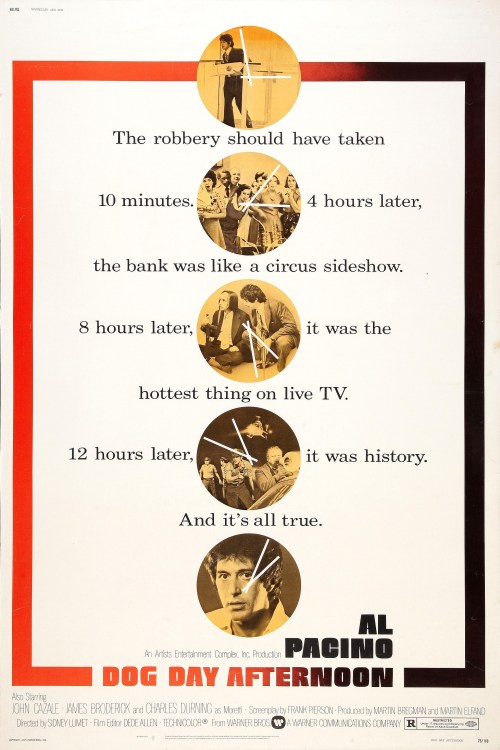
Dog Day Afternoon (1975)

dog

By Richard Winters

My Rating: 9 out of 10

4-Word Review: Money for sex change.

Dog Day Afternoon is a 1975 film based on a true story that took place on August 22, 1972.  It tells the tale of a man by the name of John Wojtowicz, who robbed a Brooklyn bank in order to pay for his gay lover’s sex change operation.  Here the character’s name has been altered slightly to John ‘Sonny’ Wortzik (played by Al Pacino), but otherwise this Oscar-winning script by Frank Pierson pretty much sticks closely to the actual events in this incredible saga about everything that can go wrong will.

Just about everyone who has watched this film will tell you how it manages to grab and pull you in right from the start.  It achieves this without having any special effects, pounding soundtrack, elaborate camera work, or artificial lighting.  Instead of ‘telegraphing all of its punches’ the film draws back and puts more emphasis on the little subtitles like the character’s facial expressions, side conversations, and other nuances that put together make this film very rich and textured.   In essence it successfully ‘shows’ instead of ‘tells’, which is a remarkable achievement since so many Hollywood films seem to want to do the exact opposite.

Director Sidney Lumet allowed for a lot of improvisation by his actors and gave each performer full rein on how to create their character, even the minor supporting ones. The result gives each and every one of the characters a distinct personality. The bank hostages become almost as fascinating as the thieves and it is interesting seeing all the different ways each one responds to the situation and how they interact with the robbers, which at times is both amusing and surprising.

The film also vividly captures 1970’s Brooklyn atmosphere. The sights and sounds of the area as well as the people’s personalities and the anti-establishment sentiment that was still quite prevalent at the time are all right on target.  After you finish watching this movie you feel like you just got back from a trip over there.  I really liked how during the opening credits you are shown all sorts of shots and scenes of Brooklyn, so by the time the story actually begins you are already well entrenched in the setting.

Pacino gives a dynamic performance in the starring role.  Some insist this is the best performance never to be nominated for an Oscar and I might have to agree.  If you are a Pacino fan than you absolutely have to see this, but if you are not a Pacino fan you still should see it because afterwards you might become one.

The supporting cast is stellar.  Sully Boyar, who was a real-life lawyer who did not enter into acting until he was in his 50’s, leaves a strong impression as the stoic bank manager.  As the police captain, the always durable Charles Durning is a blast especially during his frenzied and frantic negotiations with Pacino that almost become the film’s highlight. Another memorable moment is the improvised phone conversation between Sonny and his gay lover played by Chris Sarandon.  John Cazale is also amazing as Pacino’s bank robbing partner.  The partner in the actual incident was only 18 while Cazale was then 39, which created some controversy. However, Cazale is so convincing in the part that it is hard to imagine anyone else doing it as well.

In the end the film’s brilliance comes from its ability to convey the humanity of its characters. You can’t help but feel for the Sonny character despite his many flaws.  This a man who craves acceptance and yet goes through life being betrayed and hurt by everyone he meets. The shocked expression he shows at being betrayed by his own hostages, who he felt he had ‘bonded’ with, is, in my opinion, the most memorable shot of the whole film.

I only have two negative comments about this film and they are both minor.  One is the abrupt ending.  Since the film was made only a few years after the incident there wasn’t much of an epilogue to the characters.  The real John Wojtowicz, who really did look a lot like Pacino, didn’t end up dying until the year 2006.  It would have been a stronger conclusion by showing what happened to the Sonny character through the years and maybe even how he might of changed or grown.  My only other complaint is the fact that actress Carol Kane appears as one of the bank employees, but is shown very little.  A quirky and unique talent such as hers should have been given a bigger role.

Overall this is a great movie that I would recommend to any serious movie fan who can appreciate great film-making in top form.

My Rating: 9 out of 10

Released: September 21, 1975

Runtime: 2Hours 5Minutes

Rated R

Director: Sidney Lumet

Studio: Warner Brothers

Available: VHS, DVD (2-Disc Special Edition), Blu-ray, HDDVD, Amazon Instant Video

What Ever Happened to Baby Jane? (1962)

By Richard Winters

My Rating: 7 out of 10

4-Word Review: Living in the past.

This is a classic horror film that managed to resurrect the sagging careers of acting legends Bette Davis and Joan Crawford. It also spawned a whole new ‘psychobiddy’ genre of films. The movie is based on the 1960 bestselling novel by Henry Farrell.

The story takes place almost exclusively in an old, rundown Hollywood mansion where two aging, feuding sisters live. Baby Jane Hudson (Davis) was at one time a big child star, but never managed to cross-over to adult roles. She lives in a fantasy world, refusing to move on with her life, and takes out her frustrations on her crippled sister Blanche (Crawford), who at one time was a big movie star until a horrible car accident left her bound to a wheelchair.

The real-life feud and animosity that the two stars had for each other is now legendary. Some of the things the two said about the other is hilariously over-the-top and too many to quote here, but well worth checking out. When you hear of all the incredible things that the two did to each other behind the scenes you almost become amazed that the film was ever able to get made. I wished that a documentary had been filmed examining the movie’s production as that could have been almost more entertaining than the film itself.

All things considered, Davis is nothing short of fabulous here. She should have won the Oscar hands down and she pretty much steals the film. She also wore gaudy make-up that gives her an almost ghost like appearance. Crawford is very good as well, but her role is not as flashy. Sadly for her this was her last hurrah as her alcoholism took its toll and her roles after this were in B-movies while Davis went on strong for the next twenty years.

Of course some may argue that the real star was director Robert Aldrich. I liked the bird’s-eye shot of Blanche spinning around in her wheel chair in frustration and terror. It is brief, but gives the viewer a very unnerving feeling. The scene where Baby Jane does an old rendition of one of her routines that she did as a child in front of a mirror that she has set-up in her living room that is also surrounded by stage lights is a nice directorial touch. The campy opening that takes place in 1917 that shows Baby Jane at her peak is memorable as is the very offbeat climatic sequence on a crowded beach. I also got a real kick out of all the Baby Jane toy dolls.

Victor Buono deserves mention as he was nominated for the supporting Oscar for his role as Edwin Flagg, the fledgling composer who Baby Jane hires to help resurrect her stage show. Although best remembered for his comedic skills he was also quite good in his serious parts and his immense girth always made his presence known. I enjoyed how they form this weird quasi-relationship that is based solely on each other’s lies and delusions.

I did have a few complaints to what seemed to me to be some serious logistical flaws. One is the fact that Blanche is stuck in her upstairs bedroom with no way to get downstairs. You would think that with all the money that they once made that they would’ve been able to afford building either an elevator, or a chair lift. It also seemed implausible to believe that Blanche had been stuck in her bedroom since 1935 when she had her accident, until present day 1962, which is what the film seems to imply. As much as I liked the African-American housekeeper Elvira Stitt (Maidie Norman), who is well aware of Baby Jane’s psychosis and has no trouble standing up to her, I thought it was awfully dumb the way she set down a hammer that she was holding right in front of Baby Jane and then turned her back to her, which allowed her to be attacked that anyone else could have predicted would happen. I also felt there was a little too much background music that at times got a bit melodramatic.

Still, this is a great film that his highly entertaining from beginning to end. With the exception of some of Baby Jane’s ‘dinner surprises’ the film is devoid of any real scares and there is no gore, which may disappoint today’s younger, more jaded viewers. However, the film has a very strong, dark psychological undercurrent, which proves to be immensely fascinating and will be appreciated by those who are more sophisticated. The film’s theme, which is that of Hollywood’s fickle, vicious cycle of fame, is universal and as strong today as it was back then.

It is interesting to note that the director’s 18 year old son William, who appears at the end as a lunch attendant at the beach, produced  29 years later the made –for-TV remake of this film that starred the Redgrave sisters, but was not as good. Also director Aldrich later made two variations of this same story. One was Whatever Happened to Aunt Alice which he produced and starred Geraldine Page and Ruth Gordon and also the British classic The Killing of Sister George which he also directed.

My Rating: 7 out of 10

Released: October 31, 1962

Runtime: 2Hours 14Minutes

Rated NR (Not Rated)

Director: Robert Aldrich

Studio: Warner Brothers

Available: VHS, DVD, Blu-ray, Amazon Instant Video