Category Archives: Classic

The Marriage of Maria Braun (1979)

the marriage of maria braun

By Richard Winters

My Rating: 8 out of 10

4-Word Review: Maria gets her way.

Maria’s (Hanna Schygulla) husband a soldier in World War II is presumed dead. She decides to make her mark by getting a job and a new lover in the form of a black man named Bill (George Eagles), but complications ensue when her husband Hermann (Klaus Lowitsch) shows up very much alive. Maria enjoys her new found independence and isn’t interested in falling back into her old role, which causes friction with her husband as well as her interactions with others.

Director Rainer Werner Fassbinder creates a unique vision and manages to walk the balance between the gritty and surreal. The lighting is evocative and shadowy and nicely reflects his stage background. The sets are colorful and varied and one becomes almost hypnotically entranced with the visuals. The abandoned buildings and rundown locales especially at the beginning make a strong impression and become like a third character. Fassbinder echoes the desperation of the characters through visual means only without ever having to resort to melodramatics, which alone makes this a classic and far better than some other similar films about the period.

Equally great use is made of sound with two to three layers of it within each scene. Whether it is the noise of a radio, traffic, or someone whistling there is always some noise coming from the background much like in reality, which helps in a subtle way to make the scenes more vivid. I loved the dolly shots constantly moving the camera around in every scene throughout the rooms that the characters are in giving the viewer a full sense of their dimensions and helping breakdown the fourth wall.

Some memorable scenes include the moment when Maria’s husband comes back from the war and catches Maria in a compromising position with her new found lover. There are at least four minutes here where there is no talking from any of the characters and one becomes riveted with the silent reactions of the three, which proves powerful. Even the erotic overtones work. Normally I find that area to be rather clichéd and mechanical, but here the sweat glistening off the naked bodies seems genuinely evocative and enticing.

Many people feel this is a movie about budding feminism and applaud the strong female character. I really wouldn’t argue with that and in many ways it is fun seeing this woman forge her way ahead while remaining poised and stalwart throughout. Her relationship with rich businessman Karl (Ivan Desny) and the way she turns him into a subservient to her every whim while also explaining to him that ‘he isn’t having an affair with her, but instead SHE is having one with him’ is classic, but I also felt it seemed a bit artificial. Having a strong central character is one thing, but this woman seems inhuman. She never shows any vulnerability at any time and appears almost completely removed from the environment around her. Never once does she flinch, compromise, or back down from anything or anyone, which just isn’t possible and makes Maria one-dimensional in the process. A character is more interesting when their flaws are exposed and then they must work hard to overcome them, but this one doesn’t have any, which is my biggest issue with this otherwise excellent production.

My Rating: 8 out of 10

Released: February 20, 1979

Runtime: 1Hour 58Minutes

Rated R

Director: Rainer Werner Fassbinder

Studio: United Artists

Available: VHS, DVD (The Criterion Collection)
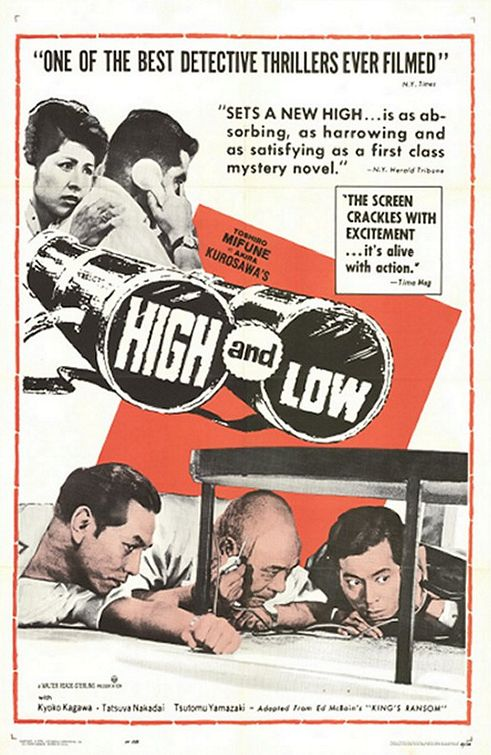
High and Low (1963)

high and low

By Richard Winters

My Rating: 7 out of 10

4-Word Review: Pay ransom go bankrupt.

Kingo (Toshiro Mifune) is an executive of a shoe company who finds out that his chauffeur’s son has been kidnapped and comes under tremendous pressure to pay the ransom even it will make him bankrupt.

As with all of Akira Kurosawa’s films the production values are solid and the story is well paced. The very methodical police work and investigation is interesting and enlightening. It’s certainly nothing like today’s CSI shows, but well done for its period. The ending scene where Mifune faces the kidnapper leaves a strong and memorable impression.

However, on the negative side the set-up to the kidnapping happens too quickly without any type of buildup or tension. Almost the entire first hour takes place inside the living room of Kingo’s hilltop house and it would’ve helped to have some cutaways to other locales.  Mifune, who is billed as the star and gives a great performance disappears during the second hour only to finally reappear at the very end and I felt it would’ve been stronger had he been involved more in the investigation. Also, the revealing of the kidnapper is unexciting and a big letdown.  I had a hard time understanding why a guy who was so very crafty and sophisticated in every facet of his planning of the kidnapping would suddenly get so conveniently dumb and sloppy at the very end.

This is a decent Kurosawa entry, but in my opinion not one of his best. Yet it is still good enough to keep you captivated from beginning to end.

My Rating: 7 out of 10

Released: March 1, 1963

Runtime: 2Hours 23Minutes

Not Rated

Director: Akira Kurosawa

Studio: The Toho Company

Available: DVD, Blu-ray (The Criterion Collection)

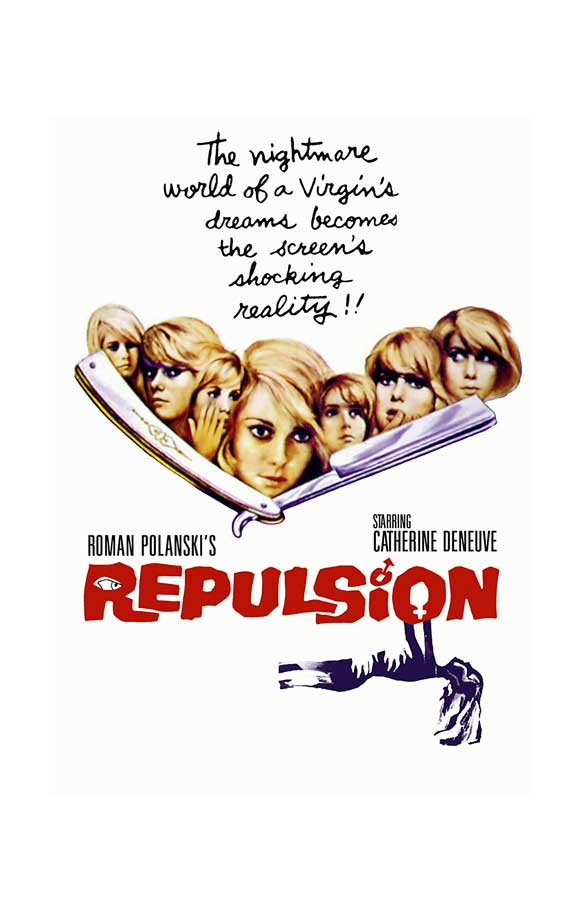
Repulsion (1965)

repulsion 1

By Richard Winters

My Rating: 8 out of 10

4-Word Review: She loses her mind.

Love or loathe him one thing is for sure the controversial Roman Polanski has made some great movies and since today marks his 80th birthday I thought it would be good to review one of his films this being his first English language one. The story, which was written by Polanski and Gerard Brach centers on Carol (Catherine Deneuve) a beautiful but lonely young woman living in an apartment with her older sister Helen (Yvonne Furneaux) and Helen’s boyfriend Michael (Ian Hendry). Carol seems detached and troubled and when Helen and Michael go off for the weekend Carol begins to suffer hallucinations while inside the apartment that becomes increasingly more frightening and eventually leads to murder.

The film works at a slow and deliberate pace that some viewers may feel put-off by. Personally I felt it was effective and made it more realistic although things really don’t start to get intense until the final hour. For me it was the little things that made it intriguing for instance the way Carol becomes fascinated with the distorted reflection of herself in a teapot, or a rolling bottle of nail polish. Nothing is over-the-top, but instead subtle and restrained. This is one of the few films that seem to understand the thought process of the mentally ill and makes you feel like you are really inside their head and seeing things as they do, which is what makes it so unnerving. The low-key approach works because like with an actual person having a breakdown it starts with little things that slowly morph into bigger ones.

Polanski shows incredible control over the material. The stark black-and-white cinematography helps to heighten the ugliness of the situation. The variety of camera angles and movements creates an almost hypnotic effect. I loved the way, as Carol gets further into her demented state, that the dimensions of the apartment begins to change, or the hands coming out of the walls. My only complaint is I wished some of these effects had been played up even more. The rape sequences are quite effective and surprisingly explicit for its time period. Yet instead of hearing Carol’s screams during these moments we instead hear the ticking of a clock, which somehow makes it even more disturbing.

Deneuve gives one of her best performances and she was at the peak of youthful beauty here. The blank almost zombie-like look in her eyes is penetrating. You get the feeling that she not only truly understands the madness of her character, but actually is the character. Patrick Wymark is also memorable as the landlord who goes from being bombastic and demanding to kind and cuddling and eventually sexually deviant in a matter of only 10 minutes.

Normally I always like a background to the characters and when they are missing or vague I find it a weakness to the script while here it is strangely a strength. We can surmise that she was most likely abused sexually when she was younger, but the who, when, and why is never made clear. This though somehow makes the character and the situation more compelling and reflects back to how psychologically fragile the human condition can be and how these things can happen to anyone. The final tracking shot, which stops on a picture of Carol as a child showing an angry look on her face is great.

The imagery and psychological approach to this thing is still one-of-a-kind. The movie viewing experience on this one remains potent and aptly deserves its classic status.

repulsion 2

My Rating: 8 out of 10

Released: October 2, 1965

Runtime: 1Hour 45Minutes

Not Rated

Director: Roman Polanski

Studio: Compton Films

Available: VHS, DVD, Blu-ray, Amazon Instant Video

The Great Escape (1963)

the great escape 3

By Richard Winters

My Rating: 8 out of 10

4-Word Review: Tom, Dick and Harry

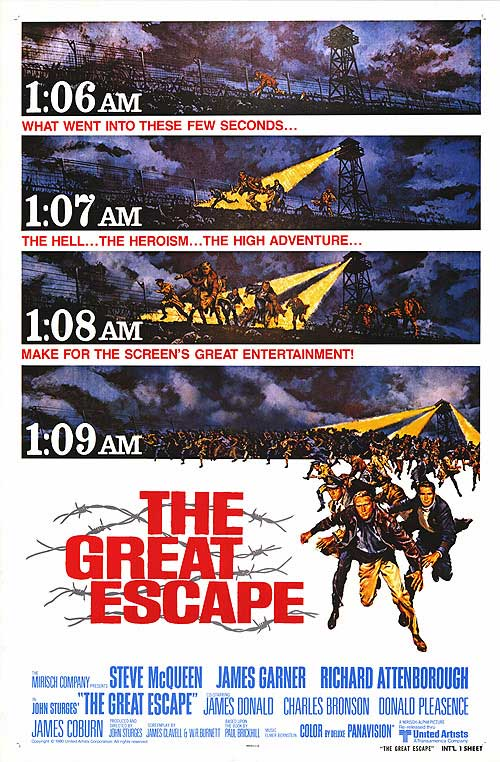
Based on a true story involving POW’s in an ‘escape proof’ German Prison camp who devise a way to get out by digging three tunnels, which will go under the barbed wire fence and allow them to get out under the cover of a nearby forest. They decide to build three tunnels and call them Tom, Dick and Harry, so if the German guards discover one of the tunnels they can simply continue to work on the other two.

The producers built a complete replica of Stalag Luft III were the actual events took place and used Wally Floody who was a prisoner of the camp and took part in the escape as an advisor. The movie moves at a polished pace grabbing in you immediately and keeping you involved all the way through. The characters share a great camaraderie and it’s a terrific testament to teamwork and how by everybody playing a little role can help make great things happen. Their resolve and ‘can-do’ spirit is infectious and one of the major reasons the film is so compelling. The bouncy, upbeat patriotic music is good although it gets played a lot and most viewers will most likely hear it playing in their head long after it is over.

I did feel that the depiction of the camp seemed a bit too cozy. The men are allowed to freely walk around and congregate in large meetings where they make their plans and it seemed to me that a heavily fortified prison camp wouldn’t allow for that, or at least be more on top of things. I wouldn’t say the German’s are portrayed on a ‘Hogan’s Heroes’ dumb level, but at times it gets close. For instance when the James Garner character lifts the wallet out of the pocket of one of the guards he does not become aware that it is missing for what seems like several days and then when he does he doesn’t suspect the Garner character and instead goes back to him and naively asks for his help in finding it. When the Germans find one of the tunnels there are no reprisals even though I and some of the others in my movie group who watched it with me felt that there should have been. Also, when the Steve McQueen character attacks one of the German guards when they shoot his friend who is trying to escape he is not sent to the cooler even though he had previously been sent there for far less infractions.

On the acting side it is all top-notch. McQueen is as cool as ever. I love his detached manner and rugged willing to take risks personality. His escape by motorcycle, which was added into the story by his request, is exciting and one of the most memorable moments in the film. Charles Bronson is good as one of the characters who are most instrumental at digging the tunnels however I felt that it seemed a bit far-fetched and like tacky Hollywood melodrama that he had spent so much time working inside the tunnels only to suddenly get claustrophobic about them just as they are trying to escape. David McCallum has very few words, but gets gunned down in exciting style at a train station. I normally love James Coburn and his character is appealing, but his attempt at an Australian accent is atrocious.

Spoiler Alert!

Despite its title the film really doesn’t seem like all that great of an escape. For one thing out of the predicted 250 that were supposed to escape through the tunnel only 76 made it out before the Germans caught onto it and closed it off. Of those 76 there are 50 who get caught, rounded up and shot at point blank range. 12 get returned to the camp and only 3 actually make it to safety. When the Steve McQueen character gets sent back to the cooler in the film’s final scene I felt a bit frustrated and depressed and that the big ballyhooed escape had really lead nowhere.

My Rating: 8 out of 10

Released: July 4, 1963

Runtime: 2Hours 52Minutes

Not Rated

Director: John Sturges

Studio: United Artists

Available: VHS, DVD, Blu-ray, Amazon Instant Video

Topkapi (1964)

topkapi 1

By Richard Winters

My Rating: 8 out of 10

4-Word Review: Granddaddy of heist movies.

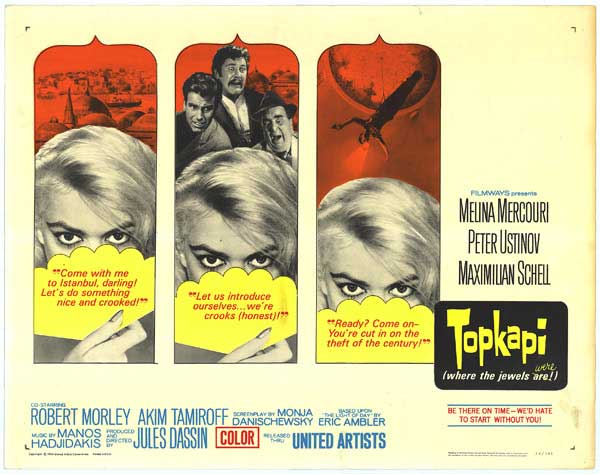
Elizabeth (Melina Mercouri) and Walter (Maximilian Schell) have formed a group of amateur thieves to help them steal an emerald dagger out of the famed Topkapi Palace in Istanbul, Turkey. Problems ensue when one of the original members of the group becomes injured and they are forced to hire on the services of Arthur Simon Simpson (Peter Ustinov) a bungling, portly small-time crook whose on-going ineptitude almost throws their well thought out plans into jeopardy.

This film has become the granddaddy of heist films and rightly so. Based on the novel ‘The Light of Day’ by Eric Ambler the story is well-crafted and nicely detailed. The plan is elaborate, but fortunately believable and plausible. Director Jules Dassin seems to have all the logical loopholes covered. The production design is plush and captivating with just the right amount of offbeat touches to keep it original and cinematic. I found myself enjoying the dry humor and characterizations interspersed in-between the planning and action. The momentum builds evenly without every feeling rushed, or draggy. The on-location shooting is a plus that not only captures the sunny climate, but also the distinct ambience and look of the region.

The climatic sequence involving the actual heist is exciting. The actors do all of their own stunts including Gilles Segal as Guilio being lowered upside down into the palace by a rope being held rigorously by Walter and Arthur and doing most of his maneuvers trapeze style. The whole scene had me holding my breath most of the way and Dassin manages to capture if all from different and interesting angles while allowing the silence to help create the tension.

Ustinov is in fine form and deservedly won the Oscar for best supporting actor. Supposedly the part was originally intended for Peter Sellers, but Ustinov gives the character a lovable quality that I don’t think Sellers could. Ustinov’s rotund physique is an added benefit and his nervous looking facial expressions are consistently amusing with the interrogation scene by Turkish authorities being his best moment. It’s nice to see the character evolve and find a confidence he didn’t think he had while gaining a begrudging respect from the others.

Mercouri sizzles. Normally I am not crazy about women with deep, throaty voices like hers, but she makes it tantalizing. The character is a self-described nymphomaniac and the expression on her face as she watches a group of men spread lotion over their half-naked bodies is worth the price of the film.

The rest of the supporting cast is okay, but I found it odd how very polished they were when Walter insisted that he wanted amateurs for the heist that had no criminal background, or record. Having them behave in a befuddled besides just Arthur would have been more realistic and expected. I also didn’t like that the Guilio never says a single line of dialogue. Apparently the character was a mute, but there is no reason given for it and in the process makes him transparent and boring.

Spoiler Alert!

The only real problem I had with the movie is the ending. As Guilio is exiting the palace a little bird flies through the window while he is closing it, which in turn sets off an alarm, which leads to the gang getting arrested. However, I couldn’t understand how the trapped bird would’ve allowed the police to figure out what happened as an exact replica of the dagger that they swipe is put onto the chest of the sultan figure. To me it just seemed like one twist too many and the scenes showing them inside the prison is campy and forced. These guys had been portrayed as being slick and sophisticated most of the way, so why turn them into clowns at the end. Possibly this was done to show that ‘crime doesn’t pay and no crime portrayed in a film should go unpunished’, which was a code most movies were forced to work under in the past. Either way it doesn’t work and kind of hurts what is otherwise a snappy piece of entertainment.

My Rating: 8 out of 10

Released: September 17, 1964

Runtime: 2Hours

Not Rated

Director: Jules Dassin

Studio: United Artists

Available: VHS, DVD (Region 1 and 2), Amazon Instant Video

Sixteen Candles (1984)

sixteen candles

By Richard Winters

My Rating: 7 out of 10

4-Word Review: He has her panties

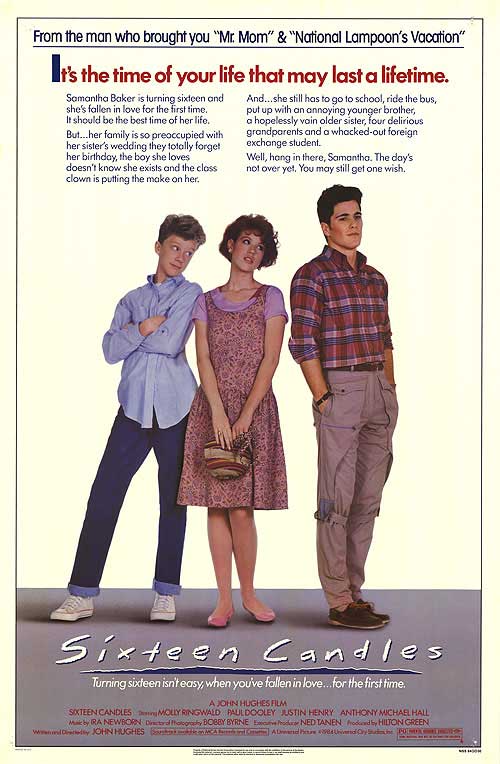
The 80’s may eventually become known as decade of the teen movie. There were so many and 98% of them were crude, moronic, and forgettable. However this disarming film, a product of John Hughes, is a winner. It’s a simple story that manages to bring out the universal truths of that age in a seamless manner. Its best asset is its ability to show how all those things that are considered insignificant to others is a big deal to teens. The film may be best suited for adults who can look back on that period with a mature perspective and a wry sense of wit as well as nostalgic to those who were adolescents when the film came out.

The film stands out from the rest in other ways too. First is the fact that the majority of the cast actually look the age they are playing and resemble the physical awkwardness. Other teen movies always seem to have pretty models and chiseled faced guys who look older than they should. The kids here also don’t have that annoying smugness. The filmmakers approach it with the idea that behind all that crudeness it is still an innocent time. It’s also nice to see parents and teens getting along and not constantly at odds. The late night talk between Ringwald and her father (Paul Dooley) is quite touching.

The film has some really funny moments. The destruction of a nice suburban home during a wild teen party is fun. Hall’s ‘official’ unveiling of Ringwald’s panties to a group of awed freshman is also memorable.

Ringwald is perfect in the starring role as she was sixteen at the time and seems to embody the character. You hardly see the acting. Hall was also a good choice as the male geek. He certainly has the scrawny physique of a typical freshman as well as the outrageous persona that he creates to help compensate for it. It is also interesting that at times he shows some mature sensibilities, which is a good example of how adolescence can be a mixture of different traits. The adult cast is great as well especially the veteran character actors who play the grandparents.

This film borders on being a minor classic even though there are a few drawbacks. One is the ending sequence where Ringwald’s older sister, who is also the bride, starts to behave erratically, which becomes comic overkill. The picture worked better when it stuck with Ringwald and her high school experiences exclusively. The film also has a few too many neat wrap-ups. The worst being when the hottest girl in the senior class falls in love with Hall, which was too much of a stretch. The music score gets heavy-handed at times especially when it’s used to accentuate a comic moment. There are also a few too many unnecessary sound effects.

John and Joan Cusack can be seen in small roles with John looking very young. Jami Gertz can be seen quickly as a drunken party guest. Also Blanche Baker, who plays Ringwald’s older sister, is the real life daughter of actress Carroll Baker.

My Rating: 7 out of 10

Released: May 4, 1984

Runtime: 1Hour 33Minutes

Rated: PG

Director: John Hughes

Studio: Universal

Available: VHS, DVD, Blu-ray, Amazon Instant Video

Halloween (1978)

By Richard Winters

My Rating: 6 out of 10

4-Word Review: Michael Meyers comes home.

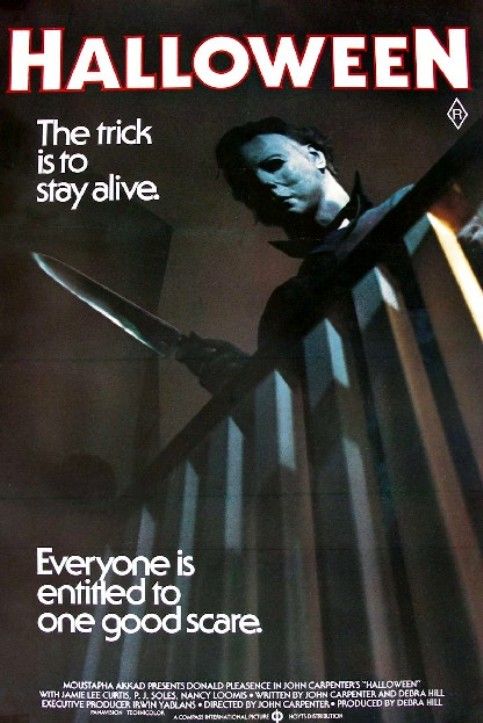
On Halloween night in 1963 6 year old Michael Myers stabs to death his older sister Judith. He is taken away to a mental institution, but fifteen years later he escapes and comes back to his hometown of Haddonfield to stalk three teenage women (Jamie Lee Curtis, Nancy Loomis, P.J. Soles) on Halloween night.

I first saw this film 25 years ago when I was in College and thought it was cool, but now on my second viewing I’m not quite as impressed. There are still some good things about it, but also in my opinion some glaring loopholes. I’ll start with the things I liked.

Cinematically it is a well mounted thriller. The lighting is perfect. The dark shadowy interiors create the feeling of menace and the little light that is shown has a bluish tone and resembles authentic moonlight. The music by director John Carpenter is distinct and has an effective up-tempo beat almost like a warning siren. The editing and pacing is great. It builds the tension nicely and has some creepy imagery.

One of the scenes I always found to be the creepiest is when Tommy, the young boy that the Curtis character is babysitting, sees from across the street Michael carrying one of his dead victims from the car to the house. In fact all the long shots showing Michael are the most effective. Somehow it was a combination not only of the way the actor walked in the costume, but his mask as well, which was apparently a William Shatner Captain Kirk mask that was painted all white.

The fact that there is never any reason given for why Michael became the way he did is also good. There are many similar true-life crimes where even after the murderer is interviewed by the psychiatrists they still can’t always come up with a satisfying explanation. Movies that try to show the reason behind why the bad guy becomes murderous usually end up being contrived and clichéd.

The three actresses looked too old for teenagers and in the case of both Loomis and Soles where already in their late twenties. Loomis though is kind of funny in her part especially with the way she interacts with Lindsey (Kyle Richards) the young girl that she is babysitting. Curtis is good and although I respect her right to going natural with the gray hair that she now sports I still felt she was at her most attractive when she had the long red hair like she has here.

On the negative side there seemed to be too many story elements that didn’t make sense. For instance Michael is institutionalized when he is six and then escapes fifteen years later and is able to miraculously drive a car even though he was never trained. The book version of the movie explains this anomaly by stating that when Dr. Loomis (Donald Pleasance) would take Michael to sanity hearings over the years that Michael would watch very closely how Loomis operated the vehicle and thus ‘learned’ how to drive, but that still doesn’t make sense because watching how something is done and then finally doing it yourself are two completely different things. Besides if watching how somebody drives where enough then every child who watched his parents drive could learn it and there would be no need for driving schools. Also, Michael escapes from the asylum without any explanation, which seemed way too convenient.

When Dr. Loomis shows up in town and tells the sheriff (Charles Cyphers) that there may be an escaped mental patient in the vicinity the sheriff comes up with the logical step of warning everybody about it, but Loomis disagrees and his reasoning is ridiculous. Also, when Laurie (Curtis) gets a call from Lynda (Soles) that sounds like she is being murdered Laurie doesn’t do the most sensible thing and that is to call the police and let them investigate it. Instead she decides to go over to the home in the middle of the night and investigate it herself, which not only needlessly puts her in a dangerous position, but also leaves the two kids that she is supposed to be watching home alone in bed, which is something a good babysitter should never do.

I also had some problems with the setting itself. Now of course the town of Haddonfield is fictitious, but the state of Illinois isn’t. It is situated right in the middle of the Midwest and there are no palm trees anywhere within its borders and yet I spotted a few lining the streets especially near the beginning when Laurie is seen walking home from school. I didn’t buy into the idea that the Meyers house would stand vacant for 15 years either. There are a lot of homes that have murders committed in them that do not remain abandoned, or considered ‘haunted’. In some cases the original house is torn down and a new one is built in its place such as the infamous John Wayne Gacy house in Des Plaines, Illinois, which is now being occupied by a new family. The neighborhood in the film looks nice and well-kept. The other homeowners wouldn’t stand for a building being abandoned for that long as it brings down the property values.

When I first saw this movie I got a real kick out of the part where Michael kills a man and then hangs him by a knife on a wall and stares at the corpse in a child-like way. However, on second viewing I don’t think the blade of the knife would have been long enough, or strong enough to go through a man’s body as well as a wooden door.

The opening sequence where we see Michael killing his sister from his perspective didn’t completely work with me either. I liked the idea of seeing the action through the two eye holes of the mask that Michael was wearing, but I think if someone is stabbing someone else that they would be looking at what they are doing, but instead the eye holes remain fixated on the sister’s face during the stabbing that is being done on the lower parts of her body, which looked stilted and unrealistic.

Now, I know this movie has a large legion of fans and some may take umbrage to my negative points, but hey, I take my film criticism seriously and feel I need to say it the way I see it. That is not to say that I ‘hated’ the movie either. I still liked it overall, but when given the issues that I described above I can only give it 6 points.

My Rating: 6 out of 10

Released: October 25, 1978

Runtime: 1Hour 31Minutes

Rated R

Director: John Carpenter

Studio: Compass International Pictures

Available: VHS, DVD, Blu-ray

Texas Chainsaw Massacre (1974)

By Richard Winters

My Rating: 9 out of 10

4-Word Review: Man can she scream.

Four young adults on a summer trip inadvertently come into contact with a mutant family and their chainsaws.

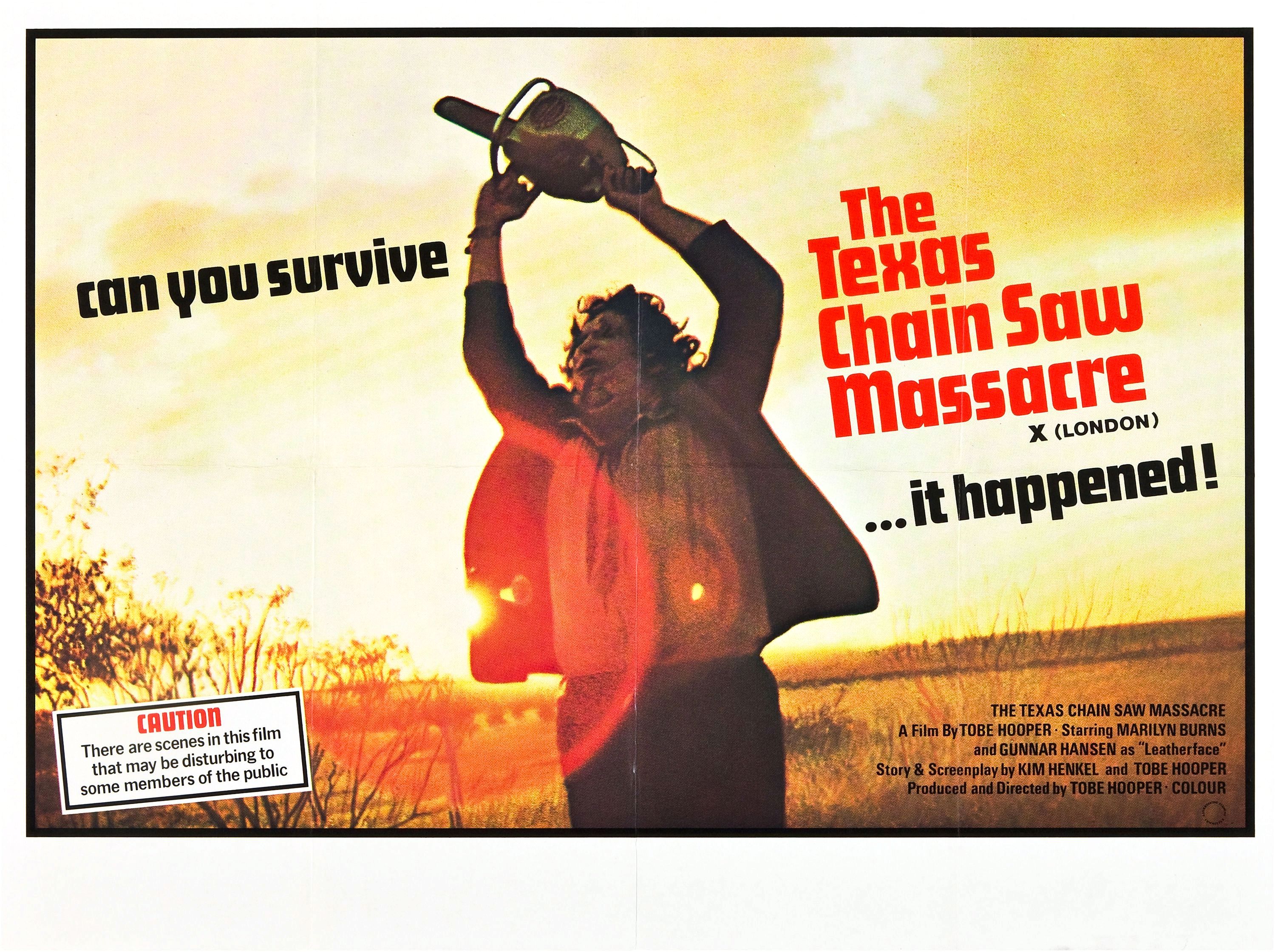
This is the type of horror film most others strive to be, but usually never succeed. The tension builds right from the start. It’s slow but consistent and eventually hitting on an almost unparalleled level. Director Tobe Hooper and cinematographer Daniel Pearl make terrific use of the location shooting. Between the music and visuals you are given an otherworldly sense. The atmosphere literally hugs you with the dementia of the situation. You feel as engulfed with it as our heroine Sally Hardesty (Marilyn Burns). It transcends most other horror films simply because of its intensity and grotesque perspective. It blends so many unusual things together and yet everything still works. It’s both artsy and raw, moody and exciting, humorous and ugly and a masterpiece in many ways.

If you are looking for gore you may end up disappointed. Despite its reputation there really is very little if any. Apparently they were going for the ‘PG’ rating, but even so certain scenes become almost laughable with their restraint. One scene in particular features Leatherface (Gunnar Hanson) jumping out at a man in a chair. He jams his chainsaw into him and yet only small droplets of blood can be seen coming out.

There is also the problem of Marilyn Burns running. By most crew accounts she was a slow runner. This caused problems because it would allow the assailants to actually catch up to her even though they weren’t supposed to. Both Hansen and Edwin Neal as the Hitchhiker have to do some goofy things to avoid reaching her. This is obvious in the final chase sequence and it hurts the tension a bit.

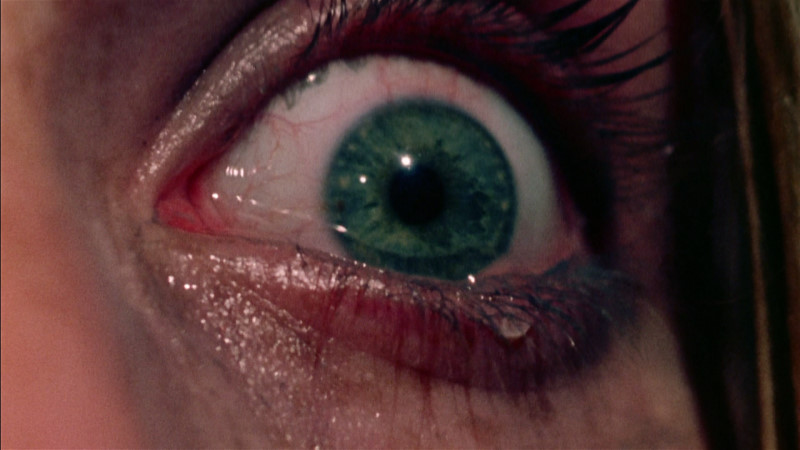
I still feel though that Marilyn was a good choice for the part. Her face holds an authentic look of terror and her screams reach amazing decibels. The graphic close-ups of her eyes are astounding and memorable.

This film makes its sequels look awful. A good companion to this picture is Hooper’s follow-up film Eaten Alive. It has the same atmosphere and intensity and is interesting in an equally odd way with Neville Brand making a unique villain.

My Rating: 9 out of 10

Released: October 1, 1974

Runtime: 1Hour 23Minutes

Rated PG

Director: Tobe Hooper

Studio: Bryanston Distributing

Available: VHS, DVD, Blu-ray 

Misery (1990)

By Richard Winters

My Rating: 6 out of 10

4-Word Review: She’s his biggest fan.

Paul Sheldon (James Caan) is a writer who has just finished his latest novel. On the way back to his publisher (Lauren Bacall) he gets stranded in a freak snowstorm and ends up being ‘saved’ by Annie Wilkes (Kathy Bates) who is his ‘number one fan’. He is injured so she takes him to her nearby house where she proceeds to make him a helpless prisoner to her tormented and delusional mind.

The story has some interesting underlying elements. The film doesn’t really explore them, but does at least touch on it. It is the metaphor of the artist and the public. He is an educated man and yet his stories appeal to those with less education and what he puts into his work isn’t always what they take out of it. He doesn’t really like these stories and wants to expand his craft, but can’t because the formulaic stuff is what sells. In a way Paul was already trapped by Annie long before he ever got to her house and it is a sad dilemma a lot of artistic people have to deal with.
Bates as Annie plays the part really well. She is the ordinary, bland looking woman that you would never think about or consider dangerous. Her strange, erratic behaviors are slowly revealed until in the end the complete monster inside is unleashed. Screenwriter William Goldman, director Rob Reiner, and Bates herself show a good understanding of the character and what makes her tick. They create a woman who is complex, real, frightening, and at times even sad and pathetic.

Caan is a good competent actor however any one of number of actors could have played the part and maybe even done better. Yet you really sense and feel his confinement and ever growing frustration and when he finally revolts at the end you love it!

On the whole the thriller is pretty standard. There are some tense moments, but it is also routine and by the numbers. I thought it was too well lighted as a good psychological thriller always works best with a lot of shadows. The room Paul is trapped in looks more like it was done on a sound stage than in a real home and the film needed a few more unexpected twists.

My Rating: 6 out of 10

Released: November 30, 1990

Runtime: 1Hour 47Minutes

Rated R

Director: Rob Reiner

Studio: Columbia Pictures

Available: VHS, DVD, Blu-ray, Amazon Instant Video

The Paper Chase (1973)

By Richard Winters

My Rating: 9 out of 10

4-Word Review: He can’t please Kingsfield.

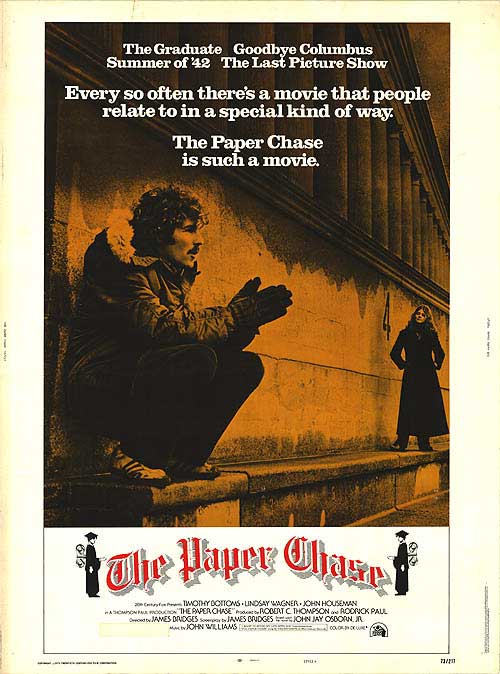
James Hart (Timothy Bottoms) attends his first year at Harvard Law School and finds himself obsessed with the notoriously stern Professor Charles Kingsfield (John Houseman). His fascination increases after he begins a relationship with Kingsfield’s daughter Susan (Lindsey Wagner). The rest of the story deals with the pressures and demands of being a law student.

This quite possibly is the quintessential movie about college life. Everything is captured in such a real and revealing way that it will very likely send the viewer back to their college days. Despite being nearly forty years old it doesn’t seem dated at all as it touches on many universals that every generation goes through at that age. If anything it is still quite topical. The few dated elements are actually fun to see including the scene in the pre-cellphone days where the students would line up and wait their turn to make a call on the dorm’s one and only pay phone.

The student characters have diverse personalities and seem like young adults one would meet during their college days, or even see on a campus today. It is nice to have a college movie where students are actually studying. In fact these scenes are some of the best moments in the film including Hart’s dealings with difficult people in his study group.

The Hart character is appealing and relatable. I liked how he is multi-faceted and displays elements from both his own era including his counter-culture hairstyle as well as past ones.

Having it filmed on-location and capturing the different seasons of the year makes the viewer feel like they are attending the school year right along with him. I particularly liked the scene shot in the historic Harvard stadium.

The film also makes terrific use of silent moments as there is very little music. Many college movies dwell on the loud and raucous partying, but there is a lot of quiet time as well particularly the first day of class in a large auditorium wondering what the instructor will be like. The opening sequence done underneath the credits showing an empty classroom quietly filling up with students was not only novel, but brilliant.

Houseman deservedly won the Oscar for his portrayal of the crotchety professor. Outside of a small and unaccredited role in Seven Days in May this was technically, at age 71, his film debut. Some may complain that the character is one-dimensional. We are never shown any type of softer side to him and I am sure most films would have thrown some in, but the fact that they don’t do it makes his mystique more interesting. My favorite moment of his is when at the end of the year the students give him a standing ovation while Kinsgfield responds with his trademark scowl before walking out of the room.

The supporting cast of students is terrific and many were making their film debuts. There is Graham Beckel as Hart’s study partner Franklin Ford who looks like a twin of Brad Dourif. There is also Edward Herrmann and James Naughton as Kevin Brooks a man with a photographic memory, but no analytical ability. My favorite though was Craig Richard Nelson as the moody and belligerent Willis Bell.

Blair Brown can also be seen as one of the female students during the classroom scenes. She speaks in a strange accent and I think she was trying too hard to get the Bostonian sound, but I ended up kind of liking it anyways.

The implementation of Kingsfield’s daughter into the story really didn’t work with me. Lindsey Wagner is a competent actress, but the way they meet on a sidewalk seemed too forced and random. It is also beating extreme odds that Hart would by chance get into a relationship with the daughter of a man that is the complete center of his universe and the fact that she turns out to be hip, sexy, and gorgeous even though she is related to a man who is anything but was also a stretch. It would have been interesting had there been a few scenes and dialogue between Kingsfield and Susan, but none is ever shown.

There is a part involving Hart sneaking into the library when it is closed in order to get into a section that houses the notes taken by the professors when they attended the school as students, which I found to be odd. I have never known any college that has done this and talking with others no one else has either. I was still willing to roll with it but found it frustrating that when Hart takes out the notes written by Kingsfield in 1927 that the camera doesn’t focus in on the page to allow the viewer to see it for themselves. Having Hart simply describe what he sees including some doodling that Kingsfield apparently made on the side of the page is not as satisfying.

I had a few problems with the end as well although it was not enough to ruin what is otherwise a great movie. However, there is a scene showing Kingsfield grading his student’s tests by himself even though most tenured professors who teach large classes have graduate assistants do this for them. It may be more cinematically satisfying especially for the general viewer to see Kingsfield doing the grading, but that is not how it actually works.

Also, when Hart receives the grades in the mail he doesn’t bother to open the letter, but instead turns it into a paper airplane and floats it into the ocean. I didn’t understand the motivation of this because during the film Hart spends an enormous amount of time preparing for the test, so I would think anyone who went through that would want to see what they got. If he wants to turn it into a paper airplane afterwards that is fine, but at least see the results. I spoke to a fan of the film who says he interprets this scene to mean that Hart was more interested in learning the subject for his own enjoyment and not concerned with what he got out of it, but if that is the case the film fails to bring that out earlier and instead seems to show the exact opposite.

My Rating: 9 out of 10

Released: October 16, 1973

Runtime: 1Hour 53Minutes

Rated PG

Director: James Bridges

Studio: 20th Century Fox

Available: VHS, DVD, Amazon Instant Video