Category Archives: Classic

The Exorcist (1973)

By Richard Winters

My Rating: 10 out of 10

4-Word Review: Possessed by the devil.

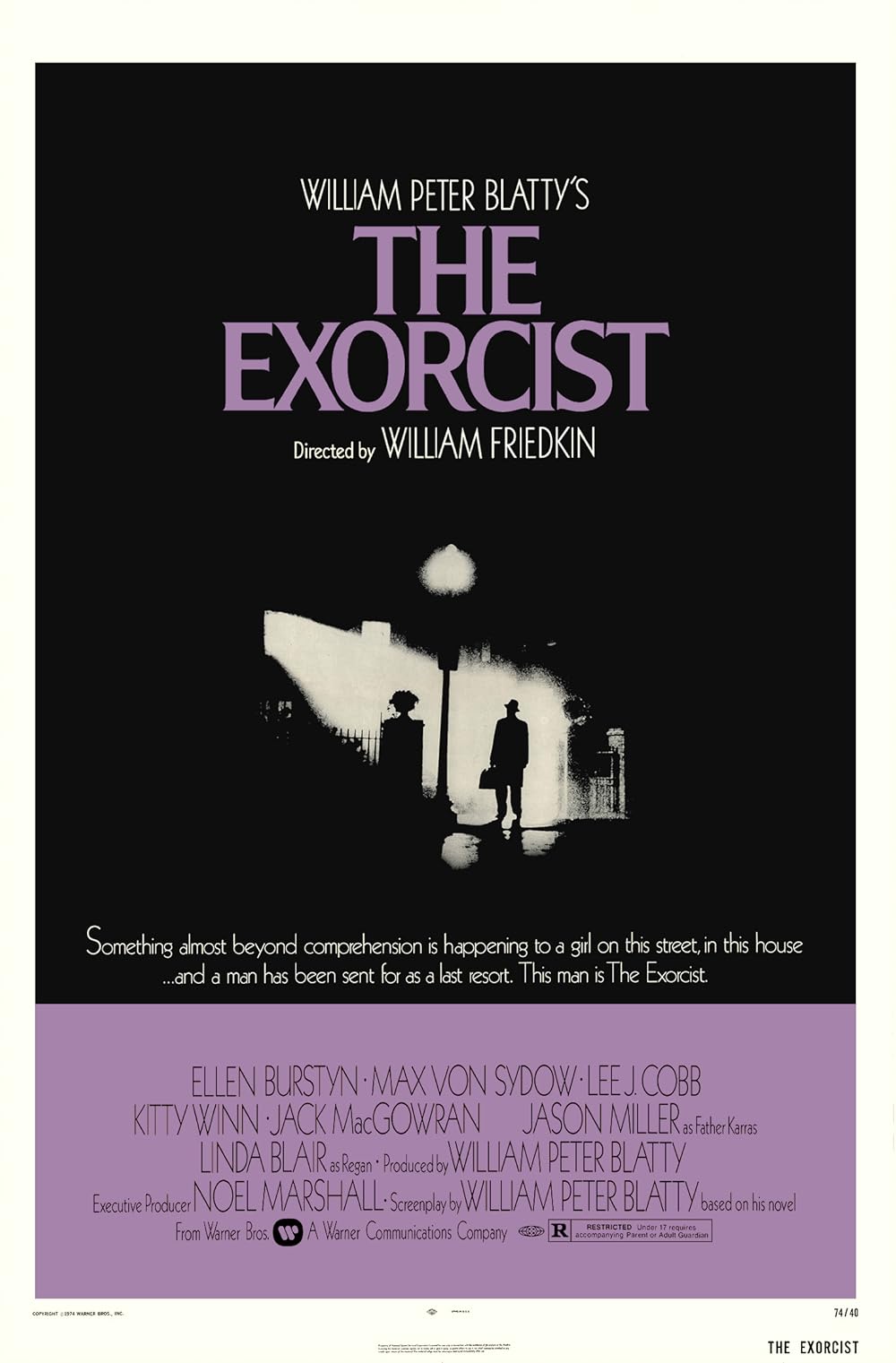
Chris McNeil (Ellen Burstyn) is a famous Hollywood actress living on location in a neighborhood of Washington D.C. known as Georgetown where the latest movie she’s working on is being shot. She’s renting a posh home along with her two servants (Rudolf Schundler, Willi Engstrom), her secretary Sharon (Kitty Winn) and her 12-year-old daughter Regan (Linda Blair). Things start out fine, but then Regan begins exhibiting odd behaviors. Chris takes her to several doctors as Regan’s anti-social traits continue. The doctors prescribe various drugs, but nothing works. At her wits end Chris, a non-believer, finally resorts to asking a local priest, Father Karras (Jason Miller) if he’ll perform an exorcism on her daughter. Karras though is going through a crisis of faith and doesn’t believe the archaic ritual will help her but becomes more convinced after he visits the girl who displays knowledge of his personal life that she would not have known about otherwise. Eventually he asks the church for permission to conduct one, but under the condition that he do it alongside Father Merrin (Max Von Sydow) an elderly man with a heart condition who had done an exorcism many years earlier in Africa.

The film was based on the bestselling novel of the same name that in-turn was inspired by the true-life event that occurred in 1949 where priests performed an exorcism on a troubled 14-year-old boy named Ronald Edwin Hunkeler. Author William Peter Blatty, read about the incident while a student attending Georgetown University. After having become a successful screenwriter during the 60’s where he wrote mainly comedies for director Blake Edwards, he approached his agent about writing a horror novel about a child possessed but was initially talked out of it. Then in 1968 he watched Rosemary’s Baby, which he felt had a weak ending that he could’ve done better, so he brought up the exorcism concept to a book publisher while attending a cocktail party and he agreed pay him a $25,000 advance to write the book in 10-months. Upon publication the sales were at first sluggish, but then after an appearance on the ‘Dick Cavett Show’ they skyrocketed, which soon lead to a movie rights deal with Blatty commissioned to write the script.

The movie follows the book closely though in a more condense form with scenes that were groundbreaking in its level of explicitness and perversity including an infamous crucifix masturbation moment. However, it’s the angiography that many viewers found the most disturbing. While it’s shockingly explicit it’s also lauded by medical professionals as being highly accurate and for many years afterwards was used in radiological training films. Many critics at the time condemned the scene labeling it ‘irresponsible’ and ‘needless’, but I liked it. A good horror movie should put the viewer in an uneasy state right from the start and then continue to turn the screws tighter as it goes on. This moment clearly telegraphs to the audience that the filmmakers will not shy away from showing something graphic even if it’s outside of good taste and if they’re going to be this brazen with this scene then it makes it all the more unsettling about what’s to come next. 

In many ways, and I don’t believe it was intentional, but the film does become an inadvertent satire on the medical, psychiatric community as their ‘diagnosis’ on Regan are really just guesses and the extreme reliance on prescribing medications, which they feel will somehow ‘resolve everything’. I didn’t really have a problem with this as I think many doctors at the time, and maybe even now, would respond the same way if given such a bizarre case. My one issue though is that eventually one of them, played by Peter Masterson, gets up in front of a roundtable of other doctors and suggests that Chris take Regan to an exorcist. I don’t believe any real medical doctor would ever suggest it or certainly be met with pushback by the other medical professionals in the room. I realize the movie had to find a way to progress to the third act, so the idea of an exorcist needed to be brought up at some point, but it would’ve made more sense had it come from Chris’s servants, who were deeply spiritual already. Chris could’ve scoffed at it at first, but then after thinking and even reading up on it, would eventually relent. 

The performances are uniformly excellent. Burstyn was not the first choice as there were other actresses more famous than her at the time, but her ability to display distraught emotion and continue to do so as it progresses and still keep it fresh and genuine makes her the best person for the role bar none. Blair is quite good too though Mercedes McCambridge does voice the demon during the exorcism moments, which kind of affects things. Don’t get me wrong McCambridge’s deep vocals makes it scarier, but had the lines, which are quite obscene, been recited by Blair herself it would’ve made it more shocking. Plus, it would still allow credence for the doctors to say it was a mental illness and not a possession since whatever was being said was coming from her natural voice. 

The real star though is Father Karras as he’s the one that goes through an actual internal change during the course of the story, from a person who’s had a crisis of faith to ultimately regaining it. Miller, who’s perfect, was not the original choice as Stacey Keach had already been offered the role and signed on, but then director William Friedkin went to watch the play That Championship Seasonwhich Miller had written and afterwards the two met backstage and Friedkin talked about his new project that got Miller to describe his own Catholic upbringing and his quarrels with it, which convinced Friedkin that he’d be the better actor and thus the studio bought Keach out of his contract. As much as I like Keach this was still a good move as Miller’s guilt-ridden face, which gets on full display every time he’s in front of the camera, leaves a lasting visual impression. I also liked the way the character remains skeptical until the very end versus other horror films that would have the people believing in the supernatural right away, or pretty quickly. However, in real-life there’s always going to be cynical people, so allowing in their apprehension through Karras makes the story stronger and more three-dimensional. 

Spoiler Alert!

I felt the ending, in which Chris pronounces Regan to be ‘cured’ and not remembering a thing and then driving away, to be a bit lacking. Chris was portrayed as being secular, but you’d think after what she saw her daughter going through would’ve changed that. This could’ve been done subtly by having her holding a crucifix, something she had despised her staff putting underneath her Regan’s pillow earlier or just shown wearing a small one around her neck. 

I also didn’t like the side-story dealing with the Burke Dennings character, played by Jack MacGowran, being apparently pushed out the window by the demon and falling to his death down a flight of cement stairs as this takes away the impact of when it happens to Father Karras at the end. Instead of Karras’ death being the shocking, unexpected twist that it should’ve it comes off more like a ‘here-we-go-again’ thing. If I had been the director I would’ve removed both Dennings death and Lee J. Cobb character completely as I really didn’t think he added much or helped progress the story forward. I would’ve still had the steps being shown in the early part of the film as a forewarning by having Karras runup them during his early morning workouts and this could’ve been when he first met Chris as they’d bump into each other one day while she was leaving to go somewhere. The head being twisted all the way around, which is described as happening to Dennings, but never shown, could’ve been revealed as occurring with Karras, possibly with his eyes glowing when the pedestrians come running to his aid, which would’ve been a good creepy final horror visual. 

My Rating: 10 out of 10

Released: December 26, 1973

Runtime: 2 Hours 15 Minutes

Rated R

Director: William Friedkin

Studio: Warner Brothers

Available: DVD, Blu-ray, Amazon Video, YouTube
Dirty Harry (1971)

By Richard Winters

My Rating: 10 out of 10

4-Word Review: Cop doesn’t like rules.

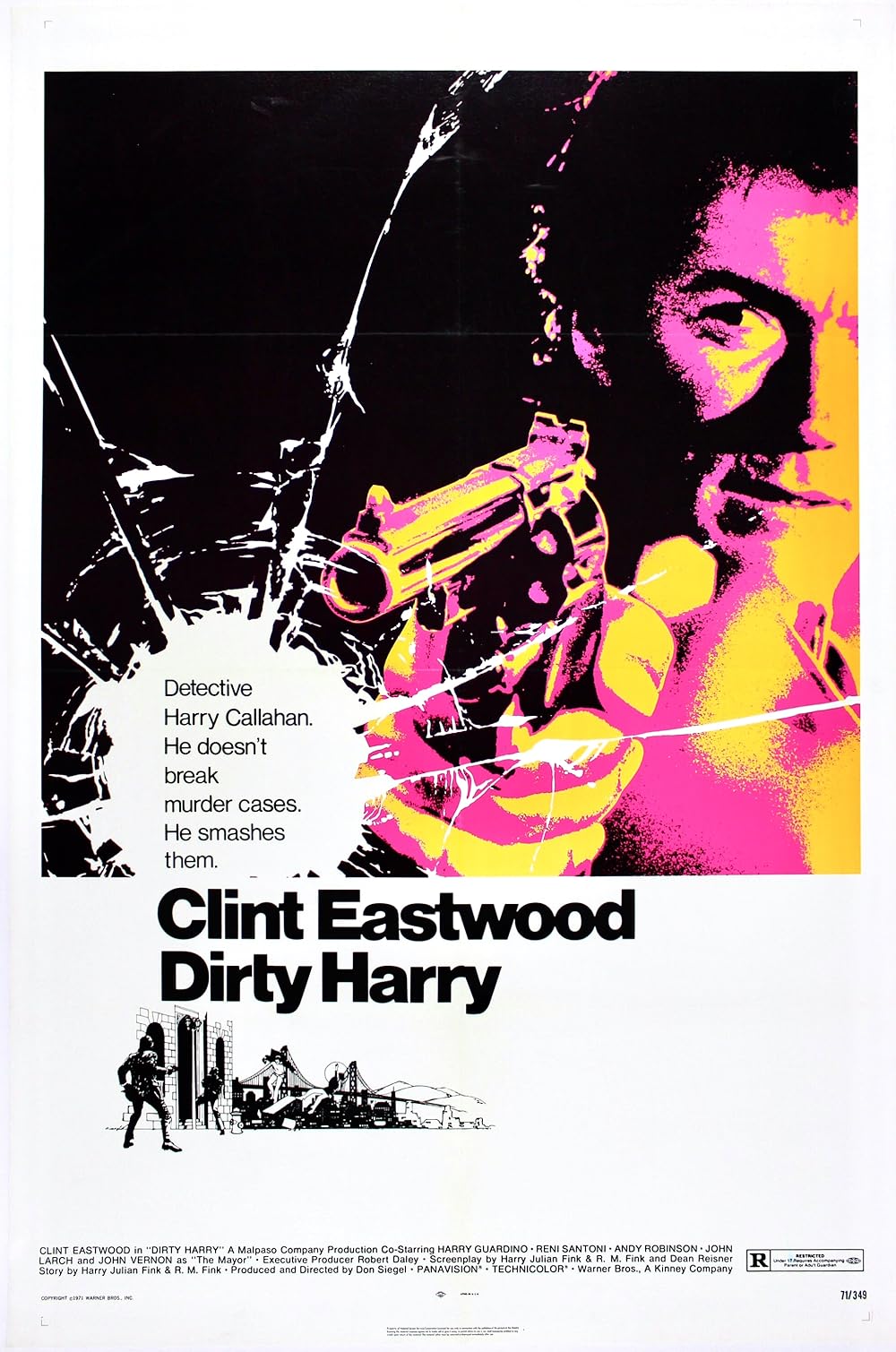
A psychotic who goes by the nickname of Scorpio (Andrew Robinson) has pledged to kill one person a day unless the city of San Francisco forks over $100,000 with his first victim being a woman (Diana Davidson) taking a swim in a pool on a rooftop of a high rise. The mayor (John Vernon) agrees to give into the killer’s demands much to the objections of Harry Callahan (Clint Eastwood) a hard-nosed cop who believes criminals are coddled by the system at the expense of their victims. Yet Harry, who’s known by his fellow cops as Dirty Harry, which he acquired for his well-known ability to circumvent rules that he doesn’t agree with, must go along with the demands of his department forcing him to act as the delivery of the ransom. This causes him to go through the humiliation of running all around the city at the whim of Scorpio who gives him directions of where to go next via different pay phones in the area. When Harry almost gets killed by doing this and then asked to be the delivery guy again, he walks out insisting that appeasing the killer is the wrong way to go. This causes even further irritation when Scorpio is later caught by Harry and then freed on a technicality convincing him that he must work on his own time in order to get the Scorpio put away permanently.

The script was written by the married team of Harry Julian Fink and his wife Rita. The inspiration came from the real-life Zodiac case who terrorized the city of San Francisco during the late 60’s and was never caught. The main character was supposed to be someone in their 50’s and was originally offered to Frank Sinatra, who had difficulty holding the Smith and Wesson gun, and decided to bow out. It was then offered to Paul Newman, Steve McQueen, who had just gotten done playing a cop in a movie and didn’t want to have to do another one, as well as George C. Scott and Burt Lancaster who both rejected it due to their feelings that the story’s theme was right-wing.

As a cop film it’s by far one of the best and has a lot of unique moments. Because Bullit had come out just a few years earlier, which featured a very famous car chase, it was decided not to replicate that one and instead we get treated to some very exciting foot chases with one occurring inside a factory mill and another at Kezar Stadium late at night. What makes these chases so interesting is that there’s no musical score played over them like in most movies, but instead we hear the pounding of their feet on the pavement and other outside ambience that helps to make these sequences grittier and more captivating. When the music does get played it’s when Scorpio is aiming his rifle to kill someone, but has the distinct sound of female vocals, which composer Lalo Schifrin put in to represent the voice he felt Scorpio was hearing inside his head.

Eastwood has made a career of playing this type of role, but here it comes off as fresh and like it was perfectly written for him and no one else could’ve played it better. His patented grimace and squint really work here and it’s interesting seeing the way his crusty exterior softens a bit as the film progresses and I liked the contrast of pairing him with a younger, less experienced cop, played Reni Santoni, that Harry initially thinks very little of, but eventually grows to like and respect. The conversation that he later has with Reni’s wife, played by Lyn Edgington, in which they discuss the emotional toll that being a cop can do to an individual really exposes the challenging job that it is as does Harry’s night on patrol where he’s forced on the spot without preparation to take on many difficult tasks including talking a man down from jumping off a building. This all helps to unglamorized the life of a cop while also revealing the underlying stressful nature of the position and why so many men and women that do it will eventually get burned out. 

Andrew Robinson, in his film debut, is excellent as well with a distinct eyes and face that looks constantly creepy. Normally I’d complain that we learn very little about his character nor the motivation for why he kills, but keeping him as an enigma helps put the focus on the main message, which is the rights of the victims and cops who try to protect them and by making Scorpio have a distinct personality would’ve humanized him and thus deluded the theme. Even so Robinson makes the most of each scene he’s in and he consistently stands out no matter what he’s doing, like the almost comical facial expression he makes when he gets stabbed in the leg. I also liked how after he does get stabbed that he then continues to walk and run with a limp versus other films where someone gets injured and they quickly recover, and it eventually becomes all but forgotten. 

Spoiler Alert!

My only complaint is how at the very end Harry throws away his badge and walks off the job. Director Don Siegel and Eastwood argued about this with Eastwood feeling Harry wouldn’t do this as being a cop was the only job he knew and his relentless pursuit for justice and putting bad guys away would overpower his urge to quit. Even if he was unhappy with some of the police procedures, he’d still put up with it, or fight to improve things from within. This is why at the end he should’ve taken out his badge and looked at it like he was thinking of throwing it, but then eventually put it back into his pocket. 

My Rating: 10 out of 10

Released: December 23, 1971

Runtime: 1 Hour 42 Minutes

Rated R

Director: Don Siegel

Studio: Warner Brothers

Available: DVD, Blu-ray, Amazon Video, YouTube
Straw Dogs (1971)

By Richard Winters

My Rating: 8 out of 10

4-Word Review: Man defends his home.

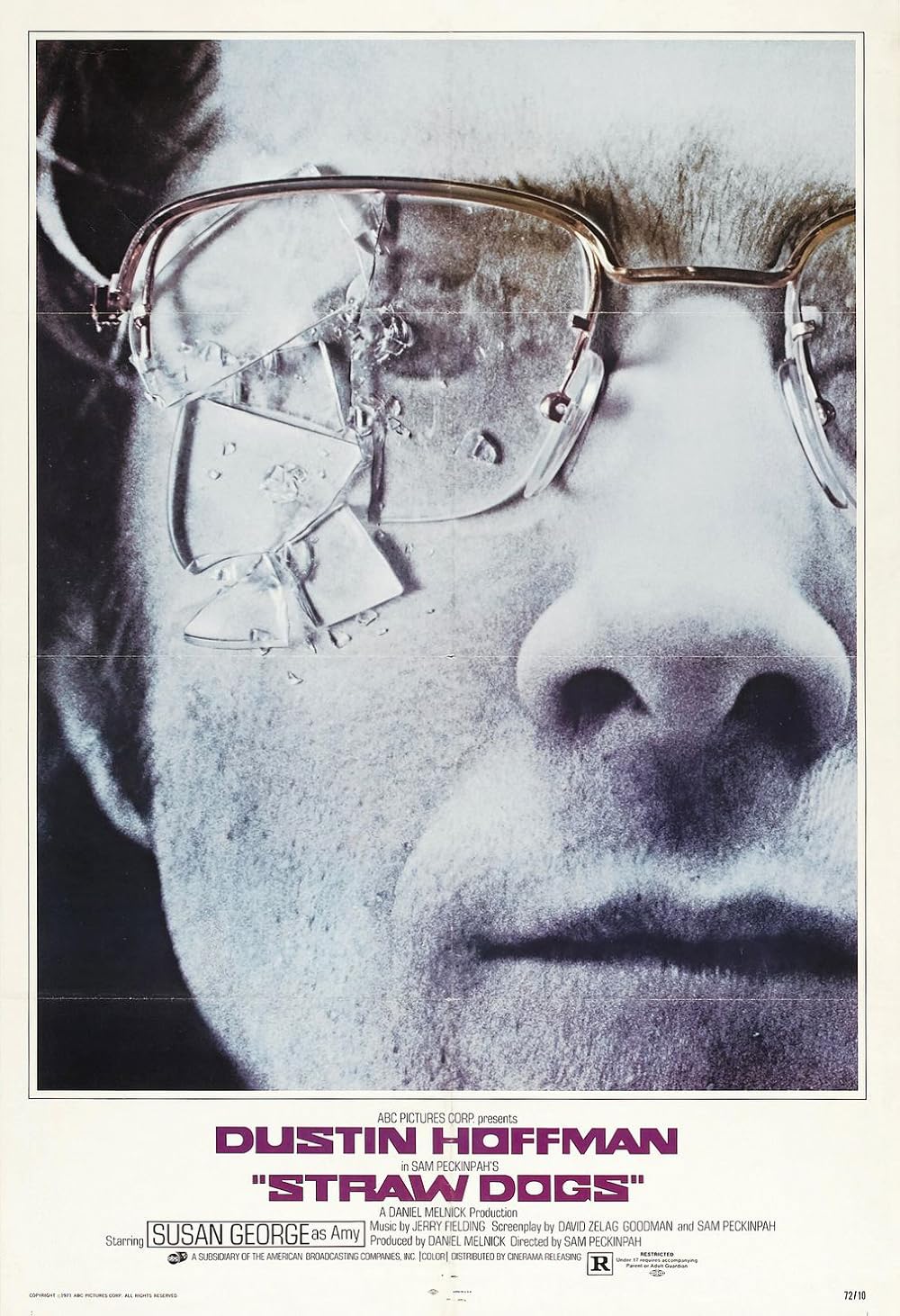
David (Dustin Hoffman), a nerdy mathematician, has been given a research grant and uses it to relocate to the rural countryside of England with his wife Amy (Susan George). They move into a farmhouse that was once owned by Amy’s father and they hire four men (Del Henney, Ken Hutchinson, Jim Norton, Donald Webster) to fix up the roof. The men though don’t work much and spend most of the time making fun of David and ogling Amy. After several bad encounters, including the grizzly death of their pet cat, David fires them and hopes that’ll be the last it, but things only get worse. When a teen girl named Janice (Sally Thomsett) disappears her violently drunken father Tom (Peter Vaughan) thinks it was caused by Henry (David Warner) a mentally handicapped man that Janice had shown an affinity for. Tom, along with the four other men, become a lynch mob determined to find Henry and bring him some ‘street justice’. David and Amy, while returning from a church service, hit Henry with their car as he’s running from the other men. David agrees to take the injured Henry into his home until a doctor can arrive, but the five men insist on getting inside to beat and kill Henry for his perceived crime. Since David had avoided having any confrontation with the men previously even when they had openly mocked him, they presume he’ll be a pushover this time as well, but David has finally decided to take a stand and will defend his home from the intruders in any way he can. 

While it was controversial at the time many now consider this the pinnacle of director Sam Peckinpah’s career and his directorial touches are supreme. The capturing of the brown empty vast landscape of nothingness, shot during the winter of 1971, brings out a surreal sense making it seem like the characters are living in a purgatory outer world where everything is dead and helps explain the deadness of the men’s souls that have been forced to endure their entire lives there. The climactic sequence where David’s home comes under siege is deftly handled. Normally in thrillers pounding music gets played during these segments to ramp up the tension, but here there’s only the sound of a distance foghorn, which makes it much more creepy, distinct, and helps accentuate the isolation. 

Some have been critical of the film’s violence especially at the time when there was activism going on that tried to stymie violent material on both TV and movies with the idea that violence was a ‘learned’ behavior and if people didn’t see it so much in entertainment, then they wouldn’t do it in real life. Peckinpah though saw it differently as he felt violence was an instinctual reaction that couldn’t just be ‘unlearned’ and that in certain situations it was necessary and not every conflict could be resolved peacefully, a message the film brings out quite well. 

While Susan George gives an excellent performance, as do the four villainous men, particularly Vaughan as their ringleader making them some of the creepiest bad guys in film history, I did find her character confusing. I didn’t understand why she’d marry a guy that she found by her own admission cowardly even bringing up that he was ‘running away’ from problems he was having at his university and his ‘hiding behind his studies’ in order to avoid it. She also shows no respect for his work and several times even vandalizes his chalk board that has his mathematical equations, so what attracted her to him in the first place? Would’ve made more sense had she initially idolized him for his academic status and then became painfully aware of his meekness as the film progressed, which would’ve made for a more interesting arch.

Spoiler Alert!

The film is based on the 1969 novel The Siege of Trencher’s Farm by Gordon Williams, but with many changes some of which worked while others didn’t. In the novel the couple had an 8-year-old girl, but in the film there is no child. To a degree it doesn’t make that much of a difference though when the bad guys attack the house it might’ve heightened the urgency more knowing that David was not only defending his ‘home’, but also the safety of his terrified daughter. The biggest change that the film does is that it creates a connection between Henry and Janice where Janice sneaks away with him during a church party where she invites him to be intimate with her, but in the process, he accidentally kills her, which seemed too similar to Of Mice and Men. It’s confusing too why this teen girl, who outside of her buck teeth seems reasonably attractive, would feel the need to throw herself at a mentally handicapped man, or get flirty with David, who is married. Why can’t she find guys her own age to fool around with? Knowing the hormones of most teen boys that shouldn’t be too hard, so without further explanation to her psyche, which doesn’t happen, her ‘inviting’ of Henry is quite unnatural and forced. 

In the book Henry is instead a child killer who’s being transported back to prison when the vehicle he’s in gets stuck in the snow, which allows him to escape. At the same time Janice, who’s mentally disabled, which isn’t made clear in the movie, runs away from a Christmas party where she ends up dying from the exposure to the cold, but otherwise it has nothing to do with the escape of Henry and is only presumed to have a connection by the five men, which makes more sense and the screenplay should’ve have kept it this way.

On the other hand, in the book none of the attacking men die and are only badly injured, but I think death gives it a more final resolution, so the movie scores there. I also liked how David is forced to resort to items he can find around the house, much like in the film Last House on the Left, which came out a year later, to fight off the bad guys versus the cliched machoism of having a big gun to blow them away and it also helps to show how intellectual wits can ultimately be used to overpower the otherwise physically stronger attackers. 

The rape scene in which the wife gets assaulted by not only one, but two men was another problematic moment as the book had no such segment. For one thing it makes it seem like she’s actually enjoying the attack, at least with the first one, and she recovers from it much too quickly and doesn’t even bother to tell David about it and able to go on relatively normally afterwards, which didn’t seem realistic and thus I think it should’ve been excised since it comes off as exploitive and doesn’t have that much to do with the main plot. 

My Rating: 8 out of 10

Released: December 22, 1971

Runtime: 1 Hour 57 Minutes

Rated R

Director: Sam Peckinpah

Studio: 20th Century Fox

Available: DVD, Blu-ray (Criterion Collection)

The Conversation (1974)

By Richard Winters

My Rating: 10 out of 10

4-Word Review: Someone is listening in.

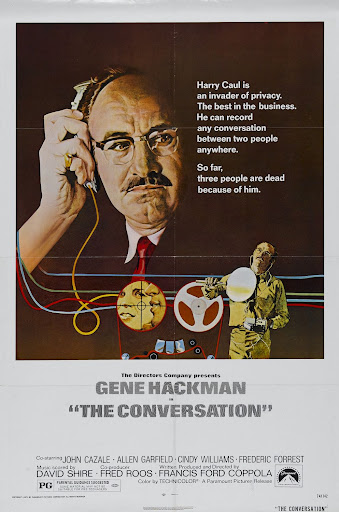
Harry Caul (Gene Hackman) is a surveillance expert who specializes in listening into people’s private conversations and has a reputation of being quite good at it. Many wealthy clients hire him to record things from their enemies that they might not be able to attain otherwise. However, one of these assignments led to the death of three people and Harry, being a highly religious man, has felt guilty about it ever since. He begins to have the same concerns with his new assignment when he overhears a couple (Fredric Forrest, Cindy Williams) who he’s recording mention that ‘he’d kill us if he got the chance’. Harry is unsure if he wants to give the tapes up to his client as he’s frightened the same scenario as before will occur. Martin (Harrison Ford) the man representing the client becomes aggressive in getting the tapes and warns Harry that they’ll get their hands on them one way or the other. Harry, a private man, soon realizes that this client is just as sophisticated in surveillance technology as he and maybe even more so as he becomes aware that his phone and even his apartment is bugged.

Inspired by real-life surveillance expert Martin Kaiser, who was a technical consultant on the production, the film deftly explores how today’s modern technology has easily evaded our private lives and how no one is safe from prying eyes and ears a concern that has become even more pronounced in the decades following its release. Many presumed that it was a testament about the Watergate break-in, which occurred a year before the movie came-out and uses much of the same sound equipment used the by criminals in the real-life event, but in actuality the script, by Francis Ford Coppola, was already complete in 1965, but was unable to get any financial backing until his success with The Godfather. 

The film scores on just about all levels especially with the way it captures San Francisco. I loved the bird’s eye-opening shot of Union Square as well as the terrific use of the fog that gets used to great effect during a memorable dream sequence. The soundtrack by David Shire is quite unique as it’s made to replicate sound waves changing frequency. I liked too that quite a bit of time is spent showing Harry inside his editing studio where he puts together the tape he’s recorded from different sources into a cohesive whole and watching him do it, even if it’s from equipment that would be deemed dated now, is impressive and makes you appreciate the expertise of the character.

Acting wise this may be Hackman’s best, and he stated in later interviews that he considers this to be his finest work, though at the time he felt it was an extreme challenge playing such an introverted person when he himself was highly extroverted, but the payoff is rewarding as he displays characteristics unlike any other role he’s played. What impressed me most was his body posture, which is hunched over, and he walks with a pensive gait, which reveals to the viewer the character’s inner angst without it ever having to be verbally explained. It’s interesting too how he’s mostly shy and stand offish during the majority of it making him seem like a wallflower, but when the subject of his sound expertise comes into discussion, he’s suddenly bragging about his state-of-the-art machinery showing how even the most unassuming of people can still have a big ego and helping to create a protagonist who’s three-dimensional.

There’s also great support from a young Harrison Ford, who appears with a scar on his chin, who despite presenting himself in a composed manner and speaking in a controlled tone of voice is quite menacing. Terri Garr is excellent as a prostitute that Harry frequents and acts as Harry’s only social outlet as well as Allen Garfield playing a huckster whose also Harry’s rival and clearly has a way about him that gets under his skin. Great work too by John Cazale who works as Harry’s assistant and their relationship runs hot-and-cold and there’s even Robert Duvall in a small, but pivotal part.

Spoiler Alert!

While the film is expertly crafted, I did find the scene where Harry’s landlady leaves him a birthday gift inside his apartment to be problematic. We see that Harry has three different locks on his door, which keenly reveals what a private person he is and how paranoid he is to protect it, and yet when he opens up his door there’s an item sitting on the floor left by his landlord. Through a subsequent phone conversation, he has with her we learn that she was able to get in by using her master key, but it’s highly unlikely that she would have three different keys for each lock.

Another issue happens at the end when Harry tears his apartment apart in desperate attempt to find the covert listening device that’s been planted by the client and is able to listen and record everything he says and does. He isn’t able to locate it despite a thorough and exhaustive search and then spends the rest of the time playing his saxophone as it’s the only thing he has left, which is where it finally dawned on me that was probably where they implanted the bug and the movie should’ve had him dismantle that too and then if he was unable to find it there, after destroying everything else, he could be seen lying in the barren, darkened room in a fetal position and completely defeated, which might’ve left an even more lasting and riveting final image.

My Rating: 10 out of 10

Released: April 7, 1974

Runtime: 1 Hour 53 Minutes

Rated PG

Director: Francis Ford Coppola

Studio: Paramount Pictures

Available: DVD, Blu-ray, Amazon Video, YouTube
Superman (1978)

By Richard Winters

My Rating: 8 out of 10

4-Word Review: The Man of Steel.

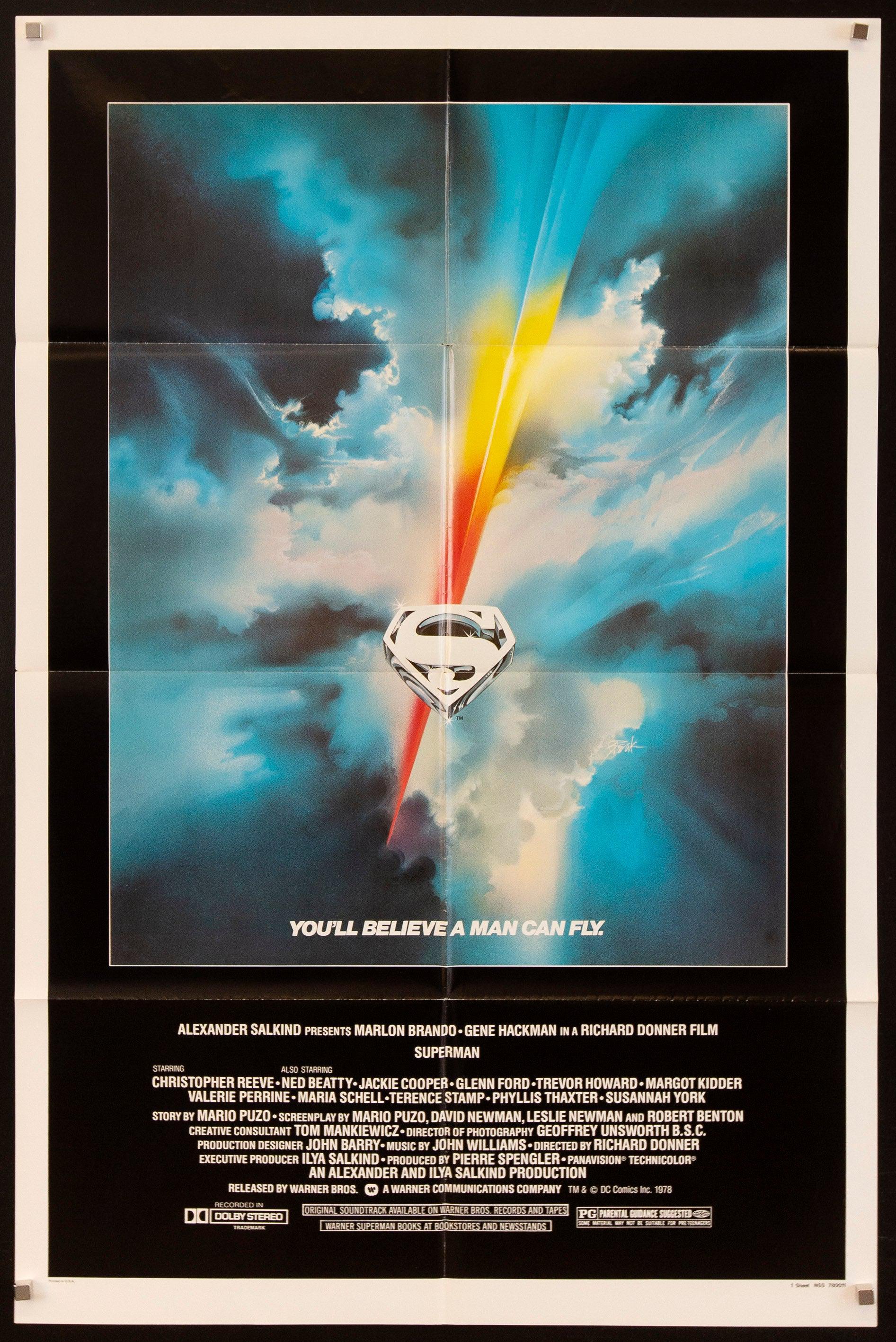
As the planet Krypton gets set to be destroyed by its exploding sun, Jor-El (Marlon Brando) and his wife Lara (Susannah York) put their child on a spaceship that takes him to the planet earth. It is there that his spaceship crash lands into a wheat field that his spotted by Jonathan (Glenn Ford) and Martha (Phyllis Thaxter) who take the child in and treat him as their own. The boy is named Clark (Christopher Reeve) and as he grows, he begins to show amazing abilities including running faster than is humanely possible and incredible strength. Once he becomes an adult, he gets a job as a reporter at the Daily Planet newspaper where he meets fellow reporter Lois Lane (Margot Kidder). He even saves her, while dressed as a superhero, from a helicopter accident and becomes known initially as the ‘caped wonder’ before finally being coined as Superman. His publicity attracts the attention of criminal mastermind Lex Luthor (Gene Hackman) who devises a plan to steal missiles and use them to create an earthquake along the San Andreas fault and thus casting off coastal California into the ocean and turning the desert land he purchased into prime real estate. Superman attempts to stop him, but Lex has found one thing that can stop him: a meteorite known as kryptonite.

At the time this film, which suffered from numerous behind-the-scenes problems and infighting, was made it was the most expensive one ever produced with a whopping $55 million budget. While the effects were mesmerizing for many back-in-the-day I don’t know if they still all hold-up. The flying segments particularly over the Statue of Liberty is impressive to a degree but can’t quite equal today’s technology and appears like two people in front of a greenscreen as does the giant red sun that moves in to destroy Kyrpton. Watching the young Clark Kent running alongside a train looks tacky too like he’s being held up by invisible wires, which he was, and his feet aren’t really ever touching the ground. In all fairness though the earthquake segment and the destruction of the Hoover Dam and the shaking of the Golden Gate Bridge remains top notch.

The script though, which takes on quite a lot and had to be slimmed down from its original 500-page version that was written by Mario Puzo, feels rushed at times and glosses over certain things that I felt should’ve been a little more drawn-out particularly when the Kents find the boy crash land in the field. The film makes it look like they just left the remains of the spaceship in the field making me think other people in the area would’ve also come upon it later and would start a panic that some alien had come out of it and invaded the town. Later on, we come to realize that the ship got hidden inside their barn, but there’s no scene showing them transporting it, or how they went about doing that, which I felt should’ve been put in for the simple sake of clarity.

Watching Superman orbit the earth in an attempt to get it to spin backwards and supposedly ‘turn back time’ is kind of cool to see and an interesting concept though not totally plausible. Making the world rotate the other way would certainly change some things like having the sun rise in the west instead of the east and have the ocean waves go in a different direction among other things, but causing everything to essentially ‘rewind’ and go back to the way they were even bringing certain people who had died suddenly back to life just wasn’t completely convincing though it’s not enough to hurt the movie as a whole.

Most fans will likely tell me I’m quibbling about the Clark Kent disguise though when you really think about it it’s not much of a disguise at all. I admit watching this muscular guy dressed in a suit and acting all clumsy and wimpy is amusing especially the way Reeve plays it but besides combing his hair in a different direction than when he’s Superman the only other difference is that he wears glasses. However, that would be tantamount to saying someone who does wear glasses but then comes to work one day without them would not be recognized by any of his friends, or co-workers especially when he’s still speaking in the same voice making me believe that Lois and Jimmy, played by Marc McClure, should and would’ve caught on to this pretty quickly. I realize the comic book did it this way, but when it got updated into a movie, they should’ve reenvisioned it a little by adding more to the Clark get-up like besides just glasses he’d also have a mustache, or goatee and speak a bit differently, so having those close to him not catch-on would be more understandable.

I think what I enjoyed most was Hackman, who didn’t play a lot of villains during his career but is highly enjoyable here. Initially he didn’t want to take the part as he felt playing a campy character would tarnish his reputation of being a serious actor, but the change of pace does him good and proves if anything how versatile he is. His refusal not to shave his head, as the Lex Luthor in the comic is bald, works in his favor as his hair gets styled differently in each scene in order to represent him wearing a wig, which creates a creative visual. Valerie Perrine is great too as his girlfriend Miss Teschmacher who helps contrast his delusional personality with her more grounded sensibilities and I just loved the way he’d yell out her name every time he got annoyed with her, which is the comedy highlight.

The rest of the supporting cast though, made up of big name starts like Trevor Howard, Maria Schell, and even Larry Hagman didn’t seem needed and given such few lines I was surprised why they’d even take the roles unless it was because of the money. Brando is an equal waste. He’s given top billing and paid an exorbitant amount of money including a percentage of the profits despite refusing to memorize his dialogue and even having his lines written on the baby’s diaper for him to read off of as he puts the child into the spaceship. Had the producers skipped the unimportant ‘star power’ and cast lesser knowns in these roles they could’ve saved themselves a lot of money, which in retrospect might’ve lessened the tensions they had with director Richard Donner for going over budget and ultimately lead to his firing and a very tumultuous follow-up Superman II, which will be covered in the next review.

My Rating: 8 out of 10

Released: December 10, 1978

Runtime: 1 Hour 23 Minutes

Rated PG

Director: Richard Donner

Studio: Warner Brothers

Available: DVD, Blu-ray, Amazon Video, YouTube
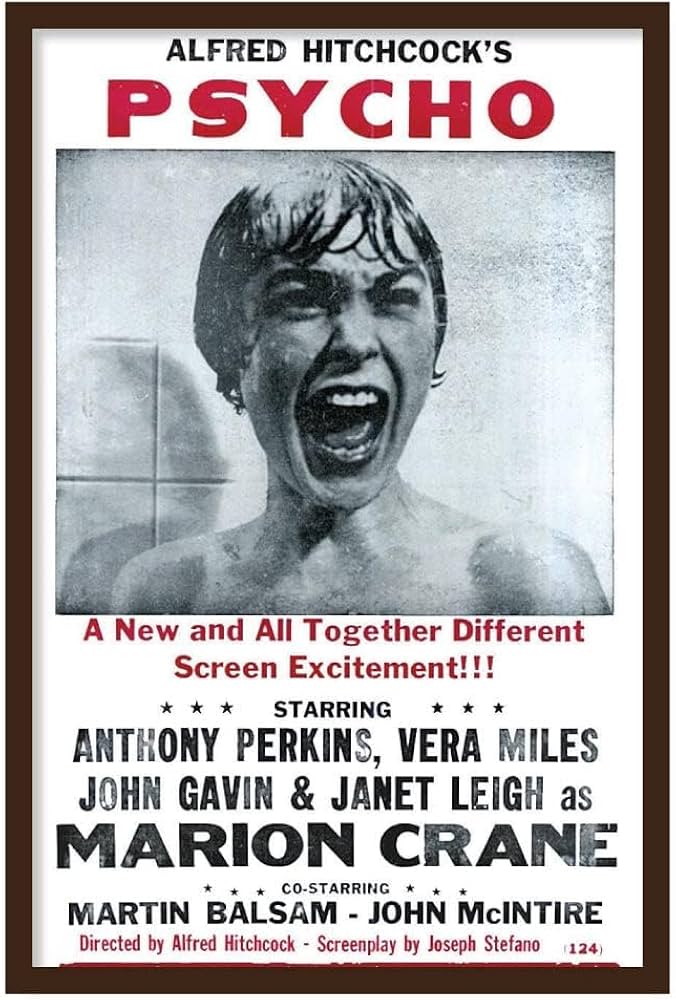
Psycho (1960)

psycho

By Richard Winters

My Rating: 9 out of 10

4-Word Review: Don’t take a shower.

Marion Crane (Janet Leigh), who works as a secretary at a real estate firm, steals $40,000 in cash from her boss (Vaughn Taylor), who trusted her to take the money to the bank, in order to help her boyfriend Sam (John Gavin) pay off his debts. As she’s traveling to where he lives she encounters a rainstorm causing her to take the nearest exit. There she drives into the lot of a isolated lodge called Bates Motel, run by a young man named Norman (Anthony Perkins) who’s still living with his mother in an old rundown house that sits ominously on a hill behind the hotel rooms.  Norman becomes immediately smitten to the woman, who signs the hotel ledger under an assumed name, and invites her to have dinner with him in the hotel office. Marion, who sees him as a awkward, but otherwise harmless guy who’s still dominated by his mother, agrees. After they eat she departs back to her room and takes a shower when what appears to be his mother, who considers all women to be ‘whores’, stabs and kills her. Norman then cleans-up the evidence by submerging the dead body and her car in a nearby swamp. Soon a private detective named Arbogast (Martin Balsam) begins investigating the case and what he finds out leads Marion’s boyfriend Sam and her sister Lila (Vera Miles) to the property where they’ll unravel a shocking secret.

The film, which at the time was considered ‘too tawdry and salacious’ to be made into a movie and thus the studio refused to give director Alfred Hitchcock the required funding and forcing him to use his own funds and crew to produce it, was based on the novel of the same name by Robert Bloch. Bloch began writing it in 1957 when coincidentally in the neighboring town not more than 35 miles from his came to the light the criminal activities of Ed Gein who killed two people while also digging up dead bodies and then skinning them in an effort to create a ‘woman suit’ he could wear so he’d ‘become his dead mother’ who had dominated him for the majority of his life. Rumors were that Gein’s crimes had inspired the book, but Bloch insisted that he had almost finished with the manuscript before he became aware of the real-life case and then became shocked with how closely it resided with his story.

While the film follows the book pretty closely there are a few differences. In the book the Marion character dies from decapitation while in the movie it’s from stab wounds. The Norman character is described as an overweight man in his 40’s while in the movie he’s thin and in his 20’s, which I felt was an improvement as it made more sense why Marion would feel less guarded around him and put herself in a more vulnerable position than she might otherwise as she still viewed him as a ‘wet-behind-the-ears’ kid. It also helps explain why Norman blunders his interview with the detective and virtually incriminates himself because he was too sheltered and not worldly-wise enough to handle pressure situations.

The film is full of a lot of firsts. It was the first to show a toilet or use the word transvestite, but what I really liked though is that it takes a different spin on the character of the victim. Typically, even today, victims are portrayed as being virginal and angelic beings particularly women, but here it works against that. Right away with the opening scene in the hotel room we see she’s definitely no virgin and what’s more she’s having sex outside of wedlock in an era where ‘good girls saved themselves for marriage’. Having her then be susceptible to corruption by stealing from her employer, or not feel frightened initially by Norman and even superior to him further works against the grain of the ‘sweet, fragile damsel in distress’ cliche and makes her seem more human since she’s not perfect and vulnerable to the same vices as everyone else, which in-turn gives the more an added darker dimension.

The film’s hallmark though is its memorable camera work from a close-up of the victim’s unblinking eye, still not sure how Leigh could’ve kept her eyes open for as long as she does, to the interesting way the house gets captured from the ground looking upward on a hill towards the sky with the creepy night clouds floating behind it.  My favorite one though is the tracking shot showing Norman walking into his mother’s room and then having the camera stop right at the top of the door frame and then spin around towards the hallway as he then leaves the room and carries his mother down the stairs. The only shot that I didn’t care for is when the Martin Balsam character gets stabbed at the top of the stairs, but instead of immediately falling over backwards and then rolling down the stairs, which is what would happen 99% of the time, he instead somehow ‘glides’ down an entire flight of stairs backwards while remaining upright and only finally falling to the floor once he hits the bottom, which goes against the basic laws of physics and to me looks fake and goofy, but other than that it’s a classic and still holds-up amongst the best horror movies made.

My Rating: 9 out of 10

Released: June 16, 1960

Runtime: 1 Hour 49 Minutes

Director: Alfred Hitchcock

Studio: Paramount

Available: DVD, Blu-ray, Amazon Video, YouTube
The Prime of Miss Jean Brodie (1969)

prime1

By Richard Winters

My Rating: 8 out of 10

4-Word Review: Teacher influences her students.

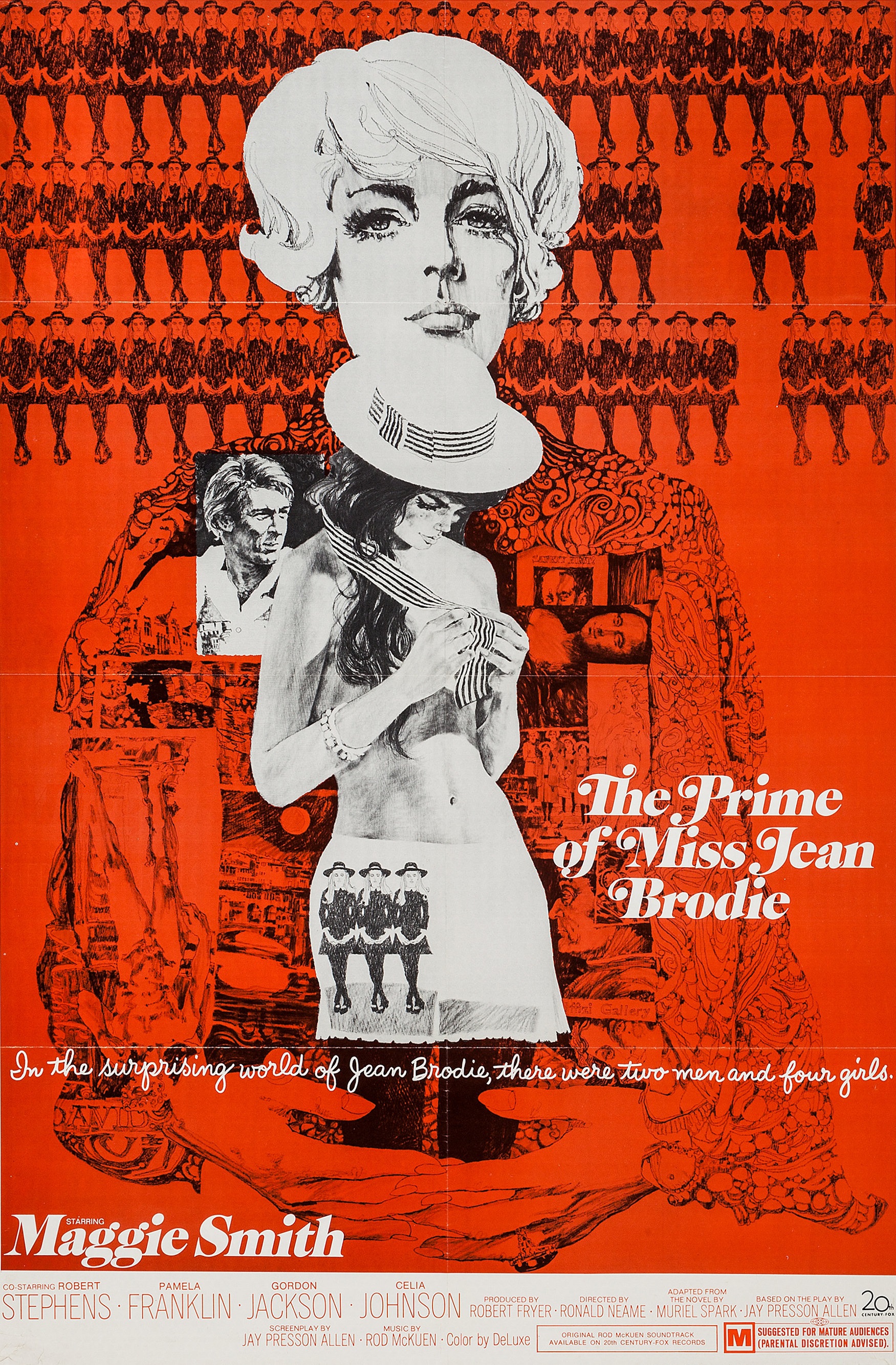
Jean Brodie (Maggie Smith) is a teacher at an all-girls school in Edinburgh, Scotland in 1932.  She routinely strays from the core curriculum and instead instills her own quirky value system, like her admiration for fascist dictators, onto her students. She views them as empty vessels there to be programmed to her liking as she routinely will say: “give me a girl at an impressionable age and she’s mine for life”. The school’s Headmistress, Miss Mackay (Celia Johnson) is aware of Brodie’s unorthodox teaching methods, but unable to do much about it, despite the repeated warnings that she gives to her, due to the fact that Brodie has tenure and been at the school longer than she. Sandy (Pamela Franklin) is one of Brodie’s students, who used to admire her teacher, but now has turned on her and comes up with a way to have her fired, which leads to a dramatic confrontation between the two.

One of the first things that struck me about the story, which is based on the play of the same name by Jay Presson Allen that was based on the novel by Muriel Spark that some feel was inspired by a teacher named Christina Kay who taught at James Gillispies School that Muriel went to as a child, is that it works against the grain of most films. In our individualistic culture the modern day movie centers around the rebel, or those that choose to work outside the system of an autocratic institution and the people that uphold those rules and enforce them are usually the villains. Here though it’s the stuffy authoritarians that ultimately become the makeshift heroes while the non-conformist gets exposed as a ‘loon’ that got too far off-base and needed a serious reeling-in.

It’s also the perfect study of someone who seeks control over others and cannot function in relationships were both sides are on equal footing. We see this not only with the way Jean openly humiliates her students by ridiculing them for even minor infractions like having their shirt sleeves rolled-up, but also in her maladjusted love life. Since she cannot have a healthy relationship with them as that would require selfless behavior from her, which she can’t give, so instead she emotionally manipulates two men (Robert Stephens, Gordon Jackson). She enjoys the attention they give her and gives them just enough incentive to keep on doing it, but never more than that. When the Jacskon character finally does get married to someone else, her sad expression isn’t about losing a person she loved, but more upset that she could no longer have this simp at her convenient disposal.

The recreation of the 1930’s girl school atmosphere was impeccable. Too many times I feel movies dealing with a bygone era don’t recreate it in an accurate way, or it gets viewed through a warped modern lens, but here I came away convinced it was accurate and this in large part could be credited to director Ronald Neame, who was alive when the story took place and therefore better able to feed-off his memory and experience. The scene where the girls all get up out of their seats and stand at attention the second the headmistress walks into the room is one of my favorite moments. To some degree it would be nice if kids today could show that kind of respect to an adult figure, but on the other hand it also reveals the dark side to extreme obedience to authority, which creates an atmosphere that allows someone like Jean to incorporate her will and beliefs onto the students without them ever questioning it.

In the end this is a terrific portrait of how teacher’s where viewed back in the day and the tremendous amount of influence they could hold over their pupils. There were no teen idols, singers, celebrities, or social media influencers back then, so the teacher was the center of most children’s lives sometimes even more so than their parents. While some things have changed the debate about what a teacher chooses to convey in the classroom and how far they should be allowed to stray from the core curriculum rages on today. No matter what side of that issue you may stand it just proves that this story is even more relevant now as it was back then.

My Rating: 8 out of 10

Released: February 24, 1969

Runtime: 1 Hour 56 Minutes

Rated M

Director: Ronald Neame

Studio: 20th Century Fox

Available: DVD/Blu-ray

Last Tango in Paris (1972)

lasttango2

By Richard Winters

My Rating: 7 out of 10

4-Word Review: Sex without knowing names.

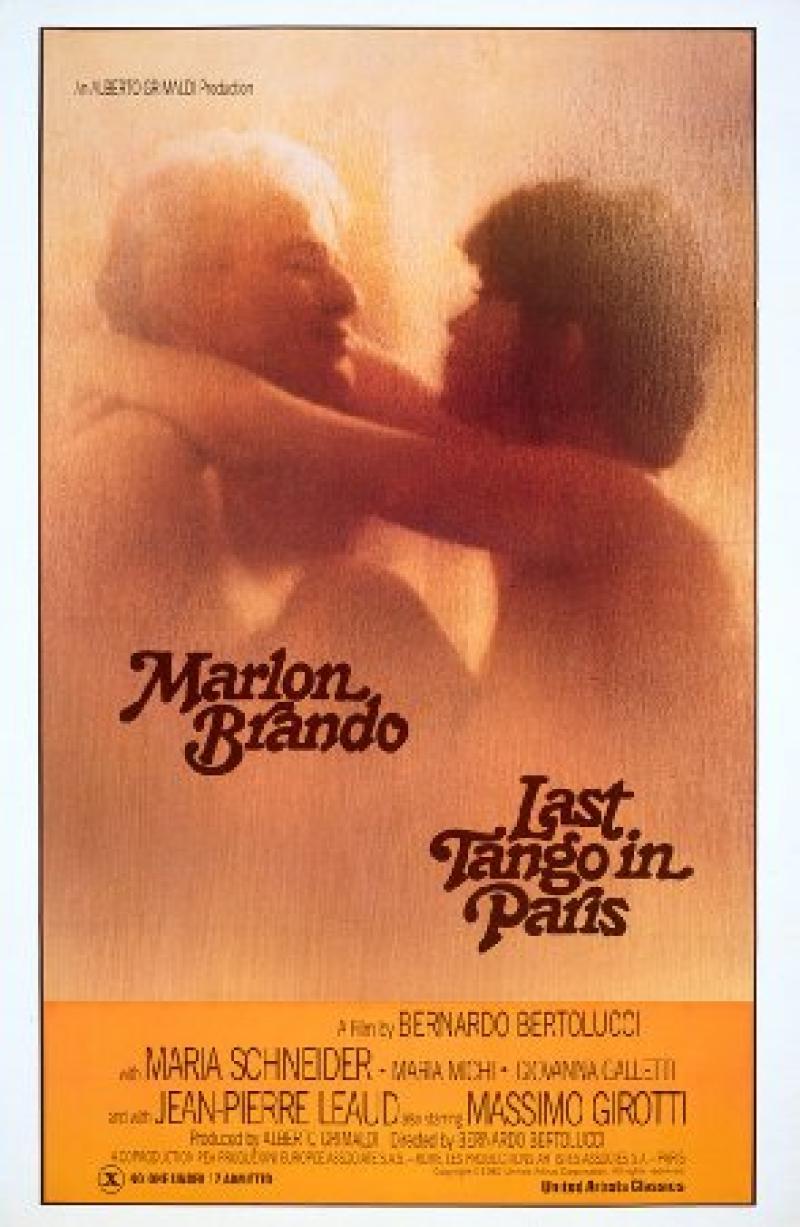
Paul (Marlon Brando) is a middle-aged American man living in Paris who’s despondent over his wife Rosa’s recent suicide. Feeling alone and without direction he meets up with Jeanne (Maria Schneider),a much younger woman, while both are looking to rent the same apartment. Jeanne is dating Thomas (Jean-Pierre Leaud) a filmmaker who wants to film her life and make it into a movie, which Jeanne is not so keen about. Despite not knowing Paul’s name, as he wants their identities to remain a mystery, she gets into a torrid sex affair with him and finds Paul’s evasive manner to be both frustrating and intriguing. However, after he rapes her he disappears and Jeanne considers their relationship over, but Paul meets her on the street a few days later, but this time he tells her all about himself, but hearing the sad details of his lonely life makes him less appealing to her. She tries to get away from him, but Paul continues to pursue her, which ultimately leads to tragedy.

The film is probably better known for the controversy and scandal it caused upon its release than anything else. While some of its sexual aspects will seem somewhat tame by today’s standards back in 1972 it became a hotly contested commodity where the government in Italy openly banned the film and ordered all copies of it seized and destroyed while also revoking director Bernardo Bertolucci’s right to vote for 5 years. Residents of Spain, where the film was also banned, would travel hundreds of miles to the French border just so they could see the film that everyone was talking about. In the US the controversy was no different with conservative pundits labeling it ‘pornography disguised as art’. In Montclair, New Jersey residents tried to physically block movie goers from going in to see the film by forming a human chain in front of the theater and those that were able to break through got labeled as being ‘perverts’.

Today the most controversial aspect are Maria Schneider’s accusations that the infamous ‘butter scene’ where Brando rapes her anally while using butter as a lubricant was not planned nor scripted and the she was taken by complete surprise. In a 2013 interview Bertolucci admits that Maria did not know the details of the scene ahead of time and this was intentional in order to capture the genuine look of shock on her face. While Bertolucci says he does not regret doing the scene he still felt bad for Maria, who maintained up until her death in 2011, that she had been both ‘violated’ and ‘humiliated’ and never spoke to Bernardo afterwards.

As for the film itself it’s interesting on a technical end, I particularly enjoyed its fragmented/dream-like narrative, but it also comes-off as being a bit overrated. It was based on Bertolucci’s own sexual fantasies regarding his desire of picking-up a young, beautiful woman off the streets and having a passionate sexual affair with her without ever knowing her name, or having any responsibilities or obligations attached to it, which is certainly an intriguing idea for a script, but the way the two come together seemed just a bit too rushed and unrealistic. Brando, who never bothered to memorize his lines and ad-libbed most of it, seems to be playing himself as he displays the same moody, self loathing quality that he also conveyed in every interview I’ve seen him in making it less about creating a character and more just him showing his true nature. Schneider is the best thing about the movie, as is the scene where the two disrupt a tango dance contest, but ultimately the film leaves one with a dark, depressed, and dismal feeling after it’s over.

My Rating: 7 out of 10

Released: October 14, 1972

Runtime: 2 Hour 10 Minutes

Rated NC-17

Director: Bernardo Bertolucci

Studio: United Artists

Available: DVD, Blu-ray, Amazon Video, Pluto TV, YouTube

Annie Hall (1977)

By Richard Winters

My Rating: 10 out of 10

4-Word Review: The perfect date movie.

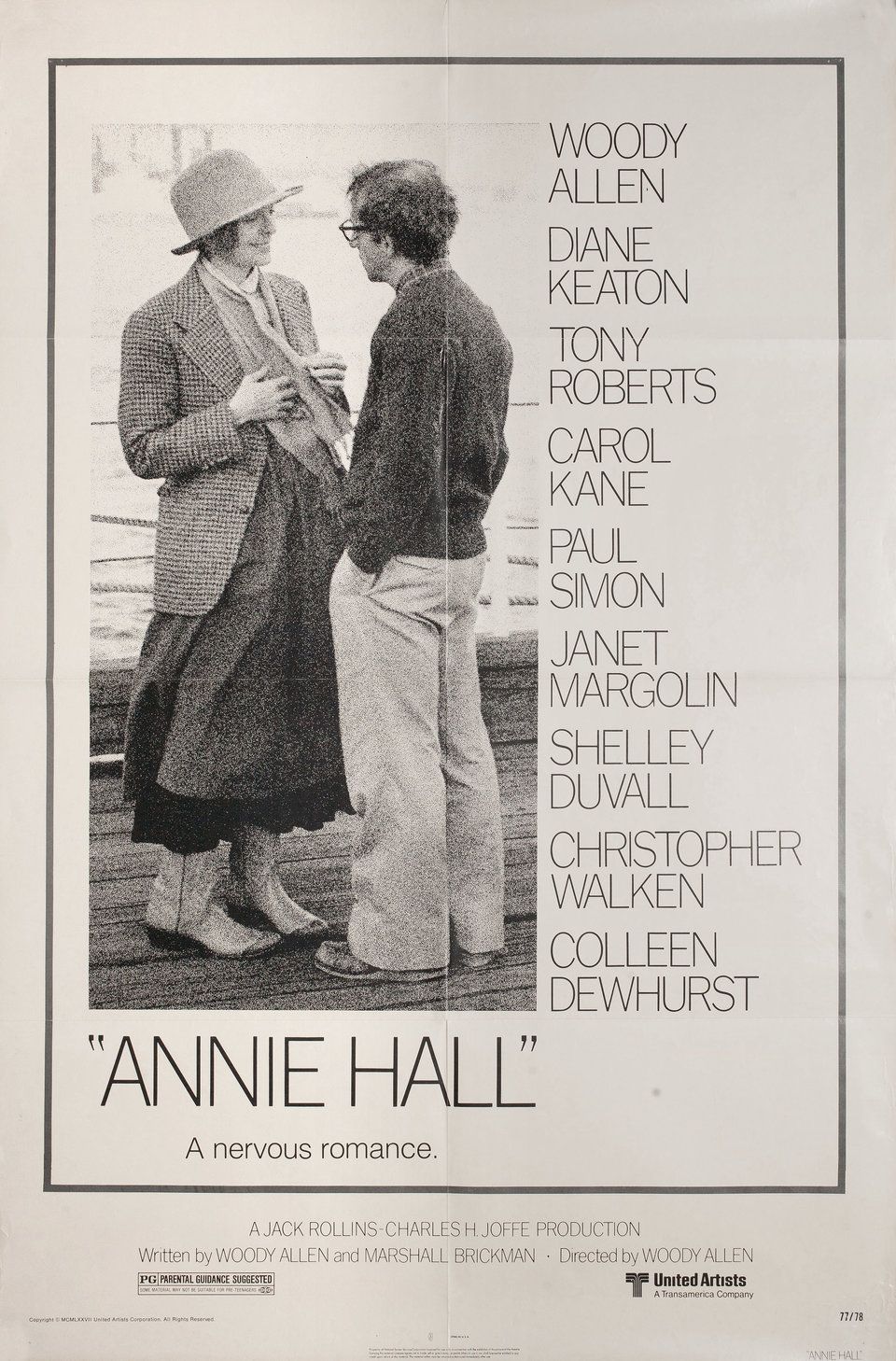
Alvy Singer (Woody Allen) is a professional stand-up comic going through a mid-life crises. Now in his 40’s he’s already been twice divorced and feeling like he may be unable to get into a solid, satisfying relationship. Then he meets Annie (Diane Keaton).  The two forge ahead into a relationship and things work well for awhile, but then the insecurities from both partners begin creating issues.

This film, which won the Academy Award for Best Picture, as well as Best Screenplay and Best Director (Academy Award for Best Actress too) has all the trappings of what I consider to be the perfect date movie. Some may disagree as the relationship between these two characters remains rocky throughout, but that’s why I think it’s so good. Other romance movies gloss over the different stages that a relationship goes through. They either rush past the start making it seem like the two people fall-in-love at first glance and immediately become a couple, or focus too heavily on the ups-and-downs of the dating phase, but then once they get married act like it’s ‘happily-ever-after’.

Here we’re given the whole shebang. We see the awkward start, which forms into an equally awkward relationship that eventually unravels once both partners realize they have different needs, much like in reality. I enjoyed how each person plays the same role, but at different times. Sometimes it’s Annie that wants to rekindle the romance while at other points she wants to break free and then at times its reversed with Alvy being the one trying to leave, or wanting to get back together. This is why I consider this to be a good date movie, especially for young couples, as they need to see that a relationship is a work in progress that constantly needs nourishing. The dynamics can evolve and both partners must be willing to adjust to the every changing needs of the other in order to keep it going.

The film is also filled with a lot of funny highly original bits that I haven’t seen done before or since. I loved the segment where subtitles get added to a scene revealing what Annie and Alvy are really thinking about each other while they have a psuedo intellectual conversation. The scene where the spirit/soul of Annie steps out of her body and then sits and watches Alvy and Annie making love in bed is funny too as is the dueling analysts bit (where the screen is split and  we see/hear Alvy and Annie talking about their romantic difficulties to their respective therapists at the same time.) This same approach occurs again with Alvy and Annie’s ‘dueling families’. Honorable mention must also go to animated bit with Woody and the Evil Queen from Snow White.

The only sad aspect is that the movie’s original cut ran 2 Hours and 4 Minutes, but the studio wanted it whittled down to a 90 minute runtime forcing many other potentially engaging bits to end up on the cutting room floor. Some of the bits that sound interesting featured Alvy’s grade school classmates in the present day, a junk food restaurant segment with Danny Aiello, as well as a fantasy segment where the New York Knicks basketball team competes against a team of 5 philosophers. Another scene had Alvy and Annie visiting hell that was reworked 20 years later and put into the film Deconstructing Harry.

Spoiler Alert!

Some of my film friends consider the ending to be an unhappy one, but I disagree. Yes, their relationship ultimately doesn’t work out and they decide to just remain friends instead, but for some couples this is actually the best option. The two were still on speaking terms and weren’t stalking or jealous of each other. Both had adjusted to the breakup and were ready to move-on. Not every relationship your in, even the ones that were fun for awhile, are meant to last and that’s okay.

My Rating: 10 out of 10

Released: March 27, 1977

Runtime: 1 Hour 33 Minutes

Rated PG

Director: Woody Allen

Studio: United Artists

Available: DVD, Blu-ray, Amazon Video, YouTube
Love Story (1970)

By Richard Winters

My Rating: 5 out of 10

4-Word Review: Romance and then death.

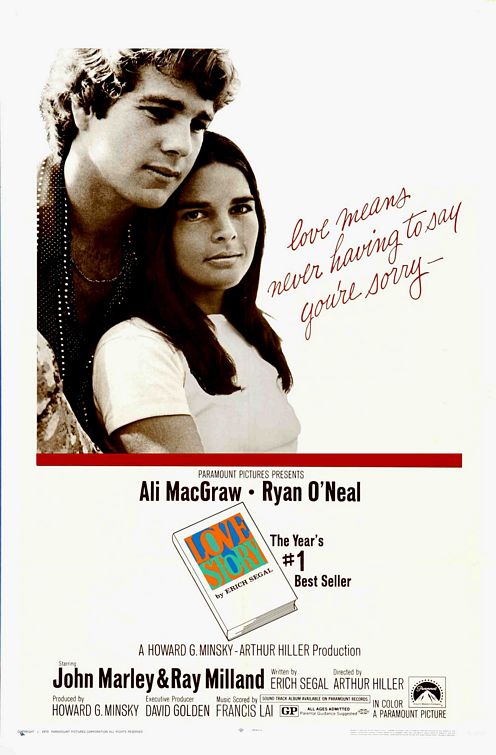
Oliver (Ryan O’Neal) is attending Harvard Law School where he meets Jenny (Ali MacGraw) a student studying classical music. The two don’t hit-it-off at first, but eventually fall in love and marry despite the objections of Oliver’s father (Ray Milland). Just as things seem to be falling into place Jenny gets diagnosed with a fatal illness, which sends Oliver’s world spinning out-of-control.

Erich Segal’s script, which he later turned into a best-selling novel, is simplistic, but the on-location shooting done in and around Harvard is outstanding and helps give the film, along with some well done hockey footage, an added energy. This is one of only a few films to be allowed to shoot there and they were kicked out after only a week due to being too much of a distraction, but it was just enough to give the movie a good authentic college vibe. The snowy landscape plays a big part of it and there’s even a scene where the two play in it, but some shots feature a lot of it in the background only to have a few scenes spliced in where there is none of it on the ground, which makes it a bit visually jarring.

On the romantic side I liked the fact that Jenny is initially prickly towards Oliver and he has to work at getting her to soften up. Men actually do enjoy a challenge and having a woman just throw herself at a guy, or having the relationship start out seamlessly is just not as interesting or realistic. However, having Oliver profess that he ‘loves’ her after only the first date glosses over the courtship aspect too much and essentially ruins the intrigue in the process.

O’Neal is excellent here and he was picked over a lot of other big name stars simply for his ability to react to a situation in effective ways, which he ends up doing quite well. Yet I felt it would’ve worked better had he been the one from the poor-side-of-town as he’s more convincing as a rugged blue collar type instead of a studious student, or their contrasting economic backgrounds not been played-up at all since for me it didn’t really add much.

Spoiler Alert!

The film’s most notorious flaw though, and one that was parodied in a very funny send-up of the movie on ‘The Carol Burnett Show’, is the whole mystery illness thing (supposedly it’s leukemia, but never explicitly stated) that comes out of nowhere without Jenny ever showing an symptoms and having her die in a sudden car accident would’ve solved this issue and been more believable.

Personally though I was more shocked by the fact that the Dr. tells Oliver about Jenny’s diagnosis before he informs her. If she were a child that would be fine, but she’s an adult and deserves to know about her own health affairs before anyone else and if this had occurred today it would’ve gotten him into a lot of trouble.

The narrative also gets a bit askew as Oliver takes the news much harder than she does. Shot after shot shows him getting all misty-eyed almost like the viewer should feel worse for him, as he is now losing the object of his affections instead of her for losing her life.

End of Spoiler Alert!

The film is also famous for the line “Love means never having to say you’re sorry”, which to me never made any sense as relationships are dependent on the other party asking for forgiveness when they’ve done wrong and simply presuming they can get away with anything and expect unconditional acceptance doesn’t work. Two of my female friends agreed with me on this, which only proves how placid and shallow this film ultimately is.

My Rating: 5 out of 10

Released: December 16, 1970

Runtime: 1 Hour 40 Minutes

Rated GP

Director: Arthur Hiller

Studio: Paramount

Available: DVD, Blu-ray, Amazon Video, YouTube