Category Archives: 60’s Movies

John and Mary (1969)

By Richard Winters

My Rating: 4 out of 10

4-Word Review: Sex and then relationship.

Considered provocative at the time this film detailed the new phenomenon of the one-night-stand, a fad in the late 60’s early 70’s that quickly went out of style upon the release of Looking for Mr Goodbar in 1977.  The story here details a rather nondescript man and woman (played by Dustin Hoffman and Mia Farrow) who meet at a singles bar and then go back to his place for sex.  The rest of the film involves them considering whether it can grow into a relationship.

The first ten minutes are pretty good. It nicely analyzes all the expected awkwardness one must have of waking up the next morning and not sure who you’ve been sleeping with. I liked how the John character secretly goes through Mary’s purse to find out more about her while Mary does the same with his telephone messages. Unfortunately after this segment Director Peter Yates unwisely decided to put in voice overs of their thoughts. This adds nothing to the proceedings and ends up being heavy-handed. It also takes away one of the fundamental points of good film-making, which is learning about characters through subtle visual observation.

The film is also no where near as sophisticated or daring as I think the film-makers would like us to believe. I expected, and would have like, the male character to have been a life-long swinger who has had many of these flings and now suddenly finds himself attracted to this woman and wants to go in a different direction. Instead we get a Hoffman character portrayed as being someone who has never done this before and only does so at the coaxing of his much more liberated friend.  This leads him to act all shy and unsure and coming off like an extension to the character he played in The Graduate. The end result is getting a very boring, bland person who responds to things in all the predicted ways instead of giving us a fresh new perspective by delving into the mind of someone living a lifestyle many of us have not experienced.  I also got a strong feeling that the film-makers had done very little research into this topic, thus giving the viewer no new insight whatsoever.  It ends up coming off like one of those trendy ‘statement movies’, but with no idea of what statement it actually wants to make.

There is no chemistry between Hoffman and Farrow at all.  Nothing is shown that would indicate why these two would want to pursue this thing any further. I actually found the scenes involving the side-story of Farrow’s affair with an older college professor (Michael Tolan) to be more interesting and filled with stronger more snappy dialogue.

In the end this ‘provocative drama’ deteriorates into being an uninspired love story. It concludes with the tired, cliche ridden scene of having John madly driving around the city of New York looking for this mysterious woman who he is convinced he is in love with despite the fact that he still does not know what her name is.  It is easy to see how, in Hoffman’s very distinguished career, why this film remains one of his lesser known efforts.

On the technical side this film is actually well done.  I liked how it inter-cut between the present day and the past as well as analyzing the previous relationships of the two characters. This film also offers a nice chance to see a young Tyne Daly as Farrow’s roommate.  Cleavon Little from Blazing Saddles fame appears briefly as a would-be film director.  Olympia Dukakis  has an amusing, non-speaking bit as Hoffman’s activist Mother.  This also marks the film debut of character actress Marian Mercer.

My Rating: 4 out of 10

Released: December 14, 1969

Runtime: 1Hour 32Minutes

Rated PG

Director: Peter Yates

Studio: 20th Century Fox

Available: VHS, DVD

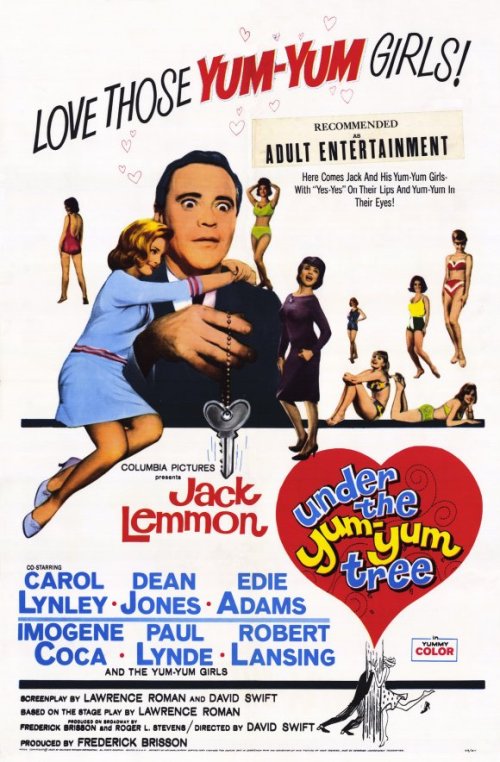
Under the Yum Yum Tree (1963)

under yum

By Richard Winters

My Rating: 3 out of 10

4-Word Review: Landlord likes pretty woman.

Jack Lemmon plays Hogan, an apartment landlord who charges $450 a month to men, but only $75 a month to a young beautiful woman. He then puts on his moves and most of the time ‘scores’ with his nubile tenants. He sets his sights on attractive college co-ed Robin Austin (Carol Lynley) who has just moved in.  Unbeknownst to him she is also bringing in her boyfriend Dave (Dean Jones). The two have decided to live platonically, so they can see if they can get along together before taking the big step and getting married. Hogan is unaware of her male counterpart as when she signed up she simply told him her roommate was a brunette and Hogan presumed it was female. When he finds out who it really is it puts a crimp on his plans, but he still persists anyways.

Although the premise of two young people who are in love cohabiting without having sex may seem antiquated and remnants of a bygone era, the truth is the characters and filmmakers were probably a little more worldly-wise then one might presume initially. For one thing Dave considers the arrangement to be ‘nutty’ and states ‘no one could live that way’. He also, towards the end of the film, gets her to drink some strong tequila in order to get her drunk and allow him to seduce her. The characters, particularly the apartment’s husband and wife maintenance crew (Imogene Coco, Paul Lynde) do not condone Hogan’s playboy lifestyle, but are also privately jealous of it and in the case of the Lynde character even fantasizes about it. I also thought it was a hoot when Robin asks her college instructor Irene (Edie Adams) whether her and her husband ‘did it’ before they were married and although Irene acts all aghast at the suggestion she is also careful not to specifically answer it either.  So even though things are not as explicit as today’s films the underlying leering elements are still there.

This was pretty much Lemmon’s vehicle and he does alright. He has never played the part of a lecherous cad before, so it was fun seeing him do something different and away from his otherwise clean-cut good guy image. The best thing though may actually be the way his apartment was decorated. It is painted in a garish, bright red and this includes the carpets, drapes, and bed sheets. He also wears shirts, socks, and a watch band with the same bright red color making the place look like hell and he the devil. I also got a kick out of a pair of violins that he has stored in a case and at the press of a button they rise up and play romantic music with the help of electronic, robotic hands.

Carol Lynley is sensational as the female lead and quite possibly the best thing about the movie. Her portrayal of a young female college student who is sweet and polite, but still headstrong and full of ideals seems timeless. I also liked that the college students here were portrayed as thinking, breathing young adults and not just one-dimensional, stoned party- animals.

Jones does well as the boyfriend who sees right through Hogan’s schemes and does not allow him to get the upper hand. However, some of the stunts that Hogan pulls including walking in on the couple unannounced at different times of the day and night as well as having him eavesdrop on them and even admit to it, would not go over in the real world and would likely get him sued.

The biggest problem with the film is that fact that there is really no plot. The entire movie is made up of these silly little schemes that Hogan tries to pull to get Dave out of the way and his hands on Robin. None of these are clever, funny, or imaginative. The one-joke premise gets stretched until it becomes excruciatingly monotonous. Most of these films that are based on hit stage plays at least have some funny banter and sharp one-liners, but this movie doesn’t even have that.  This all might have worked as a cute 30 minute episode on the old Love American Style TV-show, but at 110 minutes it is outrageously over-long. Even for a fluffy 60’s sex farce it’s incredibly vapid and lifeless.  Legendary comic character actors Coco and Lynde are wasted.

A young Bill Bixby can be seen briefly as a college student trying to rent an apartment.

My Rating: 3 out of 10

Released: October 23, 1963

Runtime: 1Hour 50Minutes

Rated NR (Not Rated)

Director: David Swift

Studio: Columbia Pictures

Available: VHS, DVD, Amazon Instant Video

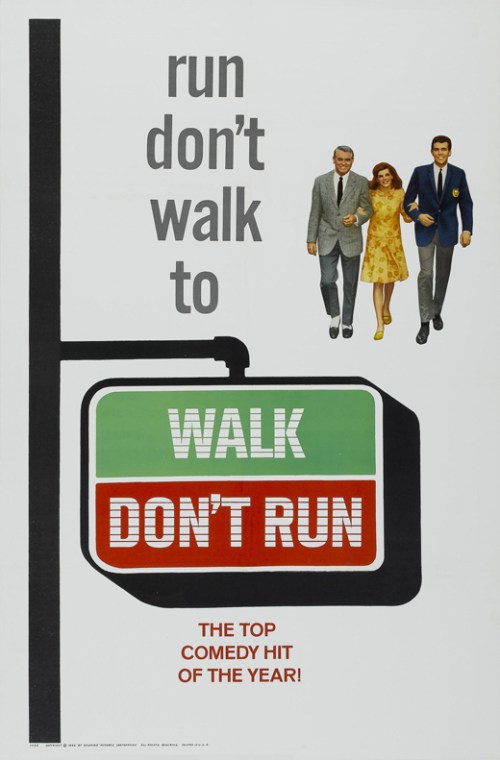
Walk Don’t Run (1966)

walk don't run

By Richard Winters

My Rating: 6 out of 10

4-Word Review: Three is a crowd.

This film marked Cary Grant’s final on-screen appearance and was also a remake of the 1943 screwball comedy The More the Merrier, which was directed by the legendary George Stevens. The story is about a British businessman named Sir William Rutland (Grant) who travels to Tokyo on business during the 1964 summer Olympics and is unable to find a place to stay as everything is booked up. He spots an ad asking for a roommate on a nearby bulletin board. When he goes to the address he finds that the apartment is being rented by an attractive young lady by the name of Christine Easton (Samantha Eggar).  She at first is reluctant to accept the arrangement as she is rather old-fashioned and feels that a man sharing an apartment with a woman would not look appropriate, but William manages to talk his way in. The next day while at a business meeting William meets a young man who is participating in the Olympics, but will not tell anyone what event he is in. His name is Steve Davis and he is played by the late actor Jim Hutton, who is probably best known to today’s audiences as the father of actor Timothy Hutton as the two look almost exactly alike. Steve is looking for a place to stay as well so William invites him to the apartment, which makes Christine even more apprehensive, but after several ‘Three’s a Company’ type scenarios they eventually get along and Steve and Christine end up falling in love.

I found the first hour to be highly enjoyable.  Grant is an old-pro and goes through his role with amazing ease. Every scene he is in is amusing and I would highly recommend the film simply for his appearance alone. I felt the film started to stagnate when they introduced the romance angle. This was another situation were in my opinion the relationship was forced and formulaic and simply put in because the producers felt it would be ‘cute’. It didn’t seem to make a lot of sense why the characters would fall in love anyways since they had only known each other for a couple of days.  It is one thing if a person is desperately looking for someone, but that was not the case with Steve who is very independent and tells everyone he has no interest in marriage. There is nothing shown as to what about Christine’s personality would click with him to begin with.  Yes, she is pretty, but she spends most of the film being rather defensive towards them and more concerned with keeping a ‘proper’ distance. The two stars show no real chemistry either.

This was an unusual foray for actress Eggar as she rarely does comedy. She mainly works in horror films and thrillers and is best known for her performances in The Collector, The Walking Stick, The Brood, and The Lady in the Car with Glasses and a Gun. I felt in those types of roles she did exceptionally well, but here her comic timing seemed off and almost non-existent when compared to the two male leads.

There is also a very silly subplot dealing with Steve being accused as a spy and this culminates with a protracted scene at a Japanese police station where all the characters get interrogated by actor George Takei from ‘Star Trek’, which isn’t good for even a few chuckles. Another scenario involves Christine’s fiancé, Julius Haversack (John Standing), and William’s attempts to keep him away from Christine so that Steve can be with her. This storyline falls flat as well simply because the Julius character is so over-the-top stupid and gullible that William’s shenanigans don’t come off as being all that clever or amusing.

About the only thing that revives the film is the climactic race where the participants are required to walk and not run, hence the film’s title. I found this interesting because I had never seen or heard of this type of race before, but apparently it is a regular event at the Olympics and has been since 1928. The difference in a walking race as opposed to a running one is that the participants must always keep a part of their foot on the ground at all times. The result looks kind of goofy, like an old person trying to run, which explains why Steve was too embarrassed to tell anyone what he did.  I found this segment interesting although the story again gets too exaggerated as the other characters get into a cab and drive alongside Steve during the race, which I didn’t think would happen because there would be enough police officers and Olympic officials there to block them. However, I loved the part where William strips down to his underwear and starts fast-walking alongside Steve and then when he is finished he goes onto a bus and rides home still in his undies with everyone staring at him.

I felt like this was two story’s put into one with the first half being much better than the second. I almost wished they had just kept it focused on the three cohabitating together and not even brought in the romantic angle at all, or maybe just at the very end.  The movie is funniest when Grant is involved and any scene without him seems to fizzle. The music score by legendary Quincy Jones is cool and I wished they had played more of that as well.  It was filmed on-location in Tokyo, but you never really get a good feel of the city, or the Japanese culture. I think more filming in the downtown locations as well as certain landmarks was needed. There were also a few outdoor scenes that despite being nicely detailed where clearly done on an indoor soundstage.

My Rating: 6 out of 10

Released: June 29, 1966

Runtime: 1Hour 54Minutes

Rated NR (Not Rated)

Director: Charles Walters

Studio: Columbia Pictures

Available: VHS, DVD, Amazon Instant Video

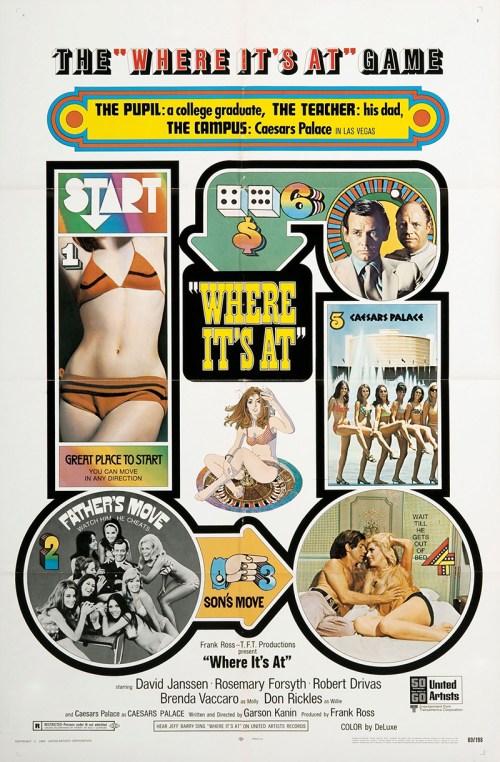
Where It’s At (1969)

where1

By Richard Winters

My Rating: 2 out of 10

4-Word Review: Father and son argue.

Garson Kanin, best know for penning such comedies as Adam’s Rib (1949), The Girl Can’t Help It (1954), and Born Yesterday (1950), tries his hand at drama here.  David Janssen plays a Las Vegas Casino owner who tries to train his son (Robert Drivas) in the business, so he can take over.  The father is a hard-bitten realist while the son, who has just graduated from college, is a strong idealist.

One of the main problems with this film is that there is nothing distinctive about it.  The arguments between the father and son are  typical stuff. The same topics were argued between ‘Meathead’ and Archie in ‘All in the Family’, but at least there they were funny.  Despite Kanin’s reputation, and despite what some sources list, this film is definitely not a comedy.  There are a few amusing bits by Brenda Vaccaro, who plays Janssen’s secretary and easily steals the film, but that is it.  The rest is  by-the-numbers drama that gets played out in a methodical way.

Despite the Las Vegas setting the sets are dull looking and unimaginative. The opening theme song by Jerry Ball is terrible and the characters unappealing.  I could never get myself involved in the story and kept checking my watch the whole time.

I was interested in seeing this film simply for the presence of Janssen.  I am a big fan of the old ‘The Fugitive’ TV series and was impressed with his work on it.  This film certainly does prove that he can act as his character here is the exact opposite of the Richard Kimble one on the TV show.  There he was always mild-mannered and self-effacing.  Here he is obnoxious and abrasive.  Unfortunately the character stays too one-dimensional in a negative way.  There is never any soft side revealed and thus causing the viewer to be uninterested in seeing what happens to him.

Robert Drivas as the son is another talented and interesting actor whose life and career was sadly cut short by AIDS in 1986.  He had some memorable performances in various TV-shows including ‘The Wild Wild West’ as well as in the movies The Illustrated Man (1969) and Joseph Strickland’s independent classic Road Movie (1974). However, his best ability was in conveying a dark brooding side to his characters, which doesn’t work here.  You never believe for an instant that the character is all that innocent, or honorable because the dark elements start coming out from the beginning.

Don Rickles appears briefly as a card dealer who starts stealing from the house.  When he is caught he breaks down into a long crying spell before he is demoted to a full-time dish washing job until he can pay the money back.  Rickles as a comedian is funny, but as a serious actor he is limited.  Yet it was still fun seeing him play such a wimpy and passive person because it goes completely against his persona.  The film might have been stronger had there been a few more scenes with him.

The film does have a bit of an interesting twist towards the end where the son decides to turn the tables on his father and takes advantage of one of his father’s shady deals by purchasing the casino from under him and then throwing the old man out on the street.  This of course shocks the father and forces him to reevaluate his values as well as what he has taught his son. This might have been more intriguing had the exact same theme not been done so much better in The Godfather movies as well as Harry Chapin’s classic son ‘Cat’s in the Cradle’.

My Rating: 2 out of 10

Released: May 7, 1969

Runtime: 1Hour 46Minutes

Rated R

Director: Garson Kanin

Studio: United Artists

Available: Amazon Instant Video

What Ever Happened to Baby Jane? (1962)

By Richard Winters

My Rating: 7 out of 10

4-Word Review: Living in the past.

This is a classic horror film that managed to resurrect the sagging careers of acting legends Bette Davis and Joan Crawford. It also spawned a whole new ‘psychobiddy’ genre of films. The movie is based on the 1960 bestselling novel by Henry Farrell.

The story takes place almost exclusively in an old, rundown Hollywood mansion where two aging, feuding sisters live. Baby Jane Hudson (Davis) was at one time a big child star, but never managed to cross-over to adult roles. She lives in a fantasy world, refusing to move on with her life, and takes out her frustrations on her crippled sister Blanche (Crawford), who at one time was a big movie star until a horrible car accident left her bound to a wheelchair.

The real-life feud and animosity that the two stars had for each other is now legendary. Some of the things the two said about the other is hilariously over-the-top and too many to quote here, but well worth checking out. When you hear of all the incredible things that the two did to each other behind the scenes you almost become amazed that the film was ever able to get made. I wished that a documentary had been filmed examining the movie’s production as that could have been almost more entertaining than the film itself.

All things considered, Davis is nothing short of fabulous here. She should have won the Oscar hands down and she pretty much steals the film. She also wore gaudy make-up that gives her an almost ghost like appearance. Crawford is very good as well, but her role is not as flashy. Sadly for her this was her last hurrah as her alcoholism took its toll and her roles after this were in B-movies while Davis went on strong for the next twenty years.

Of course some may argue that the real star was director Robert Aldrich. I liked the bird’s-eye shot of Blanche spinning around in her wheel chair in frustration and terror. It is brief, but gives the viewer a very unnerving feeling. The scene where Baby Jane does an old rendition of one of her routines that she did as a child in front of a mirror that she has set-up in her living room that is also surrounded by stage lights is a nice directorial touch. The campy opening that takes place in 1917 that shows Baby Jane at her peak is memorable as is the very offbeat climatic sequence on a crowded beach. I also got a real kick out of all the Baby Jane toy dolls.

Victor Buono deserves mention as he was nominated for the supporting Oscar for his role as Edwin Flagg, the fledgling composer who Baby Jane hires to help resurrect her stage show. Although best remembered for his comedic skills he was also quite good in his serious parts and his immense girth always made his presence known. I enjoyed how they form this weird quasi-relationship that is based solely on each other’s lies and delusions.

I did have a few complaints to what seemed to me to be some serious logistical flaws. One is the fact that Blanche is stuck in her upstairs bedroom with no way to get downstairs. You would think that with all the money that they once made that they would’ve been able to afford building either an elevator, or a chair lift. It also seemed implausible to believe that Blanche had been stuck in her bedroom since 1935 when she had her accident, until present day 1962, which is what the film seems to imply. As much as I liked the African-American housekeeper Elvira Stitt (Maidie Norman), who is well aware of Baby Jane’s psychosis and has no trouble standing up to her, I thought it was awfully dumb the way she set down a hammer that she was holding right in front of Baby Jane and then turned her back to her, which allowed her to be attacked that anyone else could have predicted would happen. I also felt there was a little too much background music that at times got a bit melodramatic.

Still, this is a great film that his highly entertaining from beginning to end. With the exception of some of Baby Jane’s ‘dinner surprises’ the film is devoid of any real scares and there is no gore, which may disappoint today’s younger, more jaded viewers. However, the film has a very strong, dark psychological undercurrent, which proves to be immensely fascinating and will be appreciated by those who are more sophisticated. The film’s theme, which is that of Hollywood’s fickle, vicious cycle of fame, is universal and as strong today as it was back then.

It is interesting to note that the director’s 18 year old son William, who appears at the end as a lunch attendant at the beach, produced  29 years later the made –for-TV remake of this film that starred the Redgrave sisters, but was not as good. Also director Aldrich later made two variations of this same story. One was Whatever Happened to Aunt Alice which he produced and starred Geraldine Page and Ruth Gordon and also the British classic The Killing of Sister George which he also directed.

My Rating: 7 out of 10

Released: October 31, 1962

Runtime: 2Hours 14Minutes

Rated NR (Not Rated)

Director: Robert Aldrich

Studio: Warner Brothers

Available: VHS, DVD, Blu-ray, Amazon Instant Video