
By Richard Winters
My Rating: 8 out of 10
4-Word Review: Artistic family harbors turmoil.
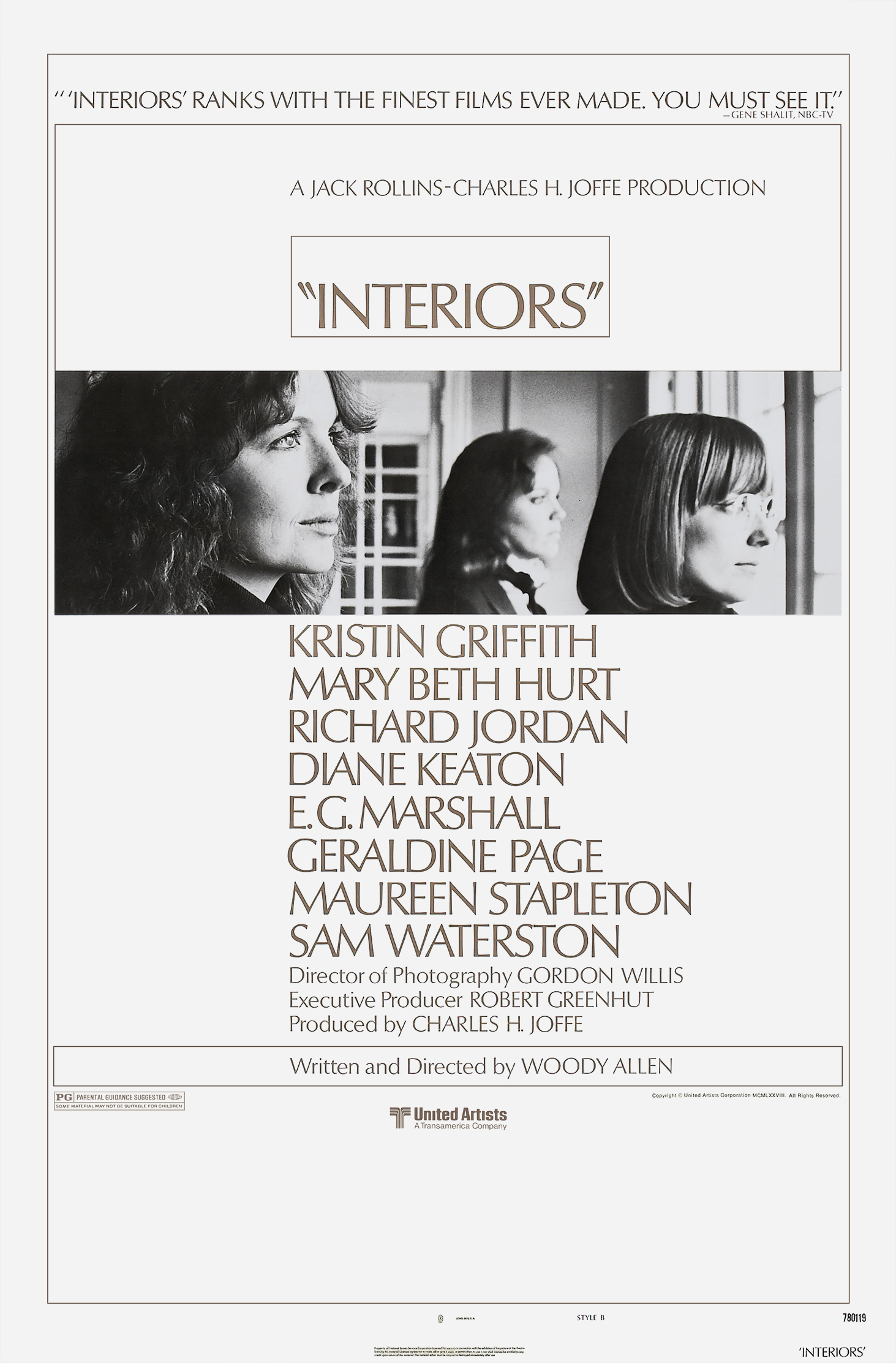
Eve (Geraldine Page) is an interior decorator whose emotions she keeps bottled-up and who also has a controlling and temperamental nature to not only her husband Arthur (E.G. Marshall), but also her three grown daughters: Renata (Diana Keaton), Flyn (Kristin Griffin), and Joey (Mary Beth Hurt). One morning, while at the breakfast table, Arthur announces to not only Eve, but also the two other daughters present, that he wants a separation though he insists it’s not ‘irrevocable’. Eve becomes upset and refuses to face it. While the two do separate she continues to cling to the delusion that they’ll ultimately reunite. When it finally becomes painfully clear that is not going to happen she then attempts suicide. While she’s in the hospital recovering Arthur goes out and meets Pearl (Maureen Stapleton) whom he quickly falls in love with. When he brings her home to meet the family they’re shocked at how he intends to marry her while his former wife is still in the hospital. This then brings out the hidden hostilities that the daughter’s feel towards their parents as well as each other and in Renata’s case the repressed envy that her own husband Frederick (Richard Jordan) feels for her.
This was Woody Allen’s first dramatic film, which was a big deal when it was first released as he’d only done wacky comedies before this and many were curious and apprehensive about him trying something so completely different from his past work. While he’d been trying to get a drama produced for years his investors constantly nixed the idea fearing that because he attracted audiences through his funny stuff that anything with a serious nature would turn-off would-be theatergoers and be a financial flop, but after the monumental success of Annie Hall they finally decidedly to relent and gave Woody the chance to spread his artistic wings.
The result overall is downright impressive. It’s clearly inspired by the films of Ingmar Bergman, his cinematic idol, but in some ways this is even moodier and more poignant than some of his stuff. While his later dramas fell into becoming a cliche of themselves using many of the same elements taken from this one, namely pretentious artistic characters living in New York who suffer from pretentious problems and relationships, here it’s fresh making the issues that they go through seem illuminating versus rehearsed and contrived like in some of his later works.
That’s not to say I didn’t find some problems here. The fact that we have characters, in this case Keaton, talking directly to the screen, apparently in an attempt to show that she’s speaking with a therapist, is a bit of a cop-put as she’s able to convey her deep seated thoughts and feelings verbally without forcing the director to have to show it through her actions and conversations, which may be more difficult to do, but also more rewarding for the viewer. Arthur’s decision to tell Eve that he wanted to leave while sitting a the meal table with the two daughters present seemed rehearsed. Normally when a couple decides to split they do it privately and have it out through a discussion or argument versus a canned speech that Arthur does, which comes-off like he’s orating in front of a group of people.
Woody’s attempts though to show the struggles and challenges people have who pursue creative endeavors I felt were quite well done. In his later dramas I found it annoying how many characters worked as artists because it reality only a very small portion of the populace can make a living that way, but here I was able to forgive it. I liked how we see close-up the challenges of this by the way Renata writes a poem on paper but is constantly scratching out words that she puts down showing the many drafts an author must go through before it eventually might come-out perfectly. The fact that it’s later revealed that her father helps fund her poetic passions made sense too as a poet able to live-off of their writings is about as rare as it gets.
Richard Jordan’s character is the one I found the most fascinating and I was genuinely surprised that while other cast members were nominated for the Oscar he wasn’t even though to me he’s superb. The way his character broods incessantly about not getting the critical accolades that he expects and how it turns him into a mopping, alcohol drinking mess who snips at his wife’s perceived shortcomings in an immaturely emotional attempt to bring her down to his level was completely on-target composite of the insecure artist. The scene where he tries to rape Flyn, so he can have the pleasure to ‘fuck someone who’s inferior to me’ fit the personality of someone who harbors frustration that they’re able to mask with a veil of civility most of the time but will allow it to come-out when alone in the presence of someone more vulnerable.
The real star though is the cinematography by Gordon Wills, who ironically went on to make his directorial debut in a movie called Windows, which was the original title for this one. The gray, cold color schemes and shots showing an ice-covered tree branch effectively reflects the icy emotions of the family and the lack of music with long pauses of silence and empty rooms help symbolize how alienated each member is from the other. The most pronounced moment involving the crashing waves of the ocean and the almost dream-like ‘conversation’ that Joey has with her mother is by far the film’s most memorable element and something that will stay with you long after it’s over.
My Rating: 8 out of 10
Released: August 2, 1978
Runtime: 1 Hour 32 Minutes
Rated R
Director: Woody Allen
Studio: United Artists
Available: DVD, Blu-ray, Freevee, Pluto, Amazon Video, YouTube
 Scopophilia